


Podcast name
Why Can’t I Remember My Childhood?
Think back to your very first memory. Maybe you remember your childhood friends or how fun it was to play with your favorite toy? But what if your memories seem out of reach, and you wonder, “Why can’t I remember my childhood?”
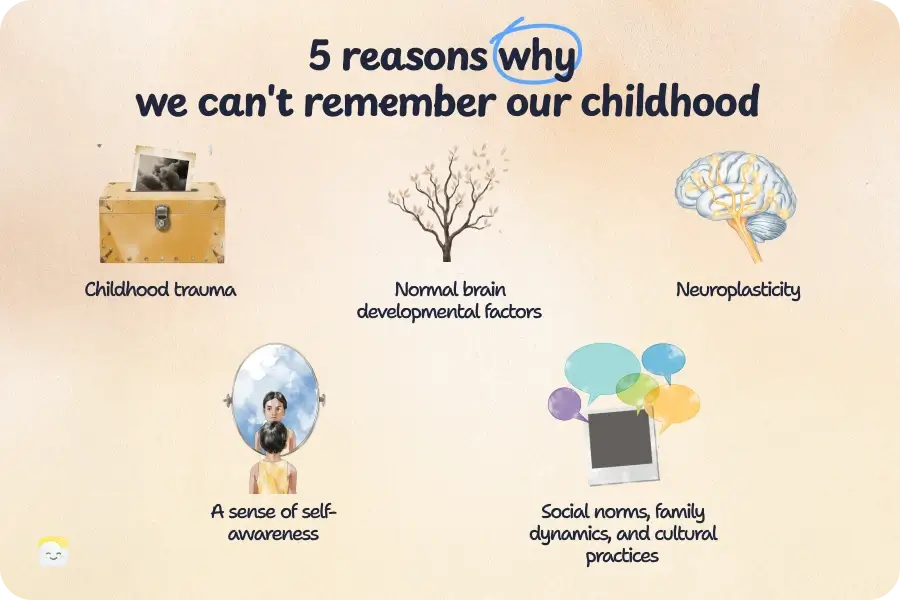
5 reasons for childhood memory loss
You might start with a question, “Is it normal that I can’t remember my childhood?” Actually, it is more common not to remember anything about your childhood than to remember everything about it. Young kids and babies are always learning, but they do not remember things for very long. Let’s explore the mechanisms behind memory development.
1. Early childhood trauma
When a child experiences trauma, such as abuse, neglect, or witnessing violence, it can profoundly affect their memory. Traumatic events have the power to alter a child’s memory, overshadowing positive memories with painful ones. In some cases, survivors may feel as though they’ve lost their entire childhood, as the trauma eclipses the memories of happier times.
If emotional regulation was a struggle in youth, particularly due to childhood trauma, the brain’s mechanisms for coping with or processing strong emotions might inhibit access to the traumatic memories.
If you suspect childhood trauma may be influencing your memory deficit, take a test to better understand your behavior and begin your healing journey.

Research suggests that trauma and memory are closely connected. Long-forgotten trauma in childhood may have long-lasting effects on the parts of the brain that support explicit memory (a type of long-term memory that’s concerned with the recollection of facts and events) [1] Fan L, Kang T. Early childhood trauma and its long-term impact on cognitive and emotional development: a systematic review and meta-analysis. July 2025 . It can also lead to traumatic dissociative amnesia.
If the emotional content of our childhood experiences was too overwhelming, it could result in the repression or distortion of these painful memories:
- Repression. It’s a voluntary act of forgetting memories, which has sparked both curiosity and controversy. Many people “repress” trauma without even realizing it because they don’t want certain memories of their painful past to affect them [2] Otgaar H, Muris P, Howe ML, Merckelbach H. What Drives False Memories in Psychopathology? A Case for Associative Activation. September 2017 . However, this defense mechanism, so-called repressed memories, has its critics and doubters.
- Trauma denial. Another psychological theory states that when you repress memories, they “go” into your subconscious. When you deny trauma, your reality is split in two. Often, denial—the active refusal to acknowledge the painful events and intense feelings in early life—shows up most strongly later in life.
2. Brain development that affects memory
The hippocampus and prefrontal cortex (brain areas) have roles in episodic memory. Their interactions are crucial for learning and remembering events, and their development during early childhood carries the responsibility of storing long-term memories.
Because these parts of the brain are not fully developed when we are born, the brain cannot store long-term memories until they are. This is a part of normal memory development and may be a big reason we cannot remember things from childhood.
Because children often lack the vocabulary to describe traumatic events, they may have difficulty forming the cause-and-effect narrative that underlies lasting memory.
Additionally, young kids are not very good at understanding time. They still have a few years to go before they fully understand clocks and calendars. It makes it hard to connect an event to a specific time and place.
But there are other possible reasons too. For example, someone who might experience emotional neglect or childhood trauma may not even remember school times.
3. Neurological changes
Neuroplasticity is the brain’s ability to change its structure by making new neural connections throughout life. But for kids’ brains, it works the best. However, this same plasticity can also contribute to the rearranging and potential ‘pruning’ of neural pathways and result in missing memories.
Repetition and reinforcement also play a role. We can think of memories as a path in the woods. It remains a neuron’s path, but once it is not used, the grass will take over.
Wondering whether the way your brain processes information influences your memory abilities, attention, or other cognitive functions in everyday life? Neurodivergent traits can affect how people learn, focus, and recall personal experiences, although they do not necessarily cause childhood memory loss. If you’re curious about your cognitive profile, try the free Neurodivergent Test to explore common traits associated with autism, ADHD, dyslexia, and other forms of neurodivergence.

4. Psychological factors & emotional patterns
To make autobiographical memories, you should have a sense of self-awareness that helps you distinguish yourself from others. Researchers have found that babies younger than 18 months have trouble with this: if you put paint on their noses and then let them look in the mirror, they don’t recognize who is there [3] Lewis, M. Embarrassment: The emotion of self-exposure and evaluation. .
In contrast, 24-month-old kids will try to wipe off the paint. By this age, they have already developed self-awareness and even some sense of self-worth. In other words, this means that people can remember things about themselves from around that time.
Additionally, language is important. The most likely thing that will happen when you try to remember something is that you will use words to picture what happened. In other words, by using internal monologue. Young children lose their preverbal memories (the earliest, not verbal, but sensational memories) later on because they were not able to reinforce them with inner speech in time.
5. Environmental factors
The richness of our childhood memories often hinges on the emotional significance of the events we encounter. If our early years did not have many “milestone” events or were relatively ordinary, we might not remember many emotionally impactful moments [4] Tyng CM, Amin HU, Saad MNM, Malik AS. The Influences of Emotion on Learning and Memory. August 2017 .
Also, cultural practices, family dynamics, and societal norms can influence not only our experiences but also our memories. For example, people from cultures that value family stories may be better able to recall childhood memories than people from cultures that don’t.
In 2009, Peterson, Qi Wang of Cornell, and Yubo Hou of Peking University found that kids in China did not have as many memories as those in Canada [5] Peterson, C., Wang, Q., & Hou, Y. “When I Was Little”: Childhood Recollections in Chinese and European Canadian Grade School Children. . According to them, this finding might have something to do with culture: Chinese people value uniqueness less than North Americans do, so they do not spend as much time highlighting specific events in someone’s life.
What is childhood amnesia?
Childhood amnesia is the inability of adults to recall memories from early childhood—the formative years before the age of around 3–4. One of the ideas is that the brain grows very quickly in early childhood, with synapses forming at a very fast rate.
However, the brain is not yet fully developed, and the prefrontal cortex, responsible for aspects of long-term and short-term memory and self-awareness, lags behind. It may contribute to the memory gaps of infantile amnesia. What 20- and 70-year-olds can remember about their early childhood is pretty much the same, even though decades have passed, researchers say [6] Heather Bronwyn Madsen, Jee Hyun Kim. Ontogeny of memory: An update on 40 years of work on infantile amnesia. February 2016 .
An interesting hypothesis has been put forward that the retention of childhood memory is associated with ambidexterity. A paper published in the journal Neuropsychology suggests that people who use both their right and left hands equally well (ambidextrous people) remember infant experiences better than right-handed people.
3 techniques to recover early childhood memories
If you wonder whether it’s possible to recover forgotten childhood memories, the answer is sometimes. While it’s not possible to force memories to return, some people find that forgotten details gradually resurface through reflection, familiar cues, or therapeutic support for trauma.
Below are three evidence-informed techniques that may help people recover memories. Remember that memory is not a perfect recording of the past, and it’s important to avoid trying to “recover” memories through suggestive methods, as they can sometimes lead to false memories.
1. Process childhood experiences through therapy
Losing early memories can be very upsetting, but reaching out to a mental health professional can be a powerful way to access forgotten or repressed memories. Therapy can help you explore your experiences, understand how your past may affect your current life, and develop healthy coping strategies.
The goal is not necessarily to recover forgotten memories but to improve your emotional well-being and understanding of yourself.
- Psychoanalysis may be really helpful for accessing those memories and working through forgotten or repressed memories.
- Trauma therapy like EMDR and narrative exposure can help you process trauma, bring implicit memories into explicit awareness, and integrate them into your experience.
2. Practice journaling
Self-guided practices, such as journaling or undertaking a personal life review, can also be beneficial. By keeping track of events in the present and the past in a planned way, you can slowly bring back memories that you thought were lost, even from your childhood.
3. Go back to places from childhood
Memories can be triggered by familiar places, smells, music, photographs, conversations, or significant life events. Sometimes specific memories become more accessible as people process past experiences or revisit meaningful places, such as their childhood neighborhoods, schools, or playgrounds.
Frequently asked questions
1. Is it normal not to remember much of your childhood?
Yes, it’s completely normal. Most people remember relatively little from the first few years of life due to a phenomenon called childhood amnesia. However, if you have very few clear memories from later childhood as well, factors such as stress, trauma, mental health conditions, or simply differences in memory may play a role.
2. Can childhood trauma cause memory loss?
It can. Traumatic experiences may affect memory formation and memory recollection. Some people remember traumatic events vividly, while others have fragmented memories or difficulty recalling parts of their childhood. Memory responses to trauma vary from person to person.
3. What is childhood amnesia?
Childhood amnesia or infantile amnesia reflects the inability to recall memories from the first few years of life, typically before the age of 3 or 4. Researchers believe this is a normal part of brain development and the way autobiographical memories are formed.
4. Does forgetting my childhood mean something bad happened?
Not necessarily. Many people have limited childhood memories for perfectly normal reasons. While trauma can contribute to memory difficulties, memory gaps alone are not evidence that abuse or another traumatic event occurred.
5. Can I recover forgotten childhood memories?
Some memories may become clearer over time through reflection or therapy, but it’s important not to assume that every forgotten memory can or should be recovered. Mental health professionals generally avoid techniques that may unintentionally create false memories.
Sources
- Fan L, Kang T. Early childhood trauma and its long-term impact on cognitive and emotional development: a systematic review and meta-analysis. July 2025
- Otgaar H, Muris P, Howe ML, Merckelbach H. What Drives False Memories in Psychopathology? A Case for Associative Activation. September 2017
- Lewis, M. Embarrassment: The emotion of self-exposure and evaluation.
- Tyng CM, Amin HU, Saad MNM, Malik AS. The Influences of Emotion on Learning and Memory. August 2017
- Peterson, C., Wang, Q., & Hou, Y. “When I Was Little”: Childhood Recollections in Chinese and European Canadian Grade School Children.
- Heather Bronwyn Madsen, Jee Hyun Kim. Ontogeny of memory: An update on 40 years of work on infantile amnesia. February 2016
Disclaimer
This article is for general informative and self-discovery purposes only. It should not replace expert guidance from professionals.
Any action you take in response to the information in this article, whether directly or indirectly, is solely your responsibility and is done at your own risk. Breeze content team and its mental health experts disclaim any liability, loss, or risk, personal, professional, or otherwise, which may result from the use and/or application of any content.
Always consult your doctor or other certified health practitioner with any medical questions or concerns
Breeze articles exclusively cite trusted sources, such as academic research institutions and medical associations, including research and studies from PubMed, ResearchGate, or similar databases. Examine our subject-matter editors and editorial process to see how we verify facts and maintain the accuracy, reliability, and trustworthiness of our material.
Was this article helpful?