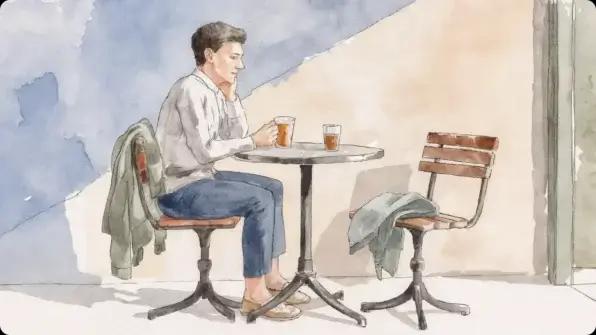


When people are ready for relationships, they genuinely want to share love and give attention. They see relationships as a partnership, not just a source of validation or comfort.
Usually, such people value bringing emotional stability to the relationship. They understand their needs and values and can communicate them clearly without fear of rejection. They don’t seek a partner to “complete” them but to grow and share life with.
“Are you ready for a relationship?” quiz
Am I ready for a relationship? Tips
Whether you’re all in, feeling unsure, or realizing you need more time, we’ve got tips to help you move forward. Let’s break it down and see what’s next for you.
1. Analyze what inner problems you try to solve by building relationships
You might feel lonely, need someone to rely on, look for validation, or want to replace your ex. This self-reflection will help you understand what aspects of your personality are better to work on. Once you acknowledge that you’re enough, it will be much easier to meet the right person.
2. To find a person who matches your values, focus on improving your emotional resilience
Take the time to explore what you truly need in a partner and in your life. When you’re clear about your values, you’ll be better equipped to look for the right person.
3. Don’t give up, and keep searching for the right person
You can visit some places where like-minded people gather, try new activities, or even explore dating apps — just stay true to your values and needs. You show the signs that you’re ready for a relationship. So, the right connection will come when you look for it with intention and patience.
7 signs you’re ready for a relationship
Do you want to learn more about love life? Save the following checklist, as it will help you understand “Am I ready to date again?” along with the quiz provided before.
1. You want to share love. It isn’t about running from inner fears
2. You feel emotionally stable

3. You feel fine alone
We asked Nicole Arzt, LMFT, if she could give some advice for those who feel lonely and look for a partner to avoid it but want to change this dynamic. This is what she says, “Everyone feels lonely at times. It’s normal to seek out relationships for connection and validation. However, it’s important to be mindful that no one person can meet all your needs. Projecting this onto a partner can reinforce resentment, so try to focus on how you can also take care of yourself when feeling lonely.”
4. You understand what kind of person you’re looking for
5. You have boundaries and can respect those of others
6. You have time and energy to build relationships
7. You’ve left your past in the past
Signs you’re not ready for a relationship
Still, along with the signs that you’re ready to build a relationship, let’s mention the warning flags that suggest you might not be quite there yet.
Here are some tips from Nicole Arzt, LMFT, for people who want to build healthy relationships but now aren’t ready. “Start by thinking about what you value in relationships. Then, think about what you want to offer most to another person. Spend time trying to focus on being the person you want to be. You can do this by prioritizing self-care, self-improvement, and working through potential relational obstacles.”
Sources
- Relationship statistics for finding a partner in 2024
- National Library of Medicine. “Creating Good Relationships: Responsiveness, Relationship Quality, and Interpersonal Goals”
- Discovery ABA. “Surprising Loneliness Statistics and Facts”
- CNBC. “Couples share up to 89% of values, new study says: ‘There are very few traits where opposites actually do attract’”
- Psychology Today. “Having Good Boundaries Increases Resiliency”
- Discover Magazine. “Your Brain’s Response to Your Ex, According to Neuroscience”
Disclaimer
This article is for general informative and self-discovery purposes only. It should not replace expert guidance from professionals.
Any action you take in response to the information in this article, whether directly or indirectly, is solely your responsibility and is done at your own risk. Breeze content team and its mental health experts disclaim any liability, loss, or risk, personal, professional, or otherwise, which may result from the use and/or application of any content.
Always consult your doctor or other certified health practitioner with any medical questions or concerns
Breeze articles exclusively cite trusted sources, such as academic research institutions and medical associations, including research and studies from PubMed, ResearchGate, or similar databases. Examine our subject-matter editors and editorial process to see how we verify facts and maintain the accuracy, reliability, and trustworthiness of our material.
Was this article helpful?