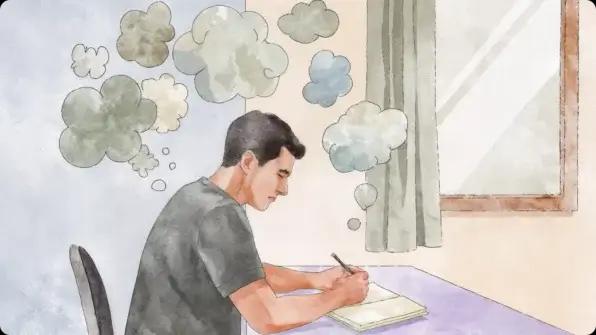


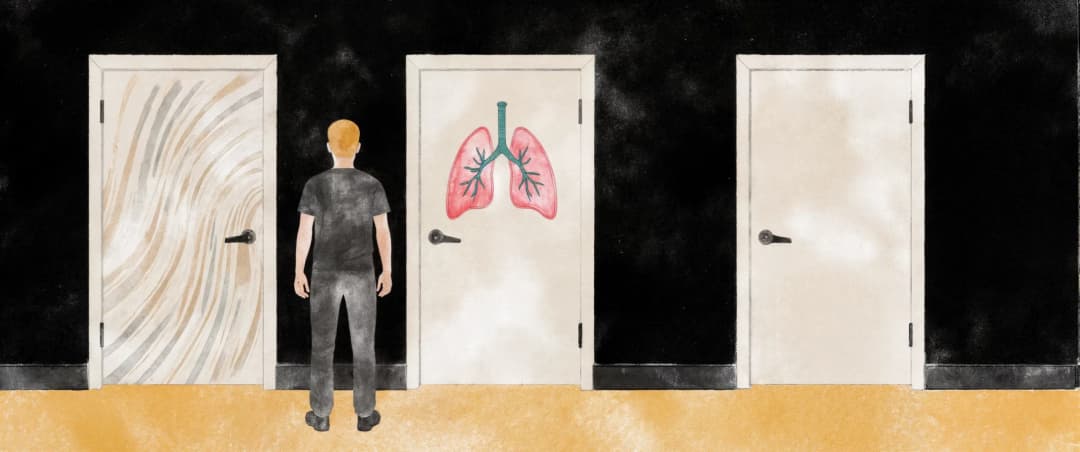
There are times when you feel like you are gasping for air and your chest is tight. Once you get there, you do not know if you are having a medical emergency or just anxiety. Do you also find it hard to breathe when you are stressed out? If you get stuck on how to tell if shortness of breath is from anxiety, this guide will help you.
The link between anxiety and difficulty breathing
Anxiety and shortness of breath are closely linked because anxiety directly affects the body’s stress response, causing faster, shallower breathing and muscle tension in the chest. This change in breathing patterns can create the sensation of not getting enough air, even though the lungs themselves are functioning normally, according to research on lung function and anxiety.
What’s more, a study shows that experiencing anxiety about not having enough air can make you even more short of breath, which can turn into an acute anxiety attack.
Famous actress Emma Stone once told Rolling Stone about herself, “When I was about seven, I was convinced the house was burning down. I could sense it. Not a hallucination, just a tightening in my chest, feeling I couldn’t breathe like the world was going to end. There were some flare-ups like that, but my anxiety was constant. I would ask my mom a hundred times how the day was gonna lay out … I wrote this book called I Am Bigger Than My Anxiety that I still have: I drew a little green monster on my shoulder that speaks to me in my ear and tells me all these things that aren’t true.”
4 key symptoms of anxiety-induced shortness of breath
How to understand if some physical symptoms of difficulty breathing are caused by emotional stress? A short answer to it is that if your shortness of breath is triggered by stressful situations, panic attacks, or moments of severe nervousness, chances are it’s anxiety-related. Here are some indicators that your shortness of breath might be due to anxiety:
1. Check anxiety symptoms timing
Anxiety-induced shortness of breath often takes place suddenly and is typically linked to a specific stressful event that triggers anxiety. It can be public speaking, uncontrollable worry about your physical health, or being faced with your phobias, like height or snakes.
2. Look at your breathing patterns
- A feeling of chest tightness, as if someone’s giving you an unexpected bear hug.
- A rapid, shallow breathing, known as hyperventilation.
- You may also feel like you can’t get a full, satisfying breath.
3. Check additional physical symptoms in your body
- Dizziness or lightheadedness makes you wish for a moment to sit down and regain your balance.
- Tension and muscle tightness that make you feel like a human pretzel.
- Heartbeat that feels thicker and faster than usual (heart palpitations).
- A stomach that feels like it is on a roller coaster that never stops (anxiety nausea).
- You are sweating a lot.
4. See how long these symptoms last
Anxiety symptoms typically ebb and flow, research on anxiety shows. They might peak during stressful events and subside when you start to relax or use coping mechanisms, such as deep breathing exercises.
Take the Breeze self-discovery tests to understand more about yourself and the triggers that may interfere with your daily life.
How to tell if shortness of breath is from anxiety or something else?
Medical conditions like asthma, allergies, heart problems, or even smoking can cause shortness of breath, too. Let’s see the difference:
- Asthma or respiratory issues or dyspnea: These conditions might produce consistent shortness of breath, wheezing, or coughing, especially during physical exertion or exposure to allergens.
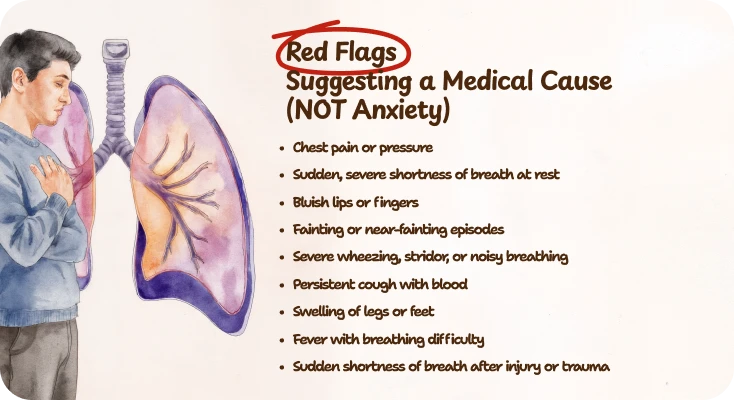
- Cardiac problems: If shortness of breath is accompanied by chest pain or swelling in the legs, or you have a history of heart disease, get medical care right away.
- Panic attacks: These can mimic anxiety but are more intense and sudden, with symptoms peaking within minutes. Other signs of panic attacks include chest pain, a feeling of choking, and a sense of loss of control.
Shortness of Breath: Anxiety vs. Physical (Somatic) Causes
Because shortness of breath can stem from either a somatic or a psychological trigger, distinguishing between the two can help you in case of a medical emergency. While only a clinical assessment can offer a diagnosis, certain patterns often point toward anxiety attacks rather than a physical health condition:
Signs suggesting anxiety as the cause:
- Symptoms appear suddenly during stress, worry, or panic
- Shortness of breath comes with fear, restlessness, or a sense of threat
- Breathing feels shallow or “not satisfying,” but improves with calm, slow diaphragmatic breathing
- Symptoms lessen when attention is redirected, or anxiety decreases
- Medical tests (lungs, heart, oxygen levels) are normal
- Episodes are recurrent and similar in pattern
Signs suggesting a physical (somatic) cause:
- Shortness of breath occurs during physical exertion or worsens with activity
- Symptoms are persistent and progressively worsening
- Breathing difficulty is accompanied by chest pain, fainting, swelling, fever, or cough
- Symptoms don’t improve with breathing or relaxation techniques
- Shortness of breath appearing in someone with a history of heart, lung, or metabolic disease
When should I seek medical attention for rapid breathing or shortness of breath?
Expert Insight
Experiencing shortness of breath can be frightening, but anxiety isn’t life-threatening. If you experience other symptoms, especially symptoms of a heart attack, such as pain or discomfort in other parts of your body, it’s important to seek medical advice quickly. If you’re struggling with anxiety, seek support from a mental health professional.

Katherine Pocock
Mental health professional
6 techniques to manage anxiety-related shortness of breath
When anxiety makes you feel like you can’t get enough air, you experience a fight or flight response. The following practices teach you to stop fighting and start watching to reduce anxiety symptoms.
1. Pursed lip breathing
One of the biggest mistakes people make when they feel anxious is trying to suck in more air. Try emptying the lungs first to create space for deep breaths:
- Focus entirely on the out-breath. Purse your lips as if you’re blowing through a straw.
- Breathe out slowly for a count of 6. Let the inhale happen naturally for a count of 2 or 3.
The Breeze app is especially helpful during anxiety-related shortness of breath. Breeze mindfulness activities like breathing techniques, journaling, or relaxation games help effectively reduce air trapping and signal the nervous system to calm down.
2. Box breathing
This practice forces the heart rate to sync with the lungs and imposes a strict, rhythmic structure on the respiratory system to break the cycle of hyperventilation and calm down:
1. Inhale for 4 seconds.
2. Hold the breath for 4 seconds (this stabilizes the CO2 levels in your blood).
3. Exhale for 4 seconds.
4. Hold empty for 4 seconds.
3. Progressive muscle relaxation (PMR)
Anxiety often hides in the chest and shoulders, making it physically harder for the ribs to expand. That’s why when you release your shoulders, you’ll notice that the “weight” on your chest disappears, allowing for deeper diaphragmatic breathing, research shows:
- Sit or lie down. Starting at your toes, squeeze every muscle group as hard as you can for 5 seconds, then “drop” the tension suddenly.
- Move from toes to calves, thighs, stomach, and finally, your shoulders and jaw.
4. The 5-4-3-2-1 grounding technique
If you can’t breathe, it’s often because your mind can’t focus on the present moment, worrying about the future. Here’s how to reduce anxiety, which сan slow your breath automatically.
Try to acknowledge:
- 5 things you see.
- 4 things you can touch (the fabric of your chair, your cold skin).
- 3 things you hear.
- 2 things you can smell.
- 1 thing you can taste.
5. The 3-minute breathing space
- Minute 1: Awareness. Close your eyes and acknowledge what is happening right now. What are your thoughts, feelings, and sensations? Try to just notice them without trying to change them. If you experience shortness of breath, just say, “Okay, there is tightness here.”
- Minute 2: Gathering. Narrow your focus strictly to the physical sensation of the breath to ground yourself. Follow it from the tip of your nose, down the back of your throat, and into the lungs.
- Minute 3: Expanding. Gently expand your awareness back to the whole body. Feel how the breath moves your entire ribcage, back, and even your seat against the chair.
6. “Weather report” technique
Instead of labeling the sensation as “I can’t breathe,” try to describe it objectively like a meteorologist. Is the air cool or warm? Is the tightness in the center of the chest or the throat? When you shift into “reporter mode,” you move the activity in your brain from the emotional center (the amygdala) to the logical center (the prefrontal cortex).
Sources
- Johnson PL, Federici LM, Shekhar A. Etiology, triggers and neurochemical circuits associated with unexpected, expected, and laboratory-induced panic attacks. 2014
- Paulus MP. The breathing conundrum-interoceptive sensitivity and anxiety. 2013
- Kim Y-K. Panic disorder: Current research and management approaches. 2019
Disclaimer
This article is for general informative and self-discovery purposes only. It should not replace expert guidance from professionals.
Any action you take in response to the information in this article, whether directly or indirectly, is solely your responsibility and is done at your own risk. Breeze content team and its mental health experts disclaim any liability, loss, or risk, personal, professional, or otherwise, which may result from the use and/or application of any content.
Always consult your doctor or other certified health practitioner with any medical questions or concerns
Breeze articles exclusively cite trusted sources, such as academic research institutions and medical associations, including research and studies from PubMed, ResearchGate, or similar databases. Examine our subject-matter editors and editorial process to see how we verify facts and maintain the accuracy, reliability, and trustworthiness of our material.
Was this article helpful?