



According to a University of Wisconsin study, about 60% of people lie at least once during a 10-minute conversation. Some do this unconsciously, while others use lies as a means of manipulation. But what kind of human behavior indicates a lie?
Find out which verbal signs and body language cues can help you spot potential lies. Start by taking an emotional intelligence test to better understand your ability to read others’ emotions and reactions.

Why Do People Lie?
Lying allows a person to establish perceived control over a situation by manipulating it. It is a defense mechanism that the liar believes allows them to avoid opening up and revealing their true self to another person for various reasons.
Paul Ekman, an American psychologist and professor at the University of California, who was a pioneer in the study of emotions and their relation to facial expressions, believed that a person may lie for several reasons:
- to protect themselves or someone else from punishment for a misdeed;
- to avoid embarrassment or to conceal an awkward situation;
- to enhance their own authority in the eyes of others;
- to receive a reward and gain admiration;
- to maintain power over others;
- to gain the attention of an audience and evoke emotion;
- to gain trust or sympathy;
- to keep certain actions secret from others;
- in self-deception, if they believe what they are saying.
Stages of lying
As research shows, once the decision to lie is made, deception typically unfolds through several stages:
- The trigger that prompts the lie
- The impulsive or calculated decision to lie
- The fabrication of a false narrative
- Telling the truth while managing stress and monitoring reactions
- The cover-up to maintain consistency
- The escalation through more lies and defensive behavior
- An outcome of being caught, getting away with it, or living with guilt
Why Is Lying Hard to Detect?
In short, lying is hard to detect because human behavior is complex. Reliable lie detection depends on patterns, context, and multiple signs appearing together.
There’s no single behavior that definitively proves someone is lying. Some cues simply signal discomfort, anxiety, or stress. In lie detection, this nervous energy can sometimes be interpreted as a potential sign of deception or guilt. However, these reactions can come from many reasons:
- The situation may feel high-pressure, like a job interview or confrontation.
- The person they’re speaking to might intimidate or stress them.
- The questions may be personal, unexpected, or intrusive.
- Their natural temperament may simply lean toward anxiety or shyness.
Expert Insight
Lying is difficult to detect due to the spectrum of reasons that may perpetuate it. For example, there is not a tidy list of ‘why’ people lie, therefore it is a difficult human experience to expertly prepare for. Just as others lie to others, there is a level of deception one can have toward their own version of reality. Self-preservation is the end-goal for lying, and due to the high-stakes nature of it, lying is prioritized to be the most successful aka the most inconspicuous.

Katherine Scott
Mental health professional
How to Tell If Someone Is Lying
When a person lies, they experience stress from the knowledge that they could be exposed. According to research on the physiology of dishonesty, it increases arousal, blood pressure, and heart rate. This may trigger reactions that are uncontrollable and can be monitored.
Speech, facial expressions, voice, eyes, and body language can sometimes reveal true feelings and thoughts. Different studies suggest several verbal and non-verbal cues indicating that people lie.
Verbal signs
1. Changes in Speech Patterns
- Overusing introductory words such as “generally,” “basically,” “mostly,” or “possibly” at the beginning of sentences.
- Lack of self-reference and avoiding “I” statements.
- Excessive use of qualifiers like “honestly,” “to tell you the truth,” “believe me”.
- Avoiding contractions. Liars may use more formal speech, saying, “I did not” instead of “I didn’t”.
- Distancing language and referring to people by full names instead of relationships.
- Avoiding various abbreviations in speech, trying to pronounce words as clearly as possible, letter by letter.
- Changes in voice pitch, speed, or intonation. If the voice becomes higher or lower, it can be a sign of stress or an attempt to conceal the truth. When lying, people tend to speak more slowly than usual, carefully choosing their words and avoiding spontaneous reactions. At the same time, a person’s voice may tremble and falter due to stress.
- When lying, people tend to repeat lies using the same words several times because they may think this is more convincing. Liars typically struggle to quickly rephrase the same “convincing” sentence, and they repeat the same thing over and over again.
- A person who pauses a lot can be pondering the sentence, which can also suggest insincerity.
2. Inconsistent or Overly Detailed Stories
- Inconsistent statements. The person can make a series of contradictory statements, often back-to-back. The reason is that even if they have thought up a lie in advance, it is quite difficult for them to keep in mind all the details of something that did not actually happen.
- Overly detailed answers. The person may provide unnecessary details to disguise the lie.
3. Avoiding Direct Answers
- Repeating the question. This usually buys the person time to respond. They may use phrases like “that’s a very interesting question” or “I knew you’d ask that” to make the pause seem shorter.
- “Memory loss”. The person may use phrases like “I don’t remember” or “I don’t know.”
- A liar often uses exaggeration, humor, or sarcasm to avoid giving a direct answer as a means of distraction.
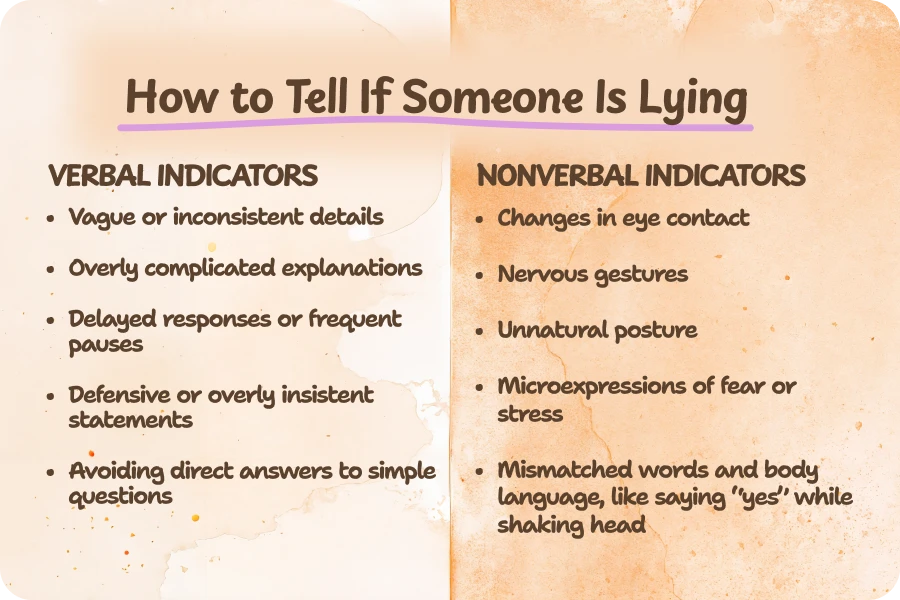
Non-Verbal Signs of Lying
- Crossing arms or hiding them behind their back may indicate a defensive behavior, which often masks a desire to hide the truth.
- Anxiety can cause a dry throat, which is often noticeable through symptoms such as licking the lips, coughing, or frequent swallowing.
- Creating distance. If the other person distances themselves during a conversation, it may indicate discomfort due to the lie.
- Liars often show anxiety through hand movements like excessive gesticulation, scratching, fiddling with their clothing, stimming, or constantly moving something on the table. This indicates tension and vulnerability.
- Demonstrative behavior, such as boredom or yawning, may be attempts to hide deception.
- Unnatural eye contact. The person telling a lie may suddenly look away when the conversation turns to a difficult topic, even though they were previously comfortable looking directly at you. Or, conversely, they may begin to catch your gaze to demonstrate openness.
Does your partner gaslight, manipulate, or lie to you? These can be signs of narcissistic abuse. Take a test to spot the behavior that may negatively impact your mental health.

8 Practical Strategies to Catch a Liar
Detecting lies requires careful observation, strategic questioning, and attention to inconsistencies. Here are techniques by international experts on lie detection that may help you.
1. Ask for the story in reverse
As liars typically rehearse their story chronologically, asking them to tell it backwards, from end to beginning, makes it much harder to maintain a narrative. Truth-tellers can do this relatively easily, but for liars, it can be difficult.
2. Use the element of surprise
Ask questions casually and unexpectedly when they’re relaxed and off-guard.
3. Ask open-ended questions
Instead of yes/no questions, use “Tell me about…” or “Walk me through…” This makes a person generate more content, increasing the likelihood of contradictions.
4. Circle back to details later
Return to specific points from earlier in the conversation. Liars may forget what they said and provide conflicting information.
5. Gather independent evidence
Check facts that can be verified, such as receipts, timestamps, witnesses, digital footprints, and location data from phones or cars.
6. After they finish answering, stay silent and maintain eye contact
Liars may feel compelled to fill the silence and reveal more or contradict themselves.
7. Introduce false information
Casually mention a “fact” you know is wrong. If they agree with it to seem knowledgeable or consistent, they’re likely lying. For example, “So this happened on Thursday, right?” when you know it was Wednesday.
8. Watch for resistance to investigation
Liars may resist, deflect, or become angry at the suggestion of fact-checking.
Why Lying Cues Don’t Always Mean Someone Is Lying
Before accusing someone of lying, pay attention to their behavior. If they consistently show the signs listed above, it doesn’t necessarily mean they’re a liar. They may simply be naturally anxious or have ADHD.
The opposite situation can be if someone is lying to you but doesn’t exhibit the above-mentioned signs. People with narcissistic traits may behave this way because they don’t feel guilty or distressed about the deception. Similarly, dark empaths who understand emotions well but use that insight manipulatively may lie convincingly while appearing calm, charming, and emotionally regulated.
This is why relying on single behaviors can easily lead to misinterpretation. Lie detection is complex, and many factors influence how people act under pressure:
- Some people are naturally nervous, avoid eye contact due to cultural norms, or have conditions that affect their behavior.
- Avoid confirmation bias. Don’t look only for signs that confirm your suspicion. Remain objective and consider alternative explanations.
- Trust patterns, not single instances. One inconsistency doesn’t prove lying. Look for multiple red flags occurring together.
Expert Insight
Unfortunately, traditional ‘lying cues’ can also indicate an insecure attachment style, general anxiety and/or trauma. One’s general comfort level when in a relationship with others can adopt some of the ‘nervous’ tendencies as they are distracted by their own inner dialogue, over-examination of their interactions, or general paranoia that those they are interacting with have poor intentions toward them. Likewise, someone may also present jittery, defensive, and overall wishy-washy on their recollection of something due to the heightened importance the subject has to them. Human emotions occur along a spectrum, which makes it difficult to singularly categorize behaviors.
Katherine Scott
Mental health professional
What Liars Say And Do When Confronted
When liars are confronted with their dishonesty, they tend to exhibit predictable behavior patterns and use specific verbal strategies to deflect or minimize their deception:
1. The most straightforward response is simply denying the accusation: “I never said that” or “That’s absolutely not true.”
2. Liars may get offensive, questioning your motives, memory, or character. They may say phrases like:
- “Why are you asking me this?”
- “I thought you believed me.”
- “Why are you attacking me?”
- “You’re just trying to make me look bad.”
- “Who do you take me for?”
- “Why do you doubt me?”
- “I thought you were my true friend.”
3. They may admit to part of the truth while downplaying its significance, saying things like, “It wasn’t a big deal” or “Everyone does it.”
4. A liar may try to redirect attention away from the core issue by bringing up unrelated matters and past grievances. For example:
– You said you were working late, but your coworker told me you left at 3 pm.
– Oh, so now you’re checking up on me? Remember when you forgot our anniversary? But I didn’t interrogate you about it!”
5. They may play the victim, saying, “I can’t believe you don’t trust me” or “After everything I’ve done for you…”
6. They may avoid answering straightforward questions and turn the conversation into a philosophical debate:
- You lied about where you were last night.
- What even is a lie, really? We all have different perspectives on truth. You’re being so judgmental.
7. They may manipulate you, creating false equivalencies and trying to make you feel guilty:
- You said you quit smoking, but I found cigarettes in your car.
- Well, you said you’d go to the gym every day, and you only went twice this week. So we’re both ‘liars’ then, right?
How the Breeze App Can Come in Handy in Spotting Lies
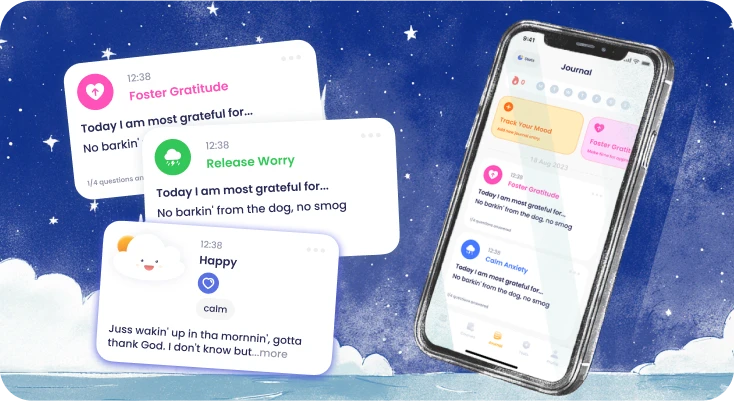
Wondering if you’re experiencing emotional abuse or cheating in a relationship and want to figure out if you’re being lied to? Breeze journaling is a powerful tool for detecting lies. When you write down conversations and events as they happen, you’re building a record that can’t be twisted later.
Journaling helps you trust yourself. Sometimes you get a gut feeling that something’s off, but you can’t quite put your finger on why. Writing through it makes you think about what actually bothered you. Was it their tone? Did their explanation make sense? What did their body language tell you? And when someone tries to gaslight and insists, “I never said that” or “You’re remembering wrong,” you’ve got proof of what really happened.
Frequently asked questions
1. Where do liars look when lying?
There is no reliable eye-movement pattern that proves someone is lying. Contrary to popular belief, liars don’t always look away. Many actually make more eye contact to seem convincing. Body language can offer clues, but only when viewed in context, not as isolated signs.
2. How to detect a lie in 3 minutes?
You can’t detect a lie with certainty in a few minutes, but you can spot possible red flags:
- Inconsistencies between the same story now vs. later.
- Body-language mismatches, like saying “I’m fine” while showing discomfort.
- Liars tend to give either too little or too much detail.
3. What is the first stage of lying?
The first stage is typically internal decision-making. Before speaking, the person decides whether to hide the whole truth, distort it, or create a false version. This stage often involves stress, planning, and self-monitoring.
Sources
- University of Wisconsin. How often do people lie? June 2024
- Drew A. Curtis, Christian L Hart. Normative aspects of lying. October 2022
- Leanne ten Brinke, Jooa Julia Lee, Dana R Carney. The physiology of (dis)honesty: does it impact health? December 2015
- Brennen T, Magnussen S. Research on Non-verbal Signs of Lies and Deceit: A Blind Alley. December 2020
Disclaimer
This article is for general informative and self-discovery purposes only. It should not replace expert guidance from professionals.
Any action you take in response to the information in this article, whether directly or indirectly, is solely your responsibility and is done at your own risk. Breeze content team and its mental health experts disclaim any liability, loss, or risk, personal, professional, or otherwise, which may result from the use and/or application of any content.
Always consult your doctor or other certified health practitioner with any medical questions or concerns
Breeze articles exclusively cite trusted sources, such as academic research institutions and medical associations, including research and studies from PubMed, ResearchGate, or similar databases. Examine our subject-matter editors and editorial process to see how we verify facts and maintain the accuracy, reliability, and trustworthiness of our material.
Was this article helpful?