


“What type of learner are you?” Insights based on the results of the test
This test was crafted based on the VARK model of primary learning styles.
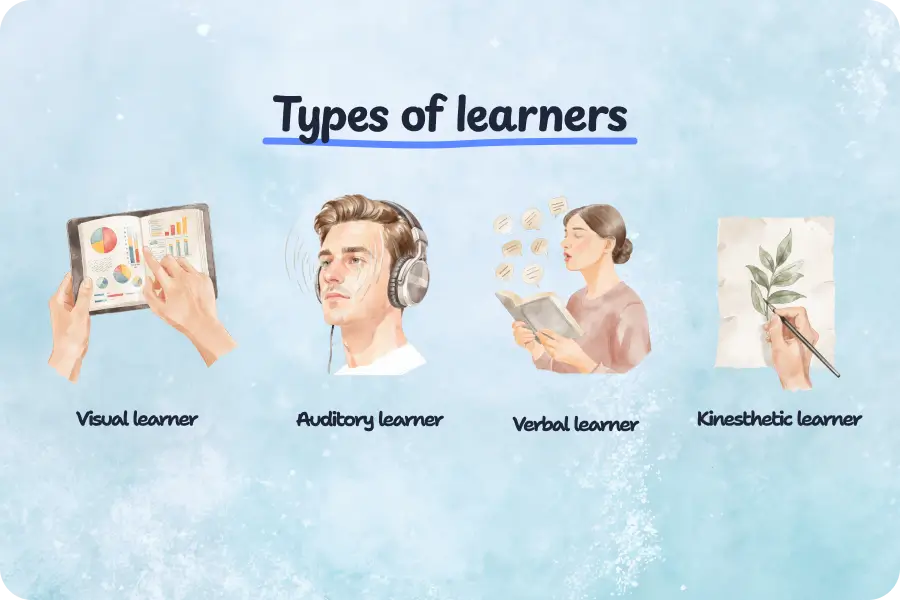
Visual learner
The best study methods for you are using mind maps, color-coding keywords in your notes, watching video demonstrations, reviewing pictures, and translating complex text into sketches.
Auditory learner
The best study methods for an auditory learner are engaging in group discussions, listening to podcasts, spelling words, and recording their voice while reading notes or learning new words. If you’re stuck on a difficult concept, try to explain it to your friend. It can help your brain lock in the understanding of the concept and remember spoken instructions better.

Verbal learner (reading / writing)
The best study methods include rewriting your notes in your own words, making lists, and turning diagrams into written descriptions. You can also try active writing, and instead of just copying, summarize a whole paragraph into a few punchy sentences.
Kinesthetic learner
The best study methods for people with this learning style are turning theory into action. Use real-life examples, experiments, and hands-on tasks whenever possible. Study in motion. You can purchase a treadmill and work while walking, use gestures to explain ideas, and break learning into short studying periods to keep your focus sharp.
Helpful tips for studying, no matter what your learning style assessment result is
There are also tips that can help you retain information better, regardless of what your learning style is. Save them and apply regularly to see how your academic performance can change.
1. Retrieval practice
When you learn something new, test yourself regularly using crossword puzzles, flashcards, or any other type of activity that is not just rereading notes. According to the research published in Medical Science Educator, this strengthens memory retrieval pathways more effectively and helps you improve long-term retention of new material. [1] Nebel C. “Considerations for Applying Six Strategies for Effective Learning to Instruction.” Med Sci Educ. 2020
Hannah Schlueter, MA, LAC, explains how people can use knowledge about their learning styles outside of academic classes. “Learning styles can be applied to much more than just academic performance. Understanding your learning style can help you build new skills faster and/or strengthen existing areas of improvement. Knowing and utilizing the learning style that fits you best will result in a deeper knowledge and application of anything you’re trying to understand.”
2. Dual coding
A study of medical students’ learning found that combining words with simple visuals, such as index cards, diagrams, and sketches, helps reinforce understanding through multiple brain pathways. [2] Madan CR. “Using Evidence-Based Learning Strategies to Improve Medical Education.” Med Sci Educ. 2023 It’s also better to keep such sessions short and engage in frequent breaks to remain focused.
3. Spaced repetition
That’s another scientifically proven learning strategy that allows for better long-term retention. Review information at increasing intervals, for instance:
- The same day
- 3 days after
- In a week
- In a month
It can help you learn complex subjects and concepts step-by-step, combat forgetting curves, and strengthen your memory over time.
Expert Insight
“Building your memory is like strengthening a muscle. It requires consistent practice and attention in order to improve. Some more tips for better memorization can include breaking the concept/task into smaller chunks, utilizing storytelling, and practicing your recall in different environments.”

Hannah Schlueter
Mental health professional
Frequently asked questions
How can I use free learning style quiz results to remember things?
Apply these learning style quiz results to try new ways of learning and discover what’s suitable for you. Don’t dwell on one way to remember things. Try different approaches, change study times, and ask your friend or family members for support to keep you accountable.
Can the concept of learning styles be a myth?
According to a study published in Frontiers in Psychology, there’s currently no scientific evidence to support the concept of learning styles. However, belief in the use of learning styles is quite popular among schoolteachers and persists in the research literature. [3] Newton PM, Miah M. “Evidence-Based Higher Education – Is the Learning Styles ‘Myth’ Important?” Front Psychol. 2017
As such, there is no one clear answer to whether following your learning style is noticeably helpful. Nevertheless, some people on Reddit say that leaning into their preferences makes studying feel more natural, even if it doesn’t directly improve outcomes.
Sources
- Nebel C. “Considerations for Applying Six Strategies for Effective Learning to Instruction.” Med Sci Educ. 2020
- Madan CR. “Using Evidence-Based Learning Strategies to Improve Medical Education.” Med Sci Educ. 2023
- Newton PM, Miah M. “Evidence-Based Higher Education – Is the Learning Styles ‘Myth’ Important?” Front Psychol. 2017
Disclaimer
This article is for general informative and self-discovery purposes only. It should not replace expert guidance from professionals.
Any action you take in response to the information in this article, whether directly or indirectly, is solely your responsibility and is done at your own risk. Breeze content team and its mental health experts disclaim any liability, loss, or risk, personal, professional, or otherwise, which may result from the use and/or application of any content.
Always consult your doctor or other certified health practitioner with any medical questions or concerns
Breeze articles exclusively cite trusted sources, such as academic research institutions and medical associations, including research and studies from PubMed, ResearchGate, or similar databases. Examine our subject-matter editors and editorial process to see how we verify facts and maintain the accuracy, reliability, and trustworthiness of our material.
Was this article helpful?