


You sleep seven to eight hours every night but still wake up tired. Or, maybe, you spend the whole weekend in bed watching TV series with your partner and then have zero motivation to work on Monday. “But why am I so tired? I should feel renewed and motivated,” you may think. If this feels relatable, keep reading.
In this article, we’ll explore 7 types of rest every person needs and explain how to integrate them into your life to boost your energy levels. Keep reading to discover how to help your mind and body recover.
Take a 5-minute test and find out how to feel more recharged daily.

The science of rest vs. sleep: why you’re still tired
Rest is a state of physical, mental, and emotional renewal that allows us to recover from constant stimulation and stress, helping to restore our energy. This term is much broader than simply “taking a pause” for sleep or doing nothing, as it also involves active restoration of the nervous system.
Sleep, in turn, is a state when a person can physically shut down so the body can:
- Repair tissues
- Regulate hormones
- Consolidate memory
However, sleep doesn’t automatically reduce mental overload, emotional tension, or chronic stress. This is why you can get enough hours of sleep and still feel exhausted.
As such, studies now define the term “rest” more broadly. According to findings published in Global Qualitative Nursing Research, rest means an activity that is personal, quiet, and effortless, and it is possible to experience rest alone or together with others. [1] Asp M. “Rest: A Health-Related Phenomenon and Concept in Caring Science.” Glob Qual Nurs Res. 2015
The whole concept is proven by Dr. Saundra Dalton-Smith, an author of the book “Sacred Rest: Recover Your Life, Renew Your Energy, Restore Your Sanity.” In the book, she suggests the idea of seven types of rest, which we’ll explore further in the article, and explains how to address the rest deficit.
What is the 42% rule for burnout?
Another professional who proves the fact that resting is more than a full night’s sleep is Emily Nagoski, Ph.D. According to her theory, people need to spend about 42% of their time (roughly 10 hours a day) resting to prevent burnout. Except for sleep, it can involve both physical and non-physical forms of rest, such as:
- Taking deliberate short breaks during the day
- Time to unwind emotionally
- Movement without pressure
- Creative activities, etc.
The idea isn’t to “do nothing” all day, but to regularly release stress so it doesn’t accumulate and lead to chronic exhaustion.
The “rest-and-digest” response: rest is about activating the parasympathetic nervous system
In our body, the “rest-and-digest” response is responsible for feeling renewed. It refers to the activation of the parasympathetic nervous system, which promotes recovery, digestion, and calmness after stress, according to findings published in the National Library of Medicine. [2] Jacob Tindle, Prasanna Tadi. “Neuroanatomy, Parasympathetic Nervous System.” National Library of Medicine. 2022
The “rest-and-digest response” doesn’t turn on automatically when you stop working or go to sleep. It activates when your body feels safe. If you’re lying in bed while mentally worrying about deadlines, your nervous system may remain in a low-level stress state. This explains why a person may feel tired even after “resting.”
The seven types of rest every person needs
To feel completely recharged, you need to take a break from various kinds of stimulation. Here are the seven essential types of restorative activities people may need depending on the situation.
1. Physical rest
Having a good nap, doing yoga, taking a short walk in the park, or lying in bed and doing nothing are all kinds of physical rest. It can involve any activity that allows your body to recover without pressure or performance goals.
Active vs. passive rest
| Active rest | Passive rest |
| Low-effort activities that help release stress | Minimal or no activity |
| Slow walking, gentle yoga, stretching, deep breathing, and massage therapy | Sleep, naps, lying down, doing nothing |
| Helps deal with mental fatigue, mild stress, or tiredness | Helps overcome physical exhaustion |
Sleep hygiene
To make physical rest more recharging, it’s essential not only to sleep at least 7-8 hours but also to take care of your sleep quality. Actionable 10-3-2-1-0 hygiene rules may be highly effective:
- 10 hours before going to bed, stop all caffeine intake
- 3 hours before bed, stop eating and drinking alcohol
- 2 hours before bed, stop working
- 1 hour before bed, stop screen time
- 0 times in the morning hit the alarm’s snooze button
2. Mental rest
Mental rest deficit can influence your productivity and ability to focus even more than physical exhaustion. When our thoughts are constantly focused on solving work-related problems or processing loads of data, people might feel mentally drained. Here are some ideas on how to rest from constant stimulation:
- Engage in meditation.
- Schedule breaks during the workday.
- Take a short break and go for a walk without your headphones on.
- Do something creative while completely focusing on the process (no background noise like YouTube videos allowed).
- Spend some quiet time in nature while focusing on your thoughts.
You can also engage in journaling with Breeze Wellbeing. The app provides advanced prompts that allow you to dump your worries and clear mental clutter.
Ongoing anxiety can leave you feeling drained. Find out if that’s the case for you with this free test.

3. Sensory rest
In the world of continuous stimulation, it’s easy to feel overwhelmed. Moreover, people tend to multitask and switch between tasks more often than even two decades ago, according to findings from Columbia University in the City of New York. [3] Sarah D’Aurizio. “Are Attention Spans Actually Decreasing?” Columbia University in the City of New York. 2024 To rest from mental stimulation and avoid sensory overload, you may need to spend some time without screens.
- Spend a few minutes sitting quietly or just observing people outside during a work break (rather than scrolling through social media).
- Use noise-canceling headphones.
- Turn off digital notifications for a set period of time.
- Sit in silence.
- Turn off the TV and spend an evening talking with your partner.
- Take a shower without music in the background.
4. Creative rest
Sometimes people may lack new ideas, as they need more creative rest. This term involves interacting with something that inspires us, brings joy, and helps us approach typical situations from a new angle.
For some people, creative rest may involve visiting theaters and art galleries. For others, it’s about baking, painting, or writing stories. It can also include brainstorming with colleagues or friends without pressure to be productive or “right.” The key is to consume or create beauty without deadlines and evaluation. Save a few more ideas that may be helpful:
- Listening to music without multitasking
- Reading fiction or poetry
- Rearranging your physical space for pleasure
- Visiting a bookstore or library
- Trying a new recipe for fun
5. Emotional rest
Emotional rest is about being authentic and allowing yourself to be with your emotions, whatever they may be. During busy days, we may try to compartmentalize or seem optimistic or calm while in reality feeling worried or frustrated. And it’s necessary to find time when you can be honest with yourself.
You may talk with a trusted friend about what makes you feel anxious. Or, you can have a good cry without feeling guilty afterwards. The goal is to free up your emotions and seek support when you need it.
Other ways to cover your emotional demands may include:
- Taking breaks from emotionally draining conversations
- Asking for reassurance or comfort when needed
- Avoiding stressful situations if possible
You can have emotional rest on your own or with people you trust. Just make sure that those around you make you feel safe, as it allows your nervous system to relax.
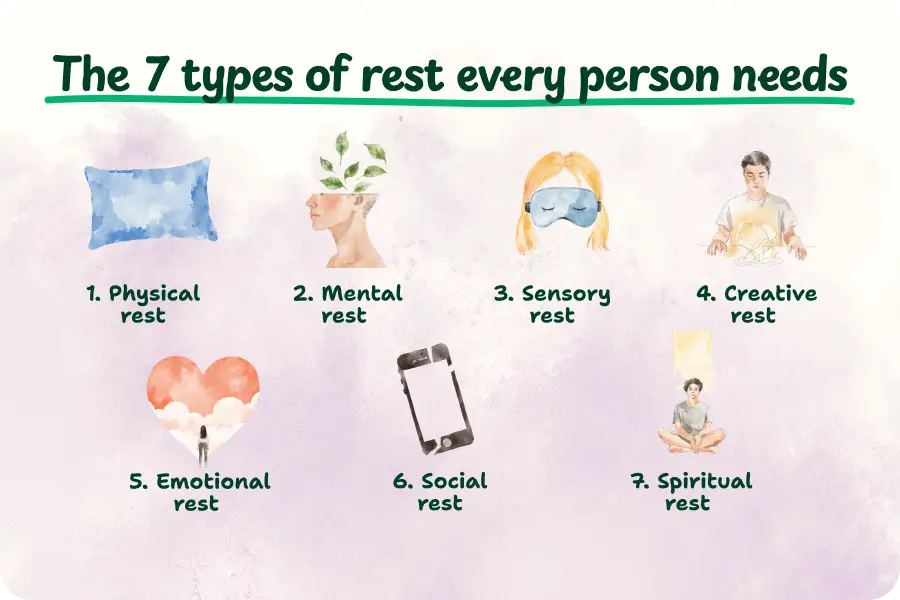
6. Social rest
This type of rest involves surrounding yourself with people who feel good to be around and avoiding those who drain your energy. Social rest deficit can make you more irritable, less empathetic, and more emotionally exhausted. You can start approaching any interaction with people like an obligation rather than a source of power.
Both introverts and extroverts need social rest. Yet, it may be a bit different. More introverted people may opt for an evening in a small company of their closest ones or even staying alone for some time. Social butterflies, in turn, might feel recharged after a few days on a trip with many friends.
7. Spiritual rest
Spiritual rest is about finding meaning in daily life and taking steps to make every day more fulfilling. Some may find this meaning in prayers, others in helping people around and community involvement, while some find it in connecting with nature or reflecting on personal values.
This type of rest should bring the feeling of purpose, so it may include setting goals or following through with big life dreams. Also, people may seek the feeling of belonging, which can be reached through shared beliefs and traditions. Here are some specific examples of spiritual rest you can engage in during the day:
- Helping someone without expecting anything back
- Reading something meaningful or inspiring
- Taking part in the community
- Spending time with people who share your beliefs
Expert Insight
“It takes time and patience to discern what kind of rest you need at a given time. You can start by asking yourself, “What would make me feel most recharged right now?” Chances are, that answer will offer some insight into which activity — whether it’s physical, emotional, or spiritual — will be most meaningful to you.”

Nicole Arzt
Mental health professional
How to rest and recover: practical self-care tips to rest daily
It may be enough to involve all 7 types of rest in your daily life to boost energy levels. Still, if you feel chronically tired, self-care should be more intentional and consistent. This is what you can do.
1. Schedule time to evaluate seven key areas of your recovery and analyze what’s needed
You can do this practice once or a few times a week. Find a quiet room, choose an evening when no deadlines make you stressed, and think about what type of rest you lacked recently. For instance, you may feel lonely and need some time with positive and supportive people. Or, maybe, you find it challenging to focus and need some mental rest.
Question yourself:
- How have I been feeling recently?
- What type of rest am I missing now?
- Which areas in life do I feel most drained?
- What change can help me recover?
2. Set boundaries and learn to prioritize yourself
Chronic fatigue may stem from doing too much without enough recovery. And while you may perfectly balance your tasks, when others reach out for support, it may be challenging to say “no.”
In such cases, remember that rest is an important component of your productivity. It allows you to take care of your overall health and help loved ones when they really need it. So, if the situation is not an emergency, here’s what you can do:
- Take a pause. When someone asks for a favor, avoid answering automatically. Say something like, “Let me check my schedule and get back to you.” This buffer gives you the mental space to evaluate if you truly have the energy to help.
- Define your “non-negotiables.” These can be 1-2 periods during your week that are sacred for rest. And until it’s something super-serious, don’t agree to do anything during this time.
- Compare the impact and the energy needed. Before taking on a new task, ask yourself whether the outcome is genuinely worth the effort. If the task is low impact but high drain, you can politely say “no.”
3. Feel the power of small rituals
True rest doesn’t always require immense time. Sometimes, a 5-minute break between tasks, 10 minutes of practicing yoga, or a quick call with a friend can help you reduce stress. Of course, you can go with the flow and adapt your recharge moments to the situation. However, planning beforehand might be effective as well.
In the evening, take a look at your plan for tomorrow and analyze it.
- Recognize the times when you are most productive so you can intentionally schedule rest immediately after it.
- Notice high-stress triggers and schedule mental breaks immediately after.
- Look for times when you’re on the way or waiting for something, so you can do a quick meditation or a relaxation game in the Breeze app to feel more recharged.
- Add small breaks to your schedule, pretty much like your plan for when you’ll have meals.
4. Rest your mind without screens
While scheduling screen-free time is an important part of mental rest, it’s essential to highlight this point separately, as technology dominates most areas of life and keeps our attention in a constant state of alert. This is how you can approach digital detox in a more meaningful way:
- Spend 1 hour after waking up without checking your phone or email
- Turn off notifications for non-essential apps
- Replace social media scrolling with reading a book
- Have screen-free meals to focus on taste and conversation
- Go for a walk outside without your phone
Nicole Arzt, LMFT, explains how a person who feels dependent on their phone can start building healthy screen boundaries without feeling anxious. “Keep in mind, you may feel a bit anxious or unsettled when setting limits around technology. This is normal; your brain may be used to the constant stream of dopamine, and it takes time for this pattern to reset. Try to stick it through — the less you rely on staying connected 24/7, the more you can reap the exquisite benefits of more clarity, curiosity, and slowness as you move through life.”
Conclusion: rest differently to take care of physical and mental health
The concept of the seven types of rest can be helpful for people to balance their time and feel more recovered. It’s better to intentionally include different forms of rest in your routine and experiment with small practices that restore energy. Try Breeze Wellbeing and engage in self-discovery tests and mindful mood tracking instead of doomscrolling, and you’ll see how it boosts your daily recovery.
Frequently asked questions
What is the book about the 7 types of rest?
The book about the 7 types of rest is called “Sacred Rest: Recover Your Life, Renew Your Energy, Restore Your Sanity” by Dr. Saundra Dalton-Smith. It describes physical, mental, sensory, creative, emotional, social, and spiritual types of rest.
Is rest the same as sleep?
No, getting enough sleep is an important type of rest that promotes physical and mental recovery. Sleep simply refers to being asleep, and it doesn’t involve creative rest, emotional recharge, social rest, or other kinds of rest that support nervous system regulation. This is why sleeping may not be enough to restore energy if other areas of rest are neglected.
What does emotional rest look like?
Emotional rest can involve freeing up your feelings in ways that promote your emotional well-being. It can include having a good cry, laughing out loud without overthinking, or sharing your worries with a loved one. Also, emotional rest is about avoiding triggers of stress that can make your life less balanced.
Sources
- Asp M. “Rest: A Health-Related Phenomenon and Concept in Caring Science.” Glob Qual Nurs Res. 2015
- Jacob Tindle, Prasanna Tadi. “Neuroanatomy, Parasympathetic Nervous System.” National Library of Medicine. 2022
- Sarah D’Aurizio. “Are Attention Spans Actually Decreasing?” Columbia University in the City of New York. 2024
Disclaimer
This article is for general informative and self-discovery purposes only. It should not replace expert guidance from professionals.
Any action you take in response to the information in this article, whether directly or indirectly, is solely your responsibility and is done at your own risk. Breeze content team and its mental health experts disclaim any liability, loss, or risk, personal, professional, or otherwise, which may result from the use and/or application of any content.
Always consult your doctor or other certified health practitioner with any medical questions or concerns
Breeze articles exclusively cite trusted sources, such as academic research institutions and medical associations, including research and studies from PubMed, ResearchGate, or similar databases. Examine our subject-matter editors and editorial process to see how we verify facts and maintain the accuracy, reliability, and trustworthiness of our material.
Was this article helpful?