


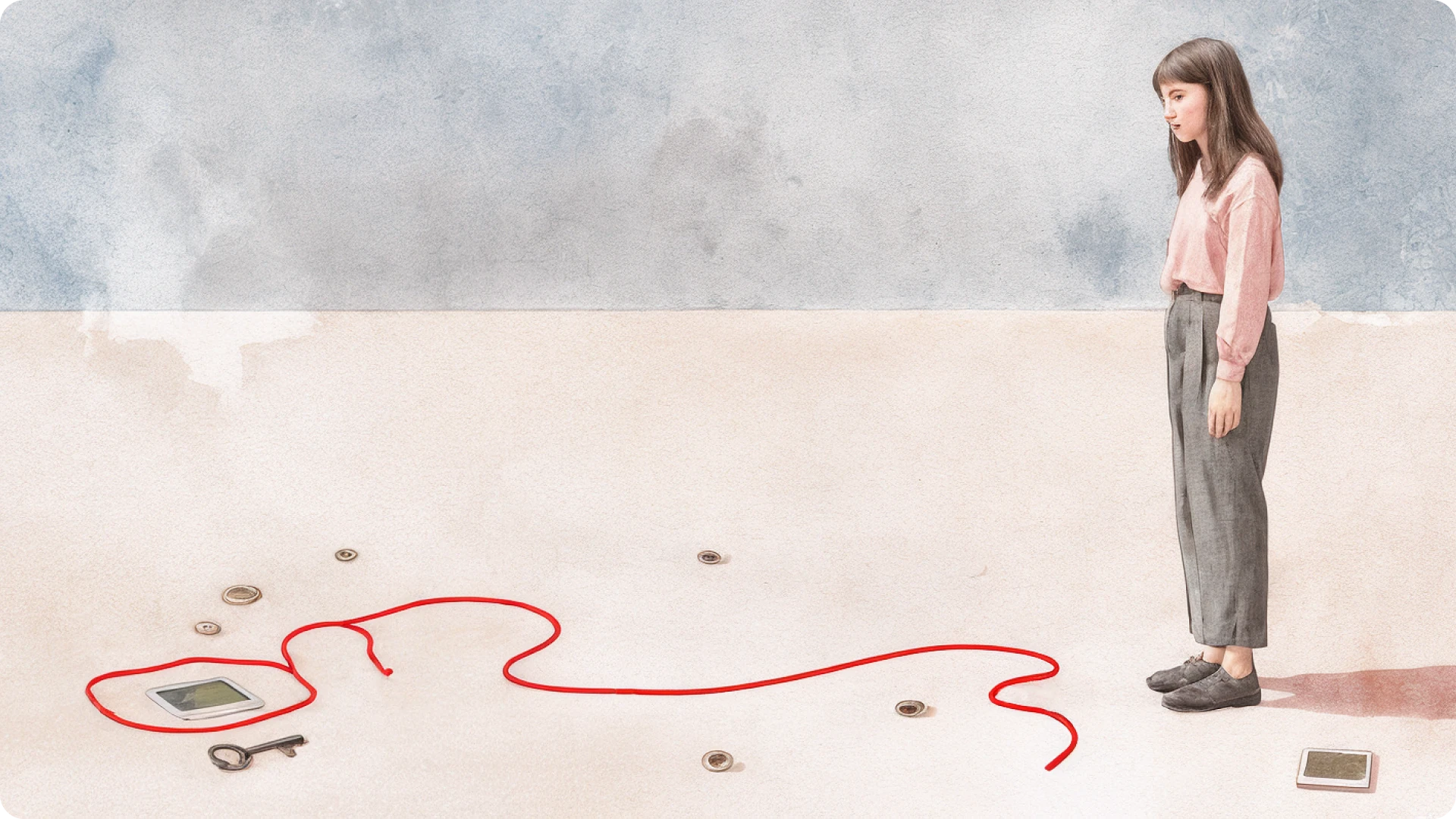
Ever feel like your partner is packing their bags behind your back? Do you constantly need reassurance that they actually care and still love you? If your answer is “yes”, it could be a sign of abandonment trauma.
This article will break down what abandonment trauma is, why it happens, and how to move forward with healthier relationships.

What Is Abandonment Trauma?
Abandonment trauma is a complex emotional response stemming from experiences of emotional neglect, rejection, or loss. These events can happen at any point in life but are often rooted in early childhood trauma.
Imagine a little kid whose grown-up isn’t always around, is emotionally distant, or unpredictable. That child might feel insecure and constantly worry about being left behind because their fundamental needs for love, safety, and connection aren’t always met.
Another example can be a parent who struggles with substance abuse and is frequently unavailable, or perhaps the one going through a difficult divorce and becoming emotionally withdrawn. In such cases, kids may experience separation anxiety and wonder if their parents actually love and need them. This is where abandonment issues come in.
You can check if you feel a fear of abandonment with our quick abandonment trauma test.

8 Symptoms of Abandonment Trauma
Symptoms of abandonment trauma may include:
- Difficulty managing intense emotions and expressing your needs. Sometimes, even small things, like your partner being unavailable for a bit, can trigger a wave of sadness, anger, or anxiety.
- Separation anxiety. You might wonder how to stop overthinking in a relationship, worry excessively about loved ones leaving, or situations that could lead to separation.
- Need for constant reassurance of love and affection. The thought of being alone can be unbearable, leading to social anxiety or codependency in intimate relationships.
- Low self-esteem. Abandonment trauma may damage a person’s sense of self-worth and make them feel “not good enough” for love in adult relationships. You might ask yourself, “Why do I feel so guilty?” believing you don’t deserve emotional intimacy and a happy relationship.
- People-pleasing. An employee with people-pleasing tendencies might take on extra work or agree to unreasonable deadlines to avoid being seen as incompetent or replaceable. Also, the one with a fear of abandonment may also apologize excessively for almost everything and avoid conflict at any cost.
- Emotional dependency. You can’t make decisions without your partner’s input. You may rely heavily on them for emotional support, often feeling lost or insecure when they are apart.
- Haunting memories or flashbacks that can be intrusive and overwhelming.
- Trust issues. Trusting others can be difficult due to past experiences. You might become suspicious of others’ motives or constantly seek signs of potential abandonment. Despite wanting deep emotional connections, you might withdraw emotionally when your partner gets close, pushing them away unconsciously.

Where Does Fear of Abandonment Come From?
The next important thing is to know the root of possible trauma caused by abandonment. According to research on abandonment trauma, these are the common causes of abandonment issues [1] UMass Memorial Health. What to Know About Abandonment Trauma. 2025 :
1. Childhood trauma
- Abuse: You may ask, “Why do I have abandonment issues if I was never abandoned?” A kid who experiences physical or emotional abuse from a caregiver may develop a deep fear of being rejected or abandoned. The caregiver, who should be a source of comfort, becomes a source of anxiety and uncertainty. This can make it hard for the child to trust and build healthy relationships later in life.
- Сhild’s emotional neglect: When a child’s basic needs for food, shelter, or emotional connection are consistently ignored, it can lead to feelings of isolation and abandonment, too. The child may feel unimportant and unlovable and develop a deep-seated fear of abandonment.
To see if you might have experienced childhood trauma, take our Healing Childhood Trauma Plan. Gain valuable insights and discover if you have the signs.
2. Loss
The death or serious illness of someone you love can be a traumatic experience. It may trigger a fear of abandonment and a sense of powerlessness. You may worry that the remaining loved ones will also leave you, and experience anxiety and insecurity in future relationships.
3. Breakups
It’s natural to feel a range of emotions, including sadness, anger, and anxiety, while going through a breakup, divorce, or separation. Sometimes, breakups can trigger fears of rejection or abandonment, even if the past relationship wasn’t perfect.
What Are Abandonment Issues?
Abandonment issues are the long-lasting effects of unresolved trauma that have an impact on a person’s emotions, behavior, and thoughts. You might also have an anxious attachment style, like becoming anxious when your partner is unavailable or far away, or pushing people away for fear of getting hurt again.
This scenario is where fear of abandonment may arise as a defense mechanism, a way to try to protect oneself from getting hurt again. Attachment issues can be a root cause of abandonment issues [1] UMass Memorial Health. What to Know About Abandonment Trauma. 2025 .
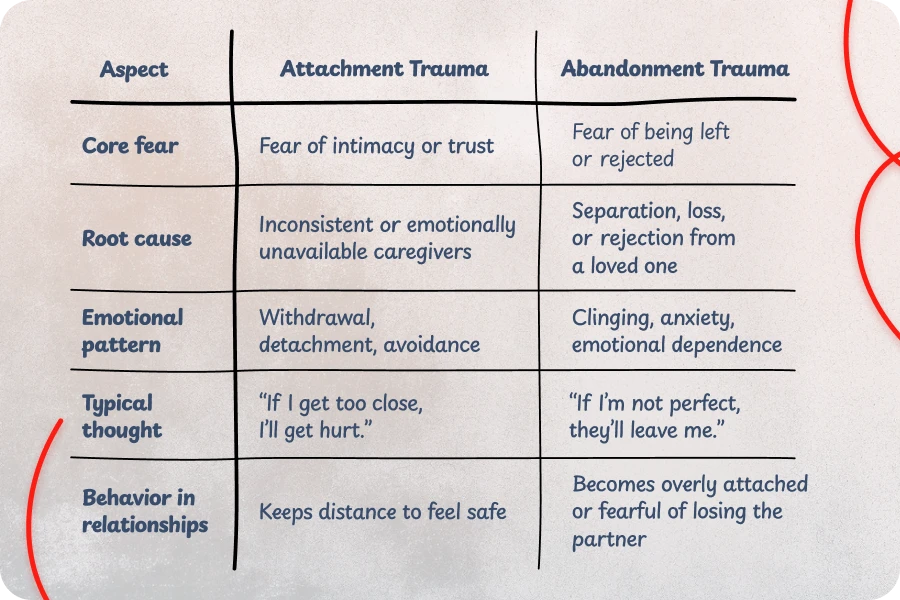
The difference between attachment and abandonment issues in relationships
According to attachment theory, attachment issues are deeply rooted in early childhood experiences, particularly those with primary caregivers [2] Inge Bretherton. The Origins of Attachment Theory: John Bowlby and Mary Ainsworth. . They are related to how someone learns to form bonds with others. Some of them might be fear of intimacy, an excessive need for approval, or jealousy.
Abandonment issues and attachment issues are closely linked, but they are not exactly the same. Abandonment is an experience, while attachment is the emotional pattern that forms in response to repeated experiences with caregivers. In other words, childhood abandonment can shape the attachment, leading to anxious, avoidant, or disorganized attachment styles. This might arise from past experiences of feeling alone, unwanted, or unloved. One of the causes might be parents’ divorce, neglect, abuse, or daddy issues.
People with abandonment issues might be terrified of their partner leaving them, even if there’s no reason to believe that will happen. To sum up, abandonment issues focus specifically on the fear of being left alone, while attachment issues concern how people form and maintain relationships.
How Abandonment Issues And Trauma Can Affect Your Relationship
People with abandonment issues may fear being left out or rejected in relationships. Things like separation, betrayal, unresolved trauma, or negative thoughts may trigger abandonment issues, according to recent research on rejection, parental abandonment, and neglect [3] Marici M, Clipa O, Runcan R, Pîrghie L. Is Rejection, Parental Abandonment or Neglect a Trigger for Higher Perceived Shame and Guilt in Adolescents? June 2023 .
This fear of abandonment may lead to clingy behavior, constant reassurance-seeking, or emotional distancing. For example, a person with a fear of abandonment might constantly check their partner’s phone or accuse them of cheating, even when there’s no evidence.
Trauma, on the other hand, may create a sense of distrust and vulnerability. Someone with abandonment trauma may struggle to form deep connections or may become overly dependent on their partners.
How Childhood Abandonment Trauma Impacts Adults
There’s a possibility that for some people, experiences of abandonment in childhood could lead to difficulties in adulthood:
- Independence vs. dependence. Abandonment trauma may trigger opposite coping mechanisms. Some people might feel a strong urge to be completely independent, wanting to take care of everything themselves, which might be a sign of parentification trauma. Others, on the contrary, might lean heavily on others, fearing being left alone again. For example, after a stressful job change, you might take on extra chores at home to feel productive or call your family more often for reassurance.
- Being paranoid may lead to increased caution. While this extra awareness isn’t always comfortable, it can help a person feel safer after feeling scared. For instance, after losing your keys once, you might double-check your pockets more often or put them in a specific place to avoid that worry.
- Emotional distress. Abandonment trauma can make it harder to manage our feelings. We might feel empty, hopeless, or even have thoughts of hurting ourselves.
Hannah Schlueter, MA, LAC, shared her thoughts about the impact of abandonment trauma, “The lasting effects of abandonment come with many intra and interpersonal challenges. Since the root of all attachment issues is the fear of rejection and abandonment, it is crucial to understand the way such experiences impact your ability to connect with others. Unresolved abandonment often results in more unstable moods, self-esteem, and relationships. Seeking out therapy and additional support to address attachment issues will lead to more effective communication skills, higher self-confidence, and increase your ability to seek out healthy relationships.”
Abandonment Trauma And Related Mental Health Conditions
Abandonment trauma can co-occur with other mental health conditions, such as:
- Anxiety disorders. People with abandonment issues may be more likely to develop anxiety disorders, such as generalized anxiety disorder or social anxiety disorder.
- Depression. People with a fear of abandonment may feel hopeless, worthless, and unlovable.
- Post-traumatic stress disorder (PTSD) can develop after a person experiences a traumatic event.
- Attachment trauma. People with attachment disorders may have difficulty trusting others, forming close relationships, or maintaining healthy boundaries.
- Substance abuse. People with abandonment trauma may be more likely to abuse substances, such as alcohol or drugs, as a way to cope with their pain and emotional distress.
- Eating disorders. People with eating disorders may use food or control over food as a way to cope with their feelings of abandonment.
4 Tips To Deal with Abandonment Issues in Relationships
Here’s how to heal childhood trauma without therapy or with the help of a mental health professional:
1. Recognize the abandonment issues and their impact on your life
Perhaps you are prone to codependent relationships, neglecting yourself for the sake of relationships, seeking approval and pleasing others, struggling with personal boundaries, or avoiding close relationships and withdrawing from contact out of fear of abandonment.
These patterns don’t mean something is wrong with you. They’re coping strategies you learned long ago, and understanding them is the first step toward healing.
Identify what triggers your abandonment fear. Is it a partner working late or a friend becoming distant? Recognizing these situations helps you manage your emotions effectively.
2. Replace negative thoughts with realistic ideas
Fear of abandonment can drive automatic reactions like jealousy or excessive anxiety. But you can recognize them, slow them down, and learn to respond differently. Instead of “They’re leaving me,” think, “They might be busy. We can talk later.”
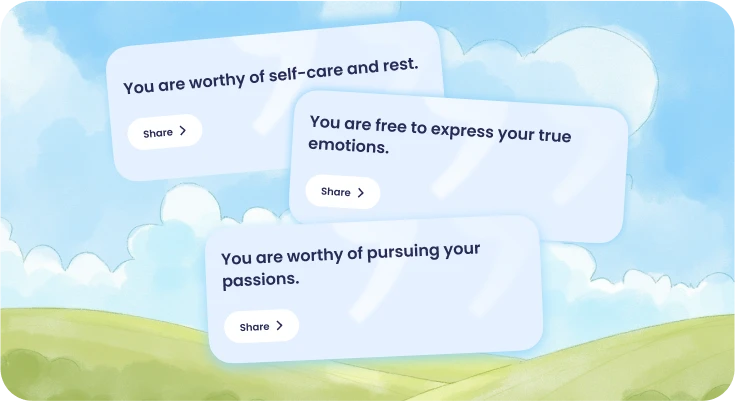
Learn to remind yourself: “Silence does not equal rejection” and “I can be loved and accepted, even in my weakest moments.” You can also use quick calming reminders such as “I am safe right now,” “I can wait before reacting,” or “I don’t have to assume the worst.” Better yet, try personalized positive affirmations in the Breeze app to get out of your head when fear takes over.
3. Stay open to new relationship experiences
If you’re frequently drawn to people who are emotionally unavailable or show avoidant attachment tendencies, this could be a traumatic trigger. Try to choose those who can offer a stable and healthy attachment:
- Notice early green flags in relationships. Look for people who reply consistently, show interest, follow through on plans, and communicate openly.
- Choose actions over intensity. Pick partners who make you feel safe and respected rather than those who create anxiety, uncertainty, or emotional highs and lows.
- Give yourself time to see who someone truly is. Consistency reveals emotional availability. Notice how they handle conflict, express emotions, and talk about their needs.
- Let yourself receive. Practice accepting care and support, even if it feels unfamiliar at first. Start noticing how it feels to be treated with consistency, kindness, and clarity, and allow yourself to slowly build trust with safer partners, friends, or communities.
- Expand your circle. Try meeting people in new environments where emotional maturity is more common. You can make new friends or meet your future partner in interest groups, classes, volunteering, or shared hobby spaces.
4. Work on your self-esteem with a mental health professional
The new relationship experience may begin in a therapeutic space, where there is stability, acceptance, and connection that heals. Psychotherapy is a place where you won’t be abandoned, even when you’re angry, crying, disagreeing, or silent. A therapist can explore the root of your fears and teach healthy coping mechanisms.
Psychotherapy may help you:
- Recognize childhood scenarios and develop new healthy ones
- Look at yourself not through the lens of “Am I good enough?”, but through the awareness of your own value.
- Experience arguing, remaining silent, making mistakes, being vulnerable, and not being abandoned. This builds trust, which can be transferred to other relationships over time.
Treatment may involve various approaches [4] Borja Luque Martínez. Abandonment trauma from a developmental perspective and its treatment. February 2023 :
- Individual, group, or family psychotherapy
- Cognitive behavioral therapy (CBT)
- Dialectical behavior therapy
- Art therapy
- Practices aimed at awareness and working with bodily sensations
Abandonment Trauma Test
Please read each statement carefully and rate your level of agreement using the following scale:
- Strongly disagree — 1
- Disagree — 2
- Neutral — 3
- Agree — 4
- Strongly agree — 5
- I feel anxious when I am in large groups of people, fearing that they might leave or forget about me.
- I often worry that my friends will eventually lose interest in me or find new friends.
- I have difficulty trusting romantic partners and often fear that they will leave me.
- I feel insecure in my family relationships, believing that they could abandon me at any time.
- I constantly worry about losing my job, fearing that I will be unable to support myself.
- I have a deep-seated fear of illness or injury, believing that it could lead to abandonment by loved ones.
- I find it difficult to adapt to change, as it often feels like a threat to my stability.
- I often feel anxious about being alone or left unattended.
- I avoid expressing my needs or feelings because I fear being rejected.
- I find it difficult to commit to long-term relationships or projects, fearing that I will be let down.
The results of the abandonment trauma test
Note: This abandonment trauma test is intended for self-reflection and should not be used as a definitive diagnosis. If you are concerned about your mental health, it is recommended to consult with a qualified mental health professional.
Count your score points to see how many of those statements you can relate to.
- 1-20: You likely have a low level of abandonment issues. You may experience occasional feelings of loneliness or insecurity, but these are generally manageable.
- 21-30: This score might mean that you may be experiencing mild to moderate abandonment anxiety. You might find it challenging to trust others or maintain long-term relationships at times. However, you can manage these feelings with healthy coping mechanisms.
- 31-40: If you scored high on this test, you are likely dealing with strong fear of physical or emotional abandonment. These issues may significantly impact your interpersonal relationships, self-esteem, and overall well-being. It’s important to seek help from mental health services.
Looking for more quizzes? The Breeze app offers tests on different types of childhood trauma, attachment style, emotional intelligence, temperament, and much more.
Key Takeaways
- Abandonment trauma is a deep-seated fear of being left alone or rejected. It may arise from childhood experiences of neglect, loss, or emotional unavailability from caregivers.
- Abandonment issues are the behavioral or emotional responses that may develop as a result of abandonment trauma
- Common signs of abandonment trauma may include anxiety, insecurity, difficulty trusting others, and excessive need for reassurance.
- Healing involves understanding the root causes, challenging negative thoughts, practicing self-care, and seeking professional help if needed.
Frequently asked questions
1. Can abandonment trauma start even if no one physically left me?
Yes. Abandonment trauma doesn’t require someone to leave. It can form when a caregiver is emotionally unavailable, unpredictable, neglectful, or overly critical. A child can feel “left alone” even when the parent is physically present.
2. How does abandonment trauma show up in adult relationships?
It can lead to people-pleasing, fear of being a burden, constant worry about being left, clinging or distancing behaviors, and difficulty trusting others. Many adults with abandonment trauma feel hyperaware of rejection cues, even when nothing is actually wrong.
3. Can abandonment trauma be healed?
Yes. Healing involves building emotional safety, learning to self-soothe, setting healthy boundaries, and forming stable, supportive relationships. Therapy, especially attachment-based, trauma-informed, or somatic approaches, helps rewire old patterns and develop a secure sense of self.
Sources
- UMass Memorial Health. What to Know About Abandonment Trauma. 2025
- Inge Bretherton. The Origins of Attachment Theory: John Bowlby and Mary Ainsworth.
- Marici M, Clipa O, Runcan R, Pîrghie L. Is Rejection, Parental Abandonment or Neglect a Trigger for Higher Perceived Shame and Guilt in Adolescents? June 2023
- Borja Luque Martínez. Abandonment trauma from a developmental perspective and its treatment. February 2023
Disclaimer
This article is for general informative and self-discovery purposes only. It should not replace expert guidance from professionals.
Any action you take in response to the information in this article, whether directly or indirectly, is solely your responsibility and is done at your own risk. Breeze content team and its mental health experts disclaim any liability, loss, or risk, personal, professional, or otherwise, which may result from the use and/or application of any content.
Always consult your doctor or other certified health practitioner with any medical questions or concerns
Breeze articles exclusively cite trusted sources, such as academic research institutions and medical associations, including research and studies from PubMed, ResearchGate, or similar databases. Examine our subject-matter editors and editorial process to see how we verify facts and maintain the accuracy, reliability, and trustworthiness of our material.
Was this article helpful?