


Podcast name
Black and white thinking
Black-and-white thinking makes you forget that nuances exist. People are either 100% good or completely bad, and every life change is either something great or a complete disaster. While it can seem like a simplified way to navigate a complex world, dichotomous thinking can lead to challenges with self-worth and communication with others.
Check the article to find out what this thought pattern stems from and how it impacts daily life, discover black and white thinking examples, and learn how to overcome related negative feelings.

What is dichotomous thinking?
Dichotomous thinking (also called “black-and-white thinking” or “all-or-nothing thinking”) is a type of cognitive distortion. A person sees situations, other people, or their emotions in extremes and everything is perceived as either completely good or completely bad. Those with dichotomous thinking may not notice nuances, or so-called “shades of gray,” and may categorize everything as absolute opposites.
Anyone can think in extremes from time to time. For instance, if during a bad day you make a single mistake at work, you might accidentally feel like a failure. It may not be an alarming sign if this feeling goes away quickly. However, maintaining a persistent, rigid perspective can lead to:
- Heightened stress
- Perfectionism
- Intense self-criticism
- Inability to make mistakes
- Lack of self-compassion
- Unstable relationships with others
Such extreme thinking may be a result of stress, anxiety-related mental health challenges, or long-term emotional pressure. It can also stem from past experiences where mistakes were punished and only “right” and “wrong” outcomes were accepted.
Black and white thinking examples in everyday life
All-or-nothing thinking is about absolutes. It can involve beliefs that if you don’t do something 100% perfectly, it’s a complete disaster. Such people may often use phrases and statements like:
- “This day is ruined.”
- “I always mess things up.”
- “If this doesn’t work out, nothing will.”
- “It is impossible to do this task.”
They may also use words like “always,” “never,” “everyone,” “no one,” “everything,” or “nothing” too frequently and without clear evidence to support such black-and-white terms.
Relationships
Imagine that you and a new coworker have become friends because you have a lot in common. You get coffee together at lunch and even go out to dinner, but then one day they disagree with you in a meeting or cancel plans at the last minute.
Suddenly, you might feel let down and start to see them as unreliable or uncaring. Dichotomous thinking can make you go from seeing the person as perfect to devaluing them.
Perfectionism
People who use dichotomous thinking might only try things they can do properly on the first try. They might also believe that one mistake means they failed. For example, they might decide not to go to the gym anymore if they skip it once because they think they “ruined everything.”
Self-Image
Maybe you see yourself in extremes, too. On good days, you might feel confident. But after a small mistake or criticism, you may suddenly think you’re not good enough. Instead of seeing yourself as someone who is learning and growing, you judge your worth by a single imperfect moment, hurting your confidence and motivation.
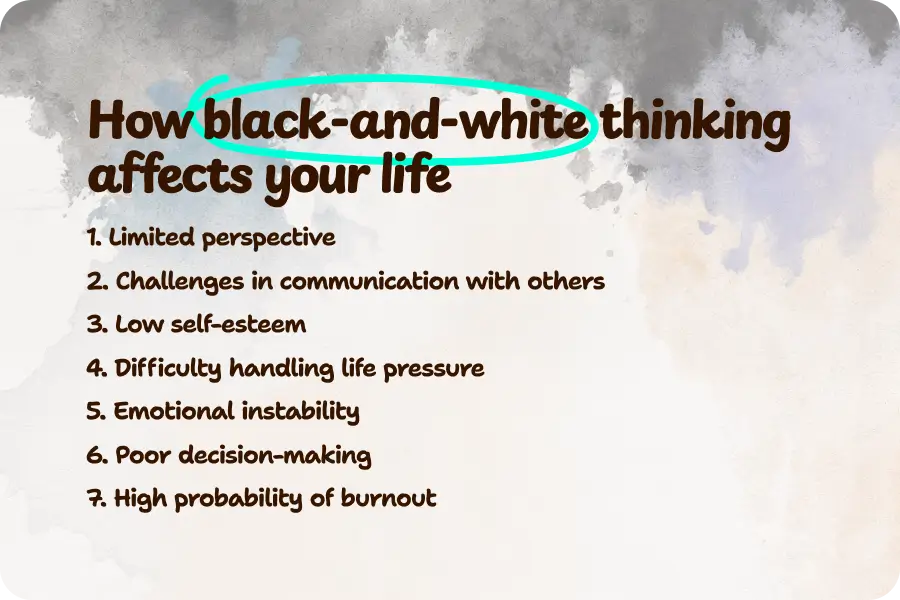
How black-and-white thinking affects your life
Intense stress that stems from extreme thinking may lead to challenges receiving feedback, unintentional self-sabotage due to constant worries, and a lack of motivation to do anything. Let’s explore these and other common consequences of this cognitive distortion in detail.
1. Limited perspective
A growth mindset and polarized thinking may be considered opposite approaches to challenges. If you want to improve your academic performance or pursue various career prospects, it’s essential to try something new.
Dichotomous thinking, however, can make any mistake feel like a catastrophe, so the person may give up an activity completely. It’s a “jack of all trades, master of none” cycle when people constantly switch between different jobs and skills.
2. Challenges in communication with others
Such people may be extremely strict or critical of others. They can find any mistakes, quirks, inconsistencies, or conflicts unacceptable. If their friend forgets to call them back or a loved one doesn’t buy their favorite flowers for their birthday, they may automatically decide that others “don’t care about” them.
This, in turn, may lead to:
- Intense emotional reactions and frequent conflicts
- Anger or anxiety outbursts
- Frequent breakups for minor reasons
- Often changing jobs or friend groups
3. Low self-esteem
An all-or-nothing thought pattern can make people overly self-critical. They may focus only on mistakes and ignore their strengths. Instead of thinking, “I did some parts well and can improve others,” they may conclude, “I can’t do this well.” This harsh inner dialogue makes it harder to recognize personal achievements or accept compliments.
4. Difficulty handling life pressure
People with dichotomous thinking tend to feel like they are constantly walking on eggshells. When situations are seen as either total success or failure, everyday responsibilities can feel overwhelming. Small setbacks may seem like proof that everything goes wrong and increase anxiety.
5. Emotional instability
People who think in two opposite ways may have intense mood swings. They might think it’s the best day of their life when everything is going well but quickly feel like it’s the worst day when a coworker gives them a casual criticism or when they spill coffee on their shirt.
6. Poor decision-making
Constant intense feelings aren’t the best advisors for making logical choices. When you are stuck in black-and-white thinking, you feel a sense of urgency to choose the “perfect” option. This pressure can lead to:
- Procrastination
- Impulsiveness
- Regret
- Doing only activities you’re good at
7. High probability of burnout
Thinking in extremes with no middle ground can lead to constant stress, emotional pressure, and an inability to approach tasks differently (out of fear of failure), resulting in complete mental and physical exhaustion. You may set impossible standards for yourself and believe that you must give 100% effort at all times.
Also, dichotomous thinking may result in:
- Lack of rest because doing nothing feels like “laziness” or “wasting time.”
- Every task, no matter how small, can feel like a high-stakes test.
- Giving up early. When you hit a minor roadblock, you might believe that the whole project is “ruined.”
Why do we think this way? Psychology of all-or-nothing thinking
Dichotomous thinking is how our minds try to cope with worries. According to the study, stress triggers the amygdala, the brain’s emotional alarm system, to override the prefrontal cortex (PFC), the rational decision-making center. It promotes binary “safe vs. dangerous” thoughts as a survival shortcut. Such a dynamic underlies dichotomous thinking during high stress, limiting nuanced processing.
Simply put, when people think in extremes, their minds try to simplify and reduce the overwhelm of certain situations. They may need to feel in control over an unpredictable environment. And by splitting the world into “good” and “bad,” the brain doesn’t have to work as hard to analyze the details of reality.
Trauma and black-and-white thinking
Traumatic experiences from the past may also promote the development of this cognitive distortion. In particular, research suggests that people’s dichotomous thinking tendency may be a form of adaptation to the harshness of their childhood environment.
When a child grows up with unpredictable parents, they learn to categorize things quickly to survive. They must know immediately if a caregiver is “safe” or “dangerous” to avoid harm.
Also, all-or-nothing thinking may develop in adulthood. If you’ve dated a person with a similar approach to life or worked in a company where success was only about perfect results, you may have learned to view situations in extremes.
Rigid thinking might also stem from:
- Fear of uncertainty
- Cultural or religious influences that emphasize strict rules
- A history of high-pressure academic settings
Mental health conditions associated with this cognitive distortion
Unhelpful thought patterns can also be a symptom of many mental health disorders. Borderline personality disorder, narcissistic disorder, and neurodivergence (ADHD and ASD), as well as eating disorders, may be a few of the most common.
1. Borderline personality disorder (BPD)
According to the study published in Cognitive Therapy and Research, dichotomous thinking is a common cognitive pattern in individuals with BPD. Such people can see both positive and negative traits in a person, but in very intense, exaggerated ways.
This means their perception of others can shift quickly depending on the situation or emotional context. Combined with intense mood fluctuations, impulsive behavior, and anger outbursts, black-or-white thinking can lead to challenges in relationships.
2. Attention-deficit/hyperactivity disorder (ADHD)
ADHD is an attention disorder that involves executive dysfunction and difficulties with processing complex information under pressure. For many people with ADHD, the brain searches for clarity amidst the chaos of competing thoughts.
This can lead to hyperfixation or “no focus at all.” Similarly, tasks might be viewed as either “extremely urgent” or “completely unimportant.” This binary approach can cause intense procrastination because if a task cannot be done perfectly and all at once, the ADHD brain may struggle to see the point in starting it at all.
3. Autism spectrum disorder (ASD)
ASD can make it difficult for some individuals to read social cues and understand the thought processes of neurotypical people. As such, they may misunderstand sarcasm or irony and come to wrong conclusions (as if they’re a bad person, for example). It can lead to an unintentional tendency to interpret situations in rigid ways.
4. Narcissistic personality disorder (NPD)
People with NPD may have an exaggerated sense of self-importance and a strong need for attention. For them, dichotomous thinking may be used as a defense mechanism to protect a fragile ego.
- Superiority vs. worthlessness. People with NPD may view themselves and others as either “winners” or “losers” and “brilliant” or “stupid.”
- Devaluation. If someone who was once admired provides even a small amount of criticism, they may be immediately “split” into the “all-bad” category to protect the individual’s self-image from the perceived threat.
5. Anxiety and depression
Stress can be among the significant triggers of black-and-white thinking. This study found that forums discussing anxiety, depression, and suicidal ideation contained more absolutist words compared to control forums. It proves the fact that people experiencing high levels of psychological distress may resort to extreme language to describe their pain.
In generalized anxiety disorder (GAD), the mind can use all-or-nothing thinking as a way to prepare for the worst. This “catastrophizing” makes it feel like there are only two outcomes: total safety or a total disaster. The brain thinks it is staying alert by getting rid of the middle ground, but in reality, it just makes the panic worse.

6. Obsessive-compulsive disorder (OCD)
Cleveland Clinic defines dichotomous thinking as one of the symptoms of OCD. For people experiencing obsessions and compulsions, a rigid approach may be part of the cycle that keeps anxiety going.
Thoughts may revolve around ideas like:
- “It’s completely safe or extremely dangerous.”
- “I can do it perfectly or totally wrong.”
- “If I’m not 100% sure, something bad will happen.”
This can push a person to repeat behaviors or mental rituals, trying to reach certainty.
7. Substance use disorder
Expert Insight
“Substance use disorder and dichotomous thinking often reinforce each other. Dichotomous thinking can show up as “I’m either completely sober or a total failure,” which intensifies shame and urges to use after even a small slip-up. Substances then become a way to regulate the distress created by these rigid thought patterns, temporarily narrowing emotional experience but ultimately strengthening the same black-and-white lens.”

Rychel Johnson
Mental health professional
8. Eating disorders
It can also be challenging to find a middle ground for people with eating disorders like anorexia nervosa, bulimia nervosa, or binge eating disorder. They may believe that certain foods and products are either “good” or “bad” and label their eating behavior as “perfect” or a “complete failure.”
For example, eating a small amount of cake or ice cream may make them feel like they have ruined the entire day. This, in turn, can trigger guilt, shame, or compensatory behaviors.
How to overcome all-or-nothing mentality: Cognitive restructuring
Cognitive restructuring is a CBT approach that helps people replace unhelpful thought patterns with more rational ones. Here, we’ll share some tips on how to get rid of all-or-nothing thinking for good.
1. Notice your feelings
Strong emotions are often the first signal that black-and-white thinking has taken over. When you suddenly feel intense anger, shame, anxiety, or disappointment, pause for a moment.
Ask yourself what just happened and what thought went through your mind. You can also use Breeze’s mood tracker to reflect on what’s going on. If stress is too extreme, it may be a warning sign that you may turn to rigid thinking.
2. Separate what you do from who you are
People living with black-and-white cognitive distortion may find it challenging to separate their self-worth from their actions and achievements. To do it, try these tips:
- Focus on your effort rather than the outcome. Remind yourself that a “failed” task doesn’t mean a “failed” life.
- Identify your core values. List qualities you have that don’t depend on achievements, such as kindness, curiosity, or honesty.
- Use objective language. Instead of saying “I am a failure,” say “I did not meet the goal I set for this specific project.”
- Practice self-compassion. Treat yourself with the same forgiveness you would offer a close friend who made the same mistake.
3. List more than “black” and “white” options
Try intentionally listing more than two possible outcomes of the situation. For example, if you’ve made a mistake in the work report, instead of thinking, “I’m terrible at my job” or “Everything is fine,” try adding more realistic options.
Maybe you were tired, misunderstood the instructions, or simply need more practice. And now you won’t necessarily get fired. You can discuss possible ideas on how to fix the situation with your manager or colleagues, correct the mistake, and learn how to avoid it next time.
4. Try emotional regulation techniques
When your brain is stuck in an “alarm” state, it becomes challenging to think in shades of gray. Using physical and mental tools to calm your nervous system can help “re-engage” your rational mind.
- Deep breathing. Use techniques like box breathing (4 seconds in, 4 hold, 4 out, 4 hold) to lower your heart rate and signal to your brain that you are safe.
- The 5-4-3-2-1 technique. Ground yourself in the present by naming 5 things you see, 4 you can touch, 3 you hear, 2 you can smell, and 1 you can taste.
- Physical movement. Sometimes, a short walk or stretching can break the mental loop.
5. Reach out for help from a cognitive behavioral therapy specialist
Rychel Johnson, M.S., LCPC, explains how CBT professionals help overcome black-and-white thinking patterns and start seeing the situation more realistically. “CBT helps therapy clients notice black-and-white thinking by slowing down automatic thoughts and examining the rules they’re living by (for example, “If I’m not perfect, I’ve failed”). A CBT therapist would help the client gently test these thoughts against evidence and explore gray-area alternatives. Through repeated practice—using thought records, behavioral experiments, and self-compassionate reframes—clients learn to tolerate nuance and respond to situations in more balanced, realistic, and emotionally regulating ways.”
Frequently asked questions
Is dichotomous thinking the same as splitting?
Yes, these terms are closely related and are often used interchangeably, but they can have slightly different meanings depending on the context.
Dichotomous thinking is a general cognitive distortion where a person sees things in extremes.
“Splitting” is a term more commonly used in relation to personality disorders. It describes a similar pattern but often focuses on how a person views themselves or others as entirely positive or entirely negative.
What is the term for black-and-white thinking?
Black-and-white thinking (or all-or-nothing thinking) means seeing the world in extremes. It is a cognitive distortion that prevents a person from seeing the “gray areas” of life and causes them to categorize everything into two opposites: good or bad.
Is black-and-white thinking a trauma response?
Yes, black-and-white thinking can sometimes be a trauma response. People may believe that their actions are either a success or a total failure because, in the past, making mistakes may have led to criticism, rejection, or emotional or physical harm.
Does black-and-white thinking disorder exist?
No, there isn’t a separate black-and-white thinking disorder. However, this mindset may be typical for people with borderline personality disorder, attention-deficit/hyperactivity disorder (ADHD), anxiety and depression, obsessive-compulsive disorder (OCD), etc.
Sources
- Folloni D, Sallet J, Khrapitchev AA, Sibson N, Verhagen L, Mars RB. “Dichotomous organization of amygdala/temporal-prefrontal bundles in both humans and monkeys.” Elife. 2019
- Mieda T, Yoshino S, Oshio A. “Association Between Individual Differences in Dichotomous Thinking and Current and Childhood High-Crime Environments.” Evol Psychol. 2023
- Napolitano, Lisa & Mckay, Dean. (2007). “Dichotomous Thinking in Borderline Personality Disorder.” Cognitive Therapy and Research.
- Arntz A, ten Haaf J. “Social cognition in borderline personality disorder: evidence for dichotomous thinking but no evidence for less complex attributions.” Behav Res Ther. 2012
- Al-Mosaiwi M, Johnstone T. “In an Absolute State: Elevated Use of Absolutist Words Is a Marker Specific to Anxiety, Depression, and Suicidal Ideation.” Clin Psychol Sci. 2018
- Cleveland Clinic. “Obsessive-Compulsive Personality Disorder (OCPD).” 2022
Disclaimer
This article is for general informative and self-discovery purposes only. It should not replace expert guidance from professionals.
Any action you take in response to the information in this article, whether directly or indirectly, is solely your responsibility and is done at your own risk. Breeze content team and its mental health experts disclaim any liability, loss, or risk, personal, professional, or otherwise, which may result from the use and/or application of any content.
Always consult your doctor or other certified health practitioner with any medical questions or concerns
Breeze articles exclusively cite trusted sources, such as academic research institutions and medical associations, including research and studies from PubMed, ResearchGate, or similar databases. Examine our subject-matter editors and editorial process to see how we verify facts and maintain the accuracy, reliability, and trustworthiness of our material.
Was this article helpful?