


Trauma can bury our memories so deeply in our minds that we cannot recall them. Most of the time, it can be a sign of dissociative amnesia. It is not amnesia to forget things like where you put your keys or the name of someone you have met twice. It’s rather not being able to remember certain traumatic events or even all of life’s events.
In this guide, we will explore this puzzling mental health condition, its intricacies, and the signs that could indicate its presence in your life.

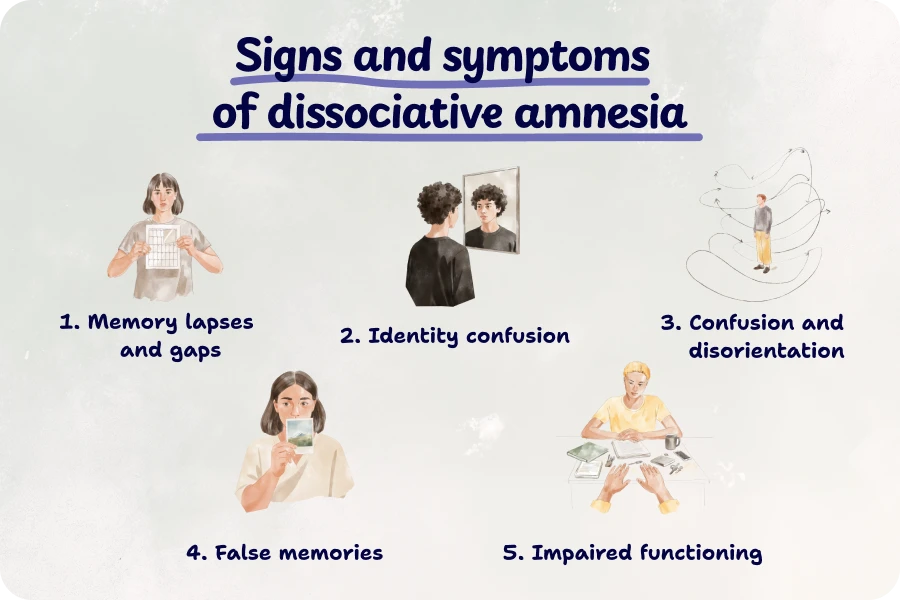
5 signs and symptoms of dissociative amnesia
The following symptoms are listed in the Diagnostic and Statistical Manual (DSM-5) for trauma-induced memory loss:
1. Memory lapses and gaps
The most apparent symptom is unexplained gaps in one’s memory—periods of time unaccounted for, episodes of forgetfulness that extend beyond mere absent-mindedness. After a while, the person might not remember important things like birthdays, milestones, or some details from childhood.
2. Identity confusion
Dissociative fugue can make a person very confused about who they are, what they are here for, and where they belong in the world. They might change who they are or give different versions of their life stories, which can cause identity crises that affect every part of their lives.
3. Confusion and disorientation
Those with memory trauma might appear bewildered and disoriented, struggling to make sense of their current situation and environment.
4. False memories
Some people try to fill in the blanks in their memories by making up memories that seem real, which can cause more confusion and stress.
5. Impaired functioning
Day-to-day activities may be severely disrupted as a result of the amnesic episodes, affecting work, school, and social life.
What do the terms “dissociation” and “amnesia” mean?
Dissociation is a mental process that causes a lack of connection between a person’s thoughts, memory, and sense of identity. This state of separation from reality can feel like an out-of-body experience, where a person may perceive the environment from a detached perspective.
It is important to tell the difference between mild dissociation that happens from time to time, like daydreaming, and more intense dissociative disorder experiences that can really affect a person’s life or mental health. Typically, this occurs after a person goes through some traumatic event.
Amnesia refers to a partial or total loss of memory. It can happen in the context of a single event or be more extensive, affecting periods of time. Amnesia can be quite a selective memory process. People who have it cannot remember certain details or events, but they can remember other things that happened in their lives.
Understanding dissociative amnesia
Dissociative amnesia is a condition in which a person is unable to recall important personal information or life events. Often, they can’t remember their childhood (starting at 3 years old) and their teenage years. It is typically associated with a physical or emotional trauma that is too distressing to remember consciously [1] David Spiegel. Dissociative Amnesia. June 2025 .
Somehow, this mental effect separates memories from consciousness, hiding traumatic events. It’s like a protective blind spot in our psyche that obscures memories to prevent overwhelming emotional distress.
Often, dissociative amnesia is seen as one of several dissociative disorders in which a person forgets important parts of their life and can not fully understand who they are or what they are going through. Other dissociative disorders are depersonalization and derealization. On average, 1.8% of people in the US are diagnosed with dissociative amnesia every year [2] Richard J Loewenstein. Dissociative amnesia: Epidemiology, pathogenesis, clinical manifestations, course, and diagnosis. November 2025 .
Are you wondering whether you have traumatic memories you don’t remember? Try the Breeze self-discovery tests about your personality, emotional abuse, narcissistic partner, and many more.

The brain’s role in memory formation and memory function
Memories are complex creations of our brain, and their formation and retrieval engage many neural pathways. For example, the hippocampus, known as the memory center of the brain, is essential for encoding new information into memories.
However, when someone experiences traumatic or stressful events, their brain’s normal memory network gets tangled up with their fear responses. This could affect brain functionality and change how they remember things.
Dissociative amnesia vs. retrograde amnesia
Although both dissociative amnesia and retrograde amnesia cause people to experience memory loss, they are very different in their causes, effects, and ways of treating them. So, what is the major difference between dissociative amnesia and retrograde amnesia?
Dissociative amnesia is usually caused by mental stress or trauma. It is the mind’s way of protecting the person from emotional pain. People who have been through a traumatic event may forget personal details or memories of certain times in their lives.
If you have dissociative amnesia, you tend to lose your personal memories more than any other kind of memory loss. Interestingly, it does not usually affect your general knowledge or skills.
Conversely, retrograde amnesia usually happens after a traumatic brain injury, like a blow to the head, or some brain diseases. As a result of physical trauma, it erases memories that were formed before the amnesia starts. So, the person cannot remember things from the past, personal experiences, or even who certain people are.
Notably, though, the ability to make new memories in retrograde amnesia stays the same, which shows an interesting aspect of how memory works.
3 types of trauma-induced memory loss
Here are the recognized subtypes of dissociative amnesia:
1. Localized amnesia
This is the most common type. In localized amnesia, the loss of memory is specific to a particular event, series of events, or a specific time frame. It is common for this type to happen after a very traumatic event, and the person may not be able to remember anything about it or the time it happened.
2. Selective amnesia
With selective amnesia, you can recall most of your past but experience memory gaps surrounding specific details or events. These gaps are often related to traumatic memories that the person has difficulty recalling and addressing.
3. Generalized amnesia
The most severe form, generalized amnesia, involves a complete loss of memory that lasts a person’s whole life. In this case, personal identity and biographical information fade, making it very hard for the person to go about their daily life.
4 causes of dissociative amnesia
Commonly, dissociative amnesia is caused by past trauma. That’s why we might ask ourselves, “Do I have trauma I don’t remember?”
1. Childhood trauma
The sections of our brain responsible for memory are incredibly sensitive to the impact of traumatic experiences, especially in childhood, when the brain is still developing.
For instance, researchers have found that early-life trauma can create a big impact [3] Cross D, Fani N, Powers A, Bradley B. Neurobiological Development in the Context of Childhood Trauma. June 2017 . Childhood trauma (C-PTSD) not only distorts the immediate perception of the event but also potentially reshapes the child’s developing brain in a way that alters its response to future stressors.
When a traumatic experience overwhelms a child’s ability to cope, dissociation can occur. All of this can make it harder to make new memories right away and cause dissociative amnesia over time as a way to protect their mental health.
Take a Toxic Family Test to better understand the complexities of your upbringing.
2. Post-traumatic stress disorder
Beyond the common stresses of daily life, extreme stressors such as war, natural disasters, and severe personal conflict can trigger memory loss.
3. Medical conditions
While rare, certain medical conditions, such as epilepsy or Alzheimer’s disease, can also lead to dissociative amnesia.
4. Substance misuse
Chronic substance misuse, particularly of alcohol and illicit drugs, may contribute to the development of dissociative amnesia in some cases.
Can dissociative amnesia be treated?
Contrary to the idea that these gaps are permanent, treatment is very much possible. However, the goal isn’t usually to force the missing memories to the surface because that can actually be retraumatizing. Instead, treatment focuses on making the person feel safe enough that the brain no longer needs to “hide” information to survive.
- Modalities like EMDR (Eye Movement Desensitization and Reprocessing) or Internal Family Systems (IFS) help the brain process the underlying trauma so the “dissociative walls” can naturally thin out.
- Since dissociation is a physical “unplugging” from the body, somatic experiencing helps people learn to stay “in their skin” when stress hits.
The long-term outlook
With the right therapeutic tools, the person can reclaim their sense of time and identity.
- Memory Restoration: For many, memories return naturally once the person reaches a state of sustained safety. When the “threat” is gone, the brain no longer feels the need to hide the data.
- Integration over Perfection: You might not get every detail back, but the emotional “charge” of the trauma fades, stopping the amnesia from happening in the present.
- The Safety Factor: The outlook depends heavily on the person’s current environment. If life is stable and supportive, the nervous system can stop using “unplugging” as its primary defense mechanism.
When to seek professional help
You may consult a trauma specialist or psychiatrist if:
- You regularly “wake up” in places without knowing how you got there or realizing hours have passed unaccounted for.
- The gaps are making it impossible to hold down a job, maintain a relationship, or handle basic chores.
- You find evidence that you’ve done things during a “blackout” that are out of character or dangerous.
Living with dissociative amnesia
Here are some things that might help with dissociative amnesia:
1. Practice self-care
In the face of dissociative or amnesic experiences, taking care of oneself becomes all the more important. Maintaining a healthy lifestyle, doing self-care activities on a regular basis, and sticking to a routine can help with mental health and stability.
Expert Insight
Many people who have dissociative amnesia aren’t aware they have it. If you suspect you have dissociative amnesia, establishing a daily routine and keeping a journal may be very beneficial to you. Establishing a daily routine that involves regular meal times, sleeping patterns, and activities can be very grounding. A regular routine also creates a sense of stability. Keeping a daily journal can help you keep track of anything you may forget while providing you with the ability to help process your emotions and track any potential dissociative episodes.

Cimone Hanif
Mental health professional
2. Support your mental health with therapy
Therapy for trauma-induced memory loss is multifaceted and often involves techniques from cognitive-behavioral therapy, dialectical behavior therapy, and eye movement desensitization and reprocessing (EMDR). The goal is not only to recover lost memories but also to reframe them so that the person can have a functional, fulfilling life.
3. Try grounding techniques
Amnesia often happens when the brain “checks out” to avoid pain. To stay in your body, you need intense sensory input. Try scent-mapping for grounding. Carry a specific, strong scent with you, like peppermint oil or a particular perfume.
When you feel that “fuzzy” or “drifting” sensation that usually precedes a memory gap, smell it. Strong scents bypass the logical brain and hit the emotional center directly, helping you practice mindfulness.
4. Build a support system
You cannot heal by yourself. Mental health professionals, friends, and family who understand how hard it is to deal with dissociative amnesia are important parts of a strong support network.
Identify two or three people who “get it.” Give them a script: “If I seem blank or keep asking the same question, just tell me what we were doing without making it a big deal.” Having people who can gently “fill in the blanks” for you without judgment reduces the shame that fuels dissociation.
Myths & facts about dissociative amnesia
The best way to help people understand and support those who have amnesia is to get rid of myths and false information about it.
Myths:
- Recovered memories are always true: Recovered memories may be accurate, but they could also be reconstructed or influenced by suggestion.
- All cases of memory loss are dissociative amnesia: Memory loss can stem from various causes, not just dissociative amnesia. It can also be childhood amnesia, for example.
- Amnesia is always unitary and extreme: Amnesic gaps can vary in severity, duration, and the amount of the owner’s past they cover.
Facts:
- It’s not just about memory: Amnesia can affect a person’s identity, sense of self, and perception of the world.
- It’s treatable: With appropriate support and treatment, people who have dissociative amnesia can experience significant improvement and even full recovery.
- It’s complex: Multiple genetic, neurobiological, and environmental factors often work together to cause this condition.
Sources
- David Spiegel. Dissociative Amnesia. June 2025
- Richard J Loewenstein. Dissociative amnesia: Epidemiology, pathogenesis, clinical manifestations, course, and diagnosis. November 2025
- Cross D, Fani N, Powers A, Bradley B. Neurobiological Development in the Context of Childhood Trauma. June 2017
Disclaimer
This article is for general informative and self-discovery purposes only. It should not replace expert guidance from professionals.
Any action you take in response to the information in this article, whether directly or indirectly, is solely your responsibility and is done at your own risk. Breeze content team and its mental health experts disclaim any liability, loss, or risk, personal, professional, or otherwise, which may result from the use and/or application of any content.
Always consult your doctor or other certified health practitioner with any medical questions or concerns
Breeze articles exclusively cite trusted sources, such as academic research institutions and medical associations, including research and studies from PubMed, ResearchGate, or similar databases. Examine our subject-matter editors and editorial process to see how we verify facts and maintain the accuracy, reliability, and trustworthiness of our material.
Was this article helpful?