


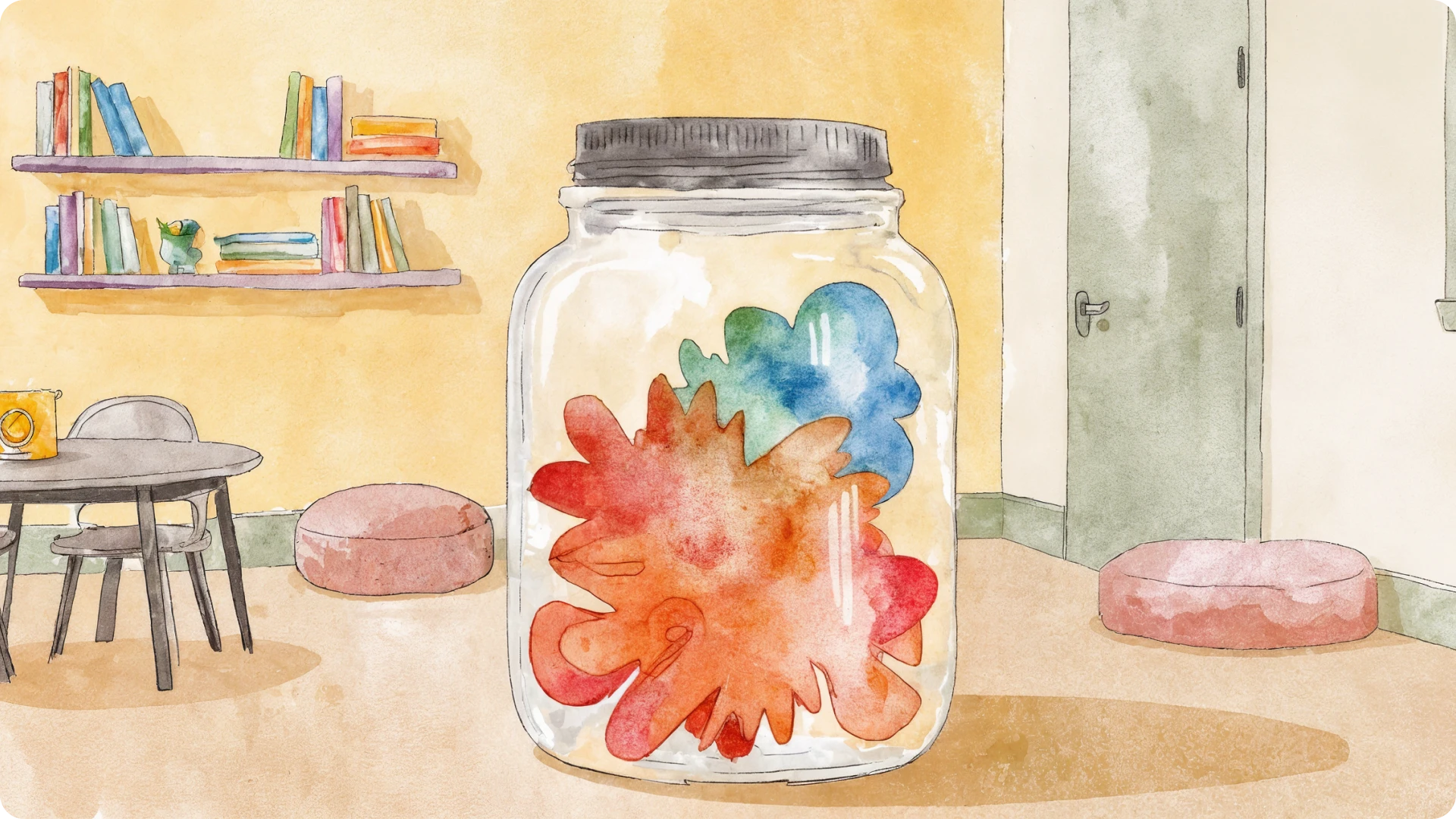
What’s really behind a child’s anger? Let’s find out when outbursts may reflect a child’s mental health needs and what to do when children suddenly express anger.
Take an emotional intelligence test if you want to understand more about your own emotional reactions as a parent. It can help you understand how you handle stress, frustration, and intense emotions so you can support your child more calmly and confidently in daily life.

Why Is My Child So Angry? Understanding the Root Causes of Anger Outbursts
The “anger iceberg” may hide more vulnerable feelings that a child doesn’t know how to express, according to research:
- They feel “stuck” or incapable of doing something. For example, if they feel like they’re failing at school, struggling with friends, or just emotionally unsafe, they might push people away.
- For a child with sensory sensitivities, a “normal” environment can feel physically painful or overwhelming. Imagine being in a room where the lights are too bright and the noise is too loud. If a child’s nervous system is overstimulated, a simple request like “put on your shoes” can be the final straw that breaks their facade or abilities to cope. In this case, their anger is a desperate attempt to make the overwhelming stimulation stop.
- Some children may feel emotions more intensely than others and lack the tools to bring themselves back down or regulate.
Common Triggers to Watch For
- Transitions. Moving from a “high-dopamine” activity (like video games) to a “low-dopamine” one (like homework) is physically painful for some kids.
- Unmet physical needs. The term “hangry” means a real physiological state caused by low blood sugar or lack of sleep, research shows.
- If a child has ADHD, learning struggles, or difficulties following instructions, it can lead to internal shame, which may show up as external anger.
- The family is experiencing a transition, such as the addition of a baby or the separation of parents. This can stir up complex emotions that are vulnerable to share, making anger the secondary emotion and an easier one to express.
Identifying Child Anger Issues: When Should You Be Concerned?
Let’s look at several signs that may indicate a child’s anger issues require professional behavioral intervention:
- they express self-harm or deep self-loathing during an outburst;
- the anger seems “unprovoked” or occurs without a clear trigger;
- the child cannot explain their feelings;
- they remain angry for 30 minutes or more;
- they seem distressed by their own anger but feel powerless to stop it;
- the child loses their temper daily or multiple times a day over the slightest things;
- the child tortures, harms, or hurts animals;
- the child is unaware of how their anger affects others;
- when aware of the consequences of their actions, they experience no empathy, sadness, or guilt;
- the child express physical aggression like frequent hitting, kicking, or destroying property;
- the child uses threats in speech;
- their drawings and writing contain themes of violence and aggression;
- the child blames others for their own aggressive behavior;
- you find yourself changing your entire family’s life just to avoid a child’s reaction;
- the child’s behavior has consistent consequences and prevents them from making friends or causes trouble at school.
Expert Insight
It’s always encouraged to seek support from a mental health clinician at the start of a concern vs playing the ‘wait and see’ game. Therapy makes the greatest impact when serving a preventative or early intervention role. Play therapy can be a great starting point for a child, since a child’s primary language until around the age of 12 is play. If there are times when you, as the parent, feel overwhelmed or helpless when trying to support your child through a big feeling such as anger, it can be a good cue that therapy could serve a helpful purpose for you and your child.

Katherine Scott
Mental health professional
6 Immediate Strategies: How to Calm a Child Down When They Feel Angry
Parents may try to start with “reasoning,” which usually just makes the child angrier. Instead, teach children these methods:
1. The 3 R’s
- Regulate (Calm the Body). Offer a “dragon breath” (big inhale, then a long “fire” exhale) or have them push their hands hard against a wall. Deep pressure exercises can be powerful in emotional regulation.
- Relate (Connect). Once the screaming stops, focus on the relationship. Use a calm voice. Say, “I can see you’re having a really hard time,” or simply sit near them so they know they aren’t alone in their anger. This makes them feel safe enough to drop their guard.
- Reason (Talk it Out). Only when the child is calm and connected can you discuss what happened. This is the time to set boundaries or talk about better ways to handle frustration next time.
2. The 3-3-3 Rule
To a child, “grounding” may sound boring. Instead, turn the 3-3-3 rule into a game to distract their brain from whatever triggered the anger.
- Spot 3 things. Ask them to be a detective. “Can you find three things in this room that are the color red?” This makes their eyes look around rather than staying locked on the source of their anger.
- Hear 3 sounds. Ask them to be super quiet for ten seconds. “What are three tiny noises you can hear? I hear the clock ticking… what do you hear?”
- Move 3 ways. Give them three specific “animal moves.” “Give me three big bear stomps, wiggle your fingers like a spider, and then shrug your shoulders like a turtle hiding in its shell.”
3. The Balloon Game
This is another playful activity based on breathing exercises. Invite your child to imagine releasing their anger, irritation, and built-up frustration into something safe. For example, they can blow those feelings into a balloon. Once it’s tied, let the balloon float away as a symbol of letting the anger go.
4. Use an “Anti-Stress Pillow”
Teach older children to redirect their anger. For example, to cope with a fit of rage, they may scream into a pillow, hit a punching bag, or engage in a sport like running. Physical activity is one of the most effective anger management techniques for both adults and children.
For children who tend to get physical when angry (pushing, kicking), use an “anti-stress pillow.” Explain that when their arms and legs feel like they’re about to hit, they can do so with the pillow. This way, the child learns the rule: “You can release anger without harming people or things.”
5. Transform emotions through art
Art techniques allow children to visualize and “see” their anger and then change or destroy it. Give your child a piece of paper and ask them to draw their anger. It could be a monster, a fireball, or any image that comes to mind. Then let them do whatever they want with the drawing: crumple, tear, trample, or paint it black.
6. Create a feelings thermometer
The main goal of this practice is self-assessment to help the child easily determine the level of their anger.
- Firstly, examine a regular mercury thermometer with your child. Discuss how the scale is constructed, what the markings are, and what they mean.
- Cut a thermometer base from thick cardboard; it can be rectangular, round, or bottle-shaped. Glue a sheet of white paper to it and draw a scale with markings from 0 to 10 on it.
- Make two small holes at each end of the future thermometer and thread a thick thread through them, securing a bead to it.
- Tie the thread at the back of the thermometer so that the bead can slide along the markings. You’ve now created an interactive toy that allows you to mentally measure your anger level by setting “degrees” from 0 to 10.
At first, you may take a thermometer with you on walks or when visiting friends. When your child starts to get angry, take out the thermometer and try to estimate how angry they are together: a three, a six, or maybe even a nine out of ten? If the anger level is too high (eight to ten), try lowering it slightly. For example, take a deep breath and blow on the thermometer.
During the game, you can ask your child questions. For example: “Is it getting a bit hot? Maybe your anger level is rising. Let’s try measuring it: what temperature are you setting yourself? Great, you’re saying it’s a six. Would you like to lower the temperature a little? To do that, let’s blow on the thermometer. Feeling a little colder now? How much do you think the temperature is now? Four degrees already? Great, let’s move the bead. So, are you cool enough to go play with the other children?”
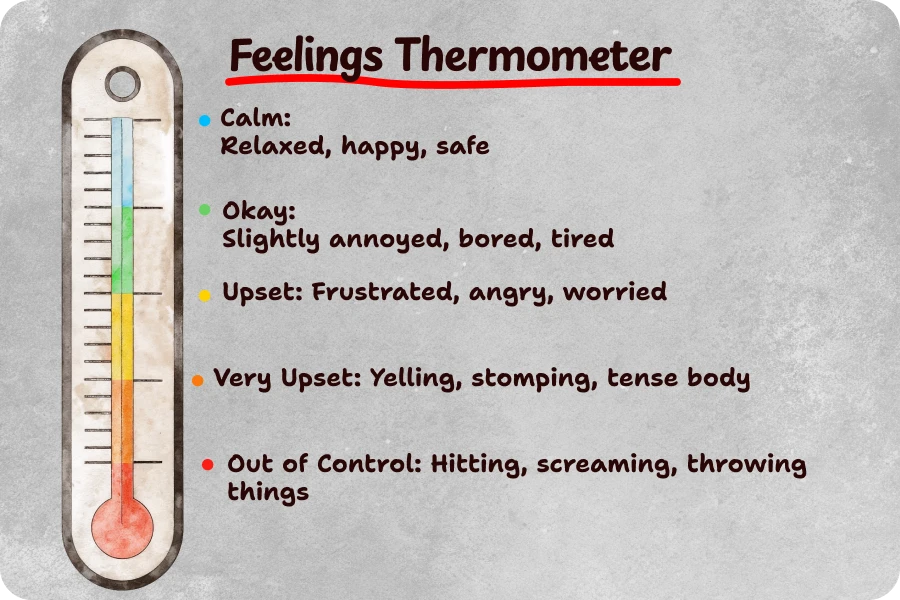
You can create similar games based on your child’s interests and preferences. Simply add a visual image, and your personalized anger management game is ready.
How to Help a Child with Anger Issues Long-Term: 5 Anger Coping Skills for Kids
Anger management is the process of teaching children how to channel their anger in a safe way. Children learn to identify the signs of anger, calm down, and take more productive actions.
1. Learn a vocabulary of feelings
When young children feel angry, they often yell, hit, and throw toys because they don’t know how to express their feelings verbally. Teach them words that represent emotions.
- You can start with words like “angry,” “happy,” “scared,” “nervous,” “anxious,” “irritated,” and so on.
- Once your child has mastered these words, teach them to use them in sentences: “I’m so angry with you right now” or “He’s irritating me.”
- Explain to them that it’s always better to express their feelings verbally than to hit, bite, or throw things.
- Reading books about emotions can also help your child better understand their feelings.
2. Empathize with your child
If your child is angry, encourage them to talk about it. Don’t interrupt them when they express their anger. Acknowledge any feelings they may have, whether anger, irritation, or anything else.
Show your child that you care. Children often experience anger when they are disappointed, neglected, or betrayed. A child may feel that anger is the only way to be heard or taken seriously. Consider what you did that caused your child to become angry. When your child has calmed down, sit down with them and sincerely ask what’s bothering them and how you can help.

3. Set a positive example for your child
Most children learn how to manage anger by watching the adults around them. Showing calm and respectful communication, especially during moments of stress, teaches your child what emotional control looks like in real life.
Speak politely to your child and to other family members, even when you’re frustrated, so they can see that strong feelings don’t require harsh words. It’s also important to admit when you’re wrong or when you’ve lost your temper, which can be difficult for caregivers with an authoritarian parenting style. Apologizing models accountability and shows your child that mistakes can be repaired, not hidden.
4. Set rules
Help your child understand that being angry is normal, but being cruel or aggressive is unacceptable. The following rules may help:
- Hitting, biting, pinching, or using violence is unacceptable
- Screaming is not allowed—everyone should speak calmly to resolve a problem
- Name-calling and hurtful words are not allowed
- Pause before speaking when anger first shows up, and wait until you feel calmer to talk things through
- Problems should be resolved when everyone is calm
- The goal of any argument should be to resolve the issue, not to prove one’s point
- After a burst of anger, apologize and make peace
5. Praise your child for positive behavior
A child’s behavior depends on how you respond to it in many ways. Most children may seek their parents’ attention and approval by any means necessary. Therefore, when your child makes an effort to calm down when they’re angry or irritated, praise them.
Expert Insight
The first focus for a child expressing aggressive behavior is safety. When a child is in the middle of experiencing a big feeling that evokes something as powerful as aggression, they are most likely stuck in a fight or flight mode. Their central nervous system has shut down their prefrontal cortex, or the parts of the brain that are responsible for reasoning and logic. It’s imperative to help the child’s heart rate regulate to below 100 BPM in order to re-establish safety. Once the child attains regulation, then one can move forward with their chosen consequences. Careful, though, as negative consequences rarely have the impact a parent is craving until the child is about thirteen years old or older. Lean more into natural consequences, or consequences that only last 24 hours. Discipline should not equal shame, but encourage mindfulness to prioritize different choices next time.
Katherine Scott
Mental health professional
Frequently asked questions
1. Is anger a symptom of ADHD in children?
Anger itself isn’t an official symptom of ADHD, but it’s very commonly connected to it. Children with ADHD may struggle with self-control, emotional regulation, and frustration tolerance. That can make big feelings, like anger, come out fast and strong.
2. What are the 3 R’s of anger management?
The “3 R’s” are often described as Recognize, Regulate, and Respond. For children, these coping skills for managing anger take time and repeated support to develop. They usually need adults to model and practice them together.
- Recognizing means noticing angry feelings early, before they explode.
- Regulating involves calming the body and nervous system (through deep breathing, movement, or taking a break).
- Responding is about choosing what to do next in a way that doesn’t make things worse.
3. Why is my child so angry all the time?
When a child seems angry “all the time,” it’s usually not because they want to be difficult. Chronic angry behavior can be linked to stress, anxiety, sensory overload, learning challenges, trauma, or feeling unheard. Some children use anger outbursts as a protective response when they don’t yet have words or tools for what they’re feeling.
4. What are 7 good ways to help deal with anger?
These approaches for managing anger are often helpful:
- Remain calm yourself, even when it’s hard, because kids borrow regulation from adults.
- Name the feeling without judgment (“That looks really frustrating”).
- Establish predictability since routines lessen emotional stress.
- Teach children coping skills during calm moments, not during meltdowns.
- To give your child a sense of control, give them options.
- Take care of underlying issues such as stress, sleep, or hunger.
- Praise positive behavior when your child handles anger even a little better.
Sources
- University of Rochester Medical Center. “Anger Expression.” August 2022
- Swami V, Hochstöger S, Kargl E, Stieger S. Hangry in the field: An experience sampling study on the impact of hunger on anger, irritability, and affect. July 2022
- Augustine ME, Stiller CA. Children’s behavioral self-regulation and conscience: Roles of child temperament, parenting, and parenting context. Jul-Aug 2019
Disclaimer
This article is for general informative and self-discovery purposes only. It should not replace expert guidance from professionals.
Any action you take in response to the information in this article, whether directly or indirectly, is solely your responsibility and is done at your own risk. Breeze content team and its mental health experts disclaim any liability, loss, or risk, personal, professional, or otherwise, which may result from the use and/or application of any content.
Always consult your doctor or other certified health practitioner with any medical questions or concerns
Breeze articles exclusively cite trusted sources, such as academic research institutions and medical associations, including research and studies from PubMed, ResearchGate, or similar databases. Examine our subject-matter editors and editorial process to see how we verify facts and maintain the accuracy, reliability, and trustworthiness of our material.
Was this article helpful?