



Podcast name
Why am I so angry for no reason?
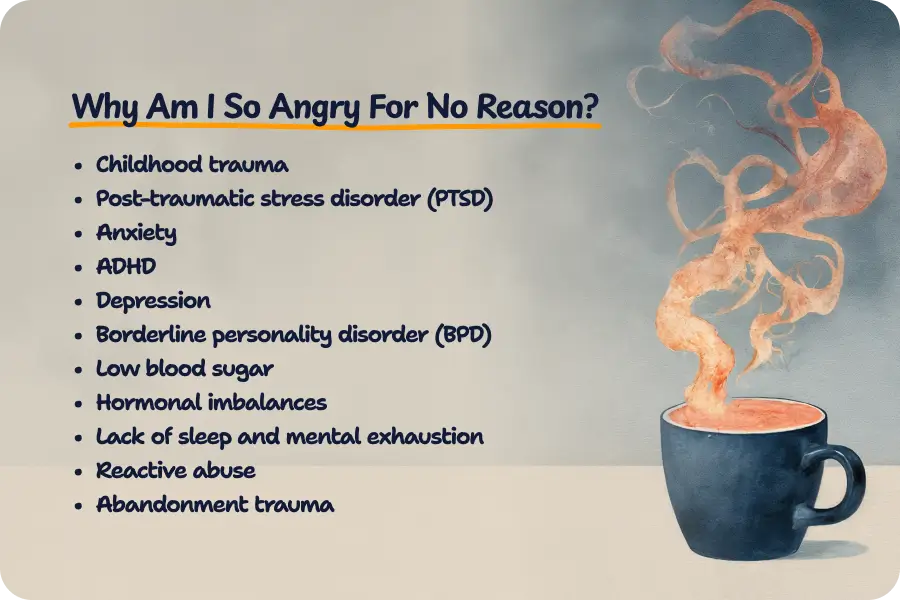
If you find yourself asking, “Why am I so angry for no reason?” you are likely experiencing a cumulative effect of hidden stressors. While it feels like you are becoming a mad person over nothing, there is almost always an underlying trigger, whether it’s low blood sugar, lack of sleep, or mental health conditions. Here we’ll help you find out what lies beneath sudden anger “for no reason.”
Psychological causes of irritability: Why am I mad for no reason?
You may be feeling angry due to childhood trauma, PTSD, or overwhelming anxiety that keeps your brain on high alert. As a result, you start treating minor inconveniences as serious threats. This leads to intense anger or feelings of irritability and intolerance toward others, even when there is no obvious reason.
1. Childhood trauma: Why am I so irritable around my family?
Feeling irritable and intolerant of others can sometimes be connected to unresolved childhood trauma. When a person experiences overwhelming stress or emotional pain early in life, the brain and nervous system may adapt in ways that make emotional reactions stronger and stress harder to regulate later in life. [1] Cimeša, Mladen & Sokić, Aleksandra & Cimeša, Božana. (2023). “Childhood Trauma and its Effect on Brain Development: Neurobiological Mechanisms and Implications.”
Certain emotions and memories may become suppressed or difficult to process consciously. However, the nervous system can still react with strong emotional responses, increased sensitivity, frustration, or anger that may seem disproportionate to the situation. Other effects of childhood trauma may include:
In particular, people who have experienced childhood trauma may have problems with anger control when they face situations similar to the ones they endured in childhood. This is why you may feel so irritable around your family if you grew up in dysfunctional dynamics.

2. PTSD and hypervigilance: Facing intense anger in neutral situations
PTSD might manifest as irritability, particularly in situations where you feel you can’t control anything. For a car crash survivor, a simple commute can trigger a PTSD-related anger response. They might also experience flashbacks, nightmares, and overwhelming fear whenever they ride in a car.
So, if you turn into a “mad person” after a particular trigger, maybe it’s a sign of PTSD. Your mind triggers the fight response, making you angry, in order to avoid repeating the traumatic event. Moreover, sometimes you might not remember the experience, but your body reacts to it.
3. Anxiety and the “powder keg” effect: Why am I irritable and want to be alone?
Chronic anxiety and a “24/7” pace may lead to decision fatigue when you feel like it’s too much to handle. Once your cognitive resources are depleted, you lose the ability to regulate emotions effectively.
As a result, your cortisol levels remain high, leaving you in a state of constant tension. [2] Dziurkowska E, Wesolowski M. “Cortisol as a Biomarker of Mental Disorder Severity.” J Clin Med. 2021 Even a minor inconvenience acts as a trigger and may cause intense anger or sudden crying spells because your nervous system simply has no more room to process irritation.
Hannah Schlueter, MA, LAC, comments, “While anger is a completely normal and common human experience, it often manifests itself as a bodyguard for other unpleasant emotions, attempting to protect you from the deeper feelings related to the issue at hand.”
Mental health conditions and neurodiversity
Certain mental health conditions and forms of neurodiversity can affect emotional regulation, stress tolerance, and the way the nervous system responds to everyday situations.
4. ADHD and sensory overload: Why you may get angry over little things
5. Depression that makes you always angry and irritated for no reason
We usually think of depression as being sad or tired, but for some people, it actually feels like being on edge. This is often called “agitated depression.” In this state, your brain loses its usual ability to manage irritability.
When you’re feeling depressed, your fuse becomes much shorter. [3] Fava M, Rosenbaum JF. “Anger attacks in depression.” Depress Anxiety. 1998 Small problems that you would normally ignore suddenly feel like huge obstacles. You might find yourself getting mad over little things or feeling intolerant of others simply because your mind is already exhausted from dealing with depression.
6. Borderline personality disorder (BPD) and rapid mood shifts
People with BPD tend to be quite sensitive to rejection or perceived abandonment. For example, during a stressful period, a loved one might reply more briefly than usual or take longer to text back. Even something like that may suddenly feel personal and trigger a strong emotional reaction that can feel hard to control in the moment.
7. Other mental health conditions and mood disorders that may cause intense anger
You may also experience increased irritability as a symptom of:
- Bipolar disorder
- Generalized anxiety disorder (GAD)
- Obsessive-compulsive disorder (OCD)
- Sleep disorders or chronic insomnia
- Substance use disorder
Why am I always angry and irritated for no reason? Physical causes
Sometimes irritability isn’t purely psychological — it can also be driven by what’s happening in the body. Physical and biological factors like energy levels, hormones, sleep, and overall health can strongly influence mood.
8. Low blood sugar and the physiology of “hanger”
The term “hangry” literally means “angry because you’re hungry,” which is a perfect description of what many people tend to experience. [4] American Psychological Association. “Are You Really You When You’re Hungry?” 2018 You may be getting irritated easily due to your brain losing its primary fuel source: glucose. When blood sugar drops, your brain perceives it as a life-threatening crisis and triggers a survival response by releasing hormones like adrenaline and cortisol.
The prefrontal cortex, which controls impulses and social behavior, requires the most energy to function and is the first part of the brain to struggle when fuel is low. Without enough glucose to power your “emotional brakes,” you become intolerant of others and lose the ability to manage irritability.
9. Hormonal imbalances: How shifts in cortisol and estrogen cause irritability
10. Lack of sleep and mental exhaustion: Why you feel irritated and want to be alone
When a person is mentally and physically exhausted, it becomes more difficult to manage emotions and cope with stress. So, questions like “Why do I have trouble sleeping?” and “Why do I get so angry?” often come together. You should pay attention to:
- Sleeping schedule and the time when you fall asleep
- Balanced diet
- Physical activity
- Time spent outside
- Time free from social media
Relationship dynamics: Why am I so angry at my partner?
Among the root causes of constant irritability may be relationship issues such as unresolved conflicts, emotional disconnection, unmet needs, poor communication, or feeling unappreciated.
11. Reactive abuse: Why am I so irritable with my partner?
If a person faces physical, emotional, or financial abuse in a relationship, they might get defensive. Reactive abuse happens when someone reacts strongly after being constantly criticized, manipulated, controlled, or treated unfairly.
They may yell, snap, or break down after being pushed too far. Later, their reaction may be used against them, while the harmful behavior that caused it is ignored. This cycle can make you worry that you are the problem, when in reality, you are just exhausted from unhealthy relationship patterns.
12. Abandonment trauma and chronic relationship tension
How to manage irritability and stop angry reactions
When a bad mood spirals into anger, it can quickly turn into an outburst. Using simple coping mechanisms can help you slow things down and regain control before you say something you might regret.
1. The deep breath technique to lower the heart rate
When irritability spikes, your body enters a “fight or flight” state and increases your heart rate. Deep, controlled breathing signals your nervous system to calm down. Try the following technique:
- Inhale for 4 seconds
- Hold for 4 seconds
- Exhale for 4 seconds
- Hold for 4 seconds
- Repeat several times
2. The 90-second rule to feel annoyed less often
This rule was popularized by neuroanatomist Dr. Jill Bolte Taylor in her book Whole Brain Living. She explains that when a person has an emotional reaction, a 90-second chemical process occurs in the body. Once triggered, the chemical surge of adrenaline and stress hormones takes exactly 1.5 minutes to flush out of your bloodstream.
If you still feel angry, it is because you are keeping that emotion alive by rethinking the thoughts that triggered it. Instead, try observing the physical sensation of the anger without acting on it for 90 seconds to allow the “chemical wave” to pass and give you back control over your reactions.
3. Environmental changes to reduce sensory triggers
To reduce the frequency of outbursts, look at how your surroundings affect your daily life. The hidden causes of irritability may involve:
All of this can keep your nervous system tense. When you reduce these triggers, you create a calmer space that helps you manage your emotions better.
Good sleep also matters a lot. A well-rested brain is less easily overwhelmed and reacts more calmly to everyday stress. When your body is rested and comfortable, it’s easier to stay patient and not snap over small things.
As Hannah Schlueter, MA, LAC, states, “Anger is often associated with impulsive reactions that can create significant strain in all areas of your life if left unregulated. Managing your responses to anger first requires a bit of introspection into the deeper emotions that are present. Labeling the underlying feelings builds emotional awareness, leading to a better understanding of yourself and what you need to cope with your anger.”
Extreme anger over little things: Do I have anger issues?
There’s no “anger disorder,” and there’s nothing wrong with feeling irritated occasionally. Anger is a healthy reaction to unpleasant feelings and a natural way to express your emotions. Moreover, sometimes, anger can prompt us to improve ourselves and everything around us.
While some people can understand the underlying causes of their irritation quickly, it might seem complicated for others. Usually, it depends on a person’s emotional intelligence (EQ), the situation’s complexity, and the tendency towards emotional dysregulation.
Getting mad over little things. When to see a mental health professional
Some people may experience situations in which angry reactions affect their quality of life and relationships. If you notice that feeling irritable and intolerant of others negatively influences your life, it may be the first red flag to check yourself for an underlying health condition. Other warning signs of severe irritability are the following.
- Your anger ruins your relationships.
- You constantly feel hostile and irritated.
- You feel that intense anger becomes uncontrollable.
- You experience violent urges that can end up hurting yourself or someone else.
- You don’t want to be so irritable anymore, but nothing seems to help.
Hannah Schlueter, MA, LAC, supports this point: “Seeking support from a professional can help you build the tools you need in order to regulate anger and gain control back over your feelings and reactions.”
Frequently asked questions
What does ADHD rage look like?
ADHD rage can feel sudden, intense, and difficult to control. A small frustration may trigger an emotional reaction that seems much bigger than the situation itself. Some people yell, snap at others, cry, shut down, or feel overwhelmed within seconds. Afterward, they may feel guilty or exhausted.
What is your anger trying to tell you?
Your anger may be trying to tell you that you need to pay attention to your well-being. It’s usually a signal that something feels wrong or emotionally unsafe. Sometimes it points to unmet needs like rest, respect, boundaries, understanding, or support. In other cases, anger can cover deeper emotions such as hurt, fear, shame, stress, or disappointment.
What is the 333 rule for anger?
The 333 rule is a grounding technique that may help calm intense emotions in the moment. You need to:
- Name 3 things you can see
- Name 3 things you can hear
- Move 3 parts of your body
This helps shift attention away from emotional overload and back to the present moment.
Why do I get so angry over little things?
Small triggers are often not really “small” to your nervous system. Stress, burnout, anxiety, ADHD, lack of sleep, overstimulation, unresolved emotions, or feeling emotionally overloaded can lower your tolerance for frustration.
Sources
- Cimeša, Mladen & Sokić, Aleksandra & Cimeša, Božana. (2023). “Childhood Trauma and its Effect on Brain Development: Neurobiological Mechanisms and Implications.”
- Dziurkowska E, Wesolowski M. “Cortisol as a Biomarker of Mental Disorder Severity.” J Clin Med. 2021
- Fava M, Rosenbaum JF. “Anger attacks in depression.” Depress Anxiety. 1998
- American Psychological Association. “Are You Really You When You’re Hungry?” 2018
Disclaimer
This article is for general informative and self-discovery purposes only. It should not replace expert guidance from professionals.
Any action you take in response to the information in this article, whether directly or indirectly, is solely your responsibility and is done at your own risk. Breeze content team and its mental health experts disclaim any liability, loss, or risk, personal, professional, or otherwise, which may result from the use and/or application of any content.
Always consult your doctor or other certified health practitioner with any medical questions or concerns
Breeze articles exclusively cite trusted sources, such as academic research institutions and medical associations, including research and studies from PubMed, ResearchGate, or similar databases. Examine our subject-matter editors and editorial process to see how we verify facts and maintain the accuracy, reliability, and trustworthiness of our material.
Was this article helpful?