

Podcast name
Fear of Vulnerability
Vulnerability is often seen as a weakness, but it is actually a powerful tool for building deep, meaningful relationships. Let’s find out what true vulnerability is and how to feel vulnerable without fear.
If you’re wondering, “Why am I attracted to emotionally unavailable men or women?” take an attachment style test.
What Is Emotional Vulnerability?
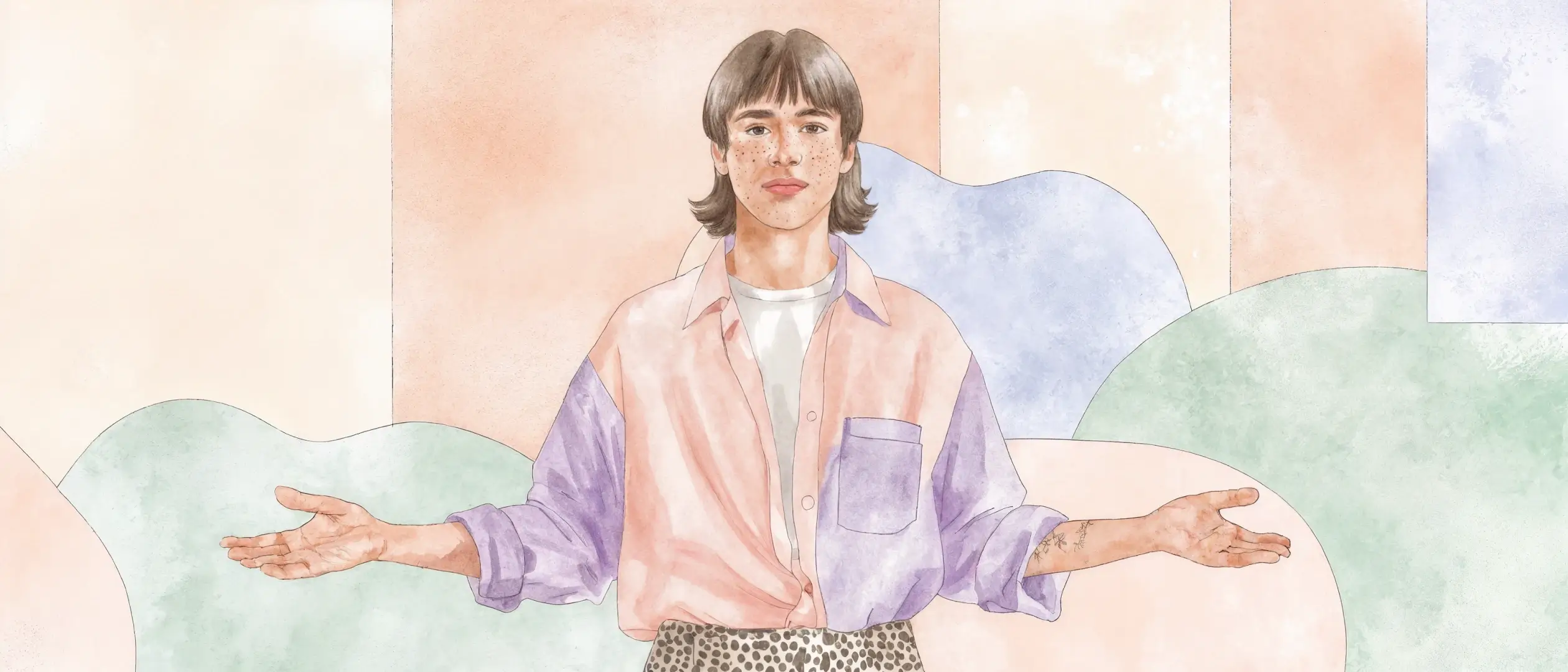
Emotional vulnerability is the choice to show up as you are, including your uncertainties and flaws. It can be admitting a mistake, sharing a fear, or expressing love to experience emotional intimacy with others.
Dr. Brené Brown, a research professor at the University of Houston and the author of six #1 New York Times bestsellers, has spent the past two decades studying courage, vulnerability, shame, and empathy. She believes that vulnerability is a part of human nature, which lets our true selves be seen and loved:
“We cultivate love when we allow our most vulnerable and powerful selves to be deeply seen and known, and when we honor the spiritual connection that grows from that offering with trust, respect, kindness, and affection.” ― Brené Brown, “The Gifts of Imperfection.”
Expert Insight
Emotional vulnerability may come intuitively to some. However, it is often an acquired skill for others. Those with histories of trauma, rejection, or betrayal may inherently feel more hesitant to be vulnerable. In these cases, it takes time and practice (as well as committing to gradual baby steps) to practice such vulnerability with others.
Nicole Arzt
Mental health professional
Understanding the Fear of Vulnerability
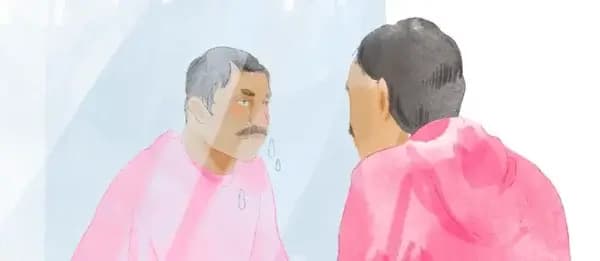
The fear of vulnerability is the tendency to avoid emotional openness or honesty because it feels unsafe, uncomfortable, or threatening. According to research, it often develops when past experiences taught a person that being open led to rejection, criticism, or loss of control.
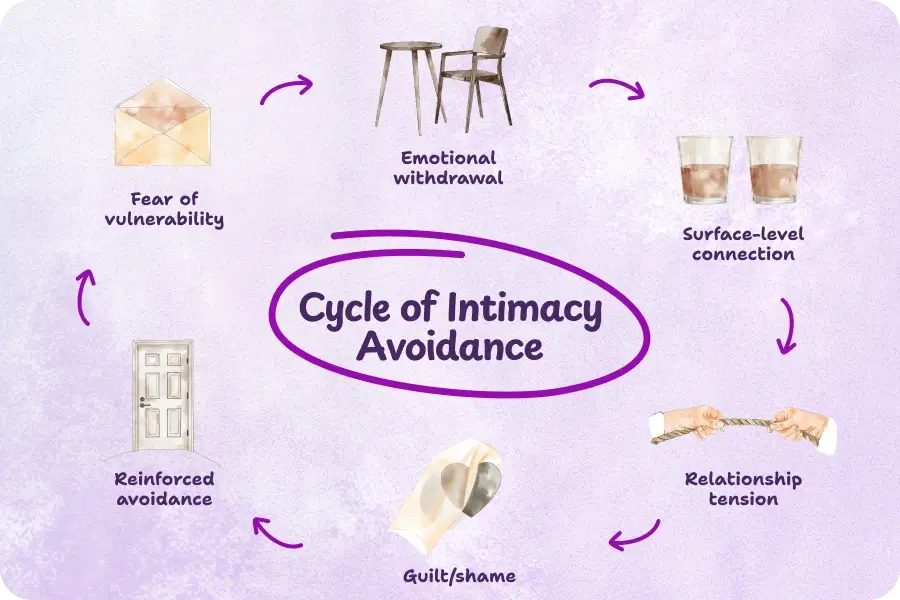
Unfortunately, the fear of being vulnerable creates a vicious cycle. It often begins with a desire for connection. As closeness develops, uncomfortable feelings such as fear, doubt, or a sense of loss of control may surface. To manage these feelings, a person may pull back emotionally, avoid deeper conversations, or subconsciously create distance in the relationship. This withdrawal can bring temporary relief—there’s less risk of “being seen”—but it often leads to loneliness or guilt. It only reinforces the person’s belief that closeness is unsafe.
Why Am I Afraid to Be Vulnerable? 6 Root Causes
The fear of vulnerability is rarely a random personality trait. Instead, it can be perceived as a survival strategy developed by a nervous system that has been taught to prioritize safety over connection.
1. Past trauma
If you were ever neglected, mocked, ignored, or punished for being honest as a child or in a previous relationship, your nervous system interpreted that openness was dangerous. Instead of vulnerability leading to comfort or understanding, it led to pain, rejection, or shame.
2. The emotional weaponization
You stay guarded because you were betrayed by someone who used your secrets or insecurities as leverage during later arguments.
3. The performance requirement
From a young age, you may have learned that love is conditional and based on high achievement or “being easy to manage.” This can make any sign of struggle feel like a breach of contract that will lead to abandonment. This is especially common in golden child syndrome, where approval is tied to success and stability rather than authenticity. Eventually, you may learn to hide discomfort or push through burnout to stay safe.
4. Hyper-vigilance
You are constantly scanning for someone’s “hidden agenda” because, in your experience, “kindness” or “safety” was often just a precursor to a demand or an emotional guilt trip.
5. Status protection and competence
In any social or professional hierarchy, humans signal “high status” through displays of competence and emotional control. Admitting a mistake or a lack of knowledge may seem like a direct hit to that signal, which creates pressure to act “perfect.” This, of course, makes sense. If you feel shaky at your job, for instance, you don’t want to draw attention to yourself. Or, if you feel like you need to look perfect to secure approval, you probably won’t want to discuss how insecure you feel wearing a certain outfit.
6. Fear of uncertainty
The human brain struggles with holding ambiguity; it likes certainty. Vulnerability is essentially a state of zero control. When you share something private, you lose the ability to manage the other person’s perception of you.
You stay guarded because the “known” pain of being closed off is easier to manage than the “unknown” reaction of an open heart.
Expert Insight
A deep fear of vulnerability may be a symptom of post-traumatic stress disorder, depression, OCD, or other mental health conditions. This can occur when the fear affects multiple parts of life, including relationships or one’s ability to take care of themselves. It may speak to how profoundly unsafe it feels to be one’s authentic self.
Nicole Arzt
Mental health professional
What Does Being Vulnerable Look Like in a Relationship?
Showing vulnerability in a relationship can look like:
- Being emotionally available with your romantic partner.
- Sharing your feelings honestly, even when there is an inherent risk of discomfort or misunderstanding.
- Admitting mistakes or uncertainty without becoming defensive.
- Expressing needs, limits, or boundaries clearly.
- Talking about fears or insecurities instead of hiding them.
- Naming the insecurity, such as the fear of being abandoned or replaced, without using anger or sarcasm as a shield to dull the impact of the confession.
Wondering how to be open in romantic relationships or how to be a better friend? Take the Emotional Intelligence test to understand your own emotions and those of other people.
12 Strategies to Overcome the Fear of Being Vulnerable
The overarching goal of vulnerability is “to stay in the room” when your brain is telling you to hide. Here are 8 advanced practices designed to help you lean into the “burn” of being seen.
1. Reframe negative beliefs
People with a fear of vulnerability may avoid connection due to intense negative beliefs about themselves or others. For example: “If I open up to someone, they will see my imperfections and abandon me.” “Love must be earned.” “I will become dependent in an intimate relationship.”
These beliefs may feel protective, but they may be disproportionate and shaped by past experiences rather than present reality. Try to reframe them. For example, “I am worthy of connection exactly as I am,” or “I can be close and still be myself.”
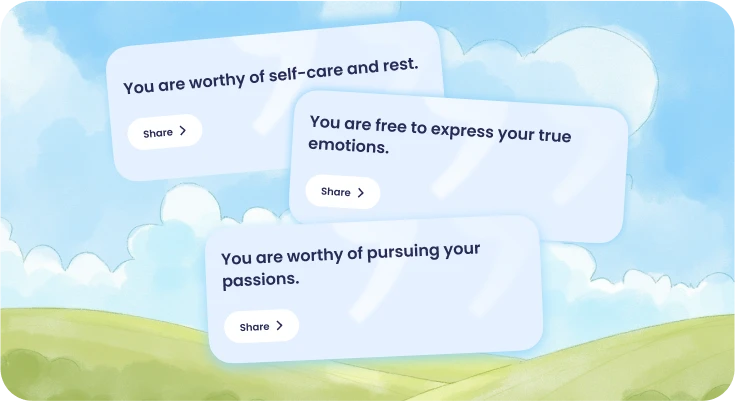
This is where Breeze’s positive affirmations come in handy. These personalized statements can boost your self-esteem:
- My imperfections make me human, not unlovable.
- Safe people do not leave when I am honest.
- I do not need to prove my worth to be loved.
- The right people stay, not because I am perfect, but because I am real.
- I trust myself to maintain balance in relationships.
- Connection strengthens me.
- I can open up without losing myself.
- A healthy connection allows space and closeness.
- I attract relationships that respect my boundaries.
- Old fears do not define my future.
2. Increase self-awareness
Being vulnerable is your choice and your responsibility. When a partner’s response triggers a spike of defensiveness or anger, the instinct is to blame their insensitivity. Still, the more productive move is to treat that irritation as internal data. You may ask yourself, “When have I experienced similar feelings before?” This approach may help you deal with negative emotions and become the best version of yourself.
3. Make a list of the reasons that prevent you from showing vulnerability
What scares you most about being open with people? Perhaps you don’t want to be hurt or are trying not to hurt a friend or partner. Or, it can be the need to control that prevents you from showing your weaknesses. Perhaps your openness in the past has led to undesirable consequences. Be honest with yourself and analyze your fears. Try writing your thoughts down to visualize them.
4. Stop mind-reading
According to research, our immediate emotional reactions often come from jumping to conclusions or interpreting someone’s words or actions in a way that triggers us. As a result, this “what if” mindset can prevent you from taking the first step toward an honest conversation.
Try to stop overthinking and assuming the other person’s reaction. Instead of predicting a reaction, treat the conversation as a live experiment. Shift your focus from your internal monologue to the actual data in front of you—the other person’s body language, their pauses, and their tone.
5. Try the “low-stakes” exposure method
You don’t have to start practicing vulnerability by confessing your deepest trauma to a stranger. Try to begin with situations where the risk of rejection is low:
- Admit your own limits: “I don’t know.” If someone uses a term you don’t know, just say, “I’m actually not familiar with that term. Could you explain it?”
- Share a small preference. Tell a friend you’d actually prefer a different restaurant instead of “doing whatever they want.”
- Acknowledge a mood. When someone asks how you are, try “I’m a bit overwhelmed today” instead of the usual “I’m good.”
- Choose one fact to share and begin with it. Start small, like worries about your career or concerns about a relative.
6. Distinguish between “safe” and “comfortable”
When you feel that tightening in your chest before speaking up, ask yourself, “Am I unsafe, or just uncomfortable?”
- Unsafe. The person you are talking to has a history of using your words against you or mocking your feelings. In this case, it makes sense to stay guarded.
- Uncomfortable. You are afraid of feeling worthless or being judged by someone who actually cares about you. In this case, it may be worth taking the risk.
7. Set boundaries for conversations
Begin difficult conversations by stating your expectations of the other person. Ask them to simply listen if you need to vent. Don’t forget to say whether you need advice or not.
Being upfront about your expectations helps the other person show up in the most supportive way. It reduces misunderstandings and makes the conversation feel more respectful and productive for both sides.
8. Try mindful breathing
Getting closer often activates internal tension. Mindfulness techniques, grounding practices, or breathwork help you stay in touch with emotions without running from them.
Try Breeze mindful breathing and play a relaxation game in the app to manage difficult emotions, recharge, and spend time learning more about your personality.
9. Gradually open up to your partner or best friend
Discuss past relationship experiences, traumatic life stories, or your childhood. The more intimate and personal stuff you share with another person, the less significant these topics will be and the less they will cause fear and anxiety. According to a study by the U.S. Centers for Disease Control and Prevention, meaningful talks can relieve stress and promote resilience.
10. Try Intentional Imperfection
If you are a perfectionist, your fear of vulnerability is likely tied to a need for “status” or a sense of approval. You can break this by intentionally failing at something small in front of others.
Admit to making a relatable mistake without a defensive “excuse” attached to it. You may say, “I completely forgot to call you back yesterday. I just dropped the ball.” Do not follow up with “I was so busy” or “My phone died.” Just own the “clumsiness.”
11. Practice the “ask for help” sprint
If you’re afraid of being emotionally or physically vulnerable, you may use hyper-independence as a defensive strategy to avoid letting others in. You may think that as long as you don’t need anyone, you can’t be let down.
Ask for a small favor that you could technically do yourself, but that would be easier with a hand. Do not apologize for asking. Just say, “Could you help me with this?”
12. Don’t let others’ reactions affect your self-worth
Fear of vulnerability whispers that emotional exposure is dangerous, but not everyone deserves that mistrust. It’s likely that the other person will respond well to your words, and you’ll feel comfortable sharing such details.
Even if you don’t get the desired reaction, you’ve still found the courage to be vulnerable in your relationship. If you were pleased with the other person’s reaction, thank them for their responsiveness. If you were hurt, express your feelings so they understand how their reaction affected you.
Praise yourself for being sincere, and practice this behavior in other relationships. Pay attention to the outcome of the interaction and see if your fear was justified.
13. Practice self-compassion after “oversharing”
You may wonder the next day, “Why did I say that? I shared too much.” To avoid the “shame spiral“:
- Check the facts. Did the other person actually react badly, or are you just projecting your own self-judgment onto them?
- If you feel awkward, acknowledge it. Saying, “I felt a bit exposed after our talk yesterday,” can actually deepen the connection.
14. Reach a mental health professional
A psychotherapist can help you trace where the fear originates. It can be childhood experiences, traumatic relationships, or losses. Understanding the sources makes it possible to practice more self-compassion and change fixed patterns gradually.
In a safe space, you can give space to emotions that you once had to suppress. This reduces their intensity and removes the need to constantly defend yourself from getting close.
Finally, psychotherapy allows you to learn to set healthy boundaries, show vulnerability at a comfortable pace, and build more trusting relationships. When a stable inner “I have the right to be heard and accepted” is formed, the fear of rejection decreases, and closeness ceases to seem dangerous.
Frequently asked questions
1.What blocks emotional vulnerability?
Vulnerability is blocked by a brain that prioritizes survival over connection. If you were punished for being open in the past, your nervous system now treats “being seen” as a literal danger.
- Fear of Leverage. You worry that your honesty will be stored and used against you later as a weapon.
- The Perfection Trap. You feel that your value comes from being “flawless,” so any mistake feels like it will lead to total rejection.
- The Control Habit. Staying closed off is predictable. Being open means losing control over how people react to you, which feels terrifying.
2. Is being vulnerable a good thing?
Vulnerability builds trust, deepens relationships, and helps people feel less alone. It can be uncomfortable, but that discomfort is often a sign of growth.
3. How do I know if I’m vulnerable?
You’re likely being vulnerable if you can talk about your feelings without immediately minimizing them, joking them away, or needing reassurance. It shows up when you can say, “This hurts me,” “I’m scared,” or “I don’t have this figured out,” even when it feels like an emotional risk.
4. Why are men afraid of vulnerability?
Many men are taught that vulnerability conflicts with masculinity. From a young age, emotions like sadness or fear may be discouraged or even explicitly punished. Eventually, this can make emotional vulnerability feel unsafe or unfamiliar.
5. Is being vulnerable attractive?
Yes, real vulnerability can be attractive because it signals self-awareness, emotional maturity, and confidence. It suggests that one’s self-worth is internally generated rather than dependent on the constant approval of others.
Sources
- Yamaguchi S, Kawata Y, Murofushi Y, Ota T. The development and validation of an emotional vulnerability scale for university students. September 2022
- Royal Holloway, University of London. New study reveals how people can catch a tendency to jump to conclusions. March 2021.
- Centers for Disease Control and Prevention. Conversations Matter. May, 2023
Disclaimer
This article is for general informative and self-discovery purposes only. It should not replace expert guidance from professionals.
Any action you take in response to the information in this article, whether directly or indirectly, is solely your responsibility and is done at your own risk. Breeze content team and its mental health experts disclaim any liability, loss, or risk, personal, professional, or otherwise, which may result from the use and/or application of any content.
Always consult your doctor or other certified health practitioner with any medical questions or concerns
Breeze articles exclusively cite trusted sources, such as academic research institutions and medical associations, including research and studies from PubMed, ResearchGate, or similar databases. Examine our subject-matter editors and editorial process to see how we verify facts and maintain the accuracy, reliability, and trustworthiness of our material.
Was this article helpful?