



You experience so many different feelings daily: happiness from meeting an old friend, sadness when you finish the last episode of your favorite TV series, and anger when your colleague makes sarcastic jokes. You may want to share these emotions with others, but it seems too difficult. Emotional conversations aren’t your strongest skill.
Here, we’ll provide some tips to make sharing feelings easier. You’ll find out why you may have trouble expressing emotions and learn healthy ways to communicate them.

Why is it so hard to express your feelings?
You may feel embarrassed about expressing your true feelings for several reasons. Maybe you believe that having negative feelings is a weakness, find it difficult to trust people around you, or fear that they will misunderstand or reject you. Past negative experiences can also play a crucial role.
1. Not knowing what your own feelings are
For people who were never taught how to name their feelings, emotions may seem confusing, and putting them into words can be a challenge. This situation might be particularly common for kids growing up in dysfunctional families or having narcissistic or emotionally immature parents. In such families, emotions can be ignored, criticized, or dismissed, so children learn that their feelings aren’t safe to show.
If you feel that childhood wounds still affect how you interact with the world, try taking Breeze’s childhood trauma test. In just 5 minutes, you’ll get a personalized plan to handle traumatizing experiences and reach inner peace.
2. Fear of conflict or rejection
Conflicts and dismissive comments from friends or loved ones can make you hesitant to share your feelings. Being labeled as “too sensitive,” “too depressive,” or “too empathetic” can make someone fear rejection and withdraw emotionally.
- “Stop crying. You’re too sensitive.”
- “Keep it to yourself if you don’t want to upset anyone.”
- “Stop laughing so loudly. It’s impolite!”
Hearing these phrases, especially at a young age, can cause a person to believe that expressing emotions is bad. And this feeling could’ve become stronger if parents, teachers, or even friends ignored a person when a kid showed their emotions.
For instance, if your ex-boyfriend regularly stated that you’re “clingy” for saying “I love you” and “I miss you” all the time, you might start suppressing your emotions in future relationships. This way, emotional communication that seemed natural before may turn into a challenge even with the right people.
3. No trustworthy people to open up to
Maybe you have no one to express feelings with. If you’ve recently moved to another country and have just a few colleagues living there, expressing emotions in real life might turn into a challenge. You probably won’t share your deepest worries with people you aren’t close to. So, you end up keeping emotions to yourself because it doesn’t feel safe to open up to someone you don’t trust yet.
4. Feeling frustrated or overwhelmed due to emotional overload
Sometimes you might experience so many emotions that they’re simply tough to process. When stress from constant work deadlines, worries about presents for close ones, anxiety for your kids’ future, and long-lasting burnout meet together, it can be difficult to explain your emotional state to anyone.
The same works for positive emotions as well. When having one of the best vacations of your life, you may want to stay quiet and process everything on your own. You may worry that “enjoying” the good feelings will leave you unprepared if hardship happens. Happiness can be so overwhelming that you don’t know how to put it into words.
How to identify what you’re really feeling
To express emotions with ease, you need to clearly understand what you feel. Separating reactions from facts, using an emotional wheel, and tracking your mood can be especially helpful.
1. Stop, take a deep breath, and ask, “What do I need right now?”
The first step toward self-awareness is to focus on the present moment. When emotions get overwhelming, breathe in and calm down. Ask yourself, “What’s happening? How do I feel? How does my body react?”
Think about what you may need in the moment. A person who needs a hug and someone to listen to their worries might feel anxious. And the one who wants some quiet time might be frustrated.
2. Separate facts from reactions
You might start rationalizing your feelings and contemplating the context. For instance, “The meeting was rescheduled” is a fact, while “I feel frustrated and anxious about it” is your reaction. Use a simple mini-scheme to separate facts and reactions:
- Fact. What happened? (“They didn’t reply to my message today.”)
- Thought. What meaning did I give it? (“I think they’re ignoring me.”)
- Emotion. How do I feel because of this thought? (“I feel rejected and worried.”)
You can state this connection out loud or even take a brief note to clarify your emotions. It will help you build a deeper awareness of your emotional states.
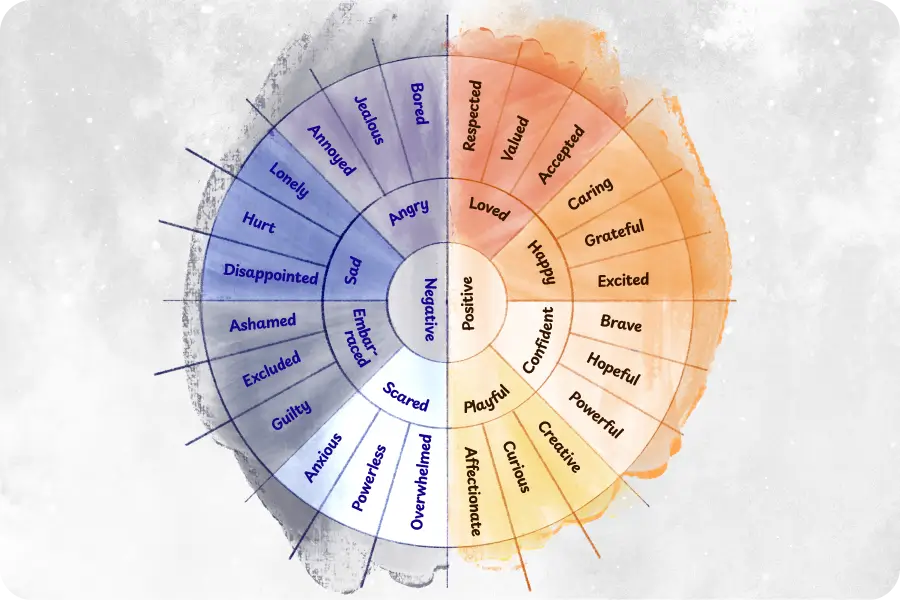
3. Use an emotional wheel
To explore feelings better and enlarge your emotional vocabulary, you can always use the emotional wheel. It takes practice to label emotions accurately, but over time, you’ll be able to notice subtle feelings without any help.
4. Analyze things that make you feel angry or stressed
In your free time, list triggers of strong emotions, such as:
- Arguments with close ones (anger)
- Missed deadlines (frustration)
- Unexpected charges (anxiety)
- Lack of rest (irritability)
- Sudden changes of plans (confusion or overwhelm)
They can be different for everyone, so it’s better to have your own list of triggers. The next time you encounter such situations, you’ll already understand that interruptions lead to annoyance, and paying taxes results in stress.
5. Talk about your feelings
Meaningful conversations start with small steps. Even a few words about your feelings can help you stay in sync with the other person. For instance, if you feel uncomfortable discussing a certain topic, say something like, “Can we talk about something else? It isn’t okay for me,” and later on, analyze what exactly you felt (embarrassment, shame, or anxiety).
6. Engage in mood tracking to notice patterns
The mood tracker in the Breeze app allows you to analyze your feelings in the moment. You can:
- Choose from the list of suggested emotions
- Add context
- Attach images
Review mood insights over time, and you’ll see recurring emotional patterns, common triggers, and situations that affect your mood the most. If you are still thinking about how to express your feelings, this practice makes it easier to put them into words.

Feelings vs. thoughts vs. mood
A clear understanding of the difference between feelings, thoughts, and mood can help you communicate what you experience better. Check out a table to distinguish them easily.
| Feelings | Thoughts | Mood |
| Emotional reactions | Mental interpretations | A general emotional state |
| Short-term (last minutes or hours) | Can be brief or ongoing | Lasts hours or days |
| Examples include fear, joy, sadness, etc. | Examples include “I’m not good enough” or “Something good is going to happen.” | Examples include calm, tense, or low mood |
| Cause strong physical sensations | Involve minimal or no physical response | Can cause subtle physical tone |
Research suggests that feelings are linked to short-lived emotions with identifiable causes, whereas moods are diffuse, low-intensity states without clear origins. Thoughts represent cognitive behavior in which ideas, images, and mental representations are experienced. All these phenomena may influence each other but refer to different aspects of our inner world.
How to express your feelings in words (even when it feels impossible)
Expressing feelings out loud may seem challenging, but letting yourself talk without rush or judgment can help you share emotions. Save some tips to feel more comfortable while opening up.
1. Start with “I feel…”
It will let you start thinking in terms of emotional experience rather than things that happened. Additionally, it helps maintain focus on yourself rather than blaming another person. For instance, saying “I feel upset” allows you to avoid projecting negative emotions on your partner, as if you say “You made me feel upset because…”
2. Think about basic emotions first
People may experience a mix of emotions at once and have complex feelings. But if you find it difficult to spot the right words, pick one of the 7 basic emotions you’re most likely to feel. These include:
- Anger
- Disgust
- Fear
- Happiness
- Sadness
- Surprise
- Contempt
This will provide another person with a basic understanding of what you’re talking about and can help you gradually work on discussing more complex feelings.
3. Let yourself pause and think
Pauses in the middle of an important conversation are completely normal. Imagine yourself talking about your ex with your best friend and trying to process your breakup to feel free from old patterns. You may experience dozens of emotions at once, from grief and sadness to anger or the feeling that you miss this person. Let yourself analyze without feeling awkward.
Do you find it challenging to express your emotions?
4. Use examples and comparisons
You may not know how to name the emotion, but you can say how it feels. For instance, you discuss a recent argument with your partner and want to explain that some of their words are especially offensive.
If you find it challenging to explain how dismissed you feel, you can compare it to something familiar, like saying, “It’s like if I started talking and you looked at your phone. It felt like my words weren’t important to you.”
5. Focus on one feeling at a time
When emotions are overwhelming, and you’re trying to turn them into words, don’t try to explain everything at once. Of course, your speech may be messy, but if you slow down and pick just one emotion, it becomes clearer.
During an argument, you may experience a mix of anger, sadness, frustration, and disappointment. Instead of listing everything, you can say, “Right now, I feel hurt because what you said stayed with me.”

6. Avoid judgment and try to soften your inner critic
Negative things can happen, and your life shouldn’t always seem happy and perfect. You can feel sad and express your feelings in a way that is comfortable for you. You may shout, cry, or struggle to find the right words. Approach yourself with self-compassion, and you’ll see how much easier it becomes to open up.
Expert Insight
“Softening the inner critic takes time and patience. It may be helpful to ask yourself, “How would I talk to my best friend if they were experiencing this right now?” Or you can try, “What would I tell a young child feeling this type of feeling right now?” Chances are, you’d offer more grace and kindness, and you deserve to give yourself those traits as well.”

Nicole Arzt
Mental health professional
7. Improve emotional intelligence
Developing emotional intelligence can help you express your feelings more clearly and become more empathetic. Taking Breeze’s EI test can be the first step in this direction. Spend 5 minutes of your time and receive a personalized plan to communicate your reactions more confidently.
How to talk about your feelings with someone you care about
It’s important to consider how to make emotional expression comfortable for the other person as well. In this section, we provide tips on creating a safe space and examining the situation from different perspectives.
1. Choose a good time
Sometimes, “right here and now” might not be the best option, especially if stress is heightened. A person you want to talk to can feel overwhelmed or exhausted. So, think about whether the other person is emotionally available and ready to listen. To express feelings productively, ensure that both of you:
- Aren’t busy
- Feel safe and calm enough to talk
- Aren’t emotionally overwhelmed
- Have time for conversation
2. Show that you’re open to discussion
Highlight that you respect the other’s perspective as well. For example, if you’re discussing moving to another city with your partner, consider their point of view. All perspectives matter, and there is no “right” or “wrong” way to feel about a given situation. While you might be excited and open to a new life, they may be worried or unsure. Accepting the partner’s feelings and looking for a common ground can make the conversation feel safer.
3. Focus on your experiences rather than projections for the other person
In healthy relationships, it’s better to avoid making assumptions about others’ behavior based on past experiences. If your ex used to dismiss your worries, don’t immediately think that a new partner will do the same. Next time you feel worried when they don’t reply right away, say something like, “I feel anxious. Can we talk about it?” instead of instantly stating that they don’t care.
4. Practice active listening
Whether you’re expressing positive feelings or sharing anxious thoughts, you won’t be pleased if the other person interrupts you. The same principle applies in reverse as well. When it’s someone’s time to express their feelings, you may need to:
- Ask open-ended questions
- Listen without planning your reply
- Validate their feelings, even if you disagree
- Notice nonverbal cues like tone and body language
- Show empathy and avoid giving advice immediately
This way, you’ll be able not only to open yourself up but also to let the other person express their feelings, thereby strengthening trust.

Common mistakes to avoid when expressing your feelings
When you’re trying to communicate your feelings to others and improve relationships, several mistakes can turn a conversation into an argument. Here’s what you should avoid:
- Being too generic. “You’re always so rude!” or “You never listen to me!” aren’t very helpful statements. They are all-or-nothing statements that dismiss the nuance of complicated interpersonal dynamics. Discuss particular situations so the other person doesn’t feel blamed for no reason.
- Passive-aggressive language. People often resort to sarcasm or backhanded compliments when they can’t express their anger directly. Instead of being passive-aggressive, talk about your feelings with the person who may have caused them. Be direct about what’s going on, and try to avoid playing any mind games.
- Expecting the other person to read your mind. No healthy personal relationships can work without communication. If you don’t express feelings directly, the other person may not realize what you need. So it’s better to say everything out loud.
- Over-apologizing for having feelings. Being happy, angry, sad, or frustrated is a normal part of life. And if you express them respectfully, there’s no need to apologize for anything you say.
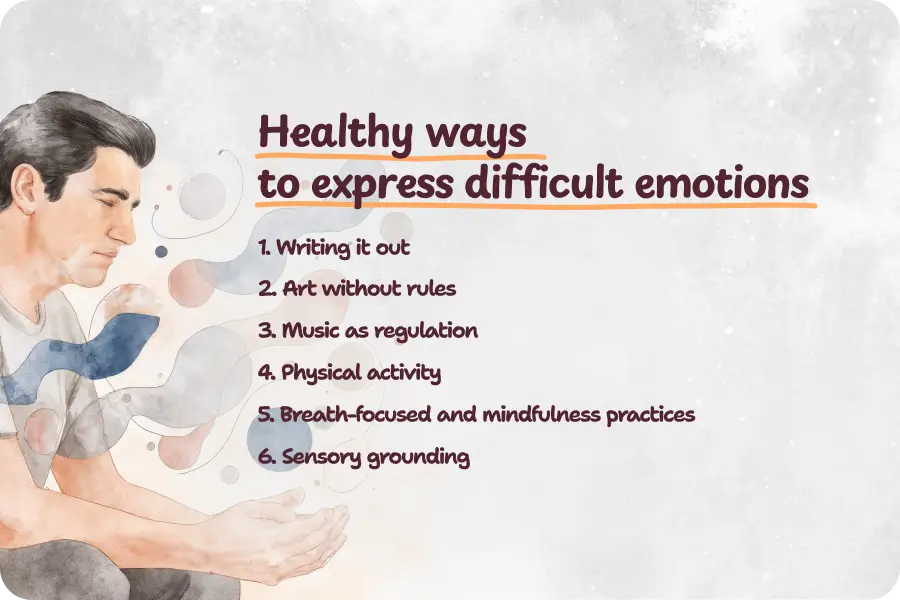
Healthy ways to express difficult emotions (beyond talking)
You don’t always need to discuss everything with the other person to process emotions. Creative outlets, physical activity, mindful exercises, and spending time with nature can also help you regulate your mood. Here’s how it works.
1. Writing it out
Research has shown that journaling, particularly expressive writing, enhances emotional expression by allowing people to articulate and process feelings about stressors. The Breeze app enables you to release worries, calm anxiety, and cultivate gratitude through simple journaling prompts. It’s always in hand, so you can express your feelings anytime and anywhere.
2. Art without rules
Painting, drawing, collage, or simple doodling can help you reach the flow state and focus on expressing what’s inside without using any logic. These practices allow you to turn off the rational part and free up your thoughts through creativity.
3. Music as regulation
Playing or listening to music is another powerful way to release difficult feelings. Some people may turn to this strategy intuitively, which is why we listen to sad music when we are about to cry or enjoy energetic beats when feeling happy.
4. Physical activity
Physical activity lets you release tension and boost dopamine and serotonin levels that drive positive feelings, according to a study published in Neuroscience. Even more, cross-body movements, such as swimming or dancing, help release trauma-related stress by re-engaging the nervous system.
5. Breath-focused and mindfulness practices
Turn to grounding techniques when you need to calm down overwhelming feelings. Try this simple practice:
- Sit or lie down comfortably and close your eyes.
- Engage in deep breathing, noticing the rise and fall of your chest.
- Scan your body from your toes to your head, noting any tension, warmth, or other feelings.
- Release stress with each breath, and anchor yourself in the present moment.
6. Sensory grounding
This grounding exercise can be helpful if you often feel anxious and angry and have no one to talk to. It will let you shift attention and let go of negative feelings without talking. Name:
- Five things you can see
- Four things you can touch
- Three sounds you can hear
- Two things you can smell
- One thing you can taste
When you might need additional support in expressing emotions
Reaching out for professional support can be the best option if you:
- Feel overwhelmed frequently with no particular reason.
- Experience headaches or other physical health issues because of stress.
- Face relationship challenges due to the lack of quality communication.
- Feel emotionally unavailable and struggle to open up despite wanting to.
- Turn to unhealthy coping mechanisms such as excessive alcohol intake or overeating to deal with difficult emotions.
- Believe that opening up is a weakness or think that it can make other people take advantage of you or reject you.
Nicole Arzt, LMFT, highlights other markers that a person needs professional support with expressing their feelings: “You may also benefit from seeking professional support if you struggle to regulate your emotions. For instance, you may find yourself going from 0 to 100 without much warning. It may take hours or days to ground yourself. This could be a sign that you’re struggling with other underlying concerns, including depression, anxiety, or unresolved trauma.”
Examples of how to express feelings
Save some phrases that might be helpful if you want to express various emotions but don’t know what to say.
Sadness
- “I feel sad that this situation happened.”
- “This really upset me.”
- “It made me feel down.”
Anger
- “That crossed a line for me.”
- “I feel frustrated right now.”
- “Let me calm down. I’m irritated.”
Emotional pain
- “I felt unimportant then.”
- “Your comments make me feel uncomfortable. Don’t say it anymore, please.”
Anxiety
- “This makes me anxious.”
- “I’m worried about how this will turn out.”
- “That hurt me.”
Uncertainty
- “I don’t really understand what you meant.”
- “I need some time to process my feelings.”
- “I’m not sure how to talk about this yet.”
Positive feelings
- “I’m so happy that you agreed to join me today.”
- “I appreciate this more than you know.”
- “This means a lot to me.”
Conclusion
Expressing feelings can seem challenging, especially if you’re accustomed to bottling everything up. Nevertheless, it’s always possible to learn to recognize and share your emotions with others.
Begin with basic emotions and gradually expand your emotional vocabulary over time. Ensure that communication is always clear and respectful. Use “I” statements and avoid blaming the other person. With Breeze, you can learn more about what you feel and have a brief emotion review every morning to understand yourself better.
Frequently asked questions
What are the 7 basic emotional expressions?
The 7 basic emotional expressions were identified by Paul Ekman, Ph.D., an American psychologist and professor at the University of California at San Francisco. These include:
- Happiness — joy and pleasure that a person shows through a smile or laughter.
- Sadness — grief, disappointment, and sorrow expressed with a lowered gaze, drooping posture, or tears.
- Anger — frustration and irritation shown through tense muscles and a raised voice.
- Fear — threat and anxiety that people show with widened eyes and tense posture.
- Disgust — strong disapproval and revulsion expressed by wrinkling the nose, pulling back, or grimacing.
- Surprise — shock that a person reveals with raised eyebrows, widened eyes, and an open mouth.
- Contempt — disrespect, expressed with a smirk or an eye roll.
What is the 90-second rule for emotions?
The 90-second rule for emotions, introduced by Dr. Jill Bolte Taylor, a neuroanatomist, states that it takes about 90 seconds for the brain to process and release an emotional reaction. During this time, a body experiences physical sensations like tense muscles or a faster heartbeat, and after 1.5 minutes, it returns to its baseline state naturally. All the following feelings linger due to a person’s overthinking and self-repetition.
How do I express my feelings through text?
To express your feelings through text, particularly using messages, you need to:
- Use “I” statements.
- Be specific about the emotion you feel and what caused it (e.g., “I’m sad because our plans changed at the last minute”).
- Avoid blaming the other person.
- Keep the explanation brief and clear.
- Check your tone and use emojis if necessary so the other person doesn’t misinterpret your message.
- Invite the person for a discussion with phrases like “I wanted to share this with you and would like to hear your thoughts.”
Sources
- Andrew M. Lane, Peter C. Terry, Tracey J. Devonport, Andrew P. Friesen, Peter A. Totterdell. “A Test and Extension of Lane and Terry’s (2000) Conceptual Model of Mood-Performance Relationships Using a Large Internet Sample.” Frontiers in Psychology. 2017
- APA Dictionary of Psychology. “Thinking.” 2018
- Ullrich PM, Lutgendorf SK. “Journaling about stressful events: effects of cognitive processing and emotional expression.” Ann Behav Med. 2002
- Jan Parker, Brenda Shook, Demaris Washington, Barbara English, Charles Tatum. “The Effect of Tension and Trauma Releasing Exercises (TRE) on Trauma Symptoms in East African Refugees.” 2024
Disclaimer
This article is for general informative and self-discovery purposes only. It should not replace expert guidance from professionals.
Any action you take in response to the information in this article, whether directly or indirectly, is solely your responsibility and is done at your own risk. Breeze content team and its mental health experts disclaim any liability, loss, or risk, personal, professional, or otherwise, which may result from the use and/or application of any content.
Always consult your doctor or other certified health practitioner with any medical questions or concerns
Breeze articles exclusively cite trusted sources, such as academic research institutions and medical associations, including research and studies from PubMed, ResearchGate, or similar databases. Examine our subject-matter editors and editorial process to see how we verify facts and maintain the accuracy, reliability, and trustworthiness of our material.
Was this article helpful?