



You’ve probably met people who seem charming at first, but something about communicating with them feels off. They agree, smile, and make compliments, but every time you talk to them, you are left feeling uncomfortable. This is how passive-aggressive behavior can manifest.
In this article, we’ll explore what passive-aggressiveness is, how to spot it, and what to do if a person you’re talking to uses this communication style with you. We’ll also explore what to do if you turn to passive aggression and want to change it.

What does “passive-aggressive” mean?
The term “passive-aggressive” describes behavior when a person expresses negative feelings indirectly via sarcastic jokes, silent treatment, avoidance, etc. On the surface, passive-aggressive people may seem polite or even friendly, but their actions might be based on hidden or quiet aggression.
Mixed signals make communication with such people tense. While words say one thing, behavior may signal another. And as nothing is stated outright, it can be difficult to identify or resolve.
People might occasionally engage in passive aggression, sometimes without even realizing it. Sarcastic jokes with friends or procrastinating an unpleasant task can be harmless and situational. However, when passive aggression becomes a regular mode of communication, it can deteriorate relationships and lead to trust issues or ongoing tensions.
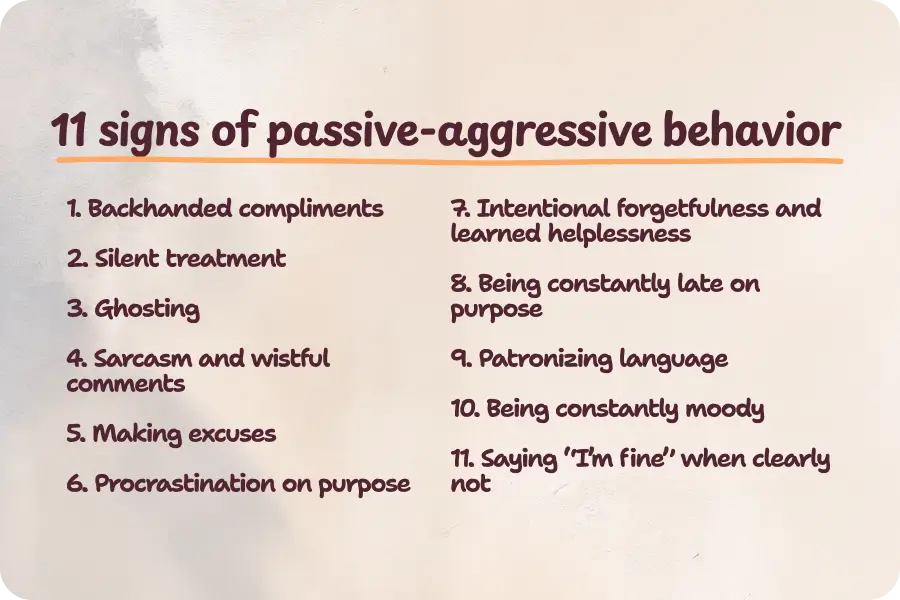
11 signs and examples of passive-aggressive behavior
Recognizing passive aggression can help you protect your boundaries, save your relationships, and maintain your well-being. Here are the most common examples of passive-aggressive actions you need to stay aware of.
1. Backhanded compliments
These comments can be considered as praises and as insults at the same time. For instance, when someone says, “I didn’t expect you to handle that so well,” on the surface, it sounds positive, but at the same time, it seems like you were quietly criticized. Other examples might include:
- “As for someone your age, you have enough knowledge.”
- “You look so great, so I almost didn’t recognize you.”
- “You’re more intelligent than you appear.”
- “I’m impressed that you managed to do it.”
2. Silent treatment
Silent treatment means avoiding conversation with another person to punish them, control their emotions, or show that you’re uncomfortable while still avoiding direct confrontation. The problem here may be that other people might not even know what they’re guilty of. Some examples can include:
- A mother who is short with her child after they misbehave or make a mistake.
- A wife giving her husband the cold shoulder after a fight.
- A family member who is not answering your calls because you refused to lend them some money.
- A coworker who doesn’t reply to your emails.

3. Ghosting
Ghosting means cutting off any contact suddenly and for no clear or communicated reason. Imagine that you have gone on a few dates with someone and even started seeing them as a potential romantic partner, until one morning, they blocked you everywhere. With no arguments or explanation of what had gone wrong, they left you feeling confused.
Such passive-aggressive behavior can make you question your communication skills, experience self-doubt, and even develop self-esteem issues.
4. Sarcasm and wistful comments
Using words that appear to be joking but contain hidden criticism or an opposite meaning can be interpreted as passive-aggressive behavior. For instance, such phrases can make a person rather uncomfortable:
- “Wow, it must be great to have so much free time.”
- “Don’t worry about me. I’m used to everyone ignoring me.”
- “I can’t wait to help you with one more task this week.”
That’s not the same as making funny jokes with friends while everyone is laughing and agreeing. If sarcasm is inappropriate or offensive, it becomes a subtle way of expressing anger rather than a way to have fun.
5. Making excuses
Another example of passive-aggressive behavior is denying or evading responsibility, even after wrongdoing. A person may try to blame circumstances, people around, or “miscommunication.”
For instance, if your colleague constantly misses deadlines and states that their manager didn’t provide clear instructions, it can mean that they don’t want to own their actions. Another example is your best friend who’s always late for gatherings because “traffic was crazy” or “their alarm didn’t go off.” When it happens regularly, such behavior may signal indirect resistance toward other people or tasks.

6. Procrastination on purpose
Another way to avoid doing something a person doesn’t want to do is procrastination. Occasional situations, such as when you clean the apartment, call your bestie, or order a new pair of jeans to avoid paying bills, can be common for most of us.
Yet, if your obligations are connected to other people’s needs, intentional procrastination can turn into passive-aggression. For instance:
- You promise to purchase a gift for your partner’s mother for her birthday, but keep delaying it till the last minute.
- You mention that you will reserve a table for your group of friends this Saturday, but you do not follow through with the reservation.
- You finish the task only when another person reminds you about it several times.
7. Intentional forgetfulness and learned helplessness
Pretending like you can’t perform certain tasks or forget about them so others don’t ask you about anything is a subtle sabotage. You don’t say out loud, “I don’t like doing this,” but instead act incapable. This way, you might create problems and additional work for other people and avoid responsibility without openly refusing, which can feel like manipulation.
Here are a few real-life examples:
- Making intentional mistakes in important emails.
- Constantly forgetting to buy bread for dinner when your loved one asks you to.
- Pretending like you don’t know how to use certain software, so your colleagues repeatedly help you with it.
- Lazily putting the dishes away so that your partner feels compelled to do it, vs. relying on you to accomplish the task successfully.
8. Being constantly late on purpose
Others can perceive this behavioral pattern as a signal that you disrespect them, lack care and consideration, or try to assert dominance. If you’re late to friendly gatherings or work meetings regularly, it can ruin others’ plans and negatively influence their trust in you.
How often do you meet passive-aggressive people?
9. Patronizing language
Pretending like you’re explaining something to a child rather than a grown-up adult might be one of the indirect ways to offend the person. It can include overexplaining simple concepts, using a condescending tone, or adding unnecessary emphasis as if someone can’t understand.
One may perceive such passive-aggressive communication as a means of asserting superiority and undermining confidence. Even without direct insults, it sends a message that the listener is less capable and disrespected.

10. Being constantly moody
If you don’t show underlying anger or frustration directly but express hostility every time someone tries to talk to you, it’s also about passive aggression. Sarcasm, short responses, and frequent irritability can make others walk on eggshells, create tension, and strain relationships.
11. Saying “I’m fine” when clearly not
Such behavior can be considered passive-aggressive because it might make other people worry, second-guess their own intuition, and guess the problem.
For instance, if you feel that you can’t prepare the presentation for stakeholders and meet the deadline, it’s better to notify your manager beforehand. This will help find the solution together.
On the other hand, if you keep saying that everything is fine and the morning before the meeting, admit that you’re not ready, it might create unnecessary stress for everyone involved.
Other situations when manageable issues turn into last-minute crises can include:
- Saying you’re fine after a fight but staying and acting upset.
- Denying tiredness instead of asking for support.
- Pretending common plans are okay when you’re actually annoyed.
How to tell if someone behaves in a passive-aggressive manner
To notice passive-aggressive behavior, follow your feelings, otherwise known as your intuition. If you’re uncomfortable, feel offended, or insecure around someone, it can signal that they act in a hostile manner. Other emotions that may arise include:
- Confusion about whether something really goes wrong or you’re just overreacting.
- Anger toward someone with no particular reason.
- Helplessness because no one tries to acknowledge your worries.
- Feeling that you lack clear communication and are walking on eggshells to avoid upsetting the other person.
- Guilt for making someone constantly unhappy, as their reactions seem to blame you for everything.
- Tension in any interaction.
- Self-doubt and challenges with self-esteem that might stem from passive-aggressive comments.
- Isolation from others who don’t see that a person is hostile to you.
Why are people passive-aggressive?
People may turn to passive aggressiveness because they find it challenging or intimidating to express their dissatisfaction or irritation directly. This pervasive pattern might stem from low self-esteem, learned behavior from childhood, fear of conflict or rejection, and power imbalance. Let’s explore these and some other causes in detail.
1. Passive aggression learned at home
Studies prove that childhood traumatic experiences significantly correlate with passive-aggressive behavior. [1] Lim YO, Suh KH. “Development and Validation of a Measure of Passive Aggression Traits: The Passive Aggression Scale (PAS).” Behav Sci (Basel). 2022 If in the early years, direct expression of anger wasn’t allowed, indirect expression of negative feelings can later turn into many forms, from sarcasm to silent treatment.
People with childhood trauma, especially those raised in dysfunctional families or with narcissistic parents, may lack examples of healthy emotional expression. They may genuinely believe that openly showing dissatisfaction is dangerous and turn to more “acceptable” (in their opinion) ways to express it.

2. Low self-esteem and the need to feel in control
If a person feels unworthy, they may be afraid to showcase their anger and might turn to passive-aggressive tactics to achieve a sense of power or control. It can be particularly common among covert narcissists who have heightened sensitivity to criticism.
They might use manipulation, guilt, and sarcasm to prove their superiority and protect their ego. Acting indirectly allows them to maintain a sense of control while avoiding direct confrontation that may expose their insecurities.
3. Struggling to name and express emotions
Emotional unavailability and passive-aggressiveness might be connected. When a person feels confused about their emotions, it may be challenging to explain them to others. For such people, minor irritation can build up over time and come out as passive-aggressive behavior.
Some of us may also fear feelings, especially negative ones. Those who believe that they should always be happy, positive, and have no problems may simply ignore challenges in communication if they arise. And as expressing anger seems inappropriate to them, they release it indirectly.
4. Avoiding confrontation at all costs
People may also turn to passive aggression to avoid open conflict, especially in professional settings or other situations when it seems completely inappropriate.
For instance, if you have a colleague who disagrees with a decision but fears speaking up, they might use sarcasm, delay tasks, or make subtle digs. Openly discussing the situation might be a better way out, but if a person is unsure of how their words will be received, passive-aggressive behavior can feel like the only option.
5. Fear of rejection and abandonment
Some people may fear that others will stop talking to them if they disagree directly. In this case, passive-aggressive behavior makes a person believe that they don’t do anything wrong.
Making excuses, giving backhanded compliments, or even showing an angry smile allows them to avoid open conflict. “Anyway, I go along with plans,” they might think. Yet, this strategy can be much more harmful for relationships in the long term.
6. Power imbalance
In social or occupational situations, when you feel powerless, indirect resistance can seem much safer than opening up. Imagine that you have a narcissistic mother who always tries to control your actions, and even though you’re an adult, she has the final say. To avoid confronting her directly, you might resort to forgetfulness, purposeful procrastination, making constant excuses, or developing learned helplessness.
7. Mental health conditions and personality disorders
Passive resistance and indirect aggression can also be signs of certain mental disorders, particularly depression, anxiety, and somatoform symptoms. [2] Christian G. Schanz, Monika Equit, Sarah K. Schäfer, Michael Käfer, Hannah K. Mattheus, Tanja Michael. “Development and Psychometric Properties of the Test of Passive Aggression.” Frontiers in Psychology. 2021 These conditions impair a person’s ability to recognize, evaluate, and express anger directly. As a result, people may redirect negative feelings inward or express them through hidden hostility toward others.
In 1952, the first American Psychiatric Association diagnostic statistical manual (DSM-I) defined “passive-aggressive personality disorder” (PAPD). It was considered a separate condition until 2013, when the disorder was removed as a formal diagnosis.
But before 2013, several studies explored the link between PAPD and other mental disorders. And even though the term “passive-aggressive personality disorder” is no longer valid, we can still turn to these studies when talking about passive-aggressive behavior and personality disorders that can cause it. These include borderline personality disorder (BPD) [3] Hopwood CJ, Morey LC, Markowitz JC, Pinto A, Skodol AE, Gunderson JG, Zanarini MC, Shea MT, Yen S, McGlashan TH, Ansell EB, Grilo CM, Sanislow CA. “The construct validity of passive-aggressive personality disorder.” Psychiatry. 2009 and narcissistic personality disorder (NPD) [4] Clemence, A. J., Perry, J. C., & Plakun, E. M. (2009). “Narcissistic and borderline personality disorders in a sample of treatment refractory patients.” Psychiatric Annals, 39(4), 175–184

How passive-aggressive behavior affects relationships
Building any kind of relationship with a passive-aggressive person may be challenging. Because such people don’t typically talk openly about their feelings, friends and family members might need to second-guess their reactions.
Staying quiet and passive-aggressive doesn’t let others understand the essence of the issue. As a result, small miscommunications can turn into larger conflicts. For example, if you don’t like a friend’s controlling personality trait but never address it directly, you might start making sarcastic remarks. Eventually, your relationships can get worse and exhausting.
Expert Insight
“Passive-aggressive communication styles and behaviors create barriers to connection within relationships. While the intention of this communication approach is a defensive mechanism, the discomfort it causes other parties within the relationship quickly overshadows this. The more we lean into passive-aggression, the more isolated we become from others and ourselves. The more this isolation creeps in, the more it impacts our sense of self and self-talk. People are meant to exist within a community, and if this fades, so does our overarching sense of security.”

Katherine Scott
Mental health professional
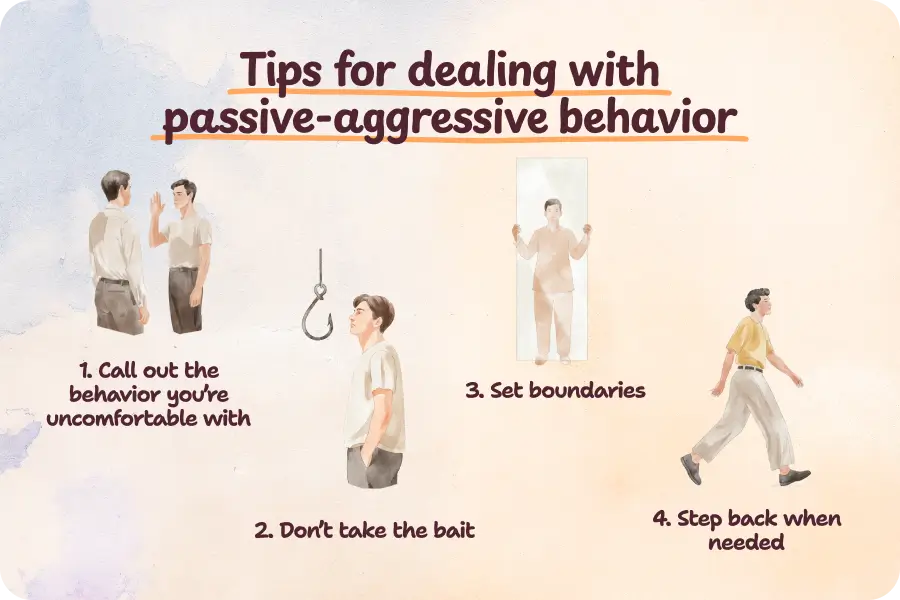
4 tips for dealing with passive-aggressive behavior
When communicating with a passive-aggressive person, stay calm and openly state that some of their actions make you feel uncomfortable. You can discuss the issue and find a common language, or set boundaries and limit communication with a passive-aggressive individual.
1. Call out the behavior you’re uncomfortable with
Take a moment to reflect on interactions with the person and notice what actually happens. Whether their jokes seem offensive or the fact that they constantly delay deadlines negatively influences your performance.
You can use Breeze’s mood tracker to analyze how you feel after every interaction, what a passive-aggressive person has said or done, and how it influences your self-esteem in the long term.
2. Don’t take the bait
When noticing the signs of passive-aggressive behavior, some people may decide to start an argument. “Don’t talk to me this way!” or “Stop being so rude to me!” These statements may escalate the situation and are intended to distract you from the passive-aggression. Instead, keep cool, avoid overreacting, and acknowledge that you feel hurt without attacking the other person.
3. Set boundaries
Once you recognize passive aggressiveness in someone’s actions, calmly point it out to them. Avoid overexplaining, but stay clear and specific about their behavior and your feelings. You may need to say something like:
- “I feel upset when plans change at the last minute. Please let me know if you can’t make it.”
- “It bothers me when sarcastic comments are made about my work.”
- “I feel uncomfortable when you stay silent about a problem. Can we talk about it?”
4. Step back when needed
Some people may understand your worries and change their behavior accordingly. But other passive-aggressive individuals can stick to their habitual patterns. And if you see that some toxic personality traits or actions keep bothering you, it may be necessary to distance yourself.
- In friendship, you can spend less time together.
- At work, try to limit interactions only to necessary work-related tasks.
- In a family, you can avoid topics that trigger passive aggression.
- And if a person is your potential or existing romantic partner, you may start thinking about whether this kind of relationship is healthy for you in general.
How to stop being a passive-aggressive person
When checking signs of passive-aggressive behavior, you may accidentally find out that some behavior patterns are typical for you. Here are some tips for eliminating passive-aggressiveness and choosing healthier ways to release your anger.
1. Recognize passive-aggressive behavior
Assess how you’ve been behaving recently and how your actions might have influenced others. For instance, you can be aggressive at work, deal with passive-aggressive comments from friends, or use sarcasm when talking to your family members.
Here are questions from a Reddit user that may help you recognize the signs of passive-aggressive behavior.
- Why am I saying this?
- Am I saying this to make the other person feel better or worse?
- If I’m not saying it to make them feel better, am I trying to guide them towards making a positive change?
- If I am trying to guide them towards a positive change, would there be a better way to go about this?”
2. Dig into the why
Passive-aggressive behavior can stem from unmet needs, insecurities, or things that became habitual or “normal.” Breeze’s journaling features can help you identify what you’re missing to start addressing the root cause of irritation. Track your worries and notice anxious thoughts to express negative emotions clearly.
Here’s how it works in real life. Imagine a mother of three children who is completely exhausted from daily responsibilities. She may find it challenging to stay calm and communicate her needs, as she’s exhausted and lacks time for self-care. At work, she may avoid eye contact, respond with short or sarcastic remarks, or withdraw emotionally just because she’s nearing burnout.
3. Speak your mind
Next time you want to make a sarcastic comment, question yourself, “What am I really feeling now?” Maybe you want to disagree with the person you’re talking to, feel uncomfortable about their comments, or get frustrated by the overall situation. So, instead of turning to passive aggression, say your thoughts out loud.
Could you please provide a few more tips on how a person can learn to communicate their feelings and needs in a direct way? Katherine Scott, M.Ed/Ed.S, LMFT, answers, “Change can be scary and uncomfortable. When we commit to shifting our communication patterns, we can experience growing pains. This is OK! It can be helpful to let some of your closest relationships know you are committed to shifting your communication patterns to healthier styles. This can give you more opportunities for grace and feedback with those you feel safest with! Also, self-compassion is necessary, as imperfection comes with the territory of change! Keep a list of ways you mindfully shifted your communication patterns, which can help you reflect on your growth and areas of continual growth.”
4. Focus on problem-solving
When the other person agrees that there’s an issue in your communication, you can talk about how to address it together. For example, your team finds it challenging to prioritize work tasks. Instead of being passive-aggressive towards each other, you can discuss deadlines and expectations.
Alternatively, you can think about how to meet your emotional needs on your own. For instance, if you see that you become passive-aggressive when you’re overwhelmed, you might focus on rest or ask for support earlier.
5. Analyze and adjust your behavior
Notice times when you managed to stay calm and openly tell what you’re angry about. Think about things that trigger emotional reactions (especially the ones you still find difficult to handle), and what you can do differently next time. Practice makes perfect, so give yourself patience.
Conclusion
Now you know what passive-aggressive behavior is and how it can influence relationships with others. Check yourself for the signs of passive aggressiveness, such as patronizing language, ghosting, or wistful comments, and assess why you may turn to it. Practice direct communication anytime you feel uncomfortable talking with others, and take Breeze’s emotional intelligence test to improve soft skills and approach every interaction like a pro.
Frequently asked questions
What is passive-aggressive behavior in a nutshell?
Passive-aggressive behavior means expressing negative attitudes indirectly through silent treatment, sarcasm, backhanded compliments, intentional forgetfulness, etc. People who are passive-aggressive don’t engage in direct conflict but rather make others feel uncomfortable around them.
How do passive-aggressive people talk?
People can use various passive-aggressive tactics in communication, particularly:
- Sarcasm
- Patronizing language
- Wistful comments
- Backhanded compliments
- Pretending like they’re always the victim
- Stating that they’re fine even when they obviously aren’t (and then acting like other people made them feel this way)
- Changing the subject to avoid accountability
What is the root cause of passive aggression?
The root cause of passive aggressiveness is the person’s inability to express and communicate their own emotions directly.
Some people may behave this way because they fear conflict or rejection. Others might have learned in childhood that if you feel angry, overt expression is unacceptable. And some people can mask unresolved issues because they don’t fully understand their emotions.
What are examples of passive-aggressive behavior?
One of the examples of passive-aggressive behavior is your friend who always cancels plans at the last minute and blames you for not understanding them because they have so many problems to handle.
Another example is your passive-aggressive colleague who makes constant jokes that you’re always lucky to get the easiest tasks and be your boss’s favorite one. Even though you perform the same amount of work, your colleague pretends to be a victim who must handle all the challenges, while you receive special treatment.
Sources
- Lim YO, Suh KH. “Development and Validation of a Measure of Passive Aggression Traits: The Passive Aggression Scale (PAS).” Behav Sci (Basel). 2022
- Christian G. Schanz, Monika Equit, Sarah K. Schäfer, Michael Käfer, Hannah K. Mattheus, Tanja Michael. “Development and Psychometric Properties of the Test of Passive Aggression.” Frontiers in Psychology. 2021
- Hopwood CJ, Morey LC, Markowitz JC, Pinto A, Skodol AE, Gunderson JG, Zanarini MC, Shea MT, Yen S, McGlashan TH, Ansell EB, Grilo CM, Sanislow CA. “The construct validity of passive-aggressive personality disorder.” Psychiatry. 2009
- Clemence, A. J., Perry, J. C., & Plakun, E. M. (2009). “Narcissistic and borderline personality disorders in a sample of treatment refractory patients.” Psychiatric Annals, 39(4), 175–184
Disclaimer
This article is for general informative and self-discovery purposes only. It should not replace expert guidance from professionals.
Any action you take in response to the information in this article, whether directly or indirectly, is solely your responsibility and is done at your own risk. Breeze content team and its mental health experts disclaim any liability, loss, or risk, personal, professional, or otherwise, which may result from the use and/or application of any content.
Always consult your doctor or other certified health practitioner with any medical questions or concerns
Breeze articles exclusively cite trusted sources, such as academic research institutions and medical associations, including research and studies from PubMed, ResearchGate, or similar databases. Examine our subject-matter editors and editorial process to see how we verify facts and maintain the accuracy, reliability, and trustworthiness of our material.
Was this article helpful?