



Podcast name
Why Am I Attracted To Emotionally Unavailable Men?
He may disappear suddenly, avoid commitments, or direct conversations about topics that concern you. In this article, we’ll talk about emotionally unavailable men and their interactional patterns.
Let’s figure out the psychological “why” behind your choices and practice 15 precise, tactical shifts to help you choose yourself and build fulfilling relationships. It is time to stop analyzing his mixed signals and start listening to your own need for stability.
Start by taking an insightful narcissistic partner test to spot toxic behavior that may harm your self-esteem and overall mental health.

Who Is an Emotionally Unavailable Man?
An emotionally unavailable man is characterized by difficulty building trusting and consistent relationships with loved ones. He may set emotional barriers and avoid discussing himself and his experiences. He may inconsistently engage with you, making him emotionally unreliable.
Emotional unavailability refers to a psychological defense mechanism where a person creates a persistent, strategic emotional distance between themselves and their partner. An emotionally unavailable person isn’t just “being shy” or “needing space.” Typically, due to past trauma, they show an active (though often subconscious) refusal to engage in the vulnerability required for a deep emotional connection.
A study on the impact of emotional unavailability on happiness level shows that it can erode trust, intimacy, and overall happiness, often leading to poor emotional health and separation in serious relationships.
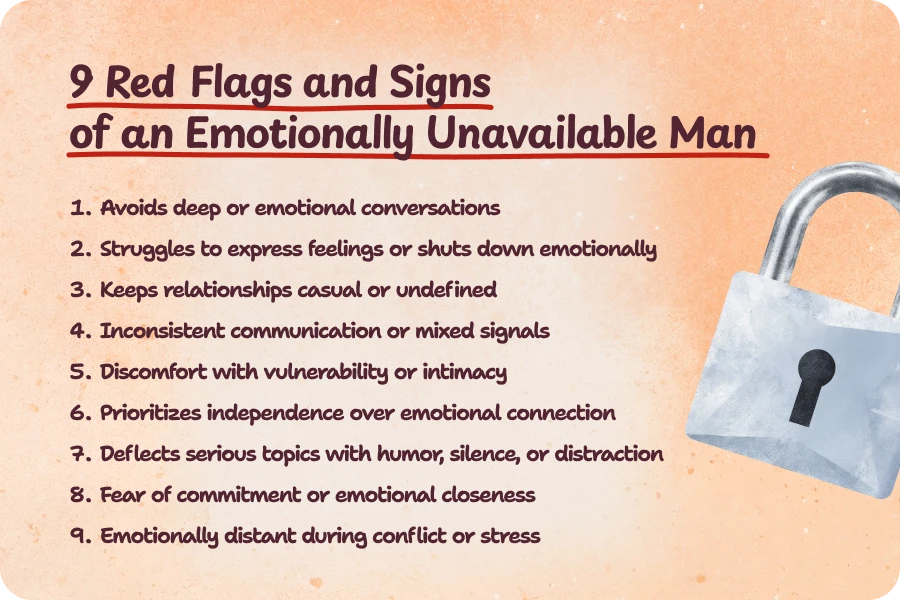
15 Red Flags and Signs of an Emotionally Unavailable Man
If you check off at least 5 of these signs, you’re likely dating an emotionally unavailable person.
- He ruminates on past relationships or frequently talks about the pain they caused him.
- He often seems emotionally distant and cold.
- He is unresponsive to your feelings and emotional needs.
- He doesn’t introduce you to his friends and family.
- He doesn’t share important events in his life with you.
- He often gets irritated over little things.
- Sometimes he disappears, and you can’t contact him for a whole day.
- He regularly emphasizes that he needs more “space” and time to himself.
- He can maintain contact with his exes, calling them friends with unclear boundaries.
- He has difficulty having deep conversations and talking about feelings.
- Instead of talking through conflict, he may initiate physical intimacy as a way to smooth things over or distract.
- He rarely asks about your thoughts, feelings, or attitudes towards anything.
- His mood can change abruptly for no apparent reason.
- He avoids questions about your future.
- He refuses to talk about your committed relationship or about “you as a couple.”
The Deep Dive: Why Am I Attracted to Emotionally Unavailable Men?
Why does it happen that even after breaking up with an emotionally unavailable partner, a person finds themselves in similar relationships again? The main cause is childhood trauma.
If parents were emotionally immature or neglectful and failed to meet a child’s basic needs, their trust system can be disrupted. It may lead to abandonment trauma, low self-esteem, thoughts like “My parents hate me,” and an anxious attachment style in the child, according to attachment theory.
Similarly, if a girl grew up with a cold mother or an abusive dad, she’s more likely to tolerate such attitudes from men in adulthood. In such cases, a person may experience counter-dependency and subconsciously seek out an emotionally unavailable partner who can manipulate them and engage in emotional abuse.
Moreover, this is where the “anxious-avoidant trap” may appear: the anxious partner seeks closeness → the avoidant partner withdraws → the anxious partner escalates pursuit. It’s a psychological loop where one partner’s need for closeness triggers the other’s fear of suffocation. It creates a self-perpetuating cycle of pursuit and withdrawal.
Expert Insight
It is a common pattern to be initially attracted to patterns of behavior and interactions based on what we ‘know’ and have experienced before. For example, some people will admit their attraction to the ‘bad boy’, reporting their edginess and risk-taking traits as exhilarating. However, this is a short-term infatuation and disregarding the potential of traits that perpetuate healthy, long-term relationships. Compatibility explorations require us to sit with our feelings and lived experiences to know what would benefit us long-term. Attraction can be disguised as old attachment patterns if we are not careful.

Katherine Scott
Mental health professional
Why Are Men Emotionally Unavailable?
There are two main explanations for this emotional pattern.
Parental relationship patterns
A person’s adult relationships may reflect emotional patterns they observed in their parents’ relationships as children. For instance, observing frequent emotional outbursts, heightened reactions, or conflicts in the family, a child may conclude that intimacy makes a person vulnerable, bringing pain and trouble.
Or, if parents don’t have developed emotional intelligence skills and don’t know how to be emotionally available, a child may also learn to suppress their feelings and develop an avoidant attachment style.
Traumatic events in childhood and breakups in the past
Fear of intimacy can be caused by childhood trauma or negative relationship experiences, research shows. If a previous relationship ended in failure, a person may fear opening up and trusting people again.

10 Tips for Dealing with an Emotionally Unavailable Partner (Husband or Boyfriend)
To change your unconscious patterns of choosing partners who are incapable of emotional intimacy, start with self-reflection and awareness of your thoughts and feelings.
1. Stop Over-Explaining Your Feelings
One common reaction to emotional unavailability is trying harder and explaining your feelings again and again in different ways. You may be hoping something will finally click. But in reality, clarity is rarely the issue. If your partner consistently avoids deep conversations, repeating yourself usually leads to frustration, not understanding. Say what you need once, calmly and clearly, and observe the response.
2. Try “Drop the Rope” Strategy
There can be a constant tension in relationships with an emotionally unavailable person. You pull for closeness, he pulls for distance. If you are the one always initiating deep talks, asking “How was your day?” and trying to “fix” the mood, stop.
When you drop your end of the rope, you finally see if he’s willing to pick it up. If the relationship falls silent the moment you stop “working” on it, you have your answer about its viability.
3. Use “The Observation Method”
Emotionally unavailable people often have a “shame trigger.” The moment they feel criticized, they distance themselves from the situation. Try to voice your observations without judgment. Instead of saying, “You’re being cold,” say, “I noticed that when I brought up our holiday plans, you walked out of the room. That makes me feel like I’m in this alone.”
4. Stop “Mind Reading”
You may be wondering why he is the way he is. Was it his mother? Was it his former partner? But understanding the “why” does not change the “is.” Consider his present behavior to be his ultimate form.
Think about it: “If he never changes another 1% for the rest of his life, can I live like this for 20 more years?” You are in love with a hypothetical, nonexistent version of him if the answer is no.
5. Shift Your Focus To Other People
If your husband or boyfriend is your only source of emotional intimacy, you may eventually starve. Diversify your “investments.” For example, consider making new friends or joining a community to find yourself. When he feels less “hunted” for intimacy, he might feel safe enough to offer a little more.
6. Set Emotional Boundaries
Stop demanding they change. Try simply stating what you will and will not tolerate. Rather than asking them to change, say, “I can’t keep talking when my feelings aren’t taken seriously.”
7. Set the “Internal Deadline”
You cannot wait forever for a “breakthrough” that may never come. Set a private window—maybe six months. If, at the end of that period, he hasn’t sought therapy or made a measurable effort to bridge the gap, you have to accept that his “unavailability” is actually “unwillingness.”
8. Stop Taking Responsibility for Their Inner World
It’s easy to believe that with enough patience, love, or understanding, your partner will eventually feel safe enough to open up. While support matters, emotional growth is a personal choice. You are not responsible for teaching an adult how to feel their feelings and process them. Carrying that weight often leads to emotional exhaustion and resentment.
9. Focus on Their Actions
During serious conversations, emotionally unavailable people tend to say the appropriate words, particularly if they detect conflict or distance. What follows is more important. Later on, do they start emotional check-ins, or do things go back to quiet? Emotional talks during stressful moments are usually less honest than patterns you see over time.
10. Seek Support Outside the Relationship
Talking to a therapist, trusted friend, or support group can help you regain perspective. Emotional unavailability often distorts your sense of what is normal in a relationship. External support can remind you that your needs are valid and shared by many others.
We asked Katherine Scott, M.Ed/Ed.S, LMFT, why secure, available love often feels “boring” to someone used to the high-dopamine “hot and cold” cycle.
Expert Insight
The high-dopamine ‘hot and cold’ cycle of relationships tends to feel good to someone who chases dopamine in other ways in their lives. Chasing dopamine ‘hits’ is like navigating life on a rollercoaster, committed to the pursuit of high ‘highs’ and low ‘lows.’ Their biochemistry could have been influenced by unpredictability and insecure attachment styles growing up, making the moments of connection feel fleeting and unpromised. This is when relationships fall into the ‘dopamine hits’ category. Available love can feel ‘boring’ to someone whose central nervous system has yet to recognize secure attachment as the thing to seek out.
Katherine Scott
Mental health professional
How to Stop the Pattern and Choose Emotional Availability
To stop the pattern and learn how to detach from someone, you have to retrain your nervous system to prefer peace over the “spark.”
1. Start Dating Consistent People
If you meet someone and feel instant, dizzying intensity, take a step back. That feeling is often your subconscious recognizing a familiar wound. Start dating people who feel “comfortable,” “emotionally generous,” or “warm” rather than “electric.” If he’s consistent and kind, give it at least five dates before you decide there’s “no chemistry.”
2. Use the “Believe Them the First Time” Rule
Emotionally unavailable partners may give a warning shot early on. They say things like, “I’m not good at relationships,” “I’m in a weird place right now,” or “I don’t want to hurt you.” Stop hearing these as “challenges” to be overcome.
When a man tells you he isn’t ready or isn’t “good” at love, believe him. Don’t try to be the exception to his rule. Thank him for his honesty and leave.
3. Move from “Is He Into Me?” to “Is He Capable?”
You may be used to spending the first month of dating asking, “Does he like me? Why hasn’t he texted?” Flip the script. Ask yourself, “Is this man capable of the intimacy I require?”
Watch his life. Does he have long-term friends? Does he handle stress without disappearing and communicate his schedule clearly? If he can’t manage his own life or his own word, he may have difficulties managing a relationship with you.
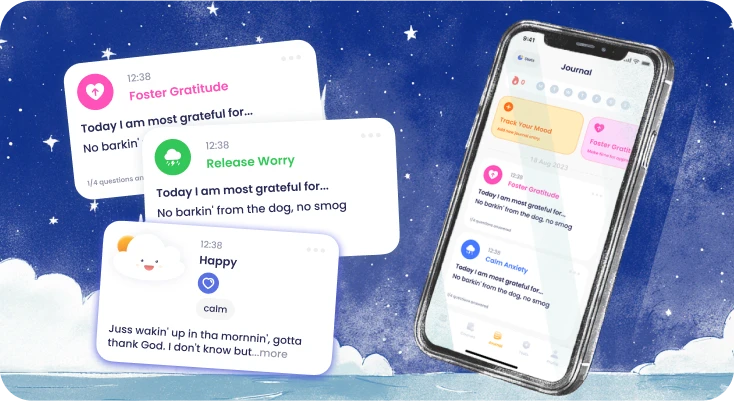
Write down your reflections with Breeze journaling. It can help you understand patterns and notice improvements to become the best version of yourself.
4. Heal the “Fixer” Mode
If you feel a compulsive need to “help” him open up or “rescue” him from his past, you are actually avoiding your own life. Try to stop finding your value in how much “work” you do for a man. For this, practice radical non-intervention. If he’s having a hard time or pulling away, let him. Don’t send the long “check-in” text.
5. Try To End Patterns Early To Avoid Drama
Quiet decisions made early may prevent louder heartbreak later. If you’re wondering how to break up with an emotionally unavailable man, remember that walking away doesn’t require a confrontation. Sometimes it looks like choosing not to continue investing once you notice repeated emotional unavailability. When a man refuses to invest in emotional intimacy, your constant “fixing” can merely postpone the inevitable breakup.
First Date Availability Checklist
Here are some questions to ask and signs to look for in the first 3 dates:
Date 1: Self-awareness
The “Ex” Factor: Ask, “What’s the most important thing you learned from your last relationship?” One of the green flags in a relationship is if he takes some accountability and speaks with respect.
The Red Flag: He calls their partner “crazy” or says, “I was just too good to her.” This signals a lack of self-awareness.
The Consistency Check: Does he show up when he says he will?
The Speed of Intimacy: Is he telling you, “I’ve never felt this way before,” on the first date? Fast-forwarding is usually a sign of love bombing, a tactic used by emotionally unavailable people to create a false emotional connection they can’t sustain.
Date 2: Emotional availability
The “Logistics” Test: Suggest a change in plans or a specific preference. “I’d actually prefer the Italian place over the sushi spot.”
What to look for: Does he adapt with ease, or does he seem irritated that he’s not in total control? Emotionally unavailable people tend to struggle with the “give and take” of partnership.
The Vulnerability Lead: Share a minor, “low-stakes” personal story.
The Sign: Does he meet your vulnerability with his own, or does he pivot back to “surface” talk?
The Availability Question: “What are you currently looking for in your life right now?”
The Red Flag: “I’m just seeing where things go” or “I’m focused on my career but open.” These are non-answers designed to keep expectations low.
Date 3: Vulnerability and openness
The Circle of Trust: Does he mention friends or family by name?
The Sign: If he feels like a “man from nowhere” with no long-term ties, he is likely an emotionally unavailable man.
The Conflict Micro-Dose: Bring up a tiny boundary. “I’m not a big fan of late-night texting.”
The Reaction: An emotionally available man typically says, “Good to know.” An unavailable man feels “suffocated” by the smallest request for structure.
The “Follow-Through” Audit: Look back at the last two weeks. Has he been a “proactive” communicator, or are you the one constantly keeping the pilot light of the conversation lit?
The “Gut Check” Summary
Ask yourself these two questions after the third date:
- Do I feel “calm” or “excited”? Excitement” in the early stages is often just anxiety.
- Am I guessing how he feels about me? If you have to ask your friends to “decode” his behavior, he is unavailable.
To ground yourself and calm your mind when you are overwhelmed by emotions, try Breeze mindful breathing. Mindfulness activities in the app can help you increase awareness of your thoughts, feelings, and environment.
Frequently asked questions
1. What kind of woman do emotionally unavailable men go for?
Emotionally unavailable men often seek out “givers”—women who are highly empathetic, nurturing, and prone to “fixing.” These women will provide all the emotional warmth while the man provides none, creating a lopsided but (for him) comfortable dynamic.
2. How does an unemotional man show love?
He usually speaks in “Logistics.” He’ll make sure your oil is changed, pay for dinner, or help you move. For him, “doing” is safer than “feeling.” That’s why he may also replace emotional vulnerability with a physical relationship. He might not want to talk about his feelings for an hour, but he wants to sit on the couch with you while you both read or have you nearby while he works on a project.
3. How to connect with a man who is emotionally unavailable?
To connect with an emotionally unavailable man, try “side-by-side” intimacy by talking during shared activities like driving or walking, which lowers his natural defensiveness. Lead by sharing small, low-stakes vulnerabilities of your own to model safety without pressuring him for an immediate, deep confession.
Sources
- Dr Nisha Khanna. Impact of Emotional Unavailability on the Happiness Level of Indian Couples and the Happiness Pie Chart as a Tool Towards Resolution: Qualitative Analysis of Case Studies. June 2023
- Li, Yuxuan. How does attachment style influence early childhood development? February 2023
- Anita L. Vangelisti, Gary Beck. Intimacy and Fear of Intimacy. January 2007
Disclaimer
This article is for general informative and self-discovery purposes only. It should not replace expert guidance from professionals.
Any action you take in response to the information in this article, whether directly or indirectly, is solely your responsibility and is done at your own risk. Breeze content team and its mental health experts disclaim any liability, loss, or risk, personal, professional, or otherwise, which may result from the use and/or application of any content.
Always consult your doctor or other certified health practitioner with any medical questions or concerns
Breeze articles exclusively cite trusted sources, such as academic research institutions and medical associations, including research and studies from PubMed, ResearchGate, or similar databases. Examine our subject-matter editors and editorial process to see how we verify facts and maintain the accuracy, reliability, and trustworthiness of our material.
Was this article helpful?