

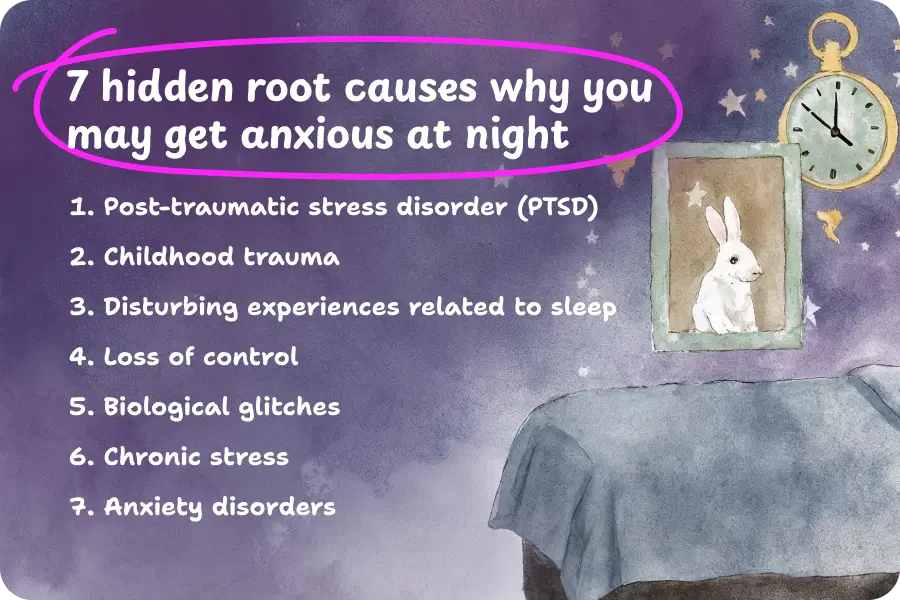
PTSD, fear of losing control, parasomnia, existential anxiety, and chronic stress may be closely linked to your fear of falling asleep. Let’s explore these and other reasons in detail.
1. Post-traumatic stress disorder (PTSD)
Studies prove that sleep disturbances co-occur with post-traumatic stress disorder (PTSD) in 70-90% of cases. [1] Marike Lancel, Hein J. F. van Marle, Maaike M. Van Veen, Annette M. van Schagen. “Disturbed Sleep in PTSD: Thinking Beyond Nightmares.” Frontiers in Psychiatry. 2021 People with PTSD may experience nightmares, insomnia, and heightened nighttime anxiety, which can make falling and staying asleep feel unsafe.
Hyperarousal and feeling vulnerable are key reasons why PTSD can make nights feel overwhelming. When it gets dark and everything becomes quiet, the usual daytime distractions fade, and intrusive thoughts can come up more easily.
2. Childhood trauma
Traumatic experiences from childhood might also cause sleep anxiety and, consequently, make mental health outcomes even worse. [2] Laskemoen JF, Aas M, Vaskinn A, Berg AO, Lunding SH, Barrett EA, Melle I, Simonsen C. “Sleep disturbance mediates the link between childhood trauma and clinical outcome in severe mental disorders.” Psychol Med. 2021 Kids who felt unsafe — due to neglect, constant conflicts between parents, or abuse they experienced — may learn to associate bedtime with danger rather than rest.

3. Disturbing experiences related to sleep (parasomnias)
Parasomnias are undesirable physical events or experiences that occur during the initiation of sleep, during sleep, or during arousal from sleep. [3] Fleetham JA, Fleming JA. “Parasomnias.” CMAJ. 2014 These may involve:
- Sleep paralysis
- Sleepwalking
- Regular nightmares
- Sleep talking
- Night terrors (waking up in panic, often without remembering why)
- Confusional arousals (feeling disoriented or not fully awake)
If you’ve ever experienced some of these, you might start associating sleep with fear or discomfort. For instance, if you’ve had the same dream where you’re falling or being chased over and over again, you may begin to dread falling asleep because you expect that experience to repeat.
4. Loss of control
You may fear losing control without fully understanding why. It can be especially common for people who tend to overthink and feel responsible for everything around them. “What if something happens while I’m asleep?” you may think, and this can make you lie in bed for two or three hours without being able to relax.
You might also believe that something is going to happen to you while you’re sleeping. Even small body sensations, like a change in breathing or a sudden heartbeat, can feel alarming and confirm that fear.

5. Biological glitches
Sometimes physical symptoms may be the cause of sleep concerns, not a symptom. If you feel shortness of breath, a sudden drop or spike in heart rate, or unusual sensations as you’re falling asleep, your brain may interpret them as danger signals. This, in turn, can turn on a fight-or-flight response (which makes it even more difficult to relax). And if such experiences repeat regularly, you may start thinking, “I don’t want to fall asleep again to avoid this feeling.”
Expert Insight
It’s important to rule out underlying medical conditions with your doctor. Certain diagnoses, like sleep apnea or restless sleep syndrome, for instance, can cause immense physical discomfort. Getting a proper diagnosis and treatment plan may support better sleep hygiene.

Nicole Arzt
Mental health professional
6. Chronic stress
Chronic stress activates the hypothalamic-pituitary-adrenal (HPA) axis and sympathetic nervous system, leading to elevated cortisol levels. [4] Cleveland Clinic. “Hypothalamic-Pituitary-Adrenal (HPA) Axis.” 2024 And if a person stays in this state for too long, their body remains in a state of fight-or-flight even at night. This makes it difficult to relax, as the brain continues to scan for threats instead of allowing sleep.
For instance, let’s say you have a tough month at work. You wake up at 6 am, bring the kids to school, come to the office, prepare reports, and sit through back-to-back meetings. By the time you get home, you feel exhausted. However, even when you finally lie down, your mind continues to race through tasks, conversations, and tomorrow’s to-do list. Instead of switching off, you feel wired and, as a result, experience sleep deprivation.
7. Anxiety disorders
People with anxiety-related mental health conditions may also experience sleep anxiety. These can include:
- Generalized anxiety disorder (GAD)
- Panic disorder
- Social anxiety disorder
- Health anxiety (hypochondria)
- Obsessive-compulsive disorder (OCD)
If you feel restless during waking hours, it may be challenging to calm down once you go to bed. For instance, a person with OCD may believe that they need to stay awake till sunrise, or otherwise something bad will happen, and someone with social anxiety might be scared of tomorrow’s job interview.
Recognizing sleep anxiety symptoms in the body and mind
Sleep anxiety may involve extreme fear of falling asleep, scary “what-if” scenarios, and a persistent sense that something bad might happen once you lose control. This fear shows up physically, too, and can involve sudden muscle twitches and a tight chest.
Mental symptoms
- Your mind can’t “switch off” and stays on high alert, making it hard to fall asleep.
- You create various scary scenarios before bed, which may involve both things that can happen while you stay asleep and worrisome thoughts about not waking up or losing control.
- The idea of being unconscious feels unsafe, as if you won’t be able to respond if something goes wrong.
- You feel afraid of a “time jump” and experience a weird feeling about how quickly time passes during sleep.
Physical symptoms
- Once you start to fall asleep, you may suddenly jerk awake with the feeling that your heart stopped or missed a beat.
- You might notice shallow or uneven breathing that makes you feel on edge.
- Your body can feel tense, restless, or unable to fully relax.
- You may also feel like you’re falling, which can wake you up.
Is it anxiety-induced insomnia or a phobia of sleep?
Sleep anxiety may stem from two conditions: anxiety-induced insomnia and somniphobia. While both of them lead to sleep disruption, the underlying cause is different: insomnia is driven by an overactive mind, whereas somniphobia is rooted in a direct fear of sleep itself.
| Aspect | Anxiety-induced insomnia | Phobia of sleep (somniphobia) |
| Main issue | Difficulty falling or staying asleep due to general anxiety | Strong fear of sleep itself |
| Emotional state before bed | Worry, overthinking, mental tension | Fear, panic, and a sense of danger are linked to sleep |
| Core thoughts | “I can’t switch my mind off.” | “Something bad will happen if I fall asleep.” |
| Physical response | Restlessness, mild tension, racing thoughts | Strong anxiety, panic symptoms, and avoidance of sleep |
| Severity pattern | Fluctuates with stress levels | More persistent and fear-driven |
This is anxiety-induced insomnia if you:
- Lie in bed with a mind full of thoughts.
- Feel tired physically, but mentally “switched on.”
- Sleep worse during stressful periods.
- Don’t fear sleep itself. You just can’t relax enough to fall asleep.
This may be sleep phobia (somniphobia) if you:
- Feel scared when it’s time to sleep.
- Avoid going to bed even when you’re very tired.
- Think something bad might happen while you sleep.
- Feel strong physical anxiety at bedtime (fast heartbeat, dread).
How to reduce anxiety at night: 4 actionable strategies
Whatever the reason for your sleep anxiety is, relaxing activities and coping techniques can help you manage it more effectively.
1. Try the “safety anchor” technique
If you feel afraid of losing control and experiencing that sudden overnight gap, use boring podcasts or white noise to fill the silence. You will hear a steady, predictable sound as you fall asleep (and in case you suddenly wake up), which makes the process feel less disturbing.
You can also hold a small object (like a worry coin) or hug a teddy bear to stay grounded. This thing becomes your “safety anchor” and gives your mind something familiar to focus on.
2. Use brain games to overcome sleep anxiety
Such games are called cognitive shuffling, and their goal is to scramble your thoughts so your brain can’t latch onto a logical, anxiety-inducing narrative. By forcing your mind to visualize random images, you mimic the fragmented thoughts that occur right before you fall asleep. This “tricks” the brain into thinking it’s safe to drift off.
The word-image method
- Choose a word that has at least 5-6 letters and no repeating letters (e.g., “planet”).
- For the letter P, visualize as many objects as you can that start with P. For example, penguin… pizza… pepper… piano…
- Don’t just think of the word. Try to visualize the object in your mind for 5-10 seconds. For instance, imagine the texture of the pizza or the sound of the piano.
- Once you run out of “P” words, move to L.
- Work your way through A, N, E, and T. Most people fall asleep before they finish the game.
The category scramble
If you find spelling difficult when you’re tired, try the category method.
- Pick a category. These can be fruits, animals, furniture, or any other things you can visualize.
- Name one item from that category for every letter of the alphabet. For fruits, these can be apples, bananas, cherries, etc.
- If you can’t think of one for a letter (like X), just skip it. The point isn’t to finish. The game aims to keep the thoughts random.
3. Shift environment to fall asleep faster
Sometimes, sleep anxiety may become stronger because the place you use for relaxation feels distressing. If you’ve had a few bad nights during the week, next time you go to bed, you might expect another nightmare.
Consider sleeping in a different location, such as your living room couch. You can also change small details like lighting or bedding to break that association. A slight shift in the environment can help your brain see the room as a safer space.
4. Do the progressive muscle relaxation technique
Progressive muscle relaxation can help your body switch from tension to rest. While lying in bed, slowly tense and release different muscle groups, starting with your feet and moving upward, then fully relax.
If you wake up during the night and feel anxious, you can repeat the same technique in a gentler form to calm your body. This helps your system associate both bed and wake moments with safety and relaxation.
5. Make lifestyle changes and ensure better sleep hygiene
Our daytime activities can lead to sleep anxiety as well. If you want to improve sleep quality and spend your evenings feeling less stressed, try the following:
- Don’t consume caffeine in the afternoon and evening
- Keep a consistent sleep schedule (go to bed and wake up at the same time)
- Limit blue light (using phone or laptop) at least an hour before bed
- Avoid alcohol or heavy meals at night
- Get regular physical activity during the day
- Create a calm bedtime routine to signal to your body that it’s time to rest
Nicole Arzt, LMFT, shares a tip for people who may experience sudden anxiety attacks in bed and for whom nothing of the above helps. “In some cases, you just need to ride out the anxiety if it strikes. Mindfulness and reminding yourself that this will pass can help neutralize the intensity of your panic. The more worry you attach to a certain thought, the stronger it becomes. So even if you still feel a bit reactive, keep affirming yourself that this feeling is transitory and will not last forever.”
Professional approaches for better night’s sleep
In some cases, sleep anxiety may be a deeper issue. If you find it difficult to cope with it alone or find your emotions overwhelming, it’s a good idea to reach out for professional help.
Cognitive behavioral therapy
CBT targets the thoughts and behaviors that keep the fear cycle going. Instead of focusing only on symptoms like difficulty falling asleep, it helps you understand why your mind has started linking bed with danger.
A key part of cognitive behavioral therapy is identifying unhelpful thoughts, such as “I won’t be safe if I fall asleep” or “Something bad will happen while I’m unconscious.” These thoughts are then gradually challenged and replaced with more realistic, neutral ones.
CBT also works with behavior patterns like avoiding sleep or overchecking the clock. A mental health professional can help you change these habits to start seeing the bed as a place for rest, not alertness.
EMDR and trauma processing
For people who have faced sleep-related trauma or have other forms of unresolved trauma, EMDR helps the brain reprocess distressing memories that get stuck in the nervous system. During a session, a therapist uses guided eye movements, hand taps, or auditory tones to engage both hemispheres of the brain.
This process mimics the natural memory filing that occurs during REM sleep, which allows the brain to move a traumatic event from the reactive amygdala to the more logical prefrontal cortex. For most people, after about 6-12 sessions, the sharp emotional sting fades, and the mind begins to recognize that the past threat is no longer present.
Medications
In more significant cases of sleep anxiety, a doctor may recommend short-term medication support. Therapy can address the underlying causes, while these medications help lower hyperarousal and stabilize sleep patterns. Medications are usually not a standalone solution but a temporary aid within a broader treatment plan.
Frequently asked questions
Can someone have a panic attack while sleeping?
Yes, these are called nocturnal panic attacks. The main symptoms include waking up from sleep feeling intense fear, difficulty breathing, sweating, shortness of breath, nausea, and a racing heart. Nocturnal panic attacks may happen without a specific trigger and can feel very sudden and disorienting, as if your body is reacting to danger while you’re still half-asleep. After an episode, it may become harder to fall back asleep due to the fear of it happening again.
How can lack of sleep and nighttime anxiety influence my mental health?
Sleep problems followed by anxious thoughts can worsen mental health by impairing emotional regulation, cognition, and mood stability. [5] Columbia University Department of Psychiatry. “How Sleep Deprivation Impacts Mental Health.” 2022 You may also notice increased irritability, difficulty concentrating, and a lower ability to cope with everyday stress. After some time, lack of sleep can intensify anxiety and create a cycle where worry makes it harder to sleep, and poor sleep makes the worry even stronger.
How can I fall asleep with anxiety?
To cope with sleep anxiety and insomnia, you may need to:
- Use techniques like box breathing exercise or the 333 rule for anxiety to stop dwelling on “what-if” scenarios.
- If thoughts keep coming, gently label them (“this is just a thought”) and return attention to your breath or body sensations.
- Try not to check the clock or your phone repeatedly, as it increases pressure to fall back asleep.
- If you’ve been awake for a long time, briefly get up and do something calm in dim light until sleepiness returns.
Sources
- Marike Lancel, Hein J. F. van Marle, Maaike M. Van Veen, Annette M. van Schagen. “Disturbed Sleep in PTSD: Thinking Beyond Nightmares.” Frontiers in Psychiatry. 2021
- Laskemoen JF, Aas M, Vaskinn A, Berg AO, Lunding SH, Barrett EA, Melle I, Simonsen C. “Sleep disturbance mediates the link between childhood trauma and clinical outcome in severe mental disorders.” Psychol Med. 2021
- Fleetham JA, Fleming JA. “Parasomnias.” CMAJ. 2014
- Cleveland Clinic. “Hypothalamic-Pituitary-Adrenal (HPA) Axis.” 2024
- Columbia University Department of Psychiatry. “How Sleep Deprivation Impacts Mental Health.” 2022
Disclaimer
This article is for general informative and self-discovery purposes only. It should not replace expert guidance from professionals.
Any action you take in response to the information in this article, whether directly or indirectly, is solely your responsibility and is done at your own risk. Breeze content team and its mental health experts disclaim any liability, loss, or risk, personal, professional, or otherwise, which may result from the use and/or application of any content.
Always consult your doctor or other certified health practitioner with any medical questions or concerns
Breeze articles exclusively cite trusted sources, such as academic research institutions and medical associations, including research and studies from PubMed, ResearchGate, or similar databases. Examine our subject-matter editors and editorial process to see how we verify facts and maintain the accuracy, reliability, and trustworthiness of our material.
Was this article helpful?