

If you often experience excessive worry, emptiness, or physical tension or feel like you can’t fully cope with traumatic events from the past, you don’t need a pep talk or “just think positive” clichés. What you may need is a different system.
Let’s find out how to do cognitive therapy at home to reduce anxiety, challenge negative thoughts, identify cognitive distortions, and build confidence.
What is CBT? Understanding CBT Techniques for Anxiety Disorders
Cognitive behavioral therapy (CBT) is a structured, evidence-based type of psychotherapy that helps people identify and change unhelpful thought patterns and behaviors that may cause them intense discomfort in daily life.
Cognitive therapy is typically goal-oriented and skills-based, meaning you actively use practical strategies during and outside of sessions.
If you’re curious about how your attention, thoughts, and focus patterns may be affecting you, take this quick ADHD test to gain more insight into your cognitive style and see what kind of support might help you most.
6 Powerful CBT Exercises at Home
Cognitive behavioral therapy targets the cognitive loop: your thoughts create your feelings, your feelings drive your behaviors, and your behaviors reinforce your thoughts.
If you wonder, “How can I do CBT at home?” here are 7 practical solutions to get out of your head, develop positive behaviors, and help your brain overcome anxiety at home.
1. Cognitive restructuring
Create a 5-column table:
| 1. Situation | What happened? (e.g., “Boss sent a ‘can we talk?’ invite.”) |
| 2. Initial thought | What did you tell yourself? (“I’m getting fired.”) |
| 3. Evidence for/against. | “He’s been quiet lately” vs. “I just finished a major project successfully.” |
| 4. Alternative thought: | “He probably wants an update on the project.” |
| 5. Outcome | Re-rate your anxiety level. Usually, it drops from a 9/10 to something more manageable. |
Why is it helpful?
This is the “core” of traditional CBT that teaches you to stop catastrophic thinking in challenging situations. Recent research shows that cognitive restructuring is an effective technique for reducing depressive symptoms by helping people identify and change distorted thoughts [3] Toussaint L, Nguyen QA, Roettger C, Dixon K, Offenbächer M, Kohls N, Hirsch J, Sirois F. Effectiveness of Progressive Muscle Relaxation, Deep Breathing, and Guided Imagery in Promoting Psychological and Physiological States of Relaxation. July 2021 .
2. Progressive muscle relaxation (PMR)
- Start in a comfortable position, sitting or lying down
- Begin with your toes and slowly move upward through your body
- For each muscle group:
- Tense the muscles as strongly as you can for about 5 seconds
- Notice the tightness and sensation of tension
- Then release suddenly and fully relax for 10–15 seconds
- Move step by step through:
- Toes → feet → calves → thighs → stomach → chest → hands → arms → shoulders → neck → face
- Toes → feet → calves → thighs → stomach → chest → hands → arms → shoulders → neck → face
- Focus on the feeling of relaxation after each release
- Breathe slowly and naturally throughout the exercise
Why is it helpful?
When you feel anxious, you may experience muscle tension. According to research, progressive muscle relaxation signals the vagus nerve that the “threat” has passed and physically forces your brain to calm down [4] Farris SG, Derby L, Kibbey MM. Getting comfortable with physical discomfort: A scoping review of interoceptive exposure in physical and mental health conditions. February 2025 . As a result, PMR reduces physical symptoms and teaches you the difference between the sensation of tension and the sensation of relaxation.
3. Interoceptive exposure
- Start by identifying which physical sensations you fear most (e.g., racing heart or dizziness)
- Choose one sensation to work with at a time
- Use simple exercises to recreate the feeling:
- Run in place for 30–60 seconds → to simulate a racing heart
- Spin in a chair → to create dizziness
- Breathe through a straw → to mimic shortness of breath
- Stay with the sensation and observe it without trying to stop it
- Remind yourself: “This is safe. This will pass.”
- Repeat the exercise regularly until the sensation feels less threatening
- Gradually increase intensity or duration as your tolerance builds
Why is it helpful?
Interoceptive exposure is a CBT technique that helps reduce fear of physical anxiety symptoms by intentionally and safely recreating them. This exercise involves safely mimicking the physical symptoms of a panic attack to show your brain they aren’t dangerous. This way, you are learning that a racing heart is just a body sensation, not a “heart attack.” This removes the fear of the fear itself, research shows [5] Kim Y-K. Panic disorder: Current research and management approaches. 2019 .
4. Challenge negative beliefs using cognitive defusion
Instead of saying, “I am useless,” say, “I am having the thought that I am useless.” Take it a step further: “I notice I am having the thought that I am useless.”
Why is it helpful?
This creates “mental space.” You realize that thoughts are just transient brain activity, like clouds passing in the sky, rather than absolute truths about who you are.
5. The thought record
- Identify the specific trigger. For example, your friend didn’t text back for 6 hours.
- Notice the automatic thought. What is your brain’s loudest, scariest interpretation? For example, “They find me annoying and are ghosting me”.
- Do the evidence check:
- Evidence FOR: “They were active on social media an hour ago.”
- Evidence AGAINST: “They usually take time to respond when they’re at work. Plus, we had a great time last weekend. They might just be tired.”
- Find the balanced perspective. A realistic middle ground can be: “They are likely busy or don’t have the energy to chat right now. It isn’t about my worth.”
Why is it helpful?
A thought record is a structured way to cross-examine the “inner critic” and stop taking things personally.
6. Breathing exercises for anxiety and anger management
1. Place one hand on your chest and the other on your belly.
2. Inhale slowly through your nose for 4 seconds, ensuring only the hand on your belly moves (your chest should remain still).
3. Hold for 2 seconds.
4. Exhale slowly through pursed lips for 6 seconds (like you’re blowing through a straw). The deep breathing stimulates the parasympathetic nervous system, which acts as a brake on the “fight or flight” response. This can help slow your heart rate, allow for the body to get more oxygen, and create space for the parts of your brain responsible for rationality and logic to come back online.
Why is it helpful?
When you’re anxious, your breathing becomes shallow and fast, which tells your brain you’re in danger. It also turns off the part of your brain that engages in executive functioning, things like rational judgment, prioritization of tasks, decision-making, and more. Diaphragmatic breathing (belly breathing) sends a physical signal to the brain to stand down, research shows [6] Hofmann SG, Hay AC. Rethinking avoidance: Toward a balanced approach to avoidance in treating anxiety disorders. March 2018 .
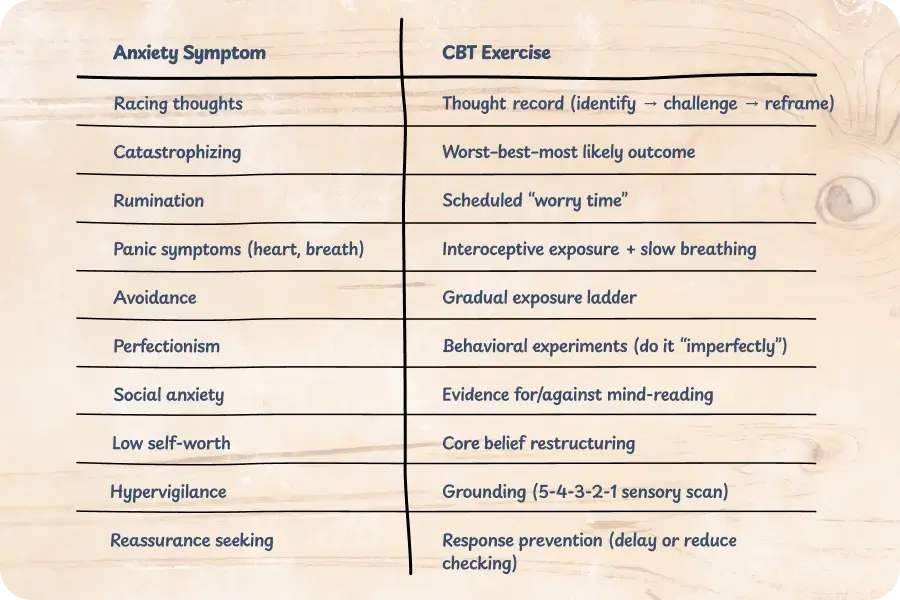
Creating Your Own CBT Homework for Anxiety
So, how to do behavior therapy at home? If you wonder how to stop overthinking, create simple homework such as:
1. Reducing avoidance behaviors using S.M.A.R.T. goals
- Pick an activity you’ve been avoiding due to anxiety.
- Break it down using S.M.A.R.T. goals (Specific, Measurable, Achievable, Relevant, Time-bound).
Why is it helpful?
Anxiety often leads to avoidance, research shows [6] Hofmann SG, Hay AC. Rethinking avoidance: Toward a balanced approach to avoidance in treating anxiety disorders. March 2018 . Behavioral activation allows you to re-engage with life in small steps, which provide a dopamine hit and help to ease anxiety.
2. Problem-solving training
- Define the problem. Be specific. Instead of “I feel worthless,” try “I am behind on three specific work reports.”
- Brainstorm solutions. Write down every possible action, no matter how small it feels.
- Evaluate and choose. Pick the easiest action.
- Break that one action into 5-minute tasks. For example, your task is to “finish the report.” In this case, a micro-step can be “open the Word document and type two sentences.” When you start with a 5-minute task, you bypass the “fear of failure” that may keep you paralyzed.
Why is it helpful?
According to research, anxiety often comes from a “global threat”, uncertainty, and the feeling that everything is too much [7] Brown VM, Price R, Dombrovski AY. Anxiety as a disorder of uncertainty: implications for understanding maladaptive anxiety, anxious avoidance, and exposure therapy. March 2023 . This training teaches you to treat problems like projects rather than catastrophes.
3. The “fear ladder” behavioral experiment
Create a “fear ladder” from 1 to 10:
- Level 1 (Easy). Saying “hello” to a cashier.
- Level 5 (Moderate). Asking a stranger for the time.
- Level 10 (Hard). Giving a toast at a wedding.
Why is it helpful?
If you avoid certain tasks because they make you feel anxious, this “ladder method” can help you climb back to confidence, a study on childhood anxiety disorders shows [8] Whiteside SPH, Biggs BK, Ollendick TH, Dammann JE, Tiede MS, Hofschulte DR, Reneson-Feeder S, Cunningham M, Sawchuk NR, Geske JR, Brennan E. Using Technology to Promote Therapist Use of Exposure Therapy for Childhood Anxiety Disorders: A Randomized Pilot Study. July 2022 .
4. S.T.O.P. Technique
When the spiral starts, use this practice:
For example, you are at a party or a meeting. You make a small joke that nobody laughs at. Naturally, you immediately think you’re “ugly” or “stupid” and want to leave.
- Proceed. Instead of spiraling, ask the person next to you a simple question about their day. Re-engage with the environment instead of retreating into your head.
- Stop. Stop scanning the room for people’s reactions. Just stand still for a second.
- Take a breath. Focus on the sensation of the air entering your nostrils.
- Observe. You feel embarrassed and “small.” The thought is “Everyone thinks I’m awkward.” The fact is, “People are likely just focused on their own conversations. One quiet joke doesn’t define my social worth.”
Expert Insight
A common mistake people make when implementing CBT skills independently is that they go in with expectations that it will solve the problem (or the unpleasant emotion) immediately. The CBT skills are meant to help reduce the intensity and practice more flexible thinking, but they do not remove the discomfort completely and may not be effective right away due to our thinking patterns being reinforced again and again over time.
Hannah Schlueter
Mental health professional
Advanced CBT Interventions for Anxiety: When to See a Professional
Self-help techniques and AI guidance can be useful starting points, but it may be time to consult a professional if you experience the following:
- Loss of function. You no longer feel fully present in your relationships or productive at work, and you avoid your friends.
- Physical somatization. Your anxiety has moved into your body in ways you can’t control. You feel chronic stomach pain, migraines, or “pseudo-seizures” that medical doctors can’t explain.
- You feel lost and stuck. You use grounding and breathing, but the intrusive thoughts return instantly.
- The safety behavior trap. You find yourself performing elaborate rituals (checking locks, seeking constant reassurance, or avoiding entire parts of town) just to feel “safe.”
A trained CBT therapist can provide structured exposure therapy, trauma-focused work, and mindfulness-based interventions:
- Cognitive processing therapy (CPT) is used primarily for trauma-related anxiety (C-PTSD). It focuses on deeply held beliefs like “I hate women” or “The world is 100% dangerous” and uses Socratic questioning to make positive changes.
- In vivo & imaginal exposure. While a “fear ladder” is great for small tasks, a professional can guide you through imaginal exposure (repeatedly recounting a feared memory) to reduce its power or in vivo exposure (physically going to feared locations) with real-time support.
- Relapse prevention planning. A mental health professional helps you map out your “early warning signs” (like subtle changes in sleep or social isolation) and builds a custom coping strategy so you never feel helpless during a crisis.
How to Stay Consistent with CBT Strategies for Anxiety
To truly succeed in managing stress and anxiety, you need to treat these exercises like a “workout” for your nervous system. The more you practice CBT therapy at home, the more effective it will be in feared situations:
- Set a regular time for practice. Put CBT practice in your calendar. Treat it like a therapy session you wouldn’t cancel. Routine reduces decision fatigue.
- Be specific and start small to avoid burnout. Instead of saying, “I’ll practice CBT every day,” commit to something concrete:
- 5 minutes of breathing each morning
- One thought record per day
- One small exposure per week
- Expect discomfort. CBT often involves facing fears or challenging negative beliefs. Progress happens outside your comfort zone.
- Get support when needed. If you struggle to stay consistent or feel stuck, working with a licensed CBT therapist can provide structure, accountability, and personalized guidance.
- Pair CBT exercises with existing habits, as they make consistency easier.
For example:- Practice grounding after brushing your teeth
- Review thought patterns during your lunch break
- Do breathing exercises before bed
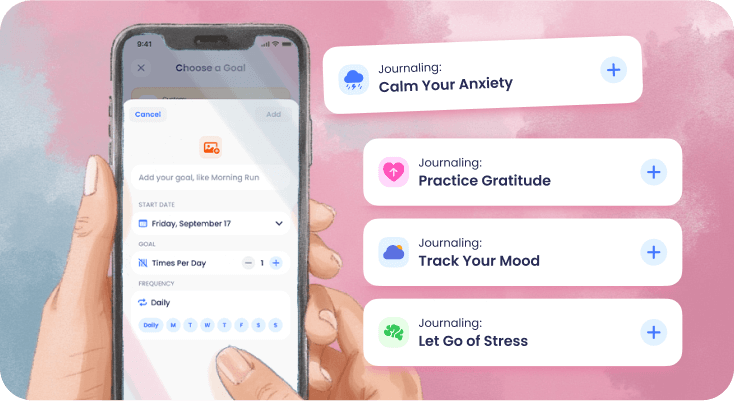
Breeze personalized routines help you transform self-care from something abstract into practical and repeatable exercises. The mood tracker in the Breeze app can help you stay consistent and motivated.
You may begin seeing patterns: irritability may follow poor sleep, or sadness may increase after social comparison on social media. Seeing these trends reduces self-blame and replaces confusion with clarity. You stop asking, “What’s wrong with me?” and start asking, “What patterns can I work with?”
Summary: The Path to Emotional Regulation
Once the nervous system shifts out of survival mode, your thoughts naturally become less extreme and more flexible. What previously felt like a permanent truth (“I hate people”) may soften into something more accurate, such as “I feel hurt” or “I need space.”
The path to emotional regulation may look like this: regulate the body, then evaluate the thoughts, then choose intentional behavior. Eventually, practicing this regulation strengthens neural pathways associated with resilience. You become less reactive and recover faster from stress.
Expert Insight
Cognitive Behavioral Therapy (CBT) has been deemed the “golden standard” of therapy for a while now; however, I think there is a lot of recent research that explores the integration of foundational CBT concepts with other evidence-based therapies. This is exciting because CBT is a great option for many, but it is not the only option and may not be a great fit for everyone.
Hannah Schlueter
Mental health professional
Sources
- Suma P. Chand; Daniel P. Kuckel; Martin R. Huecker. Cognitive Behavior Therapy. May 2023
- Bruno Santos, Lara Pinho, Maria José Nogueira,Regina Pires, Carlos Sequeira, Pilar Montesó-Curto. Cognitive Restructuring during Depressive Symptoms: A Scoping Review. June 2024
- Toussaint L, Nguyen QA, Roettger C, Dixon K, Offenbächer M, Kohls N, Hirsch J, Sirois F. Effectiveness of Progressive Muscle Relaxation, Deep Breathing, and Guided Imagery in Promoting Psychological and Physiological States of Relaxation. July 2021
- Farris SG, Derby L, Kibbey MM. Getting comfortable with physical discomfort: A scoping review of interoceptive exposure in physical and mental health conditions. February 2025
- Kim Y-K. Panic disorder: Current research and management approaches. 2019
- Hofmann SG, Hay AC. Rethinking avoidance: Toward a balanced approach to avoidance in treating anxiety disorders. March 2018
- Brown VM, Price R, Dombrovski AY. Anxiety as a disorder of uncertainty: implications for understanding maladaptive anxiety, anxious avoidance, and exposure therapy. March 2023
- Whiteside SPH, Biggs BK, Ollendick TH, Dammann JE, Tiede MS, Hofschulte DR, Reneson-Feeder S, Cunningham M, Sawchuk NR, Geske JR, Brennan E. Using Technology to Promote Therapist Use of Exposure Therapy for Childhood Anxiety Disorders: A Randomized Pilot Study. July 2022
Disclaimer
This article is for general informative and self-discovery purposes only. It should not replace expert guidance from professionals.
Any action you take in response to the information in this article, whether directly or indirectly, is solely your responsibility and is done at your own risk. Breeze content team and its mental health experts disclaim any liability, loss, or risk, personal, professional, or otherwise, which may result from the use and/or application of any content.
Always consult your doctor or other certified health practitioner with any medical questions or concerns
Breeze articles exclusively cite trusted sources, such as academic research institutions and medical associations, including research and studies from PubMed, ResearchGate, or similar databases. Examine our subject-matter editors and editorial process to see how we verify facts and maintain the accuracy, reliability, and trustworthiness of our material.
Was this article helpful?