

According to studies, social anxiety disorder (SAD) affects 15 million adults (7.1%) of the U.S. population. [1] Anxiety & Depression Association of America. “Anxiety Disorders – Facts & Statistics.” This test for social anxiety can help you find out whether you worry excessively about social events due to fear of judgment, embarrassment, or negative evaluation from others, or whether you’re simply experiencing natural shyness in certain situations.
Tips based on social anxiety test results
Now that you know whether you have moderate or severe social anxiety symptoms or none at all, it’s time to understand what those results mean for your daily life and how to respond.
Tips for those experiencing social phobia
- Make a list of social situations from least to most stressful (e.g., saying hello to a cashier, making a phone call, attending a gathering). Practice the easier tasks first before moving on to harder ones.
- Delay self-criticism. After a social interaction, wait 24 hours before analyzing it. This can help reduce the urge to replay every detail and assume the worst.
- Use a grounding technique when anxiety rises. Focus on five things you can see, four you can touch, three you can hear, two you can smell, and one you can taste to bring your attention back to the present.

Ashley Coon, MA, LPC, shares a simple yet effective insight: “A helpful thing to keep in mind is that people, more often than not, are a lot less concerned about our every movement than we think they are. Ask yourself this: Do you spend all of your time in public honing in on one individual and watching their every move? I doubt it!”
Tips for people who sometimes feel shy in social interactions
- Arrive a few minutes early. It is often easier to talk to people one-on-one before a room becomes crowded.
- Prepare three simple questions. For example: “How do you know the host?” or “What have you been working on lately?” This makes it easier to think of something to say.
- Give yourself a role. Helping with setup, bringing snacks, or greeting guests can make social situations feel more comfortable.
- Aim for one meaningful conversation. You do not need to talk to everyone. Instead, you can focus on connecting with just one person, as it already makes an event successful.
Ashley Coon, MA, Provisionally Licensed Counselor, adds, “Maybe you don’t struggle with full-blown social anxiety, but social interactions can make you uncomfortable from time to time. I get it! It’s important to be kind to that emotional response and ask yourself in that moment, “Why am I feeling uncomfortable right now?” Maybe you’re afraid everyone is looking at you funny or that you may misspeak. Whatever your fear may be, try to gently remind yourself that you’re not the only one who feels that way.”
Tips for people who feel confident in social situations
If you feel fine in social events, it’s a good idea to support others. Here’s how you can help people around you deal with stress.
- Notice who seems left out. Introduce them to the group or invite them into the conversation with a simple question.
- Balance talking and listening. Try to spend as much time asking questions as you do sharing your experiences.
- Practice social confidence in new settings. Attend a class, networking event, or community activity where you do not already know people.
What is social anxiety disorder (SAD)?
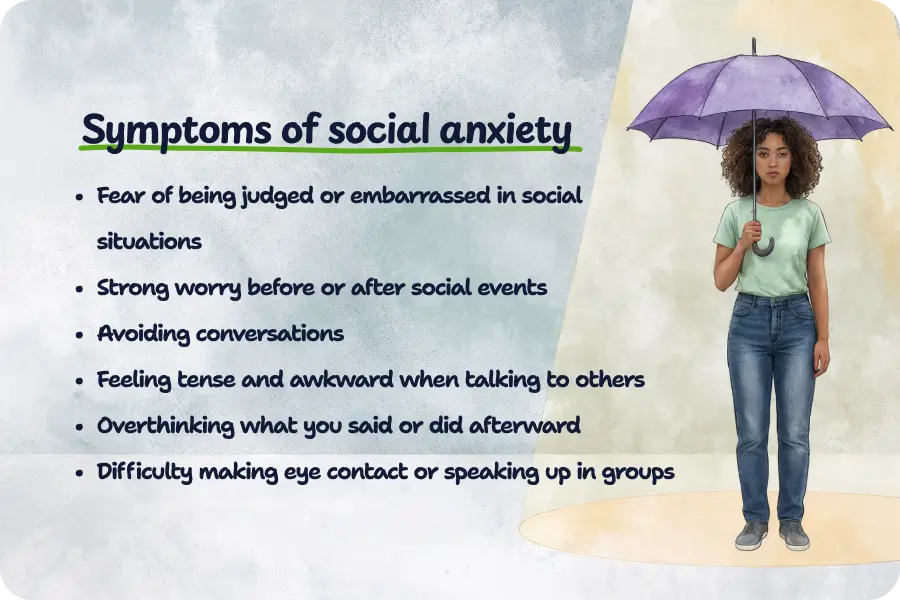
Social anxiety disorder is a mental health condition that involves a persistent fear of being judged or criticized in social situations. The symptoms of the disorder may include sweating, trembling, blushing, or a rapid heartbeat, as well as intense worry before, during, or after social interactions.
In severe cases, a person may avoid any social situations in general and experience intense distress when they need to connect with others, even in routine contexts.
Here are some situations that may feel particularly frustrating:
- Speaking in front of a group
- Meeting new people
- Making phone calls
- Eating or drinking in front of others
- Expressing opinions in group discussions
- Starting or maintaining small talk
This is how Reddit users describe their experiences:
- “I feel like I’m socially so awkward and naive, and I always end up saying the wrong things.”
- “I feel like I have to force myself to have conversations with people while everyone else does it with little to no effort.”
- “I had severe social anxiety as a teenager, to the extent of mild agoraphobia. It used to be unbearable for me to use public transport or even be seen by people outside of my bedroom.”
- “I don’t feel worthy of anything. I’m constantly trying to control what I say, and because of that, what I say becomes unnecessarily nonsensical.”

Social anxiety vs. shyness vs. introversion: What’s the difference?
You may feel anxious about everyday social situations due to natural shyness, introversion, or SAD. Here’s how to differentiate the core reason.
| Feature | Social anxiety | Shyness | Introversion |
| Core nature | Anxiety disorder related to fear of judgment | Temperamental discomfort in social situations | Personality trait focused on energy preference |
| Main feeling | Intense fear, worry, or panic in social settings | Mild nervousness or awkwardness at first | Preference for low-stimulation environments |
| Social interaction | Often avoided or endured with distress | Warm up over time, but may feel hesitant initially | Enjoyable in small doses, draining in large groups |
| Self-perception in groups | “I might be judged or embarrassed.” | “I feel a bit uncomfortable.” | “I need quiet time to recharge.” |
| Impact on daily life | Can significantly interfere with relationships/work | Usually mild and situation-based | No impairment, as it’s just a lifestyle preference |
| Physical symptoms | Sweating, shaking, rapid heartbeat | Slight tension or nervousness | No anxiety symptoms |
| Need for recovery | High after social exposure | Mild recovery needed | Strong need for alone time to regain energy |
Social anxiety and comorbidities: ADHD and autism
Social anxiety may overlap with ADHD and ASD, making it tricky to figure out where one condition ends and another begins. In fact:
- Prevalence of social anxiety in autistic individuals has been estimated to be as high as 50% (significantly higher than the estimates of 7-13% for the non-ASD population). [2] Montaser J, Umeano L, Pujari HP, Nasiri SMZ, Parisapogu A, Shah A, Khan S. “Correlations Between the Development of Social Anxiety and Individuals With Autism Spectrum Disorder: A Systematic Review.” Cureus. 2023
- The prevalence of ADHD in adolescents and adults with SAD ranged from 1.1% to 72.3%, while the prevalence of SAD in those with ADHD ranged from 0.04% to 49.5%. [3] Jakobsson Støre S, Van Zalk N, Granander Schwartz W, Nilsson V, Tillfors M. “The Relationship Between Social Anxiety Disorder and ADHD in Adolescents and Adults: A Systematic Review.” J Atten Disord. 2024
Are you thinking about whether your difficulties with communication stem from social anxiety symptoms only? Here are some signs that your social struggles might be tied to ADHD or autism rather than social anxiety alone.
Signs it might be autism (ASD) and social anxiety
- Challenges with understanding social cues. You genuinely struggle to intuitively read between the lines, detect sarcasm, or know when it’s your turn to speak. People with only SAD usually understand the rules perfectly but are terrified of breaking them.
- Social burnout from masking. You try to consciously understand other people’s body language, script conversations in advance, or force eye contact even though it feels uncomfortable. Afterward, you feel completely exhausted and need days of isolation to recover.
- Sensory overload. Big crowds, loud rooms, or bright lights overwhelm you. It may not be because you fear people, but because the sensory input feels physically painful.
Signs it might be ADHD and social anxiety
- The cycle of oversharing and isolation. Your impulsivity makes you blurt things out, interrupt others, or overshare personal details when excited. Once the dopamine fades, anxiety kicks in, and you spend days thinking that you’ve done everything wrong.
- Zoning out during conversations. You frequently lose focus when someone is talking to you because your brain struggles to hold attention. Your social anxiety then develops from the fear of being caught not listening.
- Rejection sensitive dysphoria (RSD). You experience an intense, almost physical emotional pain when you perceive even the slightest hint of criticism or rejection, especially from close people.
Next steps: How to test for social anxiety professionally and take care of your mental health
Professional evaluation
After taking the test for social anxiety from Breeze, you can reach out for professional support. A licensed mental health professional will use validated screening tools that help you evaluate avoidance behaviors and provide private results.
For instance, the Liebowitz Social Anxiety Scale is a gold standard for assessing social anxiety symptoms in different situations. It measures your reactions and behaviors across 24 situations and helps clinicians evaluate the severity of social anxiety and analyze the fear and avoidance associated with social interactions.
We asked Ashley Coon, MA, LPC, about how testing for social anxiety usually happens in therapy sessions: “Upon meeting your therapist, they will ask you to explain your mental health concerns, symptoms, struggles, and previous traumatic or difficult experiences. They may also ask you questions about your socialization as a child. You can express to them that you believe you struggle with social anxiety disorder if you feel comfortable. From there, your therapist may use the DSM-5 to go over the symptoms of social anxiety disorder with you. Depending on your therapist’s licensure and credentials, they may also utilize assessments and further diagnostic instruments. A mental health therapist will be able to discuss why you do or do not qualify for a social anxiety disorder diagnosis.”
Treatment
Of course, chasing the limelight all the time isn’t necessary to stay happy. Still, socializing is an important part of our lives. If you feel scared anytime you need to speak with a stranger, it may be helpful to get professional help to develop coping strategies for social anxiety.
Think of the following approaches:
- Cognitive behavioral therapy (CBT) helps identify and challenge negative thought patterns that contribute to social anxiety, replacing them with more realistic beliefs.
- Exposure therapy helps you gradually face social situations that make you anxious instead of avoiding them, so they become less scary and easier to handle over time.
- Acceptance and commitment therapy (ACT) teaches people to accept uncomfortable thoughts and feelings while focusing on actions that align with their values.
- Group therapy provides a supportive environment where you can practice social skills, share experiences, and realize you are not alone.
Both offline and online therapy can be helpful to treat social anxiety disorder or symptoms of social anxiety.
Frequently asked questions
What is social anxiety disorder? (SAD)
Social anxiety disorder is a constant, intense fear of social situations. People who live with SAD are afraid that others will judge them, criticize them, or watch their every move.
Those living with social anxiety find it challenging to ask for help, talk to strangers, or be in big groups of people, as well as avoid eye contact and feel nervous when starting conversations.
How to understand whether I have social anxiety or I’m an introvert?
Social anxiety is all about a deep-rooted fear of social interactions. It can make you want to steer clear of people and feel really anxious. Because of this, people with social anxiety might avoid any kind of communication.
Being introverted, on the other hand, just means you enjoy hanging out in smaller circles or spending time alone. It’s more about finding peace in quiet moments rather than avoiding social situations because of stress.
Social anxiety VS. autism. What’s the difference?
Both social anxiety and autism might involve challenges with social interactions. But while for SAD, this is the main sign of the condition, autism also usually involves:
- repetitive behaviors
- sensory sensitivities
- intense focus on certain topics, etc.
How to test for social anxiety?
Please note that only a licensed therapist can diagnose you with social anxiety or any other similar mental health condition. This social anxiety test is a free and simple tool to help you find out whether you experience the symptoms of the disorder. However, it isn’t a replacement for professional help.
If you’re worried about your results or find social situations tough, talking to a mental health expert can give you the support and answers you need.
Sources
- Anxiety & Depression Association of America. “Anxiety Disorders – Facts & Statistics.”
- Montaser J, Umeano L, Pujari HP, Nasiri SMZ, Parisapogu A, Shah A, Khan S. “Correlations Between the Development of Social Anxiety and Individuals With Autism Spectrum Disorder: A Systematic Review.” Cureus. 2023
- Jakobsson Støre S, Van Zalk N, Granander Schwartz W, Nilsson V, Tillfors M. “The Relationship Between Social Anxiety Disorder and ADHD in Adolescents and Adults: A Systematic Review.” J Atten Disord. 2024
Disclaimer
This article is for general informative and self-discovery purposes only. It should not replace expert guidance from professionals.
Any action you take in response to the information in this article, whether directly or indirectly, is solely your responsibility and is done at your own risk. Breeze content team and its mental health experts disclaim any liability, loss, or risk, personal, professional, or otherwise, which may result from the use and/or application of any content.
Always consult your doctor or other certified health practitioner with any medical questions or concerns
Breeze articles exclusively cite trusted sources, such as academic research institutions and medical associations, including research and studies from PubMed, ResearchGate, or similar databases. Examine our subject-matter editors and editorial process to see how we verify facts and maintain the accuracy, reliability, and trustworthiness of our material.
Was this article helpful?