



Everything seems pretty satisfactory. You have a stable job, a steady income, a comfortable home, and supportive people around you. From the outside, your life looks exactly the way it’s “supposed” to look. But you feel like something is wrong.
In the article, we’ll provide 10 possible answers to the question, “Why am I so unhappy when I have a good life? and explore what to do to finally feel fulfilled and happy.

10 reasons why people may feel unhappy even though they have a “good” life
You may feel frustrated and guilty even though you feel as if you have everything due to constant anxiety, unprocessed trauma, lack of purpose, cognitive distortions, and overthinking. Let’s explore these and other reasons in detail.
1. Lack of meaning or purpose
You don’t understand why you live or what your purpose in life is. These philosophical considerations have been worrying people for thousands of years. However, there’s no universal answer. Some people find meaning in building a family and raising kids; others pursue their dreams to see the world or build a business.
Studies have also proven that there’s a strong correlation between happiness and the degree of perceived meaning in life. At the same time, there’s little correlation between happiness and the pursuit of meaning. This may happen because constantly searching for a purpose can make people feel lost, especially when they feel they still haven’t found the “right” answer.
This is what may happen for people experiencing a “mid-life crisis” or even a “quarter-life” crisis. When you reach a certain milestone and realize that the traditional markers of success — like a stable career or a specific income bracket — don’t automatically translate into a sense of fulfillment, the void can feel overwhelming.
This gap between expectation and reality may trigger a period of introspection that can either lead to personal growth or a prolonged sense of stagnation.
2. Intense anxiety and chronic stress
You might have everything, but the price can be too high. For instance, you have a great position in a big company, but it causes you a significant amount of stress. Or maybe parenting feels rather challenging to you right now.
When the cortisol level is constantly high, it is difficult to feel truly happy. Chronic stress keeps your nervous system in a state of hyperarousal, where your brain is primed to look for threats rather than enjoy rewards.
The same goes for people who constantly worry about everything. Generalized anxiety disorder, social anxiety disorder, and recurring anxiety (even if it isn’t caused by a particular mental health condition) can turn a “perfect” reality into a minefield of potential disasters.

3. Routine and lack of novelty
Living in a Groundhog day can make you feel unhappy. You might have perfect relationships with friends and family, but if every day looks like wake up, work, leisure, sleep, and repeat, one day you may find yourself frustrated or bored.
Research shows that trying new things, often linked to novelty seeking, correlates with increased happiness and better mental health outcomes. This is because novelty triggers the brain’s reward system, releasing dopamine and creating new neural pathways.
4. Unprocessed trauma
Objective success does not shield a person from internal struggles. And if you live with trauma, it can still influence your self-esteem, sense of life satisfaction, and overall trust in people around you.
You might live a “good” life, but in reality, find it challenging to forgive your parents for neglect or emotional abuse. You may also experience a lot of distrust in relationships because someone cheated on you.
As a result, it can lead to mental health challenges that may not be immediately visible to others but act like a background noise that distorts your perception of reality. Even when you are surrounded by love and security, your nervous system may still be scanning for the “other shoe to drop,” preventing you from enjoying the success you’ve built.
5. Social expectations and comparison
Comparing yourself to others can be a quick way to start feeling unhappy about your life. Even if you have achieved your goals, seeing someone else who seems to have “more” can trigger feelings of inadequacy.
And in the age of social media, more and more people get caught in this trap. We start comparing ourselves to famous bloggers, celebrities, and even our friends and start thinking that they’re richer, have more fulfilling relationships, and live more exciting lives.
However, a few cognitive distortions can make these comparisons very misleading.
- People usually show only the best parts of their lives while hiding struggles, failures, and everyday problems. As a result, you may end up comparing your real life to someone else’s carefully edited highlights.
- You might see hundreds of videos and posts from other people every day. Some of them may travel, some may build a business, and some may raise kids. “I can’t cope with everything, so I’m a failure,” you may think. Still, these people don’t cope with everything as well. And you feel bad only because you compare yourself to the collective image of success of thousands of people.
6. Cognitive distortions
Other cognitive distortions may also negatively influence your own expectations of life and reduce overall happiness.
| Distortion | Description | Example in a “good” life |
| All-or-nothing thinking | Seeing things in black and white. If a situation isn’t perfect, it’s a total failure. | “I missed one gym training this week, so my entire routine is ruined.” |
| Disqualifying the positive | Rejecting positive experiences by insisting they were just luck. | “I got the promotion, but only because my boss was in a good mood that day.” |
| Catastrophizing | Expecting the worst-case scenario to happen, even when there is no evidence for it. | “My partner didn’t text back immediately. They must be planning to leave me.” |
| “Should” statements | Using “should,” “ought,” or “must” to pressure yourself. | “I should feel happy right now because I have everything I wanted.” |
| Emotional reasoning | Assuming that because you feel a certain way, it must be the objective truth. | “I feel like an impostor at this high-level job, so I must actually be incompetent.” |
| Mental filtering | Focusing exclusively on one negative detail and dwelling on it, ignoring the big picture. | One critical comment in a performance review makes you sad, even if the discussion was 95% praise. |
| Mind reading | Assuming you understand the thoughts, feelings, and intentions of other people. | “My friends only invited me because they felt obligated, not because they liked me.” |
| Fortune-telling | Predicting that things will turn out badly before they even happen. | “Even though this vacation is nice, I know something will go wrong on the way home.” |
7. The “arrival fallacy”
This term means a belief that you can’t feel happy until you achieve something specific (e.g., get a C-level role, start your own business, stop eating junk food completely, etc.). People who experience the “arrival fallacy” don’t focus on the journey and the way they reach their goal. They value only the result.
Nevertheless, when a person reaches the goal, it does not start to feel like a “better future,” which leaves some people quite confused. The previous dream doesn’t matter anymore, so people may start chasing the next goal, hoping it will finally bring a sense of accomplishment and overall happiness.
8. Feeling that something is missing
Imagine that you’ve got a checklist of what makes a “good life.” You have ticked every box, but despite this, you are haunted by a persistent, quiet feeling that there is still something missing.
Here are several reasons why it might be so:
- You have unfulfilling work. Maybe it covers your expenses, but you lack professional development, interest, a sense of contribution, or a big goal you’re helping to reach. Some people feel the inner need not only to work but also to help others or make the world a better place.
- You experience relationship challenges even if everything seems perfect at first sight. You might have a stable household and a shared social life, but if you don’t feel truly “seen” or supported in your darkest moments, the relationship becomes a source of loneliness.
- You want something entirely different. The understanding of a “good” life can vary from person to person. Maybe you live in a big city and have a six-figure job but in reality want to budget travel the world and experience other cultures. “It isn’t the life I want to live,” you may think, and it can cause frustration.
9. Toxic people around
If you surround yourself with toxic friends, it can negatively influence your mental state. Social support should motivate you to become a better person and bring happiness. However, if your friends constantly criticize your choices and undermine your confidence, even the best life can feel draining.
Pay attention if you hear phrases like:
- “You’re overreacting.”
- “Why are you even trying?”
- “That’s a stupid idea.”
- “You’re lucky anyone puts up with you.”
- “Don’t be so dramatic.”
- “You always mess things up.”
And if you lack boundaries to protect yourself and your desires, it can be even more challenging to find happiness.
10. Mental health issues
Some people may feel lost or frustrated because they deal with the symptoms of mental health challenges. Among the most common ones are:
Burnout
Burnout leads to a dysregulation of the hypothalamic-pituitary-adrenal (HPA) axis. Normally, cortisol spikes to help you meet a challenge and then drops. In burnout, the system becomes perpetually overactive.
Chronic high cortisol levels can shrink the hippocampus (responsible for memory and learning) and weaken the prefrontal cortex (responsible for executive function). This makes it physically harder to focus, solve problems, or feel rewarded by your successes.
Depression
Depression can be different. Some people may find it challenging to leave their bed or take a shower for weeks. However, there can also be high-functioning depression. In this case, a person may live a pretty “normal” life: work, meet with friends, and even laugh at jokes. But deep inside, they feel a persistent sense of hopelessness.
It happens because depression influences the brain’s reward system. In high-functioning depression, your cognitive functions remain intact enough to manage daily tasks, but the dopamine signaling is severely diminished. This creates a state of anhedonia, where the good events in your life fail to trigger an emotional reward.
Mental health conditions that can make you feel overwhelmed
While burnout and depression directly influence a person’s ability to feel happy and fulfilled, other mental health conditions can also contribute to persistent feelings of dissatisfaction, stress, or emotional exhaustion. These include:
- Anxiety disorders
- Obsessive-compulsive disorder (OCD)
- Attention-deficit/hyperactivity disorder (ADHD)
- Dysthymia (persistent depressive disorder)
- Post-traumatic stress disorder (PTSD)
- Sleep disorders
If you feel unhappy even though your life is full of positive things and fulfilling experiences, it may be helpful to reach out for professional support. Sometimes, only a mental health professional can help you understand the deeper reasons behind these feelings.
Hannah Schlueter, MA, LAC, comments, “Mood trackers are a great option for learning more about emotions and their contributors. Reflecting on if/when you felt happy or content versus if/when you felt unhappy throughout your day, week, or even month can provide more insight into the root cause.”
What scientists say about unhappiness
Scientists have studied the feeling of happiness from different perspectives. Here are the main insights you should be aware of if you feel sad without a clear reason.
- Hedonic treadmill is the tendency of humans to quickly return to a relatively stable level of happiness despite major positive or negative life changes. According to this theory, as a person makes more money or achieves more goals, expectations and desires rise in tandem, which results in no permanent gain in happiness.
- When people feel a lack of autonomy, competence, or connection with others, they may experience unhappiness and depressive symptoms even if their life circumstances seem good.
- The valuing happiness paradox suggests that societal pressure to always feel happy can backfire. When people experience normal negative emotions, this pressure can make them feel less satisfied with their lives. Studies show that when people believe they must stay positive all the time, they are more likely to criticize themselves.
- According to the research, trying to make someone else happy leads to greater subjective well-being than focusing only on making yourself happy. Helping others often creates a stronger sense of connection and meaning, which naturally boosts happiness.
5 tips to increase happiness and feel better daily
To feel better daily and start enjoying life, you need to start implementing daily habits that boost dopamine. These include physical activity, digital breaks, mindful life, and a proactive approach to things that make you feel stressed.
1. Take care of your physical health
Our body and mind are deeply interconnected. Physical health provides the biological foundation for your mental well-being. And if you neglect your physical well-being, it can also influence your overall level of happiness. Ensure you:
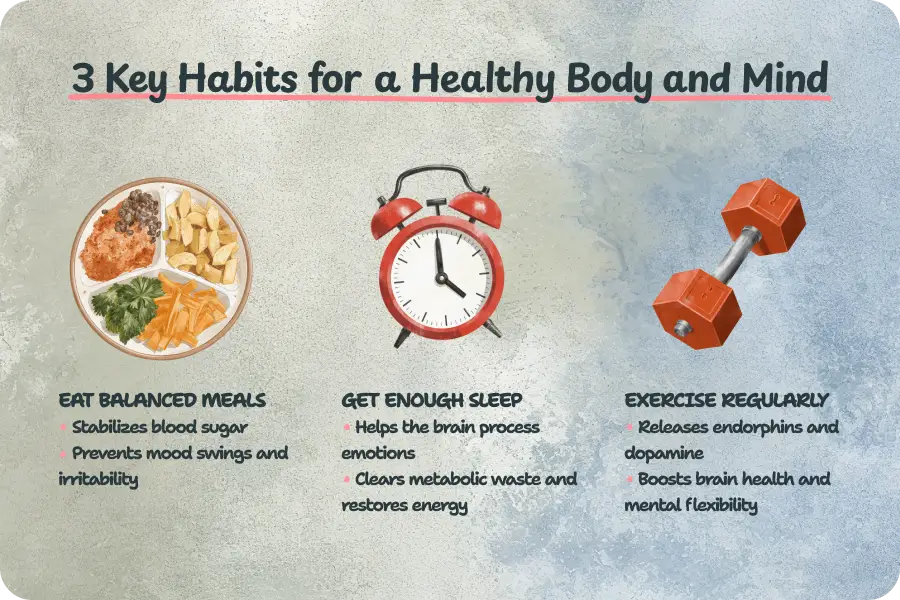
- Eat balanced meals to maintain stable blood sugar levels, which prevents irritability.
- Get enough sleep to allow your brain to process the day’s emotions and clear out metabolic waste through the glymphatic system.
- Engage in regular exercise to stimulate the release of endorphins and dopamine. Physical activity also increases brain-derived neurotrophic factor (BDNF), a protein that supports the health of your neurons and improves cognitive flexibility.
2. Seek “micro-novelty” to spike dopamine
You shouldn’t necessarily fly to the other continent to get out of routine. Even small activities that help you step off the beaten track can make you feel happier. For instance, you can:
- Take a different route to work.
- Try a new restaurant in your area.
- Listen to a music genre you normally don’t choose.
- Cook a recipe you’ve never tried before.
- Visit a new park, museum, or neighborhood.
- Start a small hobby, like sketching or journaling.
- Read a book from a genre you usually avoid.
Challenge yourself: every day try doing something you’ve never done before (or do it differently than you did before). One day you may find out that you enjoy watching documentaries, and the next day discover that you actually like early morning walks or a new type of music.
3. Organize your digital environment
Doomscrolling might be the answer to the question, “Why am I not happy, even though I have everything?” So, it is essential to curate your digital space just as carefully as your physical one.
To reclaim your focus and happiness, you should:
- Unfollow accounts that trigger upward comparison or make you feel inadequate about your lifestyle.
- Turn off non-human notifications to reduce the constant “startle response” in your amygdala. By choosing when to check your phone rather than letting it interrupt you, you reduce chronic micro-stress.
- Create “no-phone zones” in your home, particularly in the bedroom and at the dining table. This helps your brain associate specific spaces with relaxation rather than information overload.
4. Practice grounding during routine tasks
Grounding techniques help you stop catastrophizing and calm your mind when it starts spiraling into worries about the past or the future. Try this:
- Journaling. When you write down your worries, they stop dwelling in your head and turn into challenges that need solutions. You can use journaling prompts in the Breeze app, as they’re designed to provide clarity and help you feel much better after a few minutes of writing.
- Meditations. Even a short guided meditation can help you slow down, notice your thoughts without judging them, and bring your attention back to the present moment.
- Breathing exercises. Simple breathing techniques, like box breathing or counting your inhale and exhale, can calm your nervous system and quickly reduce stress.
5. End rumination and engage in problem-solving
You may have a good life but spend too much time dwelling on “what-ifs,” turning even the small problem into a spiral of worry. If this feels relatable, follow this simple routine.
- If you can fix the problem, create a step-by-step plan of what you’re going to do and then follow it. For instance, if you’re worried about work performance, list the tasks you need to complete, break them into smaller steps, and start with the easiest one. Taking action often reduces anxiety more effectively than thinking about the problem again and again.
- If the situation is outside your control, try to shift your attention to something constructive. You can talk to your best friend, do another task, or engage in physical activity. This helps break the cycle of rumination and gives your mind a chance to reset.
Expert Insight
“I think there’s a lot of pressure to experience happiness and also to feel happy most, if not all, of the time. Unpleasant emotions are normal to an extent, and we may not always fully understand why. The first step could be to remove any internal judgment from your feelings in order to more deeply explore the information they are trying to provide.”

Hannah Schlueter
Mental health professional
Sources
- Sameer Y, Eid Y, Veenhoven R. “Perceived meaning of life and satisfaction with life: A research synthesis using an online finding archive.” Front Psychol. 2023
- “Scientists Pin Down a Link Between Happiness and 1 Daily Activity.” Association for Psychological Science. 2020
- Nunez SG, Rabelo SP, Subotic N, Caruso JW, Knezevic NN. “Chronic Stress and Autoimmunity: The Role of HPA Axis and Cortisol Dysregulation.” Int J Mol Sci. 2025
- Diener, Ed & Lucas, Richard & Scollon, Christie. (2006). “Beyond the Hedonic Treadmill.” American Psychologist.
- Pietrek A, Kangas M, Kliegl R, Rapp MA, Heinzel S, van der Kaap-Deeder J, Heissel A. “Basic psychological need satisfaction and frustration in major depressive disorder.” Front Psychiatry. 2022
- Nunez SG, Rabelo SP, Subotic N, Caruso JW, Knezevic NN. “Chronic Stress and Autoimmunity: The Role of HPA Axis and Cortisol Dysregulation.” Int J Mol Sci. 2025
- Titova, Milla & Sheldon, Kennon. (2021). “Happiness comes from trying to make others feel good, rather than oneself.” The Journal of Positive Psychology.
Disclaimer
This article is for general informative and self-discovery purposes only. It should not replace expert guidance from professionals.
Any action you take in response to the information in this article, whether directly or indirectly, is solely your responsibility and is done at your own risk. Breeze content team and its mental health experts disclaim any liability, loss, or risk, personal, professional, or otherwise, which may result from the use and/or application of any content.
Always consult your doctor or other certified health practitioner with any medical questions or concerns
Breeze articles exclusively cite trusted sources, such as academic research institutions and medical associations, including research and studies from PubMed, ResearchGate, or similar databases. Examine our subject-matter editors and editorial process to see how we verify facts and maintain the accuracy, reliability, and trustworthiness of our material.
Was this article helpful?