



Being a parent isn’t easy, and setting rules is part of the job. But when rules are set without explanation or empathy, children may struggle emotionally and socially.
Among other parenting styles, such as permissive, authoritative, and neglectful, authoritarian parents are the most strict and demanding. In this article, we focus on authoritarian parenting, its impact on children’s mental health, and why balancing discipline with understanding is so important.

What Is Authoritarian Parenting?
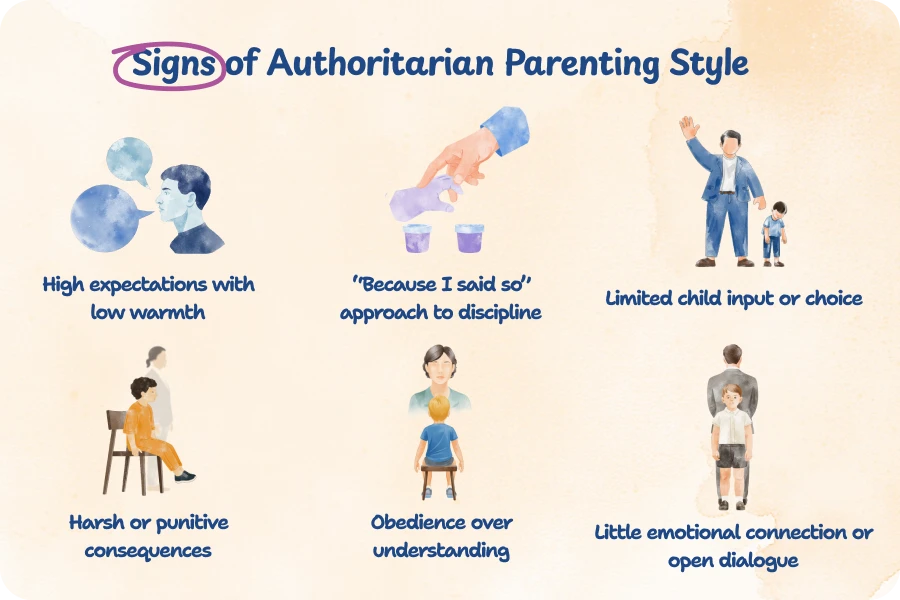
An authoritarian parenting style is characterized by strict rules, high expectations, and a consistent system of rewards and punishments. Conversations in the authoritarian parenting style are mostly the parent talking and the child listening.
Kids in families with this style of parenting generally aren’t encouraged to share their opinions, feelings, or ideas. Family decisions get made without any input from the children, even when those decisions directly affect them. Authoritarian parents usually offer little emotional support, and the child obeys them primarily out of fear, according to research on parenting styles.
Characteristics of authoritarian parenting:
- high expectations for achievement and performance;
- the demands placed on the child don’t always match their age or developmental level;
- the parent believes that only they know what is best for the child;
- strict control of personal space and interests, and the imposition of developmental activities;
- punishments for failure;
- prohibitions and threats instead of seeking compromise.
If it sounds like your parents’ behavior pattern, you may be wondering how this harsh parenting can impact your life.

8 Signs and Examples of Authoritarian Parenting Style
Wondering whether you have an authoritarian parenting style? You may find it out right away by taking the parenting style quiz. Here’s more about what authoritarian parenting may look like:
1. They have a “Because I said so” mindset
When a child asks authoritarian parents why they have to do something, the response is rarely an actual explanation. It’s more like “Because I’m the parent” or “You’ll do it because I told you to.” There’s no discussion, no room for the child to understand the reasoning. The parents’ authority itself is supposed to be reason enough.
For example, a kid might ask why they can’t go to a friend’s house. Instead of hearing “I don’t know their parents well enough yet” or “You have homework to finish first,” they just get “The answer is no, and I don’t want to hear another word about it.” The conversation is over before it starts.
2. They set rigid rules without flexibility
Authoritarian parents tend to have a lot of rules. Bedtime is 9 pm, period. It doesn’t matter if it’s a weekend, if the kid isn’t tired, or if there’s a special occasion. Homework must be done immediately after school with no exceptions, even if the child is exhausted or has had a rough day.
3. They use punishment for mistakes
Instead of teaching and supporting their child, authoritarian parents impose strict punishments for mistakes. For example, a child spills juice on the carpet, and instead of showing them how to clean it up and explaining that accidents happen, they get yelled at or sent to their room. The focus is on making the child feel bad for the mistake rather than helping them learn from it.
If a kid comes home with a bad grade, an authoritarian parent might ground them for a month and take away their phone, but they won’t sit down to figure out what went wrong. Is the child struggling with something? Do they need a tutor? The punishment is the response.
4. They don’t provide emotional support
Authoritarian parents typically don’t teach their children how to feel their feelings, making them wonder, “Why am I so sensitive?” If a child is crying because they’re scared of the dark, they might be told, “There’s nothing to be afraid of, stop being a baby.” Or, if they’re anxious about a test, they hear “You should have studied harder” instead of reassurance.
5. They are overprotective
Authoritarian parents tend to be overprotective and overbearing. They don’t trust their child to make independent decisions and fear that they may fail. For example, a responsible 16-year-old asks about getting an after-school job, and the parent shuts it down immediately with “You’re not ready for that”.
6. They set high expectations, but don’t give praise
Authoritarian parents expect a lot, such as good grades, perfect behavior, help around the house, and respect for adults. Just like narcissistic parents, they don’t balance those expectations with praise, affection, or recognition when the child meets them. Doing well is simply what’s expected, not something to celebrate.
For example, a kid might bring home a report card with all A’s and one B, and instead of hearing “Wow, you worked so hard, I’m proud of you,” they get “What happened with that B? You need to do better in math.” The one perceived failure eclipses all the successes.
7. They compare their kid with other children
Authoritarian parents may compare their child to others, emphasizing their shortcomings and the achievements of other children. It gets even worse with siblings, when parents say something like, “Why can’t you be more like your sister? She never talks back”, creating dysfunctional family roles where one child can be a black sheep.
8. They control their children and lack privacy
Parents with an authoritarian style may monitor everything their kids do to an extreme degree, not out of reasonable concern but as a way to maintain total control. They might go through phones without permission or interrogate their children about every detail of their day. For instance, a teenager might have their bedroom door removed because “You don’t need privacy from me, I’m your parent.”
What Causes the Authoritarian Parenting Style?
Authoritarian parenting usually develops from a mix of personal experiences, beliefs, and environmental factors:
1. How someone was raised
Many authoritarian parents were raised by emotionally immature parents who lacked skills in how to be emotionally available. They may have struggled to recognize or manage their own emotions, so they relied on control, rules, or punishment.
Or, their authoritarian parents believed that firmness and control prepared kids for a harsh or competitive world. If they were taught that obedience equals respect, they may naturally repeat the same style with their own children.
For example, a child who was told to “stop crying” or “do as you’re told” may grow up believing that emotions are a weakness. As adults, they may repeat this pattern with their own children, using strict rules and criticism because they were never shown how to offer empathy, reassurance, or open communication.
2. Anxiety and fear about a child’s future
Parents who worry a lot may think strictness will keep their child safe, successful, or out of trouble. They tend to believe that the stricter the rules, the less room should be allowed for mistakes.
3. Desire for control
Some parents feel a strong need to maintain order or avoid uncertainty because they struggle deeply with uncertainty themselves. In this case, strict rules and excessive control provide them with a sense of stability and authority.
4. Personal stress
When parents feel overwhelmed, exhausted, unsupported, or experience burnout, they may set rigid discipline because it seems faster or easier than emotional engagement. For instance, families facing financial stress, unsafe environments, or limited resources may adopt strict, no-nonsense parenting as a survival strategy.
5. Misunderstanding of effective discipline
Some believe that being warm, flexible, or empathetic will lead to “spoiled” children. They may not realize that firm boundaries can coexist with warmth.
5 Effects of Authoritarian Parenting on Children
Typically, strict parenting can lead to negative outcomes for a child’s emotional well-being:
1. Low self-esteem
To teach a child a lesson, authoritarian parents may withhold love, showing that it must be earned. First, the child must clean their room or get an A on a test, and only then can they be praised. Therefore, the more conditional the support a child receives, the lower their sense of self-worth tends to be.
When a child fails to live up to their authoritarian parents’ expectations, they may begin to see themselves as incapable of success and feel worthless. As adults, they are more likely to be manipulated, develop people-pleasing tendencies, and be afraid to express their opinions and argue.
2. Dependency
Children raised by authoritarian parents may grow up to be dependent and passive, lacking interests, and feel lost in life because they are used to being told what to do rather than making their own choices. They may fear making decisions, expressing desires, and taking action.
3. Rebellion
Some, on the contrary, become very independent because they don’t want to be negatively judged and feel like a failure if they make a mistake. As adults, they may develop a fear of intimacy because this mindset can make it difficult for them to trust others and be vulnerable in relationships.
4. Tendency to depression
Children who grow up in an atmosphere of total control, excessive demands, and pressure from their parents are more prone to chronic stress, overthinking, and depression, research shows.
5. Withdrawal and conservatism
Living under constant restrictions, a child becomes accustomed to the idea that nothing depends on them. As a result, they may lose their open-mindedness, seeing only the imposed paths and rejecting the opportunity to think or live another way than the way their parents lived.
Expert Insight
Authoritarian parenting often creates an environment where obedience is prioritized over emotional connection, which can limit a child’s sense of safety and self-expression. Children raised this way may struggle to trust their own judgment because their feelings and perspectives were not consistently validated. Over time, this approach can interfere with healthy autonomy and healthy emotional regulation, which can translate into issues with relationships in adulthood.

Rychel Johnson
Mental health professional
Authoritative vs. Authoritarian Parenting
Although the terms sound similar, authoritative and authoritarian parenting are very different in practice and impact. Authoritarian parenting is strict and controlling, with high demands and little emotional warmth, often expecting obedience without explanation. Authoritative parenting also sets clear rules, but combines them with warmth, open communication, and respect for the child’s perspective.
According to research on different parenting styles, the authoritative style is considered the most effective parenting style that contributes to further life satisfaction in young people. Moreover, an authoritative parenting style is most protective against risky behavior.
Here are the main characteristics of an authoritative parenting style:
- the parent sets clear boundaries while being supportive;
- the child is given an explanation of the reasons for the rules and expectations;
- the parent encourages a child’s independent development;
- a child is involved in family decision-making, their opinions are sought, and, whenever possible, taken into account;
- relationships are based on mutual agreement between the child and parent.
The authoritative style combines discipline with warmth and responsiveness. An authoritative parent sets boundaries, explains the process, and demands age-appropriate behavior from their child, while also inspiring and supporting them. To encourage compliance, authoritative parents don’t use force but apply flexible control. When the child makes an effort to meet expectations or achieve goals, the parent responds with praise and approval. As a result, a child usually feels loved and respected and develops emotional intelligence, critical thinking, confidence, and decision-making skills.
On the contrary, the relationship between children and authoritarian parents typically lacks trust and intimacy because the children don’t feel supported and can be afraid to approach their parents with problems.
Expert Insight
Authoritative parenting balances clear boundaries with emotional attunement, while authoritarian parenting emphasizes control with little room for warmth or dialogue. Authoritative parents set expectations but remain curious about a child’s feelings and perspective, which helps children internalize values and develop self-trust. In contrast, authoritarian parenting relies on fear or obedience, often teaching children to comply without understanding, which can undermine a child’s emotional security over time.
Rychel Johnson
Mental health professional
7 Tips to Improve Your Parenting Style
Here’s how to find a balance between setting boundaries and encouraging independence, and create a healthy environment for children’s cognitive and emotional development:
1. Practice mindful listening
Set aside 10–15 minutes each day for an uninterrupted conversation with your child. Put away your phone and fully focus on them. Instead of immediately giving advice or correcting behavior, reflect on what your child says.
Ask open-ended questions like “How did that make you feel?” or “What do you think could help next time?” To help your child feel heard and understood, validate their feelings with phrases like “It sounds like you felt upset when that happened.”
Practicing mindfulness can help you stay calm and present during these moments. Breeze can support this process and offer you guided mindfulness exercises and reflection tools that help you build emotional awareness, regulate your reactions, and be more attentive in everyday conversations with your child.

2. Use conditional-free affirmation
Each day, try to identify one behavior or trait to affirm that isn’t tied to performance. You may say something like “I love spending time with you,” or “I notice how curious you are about the world.”
The goal is to praise effort and personal qualities, not just results. Your words may help your child learn how to love themselves, build their self-esteem, reduce anxiety, and encourage intrinsic motivation.
It’s also helpful to practice positive affirmations for yourself, as children may absorb how parents speak to themselves. Simple affirmations include:
- “I am doing my best as a parent.”
- “I can stay calm and respond with patience.”
- “I am allowed to learn and grow, too.”
- “Mistakes don’t define me.”
In the Breeze app, you’ll find daily affirmation prompts and gentle reminders helping you stay motivated and grounded.

3. Set collaborative boundaries
Make rules consistent but stay open to discussion. For example, for homework or chores, ask, ”Which order works best for you to get these done?” When you involve your child in setting expectations, they learn responsibility and reduce rebellion and secretiveness.
4. Explain rules
Avoid saying, “Because I said so”. Instead, explain the reasoning behind your rules: “You need to finish your homework before playing because schoolwork helps you learn responsibility.” It can help a child feel respected and included.
5. Encourage autonomy through guided choice
Offer choices within safe boundaries to develop the child’s decision-making skills while maintaining structure. For example, “Do you want to do your reading before or after dinner?” or “Which of these two shirts would you like to wear?”
6. Reflect on your triggers
Keep a short journal for one week, noting moments you felt frustrated or angry with your child. Include what happened, how you reacted, and why you think you reacted that way.
For instance, you may write, “My child refused to clean their room after repeated reminders. I raised my voice and felt impatient. Later, I realized I was stressed from work and expected them to follow instructions immediately, without considering their mood or energy”.
Then, try to identify patterns in your emotional responses. Maybe you notice that certain times of day, tasks, or your own stress levels trigger stronger reactions. If you recognize these patterns, it may help you respond less impulsively and reduce harsh discipline.
Breeze journaling can help you track your emotions, reflect on triggers, and improve your emotional connection with your child.

7. Schedule connection rituals
Set up regular, positive moments with your child to build connection and emotional security. It can be bedtime reading, weekend walks, or “talking lunches.” This interaction doesn’t have to be long or complicated, but consistency matters more than duration.
Frequently asked questions
1. What is the most effective parenting style?
Research consistently shows that the authoritative parenting style is the most effective. It combines clear boundaries and expectations with warmth, communication, and emotional support. Children raised by authoritative parents tend to develop better emotional regulation, confidence, social skills, and academic performance.
2. What do authoritarian parents use for discipline?
Authoritarian parents often rely on strict rules, punishment, and obedience rather than teaching or guiding. Instead of explaining the meaning behind rules or coaching behavior, they tend to use:
3. Why is authoritarian parenting unhealthy?
Authoritarian parenting can be harmful because it focuses on control over connection. Children raised under this parenting style are more likely to experience:Sources
- Ariana Awiszus, Melissa Koenig, Julie Vaisarova. Parenting Styles and Their Effect on Child Development and Outcome. August 2022.
- Mengge Li, Lijun Fan, Jirui Wang, Peng Ma, Huoliang Gong, Zikan Deng, Jiankun Su, Yuan Gao. Influential factors of depression: The impact of harsh parenting, school support, and rumination. February 2024
- Lavrič M, Naterer A. The power of authoritative parenting: A cross-national study of effects of exposure to different parenting styles on life satisfaction. September 2020
Disclaimer
This article is for general informative and self-discovery purposes only. It should not replace expert guidance from professionals.
Any action you take in response to the information in this article, whether directly or indirectly, is solely your responsibility and is done at your own risk. Breeze content team and its mental health experts disclaim any liability, loss, or risk, personal, professional, or otherwise, which may result from the use and/or application of any content.
Always consult your doctor or other certified health practitioner with any medical questions or concerns
Breeze articles exclusively cite trusted sources, such as academic research institutions and medical associations, including research and studies from PubMed, ResearchGate, or similar databases. Examine our subject-matter editors and editorial process to see how we verify facts and maintain the accuracy, reliability, and trustworthiness of our material.
Was this article helpful?