


You’ve thought about reaching out for mental health support dozens of times. Perhaps your friend has shared that they are attending therapy and now feel much better. Or, maybe, you experience significant changes in your life and find it challenging or isolating to deal with your emotions.
“But my problems aren’t serious enough for therapy.” If these are your thoughts, keep reading. We’ve collected the signs that you need therapy and will explain how to get the most out of it.

10 signs that you need to work with a licensed therapist
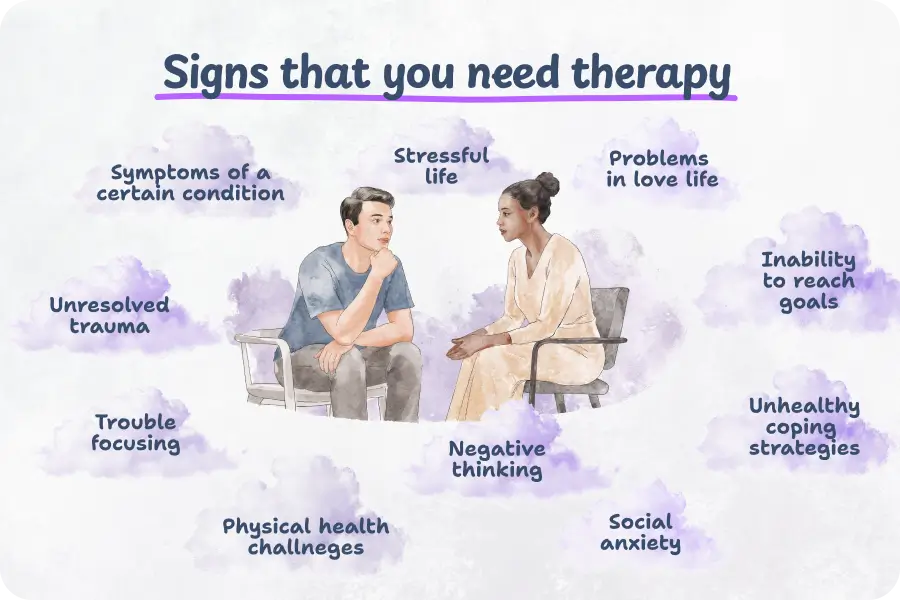
People may need help from a mental health professional if they experience consistent stress, challenges in relationships, or difficulty managing emotions. Mental health care will also be beneficial for those who deal with past trauma or suspect themselves of living with an undiagnosed mental health condition. Let’s explore these signs in detail.
1. You face a lot of stress in daily life
If you’ve recently experienced a major life change, such as moving to another city, quitting a job, breaking up, or starting a new career, therapy sessions can help you find balance as you adjust to your new normal. Symptoms of stress, such as intense anxiety or anger without a clear reason, as well as feeling constantly unhappy, may develop gradually. So, it’s better to notice them from the very beginning and reach out for support to take care of your well-being.
2. Your sleep, appetite, and level of energy are far from good
Physical health challenges like hormonal imbalances or vitamin deficiencies and constant overstimulation may be the reasons why you feel drained. However, if your workload is balanced and your physical health is all right, exhaustion might stem from mental health issues like burnout or depression.
Here are some warning signs:
- You find it challenging to fall asleep or feel tired in the morning.
- You eat much more or less than usual.
- You experience frequent headaches, muscle tension, body pain out of nowhere, and digestive problems.
- You lack energy even after a good rest.
3. Unresolved trauma affects your present
Psychological trauma changes life perspective and can cause adaptation or stress-related disorders. If you’ve experienced emotional abuse and neglect in childhood, lived in a dysfunctional family, or had a narcissistic parent, it may still influence how you perceive the world. Consultation with a mental health provider can be helpful to notice specific patterns linked to those experiences and evolve to establish a more fulfilling life experience.
The most common symptoms of childhood trauma are:
- Difficulty trusting others
- Low self-esteem
- Avoiding reminders of past events
- Strong reactions to small triggers
- Challenges in controlling your anger or sadness
- Using distractions to chronically evade reminders of past events
If you face these issues but don’t remember any traumatizing event, you might live with repressed trauma. Your mind may have blocked painful memories to protect you, but the emotional effects can still show up in day-to-day life.
4. Negative thinking seems to follow you everywhere
The guilt complex, lack of self-care, perfectionism, and internalized fatphobia are only a few reasons why you might self-loathe. But whatever the case is, constant self-criticism signals that you need support in changing core beliefs. The right therapist will help you identify patterns that contribute to negative self-perception (such as black-and-white thinking, perfectionism, or overgeneralization) and teach you to replace them with more positive beliefs.
5. You can’t keep up with the tasks
Attention-deficit/hyperactivity disorder (ADHD) is a mental health condition. In some cases, it can significantly influence our ability to manage everyday tasks or communicate with others. While it is heritable and can be diagnosed in childhood, many people (especially women) may find out that they live with ADHD only in adulthood.
Contact a mental health provider if you face:
- Difficulty concentrating
- Trouble with time management difficulties
- Constant restlessness
- Frequent impulsive decisions
- Regular procrastination
Try Breeze if you’re not ready to reach for professional guidance. A free ADHD test will let you find out whether you may live with the disorder. Spend 10 minutes of your time and get personalized insights on how to get your life together.
6. Unhealthy coping mechanisms bring temporary relief
Anytime you feel overwhelmed or stressed, a bottle of wine seems like the quickest way to calm your mind. Life feels hopeless, and the only way to handle it is to reach for something that offers immediate relief. You woke up in the morning to find that your feelings hadn’t gone away and that you didn’t feel better. If so, contact a good therapist to change the way you deal with stress and avoid developing an addiction.
Check yourself whether you turn to such unhealthy coping on a frequent basis:
- Substance abuse
- Binge eating
- Spending a lot of time online
- Compulsive shopping
- Self-harm
- Social isolation
7. Every day is monotonous and repetitive
You set goals and tried to reach them, but nothing changed. Even though you do your best to reach your dreams, it feels like something is holding you back.
Therapy is a safe space where you can explore why your mind creates this mental block. Together with a skilled professional, you’ll discover your fears, identify limiting beliefs, find out why your mind prefers to stay in a comfort zone, and learn how to reach personal growth faster.
8. You want to feel more comfortable in communication with others
For those who feel out of place in social settings, therapy can give tools to express oneself confidently. In particular, you may consult a specialist to improve emotional intelligence, learn to read social cues, build confidence in conversations, and become a better friend.
9. You keep meeting partners with the same toxic patterns
The way relationships develop always depends on two partners. But if you regularly meet people who employ gaslighting, super-intense jealousy, financial abuse, or other toxic patterns, or you always find yourself in the same scenario in relationships, it may signal that it’s time to seek therapy.
Studies have found that people select partners who resemble their parents, and in particular their opposite-sex parent. Those whose mom or dad was manipulative and emotionally unavailable may now unconsciously choose similar partners.
Difficulties in romantic relationships may also stem from insecure attachment styles. People with anxious attachment may find it difficult to break up with partners who don’t treat them well. And those with avoidant attachment can distance themselves anytime the connection starts getting serious.

10. You believe that your experiences might match a certain condition
Symptoms that appear to be caused by stress may actually stem from a different underlying issue. Reach out for consultation if you notice:
- Persistent anxiety
- Mood fluctuations
- Emotional numbness
- Suicidal thoughts
- Unhelpful behavioral patterns that you can’t explain
You can also analyze what triggers certain reactions with Breeze. The app enables you to track your emotions, add context, and gain a holistic perspective. And if some symptoms remain unexplained, it’s a sign to seek professional guidance.
“Do I need therapy?” mental health check-in: 10 questions to ask yourself
Here are a few questions that can help you discover whether you can benefit from therapy. Please answer “Yes” or “No.”
- Is it hard for you to relax even on your day off?
- Do you often feel exhausted with no clear reason?
- Did you experience neglect or abuse in childhood?
- Do you worry too much about even small mistakes?
- Are you avoiding or not interested in things you used to like doing?
- Do you tend to binge eat or drink alcohol to cope with difficult feelings?
- Are there any areas of your life that you want to improve but don’t know how?
- Do you want to feel more confident in communication with others?
- Do certain scenarios in your love life keep repeating again and again?
- Do you want to understand your feelings and learn to manage them better?
The more “Yes” answers you have, the clearer it is that a professional therapist might help you handle everyday challenges more easily.
Have you ever attended a therapist before?
What is the 3-month rule in mental health?
The 3-month rule in mental health has a few different meanings. First, it means that if certain symptoms persist longer than 3 months without improvement, it’s time to talk to a therapist. Following this rule allows people to avoid the development of severe disorders and seek help on time.
Second, it means that building an emotional bond with a new therapist takes about 3 months. Initially, sessions may feel awkward, but after some time, you’ll trust the specialist and establish a therapeutic alliance that can help you change. However, if you visit a professional regularly and still don’t feel safe or even feel in danger, it may be time to seek another specialist.
What if therapy doesn’t work for me?
Therapy may not work due to several reasons:
- Unclear goals
- Not feeling connected to your therapist
- Using an approach that doesn’t match your needs
- Lack of client engagement
- The therapist’s unprofessional behavior
- Undiagnosed mental health conditions
There may also be situations when a client expects a quick change and can’t accept that therapy is a gradual process. It’s OK if you don’t notice the result after two sessions. But when you’ve been working with a therapist for a few months, and nothing has changed, it is an alarming sign.
Expert Insight
“There are different readiness for change stages one must go through to increase the ‘helpfulness’ of therapy. It is common to begin the therapy process in the ‘contemplation’ stage of change, indicating your awareness of a problem but an uneasiness in fully committing to making the necessary changes to see a benefit. Therapy can help shift one’s mindset from precontemplation to the preparation and action stages of change. Therapy does not work unless you work at therapy, and it is imperative to communicate what is helping and not helping with your therapist! We therapists, welcome feedback, as we have yet to master reading minds.”

Katherine Scott
Mental health professional
Steps to take if therapy doesn’t bring results
- Reflect on your expectations. Analyze what you wanted to achieve when you started therapy and what you have now. If there are even small changes, it’s vital to recognize them.
- Check whether you attend sessions regularly. Maybe you work with a therapist only once a month, so it may take longer to see progress.
- Discuss your worries with a therapist. Ask questions about how long it will take to see the result and why you might not have seen it so far.
- Look for other therapists and approaches. You might need a different style of communication to get results faster. Explore specialists with various backgrounds, check their focus areas, and read how they describe their work to choose the one who resonates with you.
Do you believe that all people need therapy, or are there some who won’t benefit from it? Katherine Scott, M.Ed/Ed.S, LMFT, answers, “I believe everyone could benefit from a safe space to explore different perspectives and practice their problem-solving skills. We are not handed a rulebook on leading a fulfilling and successful life, and there are times we all face that leave us vulnerable and unsure of how to proceed. Research shows that the rapport one has with a therapist is the biggest contributor to success in therapy. We are meant to lean on community, and therapy can be a brilliant asset to the community to have during this rollercoaster we call life as we take on the pursuit of happiness.”
Frequently asked questions
Is going to therapy a red flag or a strength?
Going to therapy is a strength, as it shows your desire to feel better and live a more balanced life. You don’t necessarily need to experience mental health issues or a major life change. People can go to therapy to handle everyday stress or improve emotional resilience, and it reflects that you care about your well-being. Attending therapy is as much of a green flag as it is for someone to attend routine health checks and physicals. Mental health is a part of whole-body health.
“Therapy is necessary only when I’m in crisis.” Is it true?
No, therapy is a good decision for anyone who wants to reach personal growth and approach daily life with resilience. It allows people to develop emotional intelligence, get rid of negative thinking patterns, build new habits, and strengthen relationships. Therapy can also help you clarify your values and handle challenges that arise more effectively. Therapy is like going to the gym to maintain mental fortitude, so when life catches us off guard, we are better equipped to handle it.
Can I heal without therapy?
Healing without therapy may be possible, but more complicated. It requires deep self-reflection, patience, understanding of the healing process, and support from trustworthy people. You can feel much better by using self-awareness apps, such as Breeze Wellbeing. It allows users to track their mood, analyze thinking patterns, and reflect on their lives through self-discovery tests and journaling.
Nevertheless, there are also conditions when healing without professional support is impossible. Severe depression, anxiety disorders, PTSD, and OCD are the most common mental health challenges that require professional help.
What are the 5 C’s of mental health?
The most common 5 C’s framework includes:
- Competence — your ability to handle daily tasks effectively.
- Confidence — a belief in yourself and your strengths.
- Character — understanding what’s right and wrong and having clear values.
- Connection — support from other people and the ability to build healthy relationships.
- Caring — empathy and kindness towards others.
Some other C’s that may be included in the framework are calmness, connection, compassion, control, clarity, coping, community, and care.
What if I’m still not sure about therapy?
If you question, “Do I need therapy?” it may be worth trying to work with a mental health professional for a few sessions. This will let you notice the first meaningful changes and decide whether you’re ready to continue.
And if you want to attend therapy but are unsure about the specialist you’ve chosen, check out the article on therapist red flags. Maybe they lack professionalism, or you simply don’t feel that you trust them enough to continue effective therapy. In this case, choosing another specialist is necessary.
How can I choose the right therapist?
To find a good therapist, you need to:
- Decide on your request and main goals.
- Find out more about different types of therapists and possible approaches.
- Analyze how much time and money you’re ready to invest.
- Ask for the mental health provider’s credentials and education.
- Attend the first session and analyze your feelings.
Source
- Ferenc Kocsor, Tamsin K. Saxton, András Láng, Tamas Bereczkei. “Preference for faces resembling opposite-sex parents is moderated by emotional closeness in childhood.” Personality and Individual Differences. 2016
Disclaimer
This article is for general informative and self-discovery purposes only. It should not replace expert guidance from professionals.
Any action you take in response to the information in this article, whether directly or indirectly, is solely your responsibility and is done at your own risk. Breeze content team and its mental health experts disclaim any liability, loss, or risk, personal, professional, or otherwise, which may result from the use and/or application of any content.
Always consult your doctor or other certified health practitioner with any medical questions or concerns
Breeze articles exclusively cite trusted sources, such as academic research institutions and medical associations, including research and studies from PubMed, ResearchGate, or similar databases. Examine our subject-matter editors and editorial process to see how we verify facts and maintain the accuracy, reliability, and trustworthiness of our material.
Was this article helpful?