


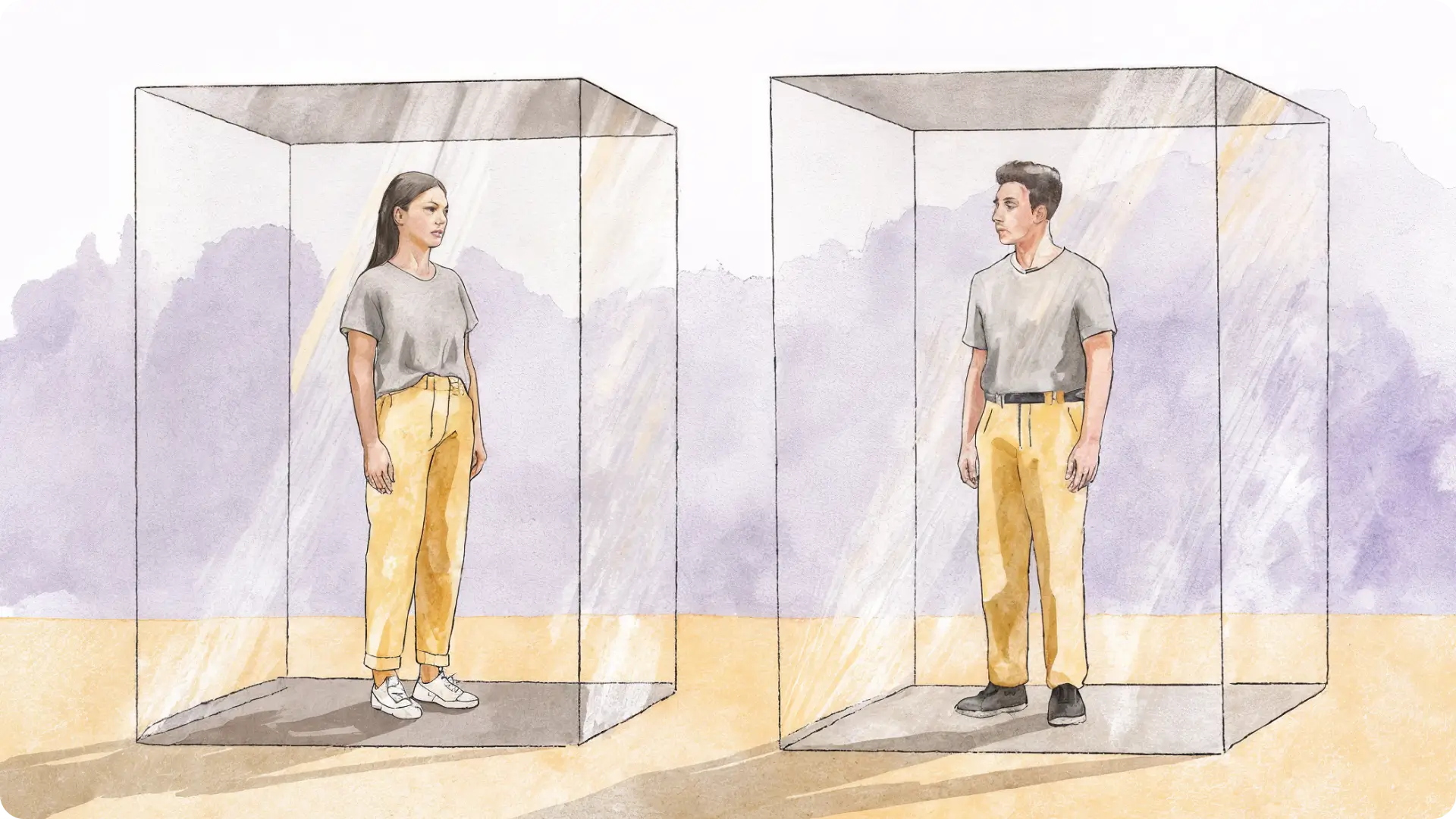
Your boyfriend had asked you to review his presentation, and your mom needed some support with cleaning her house. You’ve spent the whole day helping them and, in the evening, found yourself completely exhausted while still having plenty of work tasks that need to be completed. You’ve set your personal life on pause to make others around you happy. If these situations happen to you regularly, it might be a signal that you need to reconsider your boundaries.
In this article, we’ll talk about how to establish healthy boundaries in relationships and what to do if you feel guilty for putting yourself first.
It may be challenging to establish healthy boundaries if you live with an attachment style. Find out whether it’s really so, and get a personalized plan to address it.

What are boundaries in relationships?
Boundaries in relationships are the physical or psychological limits that signal to someone what behavior is acceptable and what isn’t. You can set boundaries in any situation where your time, energy, or emotions are involved, whether at work, with friends or family members, or in romantic relationships.
Boundaries stem from a person’s values and guide decisions, actions, and interactions with others. They help us avoid conflicts and emotional exhaustion and allow us to live a balanced life.
Having healthy boundaries means that a person knows their limits and can both communicate and reinforce them clearly and consistently. Unhealthy boundaries may be too rigid, too loose, or inconsistent, which can lead to misunderstandings or violations.
Do you think that you have strong boundaries?
Why boundaries are important
Boundaries protect our well-being. When you prioritize yourself and explain what makes you feel uncomfortable, it helps build relationships with others based on mutual respect.
The American Psychological Association states that establishing boundaries reduces the risk of workplace burnout. [1] Heather Stringer. “The benefits of better boundaries in clinical practice.” American Psychological Association. 2025 Understanding what’s right and wrong for you can help you avoid stress, protect your energy, and connect with people who care about you.
A quick word on boundaries in romantic relationships
“I find that my brand of ‘love’ means there are no boundaries with the people I care for,” states a user on Reddit. However, this strategy might not be effective in the long term.
Romantic partners may get really close and share financial responsibilities, physical space, hobbies, and routines. But you still need to know what behavior is unacceptable to you and when it’s time to prioritize yourself. This way, you’ll be able to avoid misunderstandings that linger for some time and then turn into arguments, crises in relationships, or even a breakup.

7 types of boundaries in a relationship
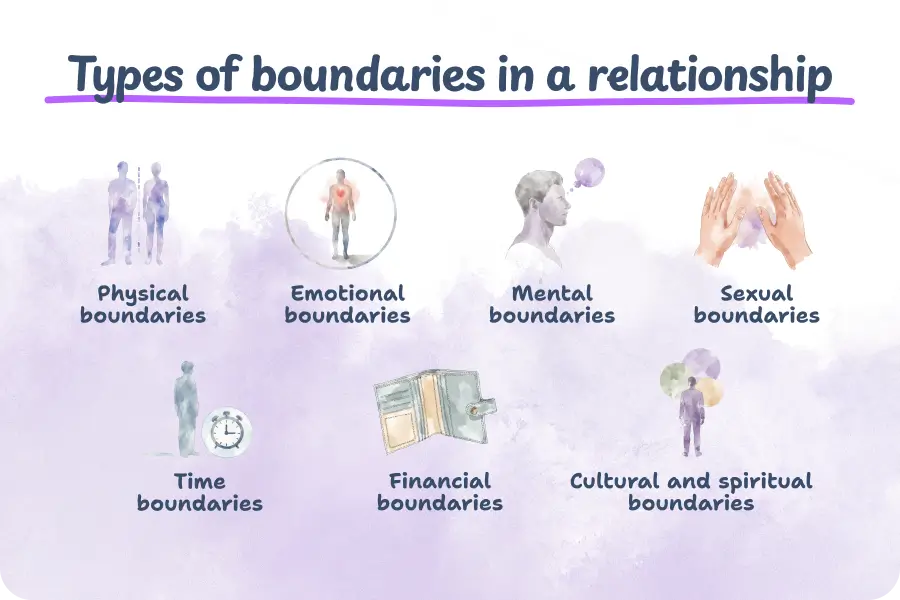
The most common types of boundaries are physical, emotional, sexual, mental, financial, cultural, and time boundaries. They define what you are comfortable with in different areas of your life.
1. Physical boundaries
Physical boundaries mean the level of physical touch or proximity a person feels comfortable with from different people. For instance, you may have tight boundaries with colleagues, where only a handshake is appropriate. At the same time, it may be fine for you to hug close friends or relatives.
For romantic partners, physical boundaries can mean the level of affection they’re ready to show in public. Some people may find forehead kisses and holding hands all right, while others prefer to keep physical affection private.
This type of boundary may also be about the amount of personal space. There are couples who sleep in different bedrooms, and there are also those who spend most of their time together.
2. Emotional boundaries
Emotional boundaries are about your feelings and how you express them to others. If you discuss everything you worry about with your best friend, it means that you have a close and open connection. At the same time, you might have rigid boundaries with your mom and avoid talking to her about something deeply personal.
Healthy boundaries are essential to succeed in different spheres of life. This emotional intelligence test can help you find out how well you maintain them.

3. Mental boundaries
Mental or intellectual boundaries relate to respecting each other’s opinions. Even if your thoughts about a particular situation differ, you don’t start to argue but rather agree that each person can have their own perspective.
People with healthy mental boundaries don’t allow others to control their decisions or pressure them to agree to something. Such an employee can express their ideas at work without fear of judgment and won’t agree to tasks that go against their values.
4. Sexual boundaries
Sexual boundaries involve practices that a person feels comfortable or uncomfortable doing themselves or toward others. These can include types of physical touch, a kind of verbal communication, the frequency of intimacy, the use of contraception, etc.
People who have healthy sexual boundaries can say “no” without guilt and ask a partner for consent. They respect their partner’s limits and are understanding when someone declines their offers.
5. Time boundaries
Time boundaries refer to the limits a person sets for certain activities to save their energy. For example, they understand that they need some personal time on Friday evening and won’t agree to join a party that their friends invite them to. Such people can have a healthy work-life balance because they stick to work hours and refuse to overwork at the expense of their well-being. They also don’t feel guilty for not being available 24/7 for someone.
6. Financial boundaries
Financial boundaries involve the way you earn and spend money. When it comes to romantic relationships, it refers to the way you manage your finances (whether you create a joint account, split bills, or maintain financial independence and cover your own expenses).
7. Cultural and spiritual boundaries
Cultural and spiritual boundaries are about the differences in traditions and beliefs people may have. For one person, celebrating Easter and gathering family members at a festive table may be important. Another partner may prefer to skip formal celebrations. People who have healthy relationship boundaries respect each other’s decisions and always try to find a common ground.
Healthy boundaries in relationships
Healthy boundaries are limits that make a person’s life easier, improve understanding with others, and encourage clear communication and self-respect. These boundaries may change, but they always promote the well-being of the person and those around them.
For example, in romantic relationships, it can be a belief that it’s unacceptable to shout at one’s partner. When feeling angry, they might need more personal space to calm down and then discuss the issue calmly.
Someone may believe that their family members shouldn’t interfere in their romantic life. They establish boundaries by communicating them, which helps avoid unnecessary conflicts and ensures their relationships remain private.
Signs you have good boundaries
- Saying “no” doesn’t make you feel guilty.
- You don’t abandon your needs to keep someone fulfilled.
- You speak up when something makes you uncomfortable.
- When another person states their boundaries, it doesn’t offend you.
- Your relationships balance between giving and receiving.
- You don’t tolerate disrespect.
- You don’t feel responsible for other people’s moods or happiness.
Unhealthy Boundaries in Relationships
Having unhealthy boundaries leaves you unable to protect your emotional well-being or doing it too aggressively at others’ expense. Some people with poor boundaries can let others invade their personal lives. Others might refuse any compromise and expect everyone around them to do only what they want.
Imagine a toxic boyfriend who tries to control how his girlfriend looks, how much she earns, or who she spends time with. This person might believe that they protect their boundaries and prevent something they consider inappropriate (like wearing too short dresses). But in reality, they neglect their partner’s autonomy and engage in emotional abuse.
Or think about an employee who constantly overworks. They might believe that they’re super-responsible, but this behavior can harm their emotional health and lead to burnout.
Signs you have unhealthy boundaries
- You agree to do something even when you don’t want to.
- You ignore your limits.
- You remain quiet and do not bother others, even when life feels overwhelming.
- You depend too much on others.
- You overshare or expect full access to others’ private lives.
- You push or ignore other people’s boundaries.
- You avoid closeness at all.
Healthy vs. unhealthy boundaries
| Healthy boundaries | Unhealthy boundaries |
| Help you take care of your well-being. | Can lead to people-pleasing or neglecting others. |
| Remain stable no matter what others say. | May change depending on pressure, guilt, or fear of conflict. |
| Allow honest communication about your emotions. | Involve hiding your feelings to appear “good” to others. |
| Respect your own needs and those of others. | Might turn into overextending or avoiding closeness. |
| Build trust in relationships. | Can cause misunderstandings or feelings of being taken advantage of. |
Consequences of not setting relationship boundaries
Lack of boundaries in relationships can lead to misunderstandings and harm both your mental and physical well-being. Here’s how it can manifest.
1. People start taking advantage of you
If you don’t have clear boundaries, others may consciously or unconsciously ask you for more than you can provide. A partner may demand you cook three meals a day, even if you work, care for kids, manage household responsibilities, and invest more in your future. A friend might ask you to lend them money regularly, even though you also lack it.
2. You feel like a victim
When you engage in people-pleasing and struggle to set healthy boundaries, you might feel overwhelmed. “I don’t deserve to rest” or “I have no choice” may run through your head. This resentment, combined with feeling powerless, can cause chronic stress.
3. Guilt and anxiety follow you everywhere
People with weak boundaries in relationships can feel guilty when they think they might disappoint someone. They put others’ needs first, and if they finally need to refuse doing something, it makes them anxious that a person may reject them or become upset.
4. Your needs fade into the background
One morning, you may realize that you can’t go to the gym, spend the weekend with loved ones, or simply have enough sleep because you choose to manage things others have asked of you.
5. Conflicts and drama become your daily routine
A person living under the constant pressure of others’ expectations may find themselves frustrated or easily irritable. You may continue to do whatever others tell you to, look however others expect you to, and so on, but it might lead to inner conflict. As a result, tension will build up, and relationships will feel draining rather than supportive.
Expert Insight
“A couple of common consequences of having too rigid boundaries are that it can create conflict or emotional distance/disconnection from loved ones. Being unwilling to compromise or find more flexibility within your boundaries can have a significant impact on your relationships, leaving you feeling lonely, isolated, or resentful.”

Hannah Schlueter
Mental health professional
Setting boundaries in relationships
Establishing boundaries in relationships requires a genuine understanding that allows you to take care of yourself and improve communication with others. It isn’t selfish to protect your well-being. Self-care gives you even more energy to share with people who truly matter.
The 4 C’s of boundaries
Here’s a simple framework of healthy boundaries that will let you set them more effectively.
- Clarity means that you clearly understand what’s fine for you and what is unacceptable.
- Communication anticipates that you explain your boundaries to others in a calm and direct manner.
- Consistency requires that setting boundaries be an ongoing process. You need to ensure that other people respect them.
- Compassion in boundary setting means that even if something goes wrong, you approach yourself and others with understanding.
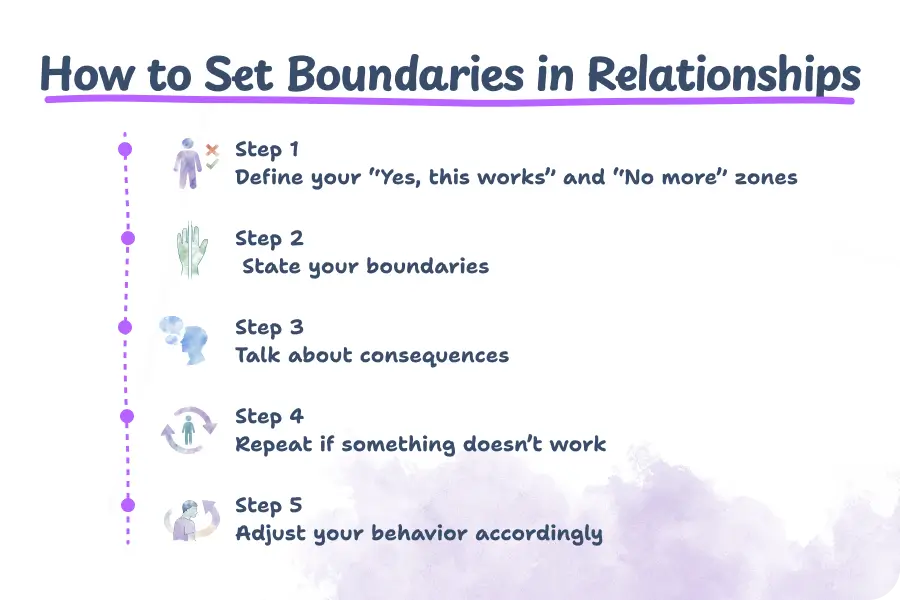
Step-by-Step: How to Set Boundaries in Relationships
Step 1: Define your “Yes, this works” and “No more” zones
Take some time to analyze what makes you feel uncomfortable. It can take a few days, weeks, or even months to reflect on different spheres of your life. Notice everything that triggers your irritation or desire to help others at your expense.
You can use a notebook to track your feelings or use Breeze’s mood tracker. The app enables you to log situations, add context, and include pictures to identify patterns over time. After checking mood analytics, you’ll see the things that influence your emotional well-being and will be able to set boundaries to avoid them in the future.
Step 2: State your boundaries
Boundaries work much better if you directly highlight them to others. Clear communication and self-confidence are the keys to success. Once something goes wrong, you can:
- Calmly explain why you consider this situation unacceptable.
- Use “I” statements to express your feelings.
- If necessary, suggest alternative ways to handle the situation.
For example, if your partner demands that you spend all of your spare time with them, you can state that it makes you uncomfortable. Avoid overexplaining or apologizing for no reason. Instead, suggest planning time together beforehand so everyone has their personal space as well.
Step 3: Talk about consequences
If a person doesn’t want to respect your boundaries, point out that it is unacceptable for you. You can explain that next time you’ll need to limit contact with them and postpone plans until communication becomes respectful. Don’t say it as a threat. It should be a calm and clear statement.
Step 4: Reinforce if something doesn’t work
People may unintentionally violate your boundaries or not realize the impact their behavior has on you. For instance, you may have a colleague who calls you after working hours and genuinely asks for help, thereby violating your digital boundaries.
When you see that a person doesn’t understand that they are doing something wrong, you may need to reinforce the boundaries multiple times so everyone remembers what feels right for you.
Step 5: Adjust your behavior accordingly
If someone keeps disrespecting your boundaries in relationships, follow through with the consequences you’ve set. Remember that it isn’t a “punishment” for another person but more like an act of self-care. You distance yourself from someone who doesn’t communicate with mutual respect.
Common challenges in setting and maintaining boundaries
Establishing healthy relationship boundaries may bring additional inner challenges (such as guilt and fear of rejection) as well as misunderstandings in communication (when people pressure you to do what they want). Here are some of the roadblocks you might experience:
1. Lack of self-awareness
You may simply lack understanding of what’s right or wrong for you. For instance, you might agree to take on extra tasks at work because you don’t want to disappoint your manager. At first, it feels manageable, but over time, everyone takes it for granted. You may notice something is “off,” but it’s hard to see when someone crosses your limits at first.
Building self-awareness can help you spot the early signs of boundary violation. So, next time you feel overwhelmed, try a simple journaling exercise in the Breeze app. Write down your frustrations and answer science-backed questions to understand what has caused them. With regular practice, you’ll learn to spot situations that make you uncomfortable much faster.
2. Fear of abandonment
People living with an anxious attachment may find it challenging to establish emotional boundaries. They might worry that even a small “no” could push someone away, and because of this, agree to plans they don’t want or stay silent when others say something hurtful.
A study published in the General Hospital Psychiatry found the link between childhood adversity and boundary difficulties, partly mediated by insecure attachment. [2] Kai MacDonald, Andrés F. Sciolla, David Folsom, David Bazzo, Chris Searles, Christine Moutier, Michael L. Thomas, Katherine Borton, Bill Norcross. “Individual risk factors for physician boundary violations: the role of attachment style, childhood trauma and maladaptive beliefs.” General Hospital Psychiatry. 2015 It doesn’t mean that everyone who fears rejection lives with childhood trauma. But if you suspect you have weak boundaries, it’s best to test and address the root of the issue.
3. Guilt complex
Setting boundaries in relationships can make people feel guilty. They might think something like, “I will distance myself from people I love,” or “It makes me a bad friend.” Nevertheless, having healthy boundaries doesn’t make a bad person. In turn, it allows you to build a balanced life and meaningful relationships.
Scientists have proven that boundary violations cause guilt and psychological distress as well [3] Glavin, Paul & Schieman, Scott & Reid, Sarah. (2011). “Boundary-Spanning Work Demands and Their Consequences for Guilt and Psychological Distress.” Journal of health and social behavior. , and they can be even more significant than the one-time stress of enforcing boundaries.
4. Difficulty expressing limits
Saying that something isn’t acceptable for you might be challenging if you haven’t done this before. Remember that boundaries in relationships should be communicated calmly and clearly. Don’t wait until you feel frustrated, and address your limits as soon as you feel discomfort.
How to maintain healthy boundaries in relationships
To protect your own feelings, you need to stay open about what crosses your limits. Check in with yourself regularly, and adjust your boundaries as situations or relationships evolve. Here are some tips for having healthy boundaries in any kind of relationship you build.
1. Accept that everyone has their own emotions and life challenges
Personal boundaries shouldn’t interfere with the needs and feelings of others. For instance, your best friend may be upset over something serious and cancel your plans for the weekend at the last minute. You might think that they don’t value your time and can’t keep their promises. Yet, if the situation is serious, you may want to consider the behavior as your friend’s attempt at setting their own boundaries.
2. Provide emotional support to each other
Boundaries in healthy relationships shouldn’t be like strict rules. Sometimes your partner may feel completely exhausted after a tough day at work and need your time and support more than usual. In this case, you can offer help or comfort without compromising your core limits. Look for balance between caring for others and caring for yourself.
3. Maintain distance from past relationships
If your ex-boyfriend or girlfriend neglected your limits, it doesn’t necessarily mean that the same will happen in current relationships. Maintaining boundaries means not letting old experiences dictate how you treat your current partner. So, even if your loved one does something wrong unconsciously, a calm reminder that it isn’t okay would be enough.
4. Communicate your individual interests
Your boundaries may change over time or develop in situations you weren’t experiencing before. For example, you may become a parent and realize you need at least 2 hours a day alone.
Don’t wait until people understand it on their own. Talk about physical and emotional boundaries you develop to ensure you’re on the same page with others and avoid conflicts.
Hannah Schlueter, MA, LAC, offers additional tips on maintaining healthy boundaries. “Maintaining healthy boundaries comes with understanding and prioritizing your own needs. Other helpful tips for maintaining such boundaries include practicing with lower-stakes situations when starting, reminding yourself of the benefits of healthy boundaries, and holding yourself accountable to uphold your limitations within all relationships in your life.”
Final thoughts
Setting and keeping boundaries is a great way to care for your mental health. Just make sure you approach this process gradually and with self-compassion. Self-discovery tests in the Breeze app can help you learn more about your personal needs and unique differences. They can serve as a reliable tool for identifying areas where boundaries are necessary and building stronger relationships over time.
Sources
- Heather Stringer. “The benefits of better boundaries in clinical practice.” American Psychological Association. 2025
- Kai MacDonald, Andrés F. Sciolla, David Folsom, David Bazzo, Chris Searles, Christine Moutier, Michael L. Thomas, Katherine Borton, Bill Norcross. “Individual risk factors for physician boundary violations: the role of attachment style, childhood trauma and maladaptive beliefs.” General Hospital Psychiatry. 2015
- Glavin, Paul & Schieman, Scott & Reid, Sarah. (2011). “Boundary-Spanning Work Demands and Their Consequences for Guilt and Psychological Distress.” Journal of health and social behavior.
Disclaimer
This article is for general informative and self-discovery purposes only. It should not replace expert guidance from professionals.
Any action you take in response to the information in this article, whether directly or indirectly, is solely your responsibility and is done at your own risk. Breeze content team and its mental health experts disclaim any liability, loss, or risk, personal, professional, or otherwise, which may result from the use and/or application of any content.
Always consult your doctor or other certified health practitioner with any medical questions or concerns
Breeze articles exclusively cite trusted sources, such as academic research institutions and medical associations, including research and studies from PubMed, ResearchGate, or similar databases. Examine our subject-matter editors and editorial process to see how we verify facts and maintain the accuracy, reliability, and trustworthiness of our material.
Was this article helpful?