



Tips for rebuilding trust in a relationship depend heavily on the specific situation. Let’s explore the most common scenarios.
Steps to rebuild trust in a relationship after lying
It may take time and effort to build a healthy relationship and help your partner heal past emotional wounds if trust has been broken. However, there are some strategies that may help you with it.
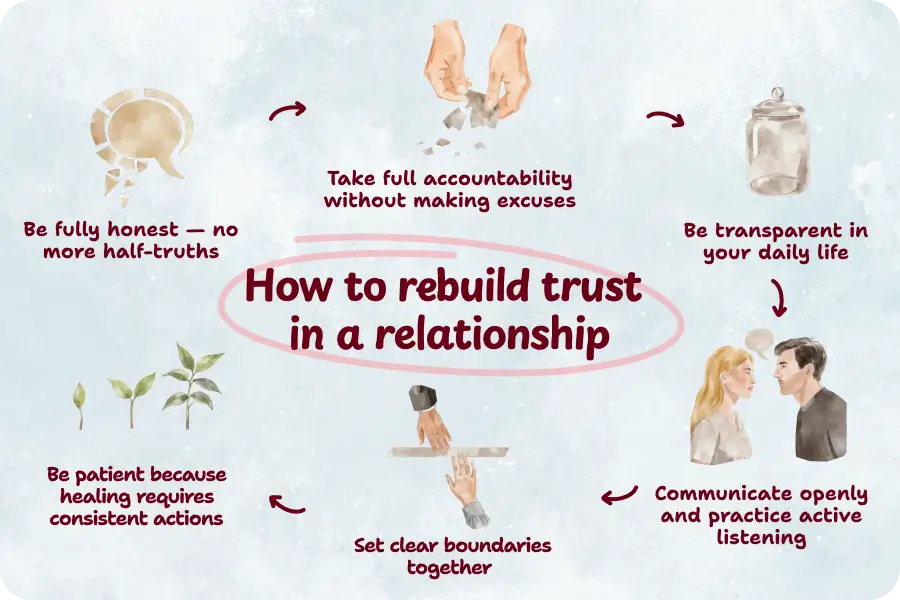
1. Be fully honest — no more half-truths
“I told her that I was working late, but I didn’t mention I actually went out with friends first.” This approach won’t work.
The only thing you can do to rebuild trust is to be 100% open to your partner and avoid any lies or hiding details. The thing is, every time your partner finds out about these small omissions or half-truths, trust falls even more.

2. Take full accountability without making excuses
You lied, cheated, neglected their feelings, or betrayed trust, but they…! This won’t help you rebuild emotional safety.
Of course, you may say something like “But you were controlling, neglected my needs, or made me feel unheard.” And maybe some of that is true. But the moment it turns into “but,” it stops being accountability and turns into justification.
For your partner, that doesn’t repair anything and rather adds more distance. Because instead of feeling heard, they feel like their pain is being balanced against yours.
3. Be transparent in your daily life
They may want to check your phone, call you in the middle of the workday, ask about your plans, or double-check simple things you never had to explain before. It may feel uncomfortable. But every time you get irritated, just remember that they live with the question, “How can I trust my wife/husband again?”
By accepting this partner’s perspective, you may quickly learn to share everything without the need to ask about it. You may also become more consistent in small actions: saying where you are, following through on plans, and not changing stories later. Over time, this approach reduces the need for them to check or question everything.
4. Communicate openly and practice active listening
To build a deeper connection and make your partner feel needed and valued, you can talk honestly about what’s happening instead of avoiding difficult topics. When they speak:
- Listen without interrupting
- Don’t defend yourself
- Use “I” statements when you want to share your worries
- Focus on understanding their feelings first, not fixing or explaining yourself right away
5. Set clear boundaries together
Of course, you may still need some privacy and want your boundaries to be respected, just as your partner may want you to respect their needs. To avoid further arguments and build a strong relationship where both people feel safe, it’s important to clearly agree on what is okay and what isn’t.
For example, you can discuss:
- What information you’re both comfortable sharing
- How you’ll communicate during the day (texts, calls, check-ins)
- What counts as a boundary violation for each of you
- What to do when trust feels shaky again
For instance, you might feel that it isn’t okay that your partner checks your phone without asking, while your partner might feel unsafe when you disappear for hours without a message. Instead of guessing or arguing in the moment, you agree on a simple rule like “no phone checking without consent” and “a quick message if plans change.”

6. Be patient because healing requires consistent actions
It may feel overwhelming, but rebuilding trust requires effort. It isn’t enough to say the right things once or show change for a few days. Trust is rebuilt through repetition — showing up the same way again and again, even when things feel tense or uncomfortable.
There will be moments when your partner still doubts you or brings up the past. That doesn’t mean that nothing is working; it means they’re still learning to feel safe again. What matters most is staying consistent in your behavior, even when progress feels slow or invisible.
How to rebuild trust in a relationship after cheating
If you’ve cheated on your partner and you decide to stay together, the healing process may be long. However, if both partners are committed to the work, it is possible to emerge with a stronger, more honest foundation.
Here is how you can navigate the path toward rebuilding trust:
- Don’t rush forgiveness. You may feel guilty and want your partner to forgive you right away. But trust can’t be forced or sped up. Your partner needs time to process what happened before they can even consider moving forward with you.
- Don’t turn shame into self-focus. Remember that they are the hurt partner. Whatever happened, you are responsible for it. So, stay with their emotions instead of shifting attention to your guilt or breaking down in a way that makes them feel comfortable. Listen, accept their feelings, and focus on what they need in that moment.
- Practice empathy. Acknowledge your partner’s pain and reflect it back in simple words like “I understand why this hurts you.” Words of care and support can build the very foundation of further trust.
- Show care in small actions. Words may not be enough; simple actions can help your loved one feel secure again. You might bring them flowers or their favorite snack, make tea or coffee without being asked, cook a meal for them, or leave a note with a kind message. You can also offer a hug when things feel tense or take over a task to make their day easier.
Expert Insight
There are other things you can do if empathy and apologies aren’t helping you rebuild trust in your relationship after cheating. For example, don’t wait for your partner to ask you where you’re going or how much you’ve spent. Instead, tell them that information on your own, even before they ask.
In some cases, this could mean giving them your phone passwords. You can also make a plan for transparency that spells out rules for social media, check-ins, and how to deal with certain people. This helps restore a sense of stability in the relationship. It can also create a predictable roadmap for couples.

Emily Mendez
Mental health professional
How to rebuild trust in a long-distance relationship
Moving forward after a painful event might be harder if you’re far apart. In this situation, maintaining a strong digital presence will be crucial. You may need to:
- Be predictable with communication. You can agree to call each other every evening, send a quick message if plans change, and stick to these routines so your partner knows what to expect.
- Don’t disappear without explanation. Staying in touch and giving simple updates helps build healthy communication. You may need to let your partner know when you’ll be unavailable and send a quick message instead of going silent, so they don’t overthink anything.
- Share your daily life, not just highlights. They may lack closeness and the ability to be vulnerable around you. You can initiate an open dialogue about your worries, talk about how your day actually felt, not just what happened, and include small, ordinary moments. This helps your partner feel connected to your real life.
- Create shared moments. Positive feelings that you experience together strengthen your emotional bond and make the relationship feel real despite the distance. You can watch something together, have dinner on a call, or simply stay connected while doing everyday things — it builds a sense of “us,” not just separate lives.
- Address doubts directly. If your partner keeps questioning some of your actions, you can initiate an open conversation, listen to each other’s perspectives, and clarify things before assumptions turn into conflict.
The Breeze app can help you get closer, no matter how far you are. Take self-discovery tests and share results with your partner to find out what you both need emotionally, what creates distance between you, and how to communicate in a way that feels clearer for both sides.
How to rebuild trust in a marriage
According to the review published in the Journal of Family therapy, there are several things that may help you build trust again:
- Proactive transparency
- Active monitoring
- Remorse and accountability
- Shared activities
- Clear communication of reasons for the betrayal [2] Giacobbi, M. & Lalot, F. (2025) “Unpacking trust repair in couples: A systematic literature review.” Journal of Family Therapy, 47, e12483. Available from: https://doi.org/10.1111/1467-6427.12483
While these can be effective to address deep issues at any stage of a relationship, in marriage, they become especially important because you share more than emotions — you share a life, responsibilities, and often long-term plans.
In this case, rebuilding trust is not just about fixing the connection between you but also about restoring stability in everyday life. This may mean being more intentional about routines, showing reliability in practical things like finances or family responsibilities, and making decisions together again instead of acting independently.
Another user of Breeze, Mary (the name’s also changed), shared her story. “After I found out about his messages with someone else, everything felt unstable — even simple things like plans or money. What helped weren’t big apologies but small, clear actions. He started telling me his schedule in advance, checking in if something changed, and including me in decisions we used to make together. We set aside one evening a week just to talk, so our relationship felt steady again.”
3 exercises to build trust in a relationship when nothing helps
If you want to rebuild trust lost, but nothing appears to be really effective, there are some practical exercises that may help you decrease tension.
1. Use conflict resolution anchor cards
These are physical or digital cards that contain specific, pre-agreed phrases or questions to use when an argument begins to spiral. When trust is broken, “fight or flight” responses often take over, making logical conversation impossible.
- How it works. Create a set of 3-5 cards. One might say, “I am feeling overwhelmed and need a 10-minute break, but I promise to come back.” Another could be, “I need to hear that you are still committed to us right now.”
- Why it helps. It provides a script for when your brain freezes. It prevents the defensive shouting matches that further erode trust by anchoring the conversation in a pre-set safety protocol.
2. Do weekly check-ins
Discuss what helped your partner feel more secure during the week and what moments triggered doubt. When trust is fragile, waiting for one big conversation may lead to built-up frustration. Weekly check-ins give you a calm, regular space to talk things through.
You can set a fixed time (for example, once a week) to answer questions your loved one has and focus on the relationship.
It stops emotions from building up and makes communication more predictable. One partner sees that their efforts matter, while the other feels heard without needing to bring things up in the heat of the moment.
3. Attend couples’ therapy
In certain situations, building trust can be difficult, regardless of the effort you invest. As such, couples therapy might be the best choice. A licensed specialist will guide difficult conversations, help you stay calm during conflict, and give both partners a safe space to speak honestly without escalation or blame.
Expert Insight
I’ve found that, in some cases, things like boundaries and proactive communication are still not enough to overcome cheating. If every conversation turns into a fight, you or your partner’s mental health is deteriorating, or if your relationship feels “stuck” without any measurable progress in moving past the problem, it may be time to seek professional help.
Emily Mendez
Mental health professional
The reality of broken trust: Why healing takes more than an apology
You did something wrong, said “sorry” multiple times, and may feel that your relationship is ready for moving forward. However, it may not be that simple. A study published in Frontiers in Psychology found that when someone is deeply hurt by a betrayal, a simple apology isn’t enough to rebuild trust. [1] Ma F, Wylie BE, Luo X, He Z, Jiang R, Zhang Y, Xu F, Evans AD. “Apologies Repair Trust via Perceived Trustworthiness and Negative Emotions.” Front Psychol. 2019
The thing is that they don’t feel safe with you anymore. The partner might start noticing small inconsistencies, dwell on the same questions in their head, and think about whether they should get ready for further pain.
This is why nothing seems to work. You’re trying to live further and focus on improving relationships, while they’re still trying to feel safe in the present. And at this point, you may need to accept that the past version of your relationship is gone forever.
But the good thing is that you still can try to build trust from scratch, pretty much like you did at the beginning of your story.
Examples of things that can break trust in a relationship
“But I didn’t do anything wrong!” If you think this way, but the emotional connection is already broken, it could be that something small kept happening over and over again.
Except for more obvious things like cheating or lying to a partner about significant things, relationship trust may be broken due to minor but repetitive behaviors that erode safety. The problem is, these actions don’t always look serious in the moment. But when they repeat, they start to send a message: you can’t fully rely on me.
These can include:
- Saying you’ll do something and not following through
- Being late or canceling plans at the last minute without explanation
- Ignoring messages without reason
- Dismissing your partner’s feelings (“you’re overreacting,” “it’s not a big deal”)
- Hiding small details to “avoid conflict”
- Being emotionally unavailable when your partner needs you
- Flirting with others or crossing subtle boundaries
- Not taking responsibility and shifting blame
- Making jokes at your partner’s expense
- Emotionally involving with people online
- Acting differently in private and in public
- Being inconsistent — warm one day, distant the next
Breeze’s user, Zoey (the name has been changed), agreed to share when she felt like a betrayed partner. “I didn’t feel like it broke in one moment,” she said. “It was small situations.” Like when he said he’d be home at 7 and came back hours later without texting. Or when I asked how his day was, he left parts out “to avoid drama,” and I later found out that things didn’t match. I’d bring it up and hear, “It’s not that serious.” Other times I’d be ignored mid-conversation because he was on his phone, then act as if nothing happened. None of it looked big on its own, but I stopped feeling safe relying on his words.”
How to trust your partner again after they did something wrong
But what if that was you who felt hurt and betrayed? If so, it’s normal to feel unsure, angry, or even distant for a while.
First of all, remember that no one can persuade or force you to “just trust again.” It’s only your decision whether you want to continue this relationship or not. Trust returns only when you start seeing consistent changes in your partner’s behavior over time, not just hearing apologies.
Give yourself time to observe what is actually happening now. Do they keep their word? Are they honest even in uncomfortable moments? Do they respect your feelings instead of dismissing them? These small signals matter more than big promises.
And don’t ignore your emotions. If something still feels off, talk about it instead of pushing it away.
After some time, track progress. You may notice that things start getting better, or, vice versa, you want to leave this person and start a new relationship from scratch. Any decision is valid as long as it’s based on how you actually feel, not pressure, guilt, or fear of being alone.
Frequently asked questions
Can a relationship ever go back to normal after trust is broken?
Yes, in some cases, rebuilding trust is possible through open communication and consistent effort. The healing process may take time, but as a result, you may reach an even deeper understanding.
Nevertheless, both partners need to have a desire to move forward. If one partner wants to continue the relationship and the other thinks that the pain caused to them is too difficult to handle, rebuilding trust may not be possible.
How long does the healing process typically take?
Rebuilding trust takes time, but there’s no universal answer to “How long?” Everything depends on the depth of the betrayal, how both partners handle it, and the history you share.
Research shows that the length and quality of your relationship before the breach play a big role. [3] Schilke O, Reimann M, Cook KS. “Effect of relationship experience on trust recovery following a breach.” Proc Natl Acad Sci U S A. 2013 If trust was broken early on, when the connection was still forming, recovery can be much harder. But in long-term relationships, where there’s a strong history of safety and consistency, people are more likely to rebuild trust.
What are the signs that emotional trust is actually being rebuilt?
A few signs that you’ve managed to build trust again may include:
- less need to double-check things
- conversations feel calmer, with less tension and defensiveness
- your partner begins to believe your words again
- more openness and honesty from both sides
- emotional closeness slowly returns (sharing thoughts, feelings, daily moments)
- less focus on the past, more focus on the present
- small acts of care feel natural again, not forced
These changes are typically gradual, but together, they show that safety and connection are coming back.
Will my trust issues ever go away?
You may stop experiencing trust issues if your partner provides a safe space where your feelings are taken seriously, your boundaries are respected, and their actions stay consistent over time. However, if nothing works or the roots stem from your childhood or deeper past experiences, professional guidance may be necessary.
Sources
- Ma F, Wylie BE, Luo X, He Z, Jiang R, Zhang Y, Xu F, Evans AD. “Apologies Repair Trust via Perceived Trustworthiness and Negative Emotions.” Front Psychol. 2019
- Giacobbi, M. & Lalot, F. (2025) “Unpacking trust repair in couples: A systematic literature review.” Journal of Family Therapy, 47, e12483. Available from: https://doi.org/10.1111/1467-6427.12483
- Schilke O, Reimann M, Cook KS. “Effect of relationship experience on trust recovery following a breach.” Proc Natl Acad Sci U S A. 2013
Disclaimer
This article is for general informative and self-discovery purposes only. It should not replace expert guidance from professionals.
Any action you take in response to the information in this article, whether directly or indirectly, is solely your responsibility and is done at your own risk. Breeze content team and its mental health experts disclaim any liability, loss, or risk, personal, professional, or otherwise, which may result from the use and/or application of any content.
Always consult your doctor or other certified health practitioner with any medical questions or concerns
Breeze articles exclusively cite trusted sources, such as academic research institutions and medical associations, including research and studies from PubMed, ResearchGate, or similar databases. Examine our subject-matter editors and editorial process to see how we verify facts and maintain the accuracy, reliability, and trustworthiness of our material.
Was this article helpful?