



Staying late at work finishing a colleague’s project? Putting aside urgent matters to help a friend out once again? “Yes, sure.” If this is your default answer and you’re often characterized as “sweet” and “responsive”, you may wonder if there’s a better way to handle things. Here’s a recovering nice guy guide that can help you feel confident and start building healthy relationships.
Start by taking the Personality Test to get insights about your behavior patterns, values, and priorities.

What Does It Mean to Be a Nice Guy?
“A nice guy” is a term that is used for a person who puts others’ needs above their own, avoiding conflict and seeking approval. This person actively strives to help others, cares for them, and aims to be helpful, since he may believe that his value depends on how helpful and convenient he is to others.
A person with ‘nice guy syndrome’ may constantly “scan” others, looking for an opportunity to do a favor. For example, he might ask a friend, “Aren’t you cold? Should I bring you a blanket? Make some tea? Close the window? Tell me if you need anything, right?” It can come from the need to try harder in order to earn love and admiration.
Nice guys may have difficulty making decisions, setting personal boundaries, or standing up for themselves. Unable to directly express their wishes, such people can feel disappointed or resentful when things don’t go their way. As a result, constantly focusing on other people’s feelings and suppressing his desires may lead them to burnout and internal question, “Why didn’t I say anything again? What is wrong with me?“
His relationships may also be affected by this attitude because his loved ones may not even suspect his true feelings and the “covert contracts” the nice guy constantly makes. According to Dr. Robert Glover’s book No More Mr. Nice Guy, a covert contract is an unspoken, one-sided agreement that a nice guy makes in his head, but never clearly communicates to others [1] Robert A. Glover. No More Mr Nice Guy: A Proven Plan for Getting What You Want in Love, Sex, and Life. December 2002 .
People with this syndrome expect certain outcomes in return for the “good” behavior and may quietly harbor resentment towards people for their ignorance. When they don’t receive the gratitude they expect, they may also express their dissatisfaction through passive aggression.
The Breeze app offers a variety of quizzes, such as the avoidant attachment style quiz, narcissistic partner test, toxic test, and many more, to help you understand why and in which situations you may behave like a nice guy.
Signs You Can Be A “Nice Guy”
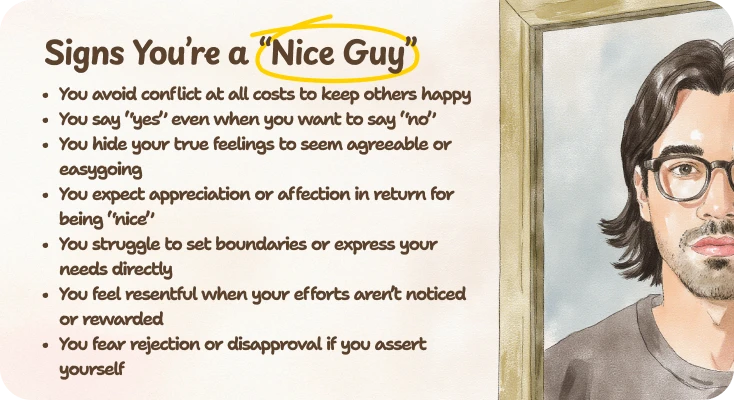
Here are more key signs that can help identify the “nice guy” syndrome:
- You feel a constant desire to please others, even at the expense of your own interests
- You fear expressing your opinion if it conflicts with the opinions of others
- You have an exaggerated willingness to help, including taking on other people’s responsibilities
- You are sensitive to the idea that someone doesn’t like you
- You tend to avoid conflict at all costs
- You may believe you’re the only person who can fix things and “save” others
- You don’t have a positive attitude towards yourself
- You feel like you’re being used in relationships
- You often feel disappointed and angry because your contributions are overlooked or taken for granted
- You may manipulate people through feelings of guilt or duty
Are you emotionally available? Take a quick Emotional Intelligence test to see whether you express kindness in healthy ways.
What Causes Nice Guy Syndrome?
Often, the origins of the nice guy syndrome and people-pleasing tendencies can be traced back to childhood, according to 2025 research [2] JSTOR. “Exploring the Relationship Between Narcissism and Extreme Altruism.” Spring 2018 . A child who is constantly criticized or completely ignored tries to be a “good boy” to earn parental love. In this case, “good” means whatever others want to see or gain from them. Typically, such children are punished for mistakes or for showing their emotions. Moreover, sometimes the behavior of an abusive father or narcissistic mother can be unpredictable, resulting in their child learning to be cautious and obedient to avoid their anger.
Think back to the qualities your parents praised you for as a child. They probably wanted you to be obedient and quiet, to follow a schedule, or to wear clothes they bought you without your approval. Such children are called “easy”, but they also learn to ignore their own needs and may develop behavior patterns of a nice guy.
Want to understand why you may become a nice guy and what it has to do with your childhood trauma? Take a test to find out whether it’s influencing your well-being.

Another possible reason for being a nice guy is altruistic narcissist tendencies, also typical for children of narcissistic parents. It’s a pattern where a person helps others not purely out of kindness, but to feel needed, superior, or morally good. Such people often tie their self-worth to being seen as generous, caring, or self-sacrificing. According to research on narcissism, it’s their way to maintain control and self-importance through giving [2] JSTOR. “Exploring the Relationship Between Narcissism and Extreme Altruism.” Spring 2018 .
Expert Insight
Though the two may have some overlap, the difference lies in the motivators of behavior. Nice guy characteristics result from prioritizing the needs of others in order to be valued, where altruistic narcissists are more focused on prioritizing their own self-image and reputation.

Hannah Schlueter
Mental health professional
How to Stop Being a Nice Guy: 10 Steps to Self-Care
If you wonder how to stop being a nice guy and change your life, here are practical steps that can help you break free from old patterns of behavior:
1. Stop thinking that if you’re not nice, you’re bad
If you’re framing your choices as either being “nice” or “bad,” you may be engaging in black-and-white thinking. This distorted belief oversimplifies reality, creating stress and internal conflict. The truth is, there are times when it’s healthy and appropriate to show kindness, empathy, and patience, and other times when it’s necessary to protect your boundaries or confront uncomfortable situations.
2. Let go of unnecessary commitments
It can be difficult at first, especially if you’re used to always saying “yes.” To break the habit of automatically responding to every request for help, consider all offers from the perspective of your own needs. Instead of automatically saying “yes,” ask, “Why do I need this?” or “How will I feel if I agree?” Try to start small: say “no” to one request a day that makes you uncomfortable.
If you find it hard to say “no” to someone’s face, try texting instead. This way, it can be easier to cope with your emotions and defend your position.
Use empathetic phrases if you’re concerned that the person might be offended by your refusal. For example, you could say:
- “I understand this is important to you, but I don’t have the capacity to take it on right now.”
- “I really wish I could help, but I need to focus on my own tasks this week.”
- “Thank you for thinking of me! I can’t commit right now, but I hope it goes well.”
- “I’d love to support you, but I need some time for myself today.”
3. Learn to ask and accept help from others
The nice guy usually does everything by himself. He may think he’s saving the other people or at least earning respect, but this can sometimes result in people leaning on him too much or taking advantage of him. To stop being a nice guy, try to learn to ask and accept help from others:
- Ask for advice or a small favor. It could be as simple as “Can you help me carry this?” or “What do you think about my idea?”
- Share your feelings. Instead of pretending everything is fine, try saying, “I’ve been a bit overwhelmed lately, could you listen for a minute?”
- When someone offers help, don’t rush to say, “No, it’s fine.” Practice saying “Thank you, that means a lot.”
4. Offer an alternative if you want to soften your refusal
Along with your refusal, you can offer a more comfortable alternative. For example, if your relatives ask you to help with a renovation, explain that you’re too busy right now, but you can lend them some tools or share the contact information of a trusted handyman.
5. Identify manipulation and manipulators
People may notice you tend to seek approval and abuse this need of yours. Think about who in your social circle may manipulate and take advantage of you at every opportunity. Learn to recognize toxic friendships and manipulations like “No one but you can help me”, “You’re my last hope,” or “I could ask anyone else, but you’re the best.” Reduce contact with such people and spend time with those who like you for who you are, value your help, reciprocate effort, and can also be your support system.
6. Stop making covert contracts
The next important step is to stop expecting gratitude and recognition in return for helping. This mindset is often called the “give to get” principle. You might do kind things for others, hoping they’ll naturally return the favor, appreciate you more, or meet your emotional needs without you ever having to ask directly.
Try practicing open communication and express what you truly want instead of assuming others will just “get it.” If you’re helping someone, do it because you want to, not because you’re hoping it will make them like you.
You can start with honest statements:
- Instead of saying, “It’s fine, whatever you want,” try saying, “I’d actually prefer to stay home tonight, I’m tired.”
- Instead of waiting for someone to notice you’re upset, say, “I felt ignored in that conversation, and it bothered me.”
- When you need support, don’t hint or hope others will guess. Say directly, “I could really use your help with this.”
7. Develop assertive communication skills
Assertiveness is the ability to express your thoughts and feelings directly but respectfully. It can allow you to be mindful of people’s requests but avoid immediately promising any help. Here’s how you can become the best version of yourself through assertiveness:
1. Don’t rush into decisions
When someone asks you for a favor, tell them you need time to think it over. This will allow you to think more about their requests instead of immediately agreeing to help. Find out the details of what you’ll be asked to do, and consider whether you have the time and energy for the task.
If someone demands an immediate answer, it’s best to decline to make a decision right away, because agreeing immediately means committing. You’ll have the opportunity to agree later if the help is relevant.
2. Refuse confidently
To feel confident in your decision, formulate clear reasons for your refusal. However, you don’t need to explain them in detail to the person asking for something from you. A lengthy discussion can create the feeling that you’re ready to agree.
Here are some simple phrases to get you started:
- Thanks for the invitation, but I can’t at this time.
- I won’t be able to go with you, but be sure to let me know how it went.
- Maybe another time. I’d love to hear from you next week.
- Sounds great, but no, thanks.
3. Set boundaries and a time limit
If you do agree to help, communicate upfront how much time you’re going to spend, what day, and where. Set the terms: “Okay, I’ll help you move. I can arrive at 3, and we’ll pack until 7, then I have to go.” It’s important to be consistent and spot boundary violations if people start demanding more. If the project drags on, evaluate how much longer you can help. If it’s not convenient, choose yourself.
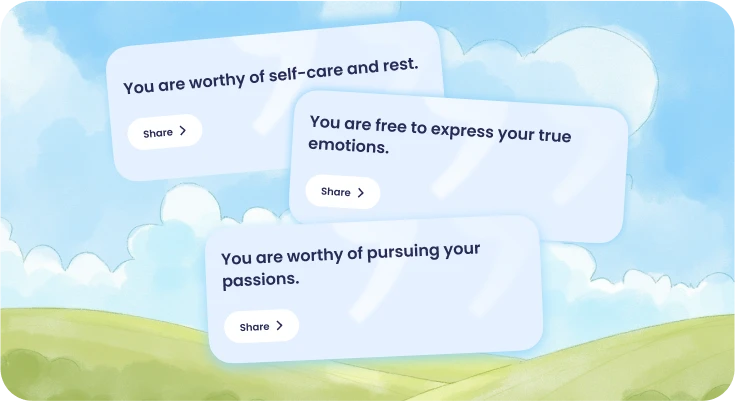
Consistency builds respect, both from others and from yourself. To stay confident and guilt-free while setting boundaries, use positive affirmations in the Breeze app. You can remind yourself:
- “My time and energy are valuable.”
- “It’s okay to say no without feeling guilty.”
- “Setting boundaries helps me build healthier relationships.”
8. Be persistent in achieving your goals
“Nice guys” tend to be passive and only become active when helping others, pursuing approval. They can be so focused on satisfying the needs of others that they lack the time, energy, and motivation to achieve their own goals.
This passivity may lead to a life where they neglect their own needs and lose track of what they want for themselves, feeling lost. To avoid this, you need to clearly define your goals and core values to constantly keep them in mind.
Before agreeing to someone’s request, consider whether it will help you achieve your goals and feel happier. If the answer is “no”, it can be better to refuse. Using Breeze personalized routine plans, you can set up goals and track your progress to get motivated.

9. Boost your self-confidence with body language
According to research on the persuasiveness of confidence, body language can help you feel more confident in social situations [3] Newman R, Furnham A, Weis L, et al. Non-verbal presence: How changing your behaviour can increase your ratings for persuasion, leadership and confidence. April 2016 . That’s why things like a nice smile, eye contact, standing up straight, and keeping your hands still can help you talk to anyone confidently.
If you have to discuss an important project with your boss or politely refuse to help someone, keep your shoulders relaxed, face the person directly, and avoid crossing your arms. You may also think through what you want to say in advance and write down the main points. This can help you stay on track, for fear of disappointing others, and protect your own interests.
10. Practice self-awareness to shift from being a “Nice Guy” to becoming a “Real You”
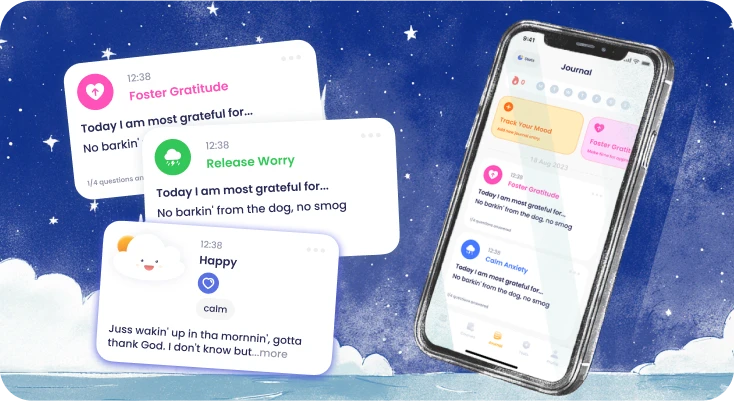
When all your attention is focused on others and not on yourself, you can lose the ability to listen to yourself and recognize your inner voice. Breeze guided journaling with its thought-provoking questions may help you to learn how to feel your feelings, track repeated reactions, such as automatically saying “yes,” avoiding conflict, or people-pleasing, and identify situations, people, or thoughts that provoke stress or guilt.
What Happens When You Stop Being a Nice Guy
At first, others may be surprised or even resistant to your change. But eventually, your relationships in a couple become more balanced and respectful, and you experience a sense of emotional freedom you’ve never had before.
The reason is that constantly worrying about what others think, the desire to control others’ emotions, and to remain good to everyone is exhausting and harmful to mental health.
Expert Insight
When addressing these patterns of behavior, it opens up the opportunity for more genuine connection and a life more aligned with your own values and interests. It creates space to exist outside of the expectations of others and create a life for yourself.
Hannah Schlueter
Mental health professional
Sources
- Robert A. Glover. No More Mr Nice Guy: A Proven Plan for Getting What You Want in Love, Sex, and Life. December 2002
- JSTOR. “Exploring the Relationship Between Narcissism and Extreme Altruism.” Spring 2018
- Newman R, Furnham A, Weis L, et al. Non-verbal presence: How changing your behaviour can increase your ratings for persuasion, leadership and confidence. April 2016
Disclaimer
This article is for general informative and self-discovery purposes only. It should not replace expert guidance from professionals.
Any action you take in response to the information in this article, whether directly or indirectly, is solely your responsibility and is done at your own risk. Breeze content team and its mental health experts disclaim any liability, loss, or risk, personal, professional, or otherwise, which may result from the use and/or application of any content.
Always consult your doctor or other certified health practitioner with any medical questions or concerns
Breeze articles exclusively cite trusted sources, such as academic research institutions and medical associations, including research and studies from PubMed, ResearchGate, or similar databases. Examine our subject-matter editors and editorial process to see how we verify facts and maintain the accuracy, reliability, and trustworthiness of our material.
Was this article helpful?