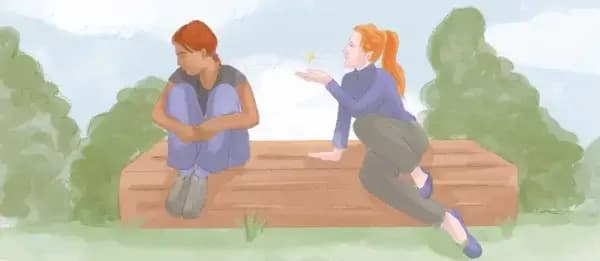


Have you ever wondered how your attachment style influences your relationships? Attachment theory identifies four main attachment styles: secure, anxious, avoidant, and ambivalent. This style of emotional interaction affects the further development of close relationships with others [1] Li, Yuxuan. “How does attachment style influence early childhood development?” February 2023 .
People with an avoidant attachment style tend to avoid intimate connections because they are afraid of being vulnerable, rejected, or losing their independence. This pattern can lead to feelings of loneliness, isolation, and being misunderstood. Let’s find out whether it’s your attachment style.
How Avoidant Attachment Style Impacts Adult Relationships
Avoidant attachment in adulthood can take different forms, most often showing up as fearful-avoidant or dismissive-avoidant behaviors. According to research on the insecure pattern of attachment, both styles are rooted in a deep discomfort with emotional closeness, but they express this in distinct ways [2] Cassidy J, Berlin LJ. The insecure/ambivalent pattern of attachment: Theory and research. .
Dismissive-avoidant attachment style
Dismissive-avoidant attachment style is the most emotionally closed way of interacting with a partner.
A person with a dismissive attachment style tends to minimize the importance of emotions and intimacy. While they can form attachments, they often suppress or ignore emotional needs to maintain independence. As a result, avoiding conflicts and suppressing emotions can lead to unresolved issues within relationships and even health issues, as 2024 research states [3] Tyra AT, Fergus TA, Ginty AT. Emotion suppression and acute physiological responses to stress in healthy populations: a quantitative review of experimental and correlational investigations. June 2024 .

Fearful-avoidant attachment styles (Anxious-avoidant, disorganized attachment style)
This insecure attachment style is a combination of the avoidant and anxious attachment styles. Relationship dynamics in this situation may be unstable since one person may push a partner away one day and seek intimacy the next, wondering how to fix anxious attachment style.
They often show a “push-pull” dynamic in relationships, moving towards closeness but then withdrawing when they feel vulnerable or rejected. This can feel unpredictable to partners.

People with a fearful-avoidant attachment style may see themselves as unworthy of love or incapable of maintaining stable relationships. They may have low self-esteem and blame themselves for relationship difficulties, wondering, “Why do I feel guilty all the time?”.
They experience high anxiety being close to people, need constant reassurance, overanalyze partners’ behaviors, and become hypervigilant about signs of rejection. As a result, they may unconsciously sabotage relationships. For their romantic partners, this communication often feels turbulent and emotionally intense.
Expert Insight
Someone with an avoidant attachment style is also likely to ignore or suppress their own emotions. Building emotional literacy around their own experiences can help them find more comfort in the feelings they experience, leading them to be more likely to share or advocate for their needs within relationships.
Hannah Schlueter
Mental health professional
How to Develop a Secure Attachment Style
A person who has a secure attachment style is one who consistently forms close relationships, knows their emotional needs, isn’t afraid to express their love or commitment, and is able to support their partner’s emotions. They also have a stable sense of self and a solid self-worth regardless of their relationship status.
Although attachment style is formed in childhood, it is not permanent. Building a secure attachment in adulthood is very much possible. Conscious self-improvement, psychotherapy, analog activities, and self-reflection are ways to help a person understand their fears and change their negative thoughts to develop an earned secure attachment style and foster healthy relationships.
What tools can help you become more self-aware? The Breeze app offers personalized quizzes, such as the emotional intelligence test, narcissistic partner test, childhood trauma test, and emotional availability quiz, that can help you see patterns you might not be aware of.

Moreover, the app also has self-reflective journaling prompts to help you slow down, identify your emotions, and understand what makes you feel anxious or frustrated, using the Breeze mood tracker and mood notes to monitor your improvements over time.
Finally, you can use Breeze’s customized routines to set up goals like “Practice gratitude with your partner” or “Share one small secret or personal story each week” to overcome your avoidance in close relationships. Then, you can mark off each goal as you go and track your progress.
Expert Insight
Building a secure attachment takes time, effort, and a lot of awareness. If you want to change your attachment style, I recommend seeking a licensed professional to help you identify underlying experiences related to your current attachment style and work together to find more trust, vulnerability, and security within the relationships in your life.
Hannah Schlueter
Mental health professional
Sources
- Li, Yuxuan. “How does attachment style influence early childhood development?” February 2023
- Cassidy J, Berlin LJ. The insecure/ambivalent pattern of attachment: Theory and research.
- Tyra AT, Fergus TA, Ginty AT. Emotion suppression and acute physiological responses to stress in healthy populations: a quantitative review of experimental and correlational investigations. June 2024
Disclaimer
This article is for general informative and self-discovery purposes only. It should not replace expert guidance from professionals.
Any action you take in response to the information in this article, whether directly or indirectly, is solely your responsibility and is done at your own risk. Breeze content team and its mental health experts disclaim any liability, loss, or risk, personal, professional, or otherwise, which may result from the use and/or application of any content.
Always consult your doctor or other certified health practitioner with any medical questions or concerns
Breeze articles exclusively cite trusted sources, such as academic research institutions and medical associations, including research and studies from PubMed, ResearchGate, or similar databases. Examine our subject-matter editors and editorial process to see how we verify facts and maintain the accuracy, reliability, and trustworthiness of our material.
Was this article helpful?