



You may notice that you’re not accepted by women in your workplace, group of friends, or your partner’s family. Or, you’re often irritated by provocatively dressed or loud women or jealous of female achievements. One of the possible causes is misogyny, a hatred toward women.
The situation is complicated by the fact that this hostility can be expressed not only by men but also by other women. Let’s explore misogyny through the contemporary lens and how to overcome it.
One possible reason for your strong negative emotions and difficulties in building healthy relationships with women can be the ongoing impact of an early traumatic event. Take the test to find out if you’re experiencing the impact of childhood trauma on your life today.

Why Do I Hate Women?
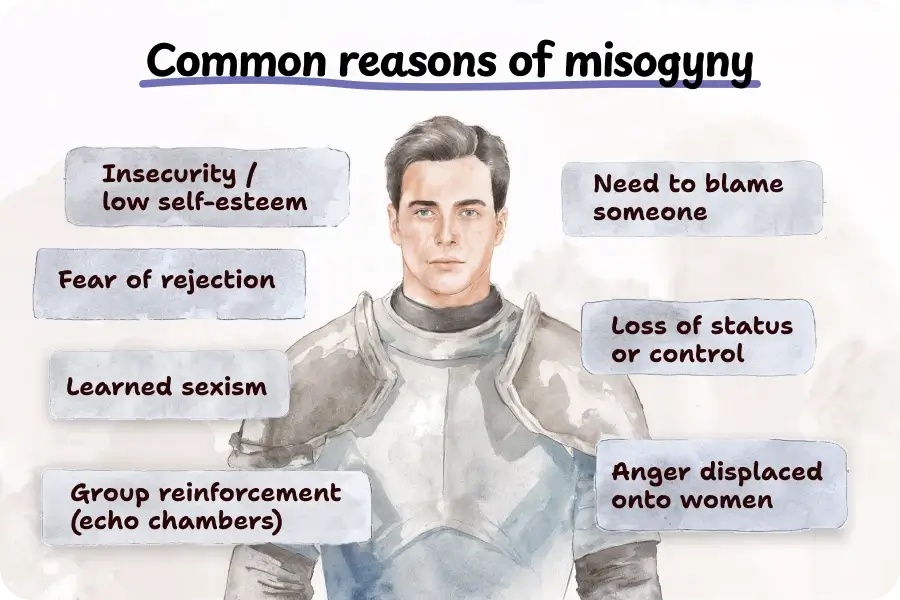
Many people who feel something like hatred towards women aren’t actually reacting to women as a group, according to research. They may react to pain, fear, resentment, or powerlessness that got attached to that label. Here are some common sources of this feeling:
1. Hurt that never got processed
Experiences like betrayal, bullying, neglect, or judgment can turn into anger toward women for some people, especially when those experiences are intense, repeated, or happened early in life. It can be rejection by a crush, humiliation by a teacher, or a harsh criticism from a narcissistic mother. If those experiences were specifically tied to females, the person might grow to view all women as a threat to their self-worth.
Other research also shows that if a boy is a frequent witness to physical and emotional domestic violence, he is more likely to develop misogynistic views and become abusive towards women as an adult.
2. Learned narratives
Online spaces, peer groups, or family environments may feed simplified stories such as “women are shallow,” “women only want money,” or “women are the problem.” Those hostile narratives may feel comforting because they give pain a clear villain. Instead of dealing with uncertainty, rejection, or mixed experiences, blame is assigned to a single group.
3. Fear disguised as hate
Sometimes fear of vulnerability, intimacy, rejection, or not being “enough” flips into contempt. Pushing women away first creates the illusion of control: if rejection is initiated rather than received, the underlying fear remains untested and unexposed. In this way, hatred is less a belief than a defense mechanism. It protects the ego from vulnerability, but at the cost of reinforcing isolation and preventing genuine connection.

Why Do Men Hate Women So Much?
Hatred toward women often grows out of fear, insecurity, and social pressure rather than reason or personal experience.
1. Psychological defense and fear of losing control
When women begin to occupy equal positions in society, some men may develop a fear of losing their privileges, jobs, and control. Misogyny can be a way to protect oneself from the threat of changes to the established social order.
2. Suppressed sexual desires
Men may accuse women of allegedly “manipulating” them by displaying their sexuality. This may be because they have complicated internal conflicts related to sexual desire. They perceive a woman’s sexuality or behavior as a threat. Or, they have shame about rejection, causing them to feel angry if a woman does not desire them sexually.
3. Cultural pressure and the “performance” of masculinity
Some men are raised with the belief that their worth is tied strictly to their ability to “acquire” status or partners. When they fail to meet these narrow definitions of success, they feel a sense of betrayal. They may feel they “followed the rules” but didn’t get the “reward.” It may lead to a specific type of resentment toward the group they feel is withholding that validation.
In this case, hating a group can be just a way to avoid self-loathing. It’s easier to project blame outward than to look inside. If you feel like you aren’t “manly” enough, successful enough, or attractive enough, that internal pain can be overwhelming. To cope, the mind turns that hurt outward.
How Male Misogyny Runs Rampant & Algorithms Feed “Incel” (Involuntary Celibates) Content
The term “incel” (“involuntary celibate”) emerged from online subculture, and it refers to men who resonate with being unable to find a romantic or sexual partner despite desiring one. While the term originated in the 1990s as a neutral space for people of all genders, it has evolved into a male, often radicalized community with a specific ideological framework.
At the core of the modern incel community is a philosophy known as the “Black Pill.” It is a fatalistic worldview based on the belief that romantic success is determined entirely by factors outside of a person’s control, such as:
- The belief that physical attractiveness is the only metric of value.
- Hypergamy, or the claim that women only pursue a small percentage of “alpha” males.
- The idea that because they were born “unattractive,” there is no point in self-improvement or social effort.
The incel subculture functions as a psychological trap. It replaces the possibility of personal growth with a cycle of externalized blame. The “Black Pill” ideology forces feelings of worthlessness and isolation among men. These communities do not offer a solution to loneliness but rather a framework for sustaining it through collective despair.
Based on new research by Dublin City University, this is how TikTok’s and YouTube’s engagement-based recommendation/“For You” algorithms can end up exposing vulnerable men to incel-related, misogynistic, and extremist content.
| Step/Mechanism | TikTok (For You Page) | YouTube (Recommendation System) |
| 1. Input Signals (User Interaction) | Clicks, watch time, likes, shares, re-watches, and searches are all interpreted as interest signals. | Similar signals include watch history, likes/dislikes, comments, subscriptions, and time spent. |
| 2. Content Matching | Rewarding high engagement and showing more similar content. | YouTube’s system favors videos that keep users watching longer and clicking “next.” |
| 3. Semantic Shifts (Rebranding) | Incel ideas and male misogyny are reframed using self-improvement language (“Sub5s,” “PSL Scale”) to pass detection. | There’s no research confirming this happens specifically for incels, but algorithms can amplify alt-right, “female filth,” manosphere, alpha nature, dominant alphas, toxic masculinity, and misogynistic content by clustering together related themes. |
| 4. Normalization / Community Reinforcement | Repeated exposure can make extreme online subculture narratives seem “normal,” especially when framed as self-improvement. | Exposure to similar community content fosters a sense of belonging and validation, which can make radical ideas feel normative. |
Expert Insight
Therapy can explore the roots of feeling unlovable and the associated fears related to physical attraction. People who feel insecure about their looks may also struggle with their self-worth. However, by improving self-worth, this tends to improve one’s capacity to engage in relationships with others. This, in turn, can increase a sense of self-love or internal acceptance.

Nicole Arzt
Mental health professional
Female Misogyny: Can Women Be Misogynistic?
Yes, female misogynists may subconsciously accept and mirror the sexist prejudices and social stigmas present in society.
1. The “own gender climb” and identity conflict
An “own gender climb” is when someone puts down their own gender to make themselves look better, smarter, or “different” to the opposite sex. This involves putting down “typical” feminine ideal traits to prove they are more logical, tougher, or “not like other girls.
When a person feels like a failure around their gender, they may try to “climb” out of that group and align themselves with the other side to get validation or status.
A prime example is the “Pick Me” dynamic in modern dating. Female misogynists may tell a man, “I don’t have female friends because they are all too much drama. I prefer hanging out with guys.” She is putting down her gender to make herself seem more “low-maintenance” and appealing to men.
Another example of internalized misogyny can be linked to a lack of emotional intelligence in the workplace. A female executive is extra harsh on the younger women in the office, telling the male counterparts or board members, “Women in this field usually aren’t tough enough, but I’m different.” She is distancing herself from her gender to prove to the men in power that she belongs in their “club.” As a result, some people may develop the illusion of “natural” male superiority.
2. Policing other women, slut-shaming, and competition
Female misogyny may show up as harsh judgment toward how other women dress, parent, or conduct their romantic lives. If a woman believes there is only one “right” way to be a woman, she may become the primary enforcer of those restrictive rules.
For example, a woman who has chosen a traditional domestic path might aggressively criticize other women who prioritize their professional identity, labeling them as “bad women” or “bad mothers.” Conversely, other women may shame stay-at-home mothers as “unambitious” or “choosing complete female submission.” In both scenarios, the woman is using a narrow definition of womanhood and “women’s life’s mission” to invalidate others.
Why Does Society Hate Women? A Sociological Perspective
Society doesn’t purely “hate” women in the emotional sense. Rather, it often functions through a system of rules and expectations that devalues women to maintain a specific power balance.
1. The “default male” bias
British science journalist and sociologist Caroline Criado Perez emphasizes in her book “Invisible Women” that the majority of our environment is created using a male “standard,” from automobile safety features to medical research. When the male experience is treated as the universal default, women’s needs are seen as “niche” or “atypical.” This isn’t always conscious hatred, but it is a form of structural neglect that suggests women are secondary participants in public life.
This bias shows up in everyday design choices. Long lines for women’s toilets, for example, are often treated as unavoidable, even though they result from planning based on male usage patterns and ignoring biological and practical differences. Similarly, many homes and public interiors are designed around male height, reach, and routines, affecting everything from counter heights and storage placement to tools, lighting, and safety features.
2. Economic devaluation (the care penalty)
Careers traditionally associated with women, such as caregiving, cleaning, and emotional support, are often paid at much lower wages than more masculine roles. By economically devaluing “feminine” work, society reinforces the idea that these contributions are natural obligations rather than skilled labor. This pattern keeps women in a position of systemic financial vulnerability.
3. Minimizing domestic abuse
Phrases like:
- “He only hit her because he loves her so much; he just has a ‘fiery’ personality,”
- “She really knows how to push his buttons; she shouldn’t have provoked him.”
- “Whatever happens behind closed doors is their business” is an example of blame-shifting and normalization of male aggression towards women.
In this way, society may reframe a lack of impulse control and a desire for dominance as an “excess of love” and make abuse seem romantic, deserved, or private.
Expert Insight
Society can also degrade feminine qualities by covertly or overtly shaming their hobbies or preferences. For example, someone may criticize a woman for being “too vain” if she values fashion and makeup. At the same time, a woman who loves cars or home repair projects may be perceived as ‘manly,’ even though her preferences have nothing to do with her gender.
Nicole Arzt
Mental health professional
6 Tips to Stop the Cycle of Hate
If you want to stop hating everyone and challenge stereotypical attitudes towards women, that process requires patience and persistence.
1. Analyze the roots of your biases
The first step to changing your life is acknowledging the problem. Try to understand where your personal biases and attitudes come from. This may be rooted in your upbringing, cultural stereotypes about traditional gender norms, or an environment that attributes modern women’s stereotypical feminine virtues.
To begin this process, ask yourself, “Why have I specifically targeted women as the primary cause of my frustrations, rather than looking at the broader systemic or personal factors in my life?”
2. Deepen your knowledge of gender issues
Reading books, watching documentaries, and attending lectures about gender equality may help you better understand the challenges women face. Learning about the history and experiences of others can change your perspective and help develop empathy.
Try to actively listen to and support the women in your community. Pay attention to their feelings, concerns, and experiences. Participate in discussions about gender roles, social justice, and women forging ahead, and listen to their opinions and experiences.
3. Monitor your reactions
Notice how you comment on the behavior of female characters when watching movies. Or, how you react to the “inappropriate” behavior or appearance of other women (too much makeup or too provocative clothing). What specific words and epithets do you use when talking about other women? Take a moment to listen to how you speak about women when they aren’t in the room.
4. Avoid misogynistic language
Sometimes, the most damaging phrases are the ones that sound like a “compliment” or a joke but actually rely on an insult to the entire gender. Removing these “micro-insults” from your vocabulary is a practical way to stop the cycle of externalized blame:
- “You’re actually really logical for a woman.” This implies that women are inherently irrational and that the one you’re talking to is a rare occurrence.
- “You’re a great driver. So few women can actually handle a car properly.” This turns a personal achievement into a weapon against every other woman.
- Using the words “girl” or “pussy” as synonyms for “coward” or “weakling.” Furthermore, adult women should not be called girls.
- Turning a woman’s strength into a moral failing with misogynistic “she-devil” or “witch”.
- Framing self-righteousness as specifically female and domestic behavior with phrases like “holier than thou housewife.”
To test yourself, you may ask this self-reflection question: “If I replaced the word ‘woman’ in my sentence with ‘person,’ does the sentence still make sense, or was I only saying it to point out a perceived gender flaw?”
5. Audit the content you consume
Once you learn to recognize misogyny in simple, everyday interactions, you may begin to see it in the information you consume daily, especially on social media. Here, your task is to eliminate sources that reinforce your internalized misogyny. Try to diversify your feed with people who express alternative views, even if they initially seem unusual or uncomfortable.
One of our users shared her experience: “I once followed a reality television star who expressed fat-shaming and promoted weight loss at any cost. I thought she was supposed to motivate me to exercise and become the best version of myself. So, every day, I read her rather aggressive posts, in which she criticized other women. As a result, I began to dislike my body even more, feeling ashamed of it.
Realizing that her content was having a rather destructive effect on me, I unfollowed her and began to feel more comfortable in my own skin, learn to love myself, and find motivation for exercising.”
6. Seek therapy
These feelings of hatred can be a “smoke” from a fire that started long ago. A therapist can help you determine if you’re reacting to the person in front of you or a trauma from your past. Different types of therapy can help you challenge your thought patterns and look at the “parts” of you that feel wounded or protective.
Frequently asked questions
1. Can a woman be misogynistic to a man?
No, misogyny specifically means hatred, contempt, or prejudice against women. However, a woman can:
- Hold misogynistic beliefs
- Be sexist toward men
- Enforce patriarchal norms that harm men (e.g., “men shouldn’t cry”)
2. What’s it called when a man hates or degrades women?
Misogyny. That’s the textbook definition: hatred, distrust, or devaluation of women. It can show up as attitudes, behaviors, or systems—not just overt hate.
3. Why are most men afraid of women?
They aren’t—as a group. That’s a common overgeneralization. Some men may feel fear or experience anxiety around women because of:
- Social conditioning (pressure to perform masculinity, fear of rejection)
- Inexperience or lack of social confidence
- Shame or guilt taught around desire or emotions
- Fear of social consequences (being judged, rejected, or misunderstood)
- Past negative experiences
Sources
- Kimberley Brayson. Hating Women: A Constitution of Hate in Plain Sight. August 2024
- Abi Rached M, Hankir A, Zaman R. Patriarchal Upbringing in the 21st Century: The Impact Emotional Abuse Related to Parental Styles Has on the Genesis of Gender Inequality and the Development of Unresolved Trauma in Children. December 2021
- DCU Institute of Education. New research shows how TikTok and YouTube Shorts are bombarding users with misogynist content. April 2024
Disclaimer
This article is for general informative and self-discovery purposes only. It should not replace expert guidance from professionals.
Any action you take in response to the information in this article, whether directly or indirectly, is solely your responsibility and is done at your own risk. Breeze content team and its mental health experts disclaim any liability, loss, or risk, personal, professional, or otherwise, which may result from the use and/or application of any content.
Always consult your doctor or other certified health practitioner with any medical questions or concerns
Breeze articles exclusively cite trusted sources, such as academic research institutions and medical associations, including research and studies from PubMed, ResearchGate, or similar databases. Examine our subject-matter editors and editorial process to see how we verify facts and maintain the accuracy, reliability, and trustworthiness of our material.
Was this article helpful?