

Podcast name
Only child syndrome
You were raised as an only child in a family, and want to know how it influenced your whole life. Or maybe now you have only one kid and are thinking about their future. If so, keep reading, as this article explores myths and true traits of only children.
We’ll talk about how growing up without siblings can shape personality, relationships, and emotional patterns in adulthood. You’ll learn about only child syndrome and discover research-based data on whether it really exists.

What is only child syndrome?
“Only child syndrome” is a term suggested by child psychologists G. Stanley Hall and E.W. Bohannon at the end of the 19th century. It hypothesized that children born in families with no siblings tend to be lonely, self-centered, unempathetic, and maladjusted.
This theory was rather popular when it first arose, and even one of the originators of the term stated that being an only child is “a disease in and of itself.” Yet, now this view is considered outdated and overly simplistic. It was based on the questionnaire, which categorized children with various (mostly negative) traits. Presently, there’s no controlled research that proves a significant influence of being an only child on personality development and further adult life.
Today, psychologists agree that “only child syndrome” is not a recognized diagnosis. Parenting style, emotional availability, social exposure, and cultural context play a far more decisive role in shaping a child’s personality than family size alone.
What does mental health research say about only child syndrome?
Research on personality differences among only children is limited, and findings may vary depending on social status, cultural background, the year the research was conducted, and access to social interaction. Still, studies find no consistent disadvantages associated with being an only child.
- A study published in the Journal of Research in Personality closely examined six personality traits in more than 20,000 adults from New Zealand. Their results state that only children were a little less honest and conscientious and a little more emotional and open, but these differences were very small.
- Another study by Joshua D. Foster, Jennifer R. Raley, and Joshua D. Isen has found that the level of narcissistic tendencies is equal among only children and kids from large families.
- According to the 2023 findings, only children in the UK exhibited comparable performance on cognitive assessments and reported analogous levels of well-being.
- Research evidence published in the American Journal of Orthopsychiatry suggests that only children don’t feel lonelier than those growing up with siblings.
Common only child syndrome traits and stereotypes
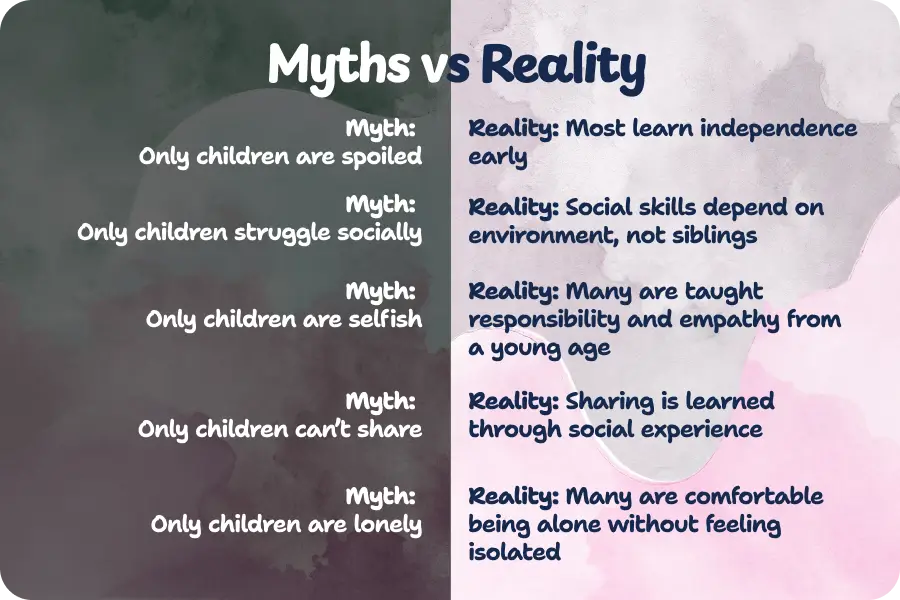
People who believe that growing up in larger families is more beneficial for kids’ development state that only children may be “spoiled” by undivided attention. This statement might lead to negative stereotypes and common myths, which we’ll break down further.
Myth 1: Only children have poor social skills
Supporters of the theory state that being a single child means a person doesn’t learn how to share, negotiate, or resolve conflicts from an early age. They may say that a lack of communication with other kids at home can lead to challenges with teamwork, compromise, and sharing.
Reality: It might have been partially true at the end of the 19th and the beginning of the 20th century, when kids grew up with limited access to peers outside the family.
Nevertheless, now only children can interact with peers at school, in extracurricular activities, or online. Social skills no longer depend on having siblings at home.
Myth 2: Kids without siblings feel lonely
Some may think that growing up in a one-child family is equal to feeling isolated. Such kids are assumed to lack connection at home.
Reality: If you were an only child, you could still interact with other kids outside of home. Moreover, only kids get their parents’ full attention and may receive even more care and connection than those in families with multiple children.
Myth 3: Only children are selfish
“They always get what they want and don’t need to share with anybody.” This argument may be shared by supporters of the only child theory to suggest the idea that such kids are spoiled.
Reality: Parent-child relationships can vary from family to family. Some kids might really grow up selfish. But it can also happen in families with multiple siblings when one child is favored. Selfishness doesn’t stem from family size but more from values (like empathy or responsibility) that parents teach and model for their kids.
Also, only children can face more expectations from their parents and other adults. It can teach only children to manage their own needs while being mindful of others.

Myth 4: Such kids are too sensitive to criticism
When kids play together, they might tease each other, compete with each other, and get a lot of feedback from their siblings. Supporters of the theory believe that in the absence of these experiences, only children develop diminished tolerance for criticism.
Reality: The truth is that how sensitive you are to criticism has more to do with your emotional safety, attachment style, and parenting than with having siblings. Only children can learn how to deal with criticism through school, friends, sports, and other activities. Some may even learn to control their emotions better and think about themselves more deeply by talking to adults more.
Myth 5: Children without siblings are maladjusted
People who believe in the theory can say that an only child experiences “overprotection” at home and never has to look for compromise with siblings. This, combined with being the center of attention, can make it difficult to handle setbacks.
Reality: If there’s more than one child in a family, kids really need to look for compromise more often. Yet, people may learn to cope with criticism and failure outside of sibling dynamics as well. They can improve their communication skills at school, with their parents at home, or with their friends.
Myth 6: Only kids are bossy
“When children grow up without siblings, they may get used to the feeling of control. Their parents can do literally everything they ask for, which makes them bossy.” Supporters of the only child syndrome theory development may use this statement to highlight significant differences between only children and those raised with siblings.
Reality: This assumption oversimplifies family dynamics. Parents may not fulfill every request of the child. Also, being assertive or taking initiative might be mistaken for bossiness. Only children may express their opinions more confidently because they are used to communicating with adults, but this does not mean they lack cooperation, flexibility, or empathy.
Myth 7: Only children tend to be hyper-independent
Another idea that follows the only child syndrome is that such kids have antisocial tendencies. They lack experience with group activities and find it challenging to cooperate with others.
Reality: Hyper-independence may be a result of childhood trauma, past negative experiences, or PTSD, and can occur regardless of the number of siblings in the family. It is partially true that only kids can be more independent, but it doesn’t typically turn into toxic (hyper) independence.
3 benefits of growing up without siblings
Being an only child can bring benefits during one’s life span, including strong relationships with parents, self-sufficiency, and a desire to achieve more.
1. Stronger bonds between parents and a child
Sometimes, parent-child relationships are stronger when there is only one child in the family. This can lead to emotionally rich relationships. Because of this, only children may become aware of their feelings and have a secure attachment style, which helps them make strong connections later in life.
2. Self-sufficiency
If parents don’t keep an eye on everything, one child might learn how to solve problems and do things on their own. This ability to rely on themselves can last into adulthood and help these kids deal with work, relationships, and other responsibilities.
3. Feeling more comfortable with adults
Only children may feel more at ease with adults than with peers. Because their main social circle is made up of parents, grandparents, and family friends, they may learn more advanced words, jokes, and communication patterns than their peers.
This way of talking can make them seem “wise beyond their years.” But it might also make peer relationships less connected.
One child’s problems in adulthood
Despite the fact that common myths about growing up without siblings are untrue, many only children might face unique challenges later in life. These can include the need to care for aging parents, greater responsibility in front of other family members, and perfectionism.
1. Parental expectations
Parents may perceive only children as carriers of their hopes and ambitions. Without siblings to share this pressure, expectations around success can feel too intense. As a result, kids may develop:
- Fear of failure
- Perfectionism
- Strong inner critic
Narcissistic parents might approach a child as their extension rather than as a separate individual. As adults, only children raised in such dynamics may find it difficult to separate their desires from others’ expectations and feel chronic guilt when prioritizing themselves.
Also, regardless of parenting style, only children are more likely to care for their parents later, according to an Ageing & Society article. It can create additional pressure in adulthood.
2. Challenges with autonomy and intimacy
Only children may value independence and self-reliance more than others. This can be a strength, but it might also make close adult relationships feel complicated. Such people avoid asking for help, sharing vulnerability, and fully relying on a partner.
3. Feeling responsible for others’ emotions
Expert Insight
“The main contributor to this pattern is related to the attachment style that is created with the child’s caregivers. If caregivers are making the child feel responsible for the caregivers’ emotions, the child will internalize such patterns and likely experience deeper people-pleasing tendencies into adulthood.”

Hannah Schlueter
Mental health professional
Psychological facts: How to combat the negative effects of only child syndrome
For parents
- Ensure your kids have plenty of opportunities to interact with other children. It will help them develop better problem-solving skills and reduce social anxiety.
- Avoid overprotecting them. Let kids handle communication with other children on their own. Also, it’s better not to interfere with conflicts unless safety is at risk. Resolving small disagreements on their own helps them learn negotiation and emotional regulation.
- Encourage hobbies that require teamwork. When children play together, they learn to share roles and interact in society. If your kid can’t do it at home, they may need a hobby where they can find friends and develop new skills.
- Set realistic expectations. Don’t demand them to get only A’s at school and attend dozens of extracurricular activities. If you don’t want a child to develop a strong inner critic in the future, remember that personal growth matters more than perfection.
For grown-up only children
- Work on setting healthy boundaries in relationships. Because you were the center of your parents’ world, you might feel like you have to be “on” for everyone. So, learn to say no and protect your time when necessary.
- Practice asking for help and delegating tasks. At work or in relationships, you don’t need to handle everything alone. Start with small tasks and gradually build trust that others can support you.
- Explore mindfulness or self-reflection to balance independence with intimacy. You can use Breeze’s mood tracker to see how opening up influences your emotions. After some time of such reflection, you’ll improve self-awareness and learn to communicate your needs more clearly.
Hannah Schlueter, MA, LAC, shares more insights on how grown-up only children can cope with the negative effects of maturing without siblings. “Adults who were the only child in their family may not experience negative effects of growing up without siblings. If you have concerns about adjusting to adulthood after being an old child, it’s important to look at where exactly your struggles exist (interpersonally, emotionally, occupationally, etc.). Finding a professional to help support you in processing your experiences and making the necessary changes is a great next step.”
Famous adults: Only children’s success stories from Hollywood to history
Daniel Radcliffe was the only child of a casting director and a literary agent, so his parents were on set with him every day while they were filming Harry Potter. This constant adult supervision and support prevented the usual “child star” burnout. He was homeschooled on set, so he didn’t have much of a social life outside of work.
Charlize Theron was also an only child, raised in South Africa in a family of road builders. Although her childhood was rather unstable, she developed strong independence and resilience. These traits helped her move abroad alone at a young age, build a career from scratch, and become an Academy Award-winning actress and producer.
Chelsea Clinton is a writer and the only child of former US President Bill Clinton and Hillary Clinton. Growing up in the public eye meant constant attention and high expectations, but it also gave her early exposure to politics and public service. As an only child, she learned to navigate adult spaces comfortably and developed strong communication skills.
Conclusion: Is it better to be an only child?
Being the only child in the family is as good as growing up with siblings. Despite the fact that being an only child can create unique challenges, such as loneliness or pressure from parental expectations, they may also develop strong independence and confidence early in life.
Frequently asked questions
What are the struggles of the only child?
The challenges only children may face include isolation, difficulty with social skills and conflict resolution, as well as intense parental expectations. However, these challenges aren’t inevitable. Supportive parenting, friends, school, and other social experiences help only children develop good social skills, independence, and resilience.
What is the typical characteristic of an only child?
Years ago, many only children were described as selfish, bossy, hyper-independent, egoistic, and lonely. However, current research hasn’t found any evidence that only kids are different from those growing up with siblings.
What causes only child syndrome?
At the end of the 19th and the beginning of the 20th century, people believed that all kids who grew up without siblings were likely to develop only child syndrome. However, now this “diagnosis” is considered inaccurate. Modern quantitative reviews show that being a single child does not inherently lead to personality problems.
Do only children tend to be more successful?
No scientific research proves that only children tend to be more successful. It rather depends on the environment the kid grew up in, as well as the level of one’s own ambitions, which leads to further success and overall well-being.
Sources
- Samantha Stronge, John H. Shaver, Joseph Bulbulia, Chris G. Sibley. “Only children in the 21st century: Personality differences between adults with and without siblings are very, very small.” Journal of Research in Personality. 2019
- Joshua D. Foster, Jennifer R. Raley, Joshua D. “Further evidence that only children are not more narcissistic than individuals with siblings.” Personality and Individual Differences. 2020
- Lin, S., Falbo, T., Qu, W., Wang, Y., & Feng, X. (2021). Chinese only children and loneliness: Stereotypes and realities. American Journal of Orthopsychiatry, 91(4), 531–544. https://doi.org/10.1037/ort0000554
- Alice Goisis, Jenny Chanfreau, Vanessa Moulton, George B. Ploubidis. “Only Children and Cognitive Ability in Childhood: A Cross-Cohort Analysis over 50 Years in the United Kingdom.” Population and Development Review. 2023
- Chanfreau J, Goisis A. “Patterns of help and care by adult only children and children with siblings.” Ageing and Society. 2024;44(1):200-223.
Disclaimer
This article is for general informative and self-discovery purposes only. It should not replace expert guidance from professionals.
Any action you take in response to the information in this article, whether directly or indirectly, is solely your responsibility and is done at your own risk. Breeze content team and its mental health experts disclaim any liability, loss, or risk, personal, professional, or otherwise, which may result from the use and/or application of any content.
Always consult your doctor or other certified health practitioner with any medical questions or concerns
Breeze articles exclusively cite trusted sources, such as academic research institutions and medical associations, including research and studies from PubMed, ResearchGate, or similar databases. Examine our subject-matter editors and editorial process to see how we verify facts and maintain the accuracy, reliability, and trustworthiness of our material.
Was this article helpful?