


You’ve only started dating, or perhaps you have only been together for some time; whatever the case, something feels off. You may experience strong physical attraction and even have similar preferences, yet conflicts keep arising.
Do you have fundamental differences in values and personalities, or is it just a temporary crisis? This compatibility test can help you find out.

Check your compatibility for a long-term relationship
You and your partner need to choose answers separately and then compare the results.
- I need reassurance from my partner.
- Often
- Sometimes
- Rarely
- I can express my emotions openly.
- Often
- Sometimes
- Rarely
- When my partner doesn’t show affection, I get nervous.
- Often
- Sometimes
- Rarely
- I don’t need much personal space.
- Often
- Sometimes
- Rarely
- I prefer resolving disagreements immediately rather than handling everything on my own.
- Often
- Sometimes
- Rarely
- I can calmly discuss difficult topics.
- Often
- Sometimes
- Rarely
- I don’t overthink every partner’s phrase during an argument.
- Often
- Sometimes
- Rarely
- I apologize when I’m wrong.
- Often
- Sometimes
- Rarely
- Career is my top priority.
- Often
- Sometimes
- Rarely
- I can’t feel secure without financial stability.
- Often
- Sometimes
- Rarely
- I need long-term goals in a relationship.
- Often
- Sometimes
- Rarely
- I value my independence within a relationship.
- Often
- Sometimes
- Rarely
- Sex strongly affects my relationship satisfaction.
- Often
- Sometimes
- Rarely
- I need regular physical affection (e.g., touch and hugs).
- Often
- Sometimes
- Rarely
Results of a relationship match test
Now sum up your totals. This step will help you see the bigger picture beyond individual answers and understand how compatible you are as a couple.
0-5 point difference. It seems that you’re a good match.
You likely value the same things, including how much space you need, how you handle conflict, and what commitment actually looks like, so the relationship feels safe.
6-11 points difference. Some aspects of your approach to life align, but others create tension.
To reach a common understanding and build relationships based on mutual trust, you may need to discuss details and speak when you feel hurt. Also, try the Breeze app to track your feelings and what triggers them. This way, you’ll be able to notice the cause of recurring conflicts much faster and discuss it on the spot.
12+ point difference. You see life from different perspectives.
It doesn’t necessarily mean that you can’t date at all. However, without self-awareness and consistent effort from both sides, these differences can lead to misunderstandings. Long-term success would require open dialogue, mutual respect, and a willingness to consciously meet in the middle.
Expert Insight
“Having a completely different personality score on a compatibility test is not necessarily a bad thing. Contrasting personality types can actually strengthen your relationship, especially when you view these differences as strengths and not weaknesses. When communicating with each other, try to focus on the common ground between you. This way, you can build a foundation of friendship that exists outside of your personality differences.”

Emily Mendez
Mental health professional
Section scores and how they influence relationships
- 0-2 point difference — high compatibility.
- 3-6 point differences — moderate differences.
- 7+ point difference — a significant mismatch.
Emotional needs
Questions 1-4 are about how much affection you need and how you tend to show it to your partner. Some people need a lot of personal space, and others can experience stress when they don’t see a partner for a few days. If one of you likes texting every hour and the other prefers meeting on weekends, it can cause stress.
Communication during conflicts
Questions 5-8 address how you approach conflicts. For example, in a family, one person may need to talk things through immediately, while the other shuts down to process alone. It can create a cycle of chase and retreat.
This pattern can leave both partners feeling unheard. The person who needs to discuss everything feels abandoned, and the one who withdraws feels inadequate.
Lifestyle
It’s almost impossible to build something stable if one partner wants to build a career in New York while the other one prefers spending quiet days somewhere in Australia with their children. So, questions 9-12 are about common life goals and values.
Of course, this example may sound exaggerated, but when two people focus on building different futures, it can end up in either a compromise or a breakup.
Physical attraction
Questions 12-14 refer to sexual desire. If one person sees physical intimacy as a requirement for emotional safety and the other one sees it as optional, it can lead to low self-esteem, emotional withdrawal, feelings of loneliness, and relationship dissatisfaction.
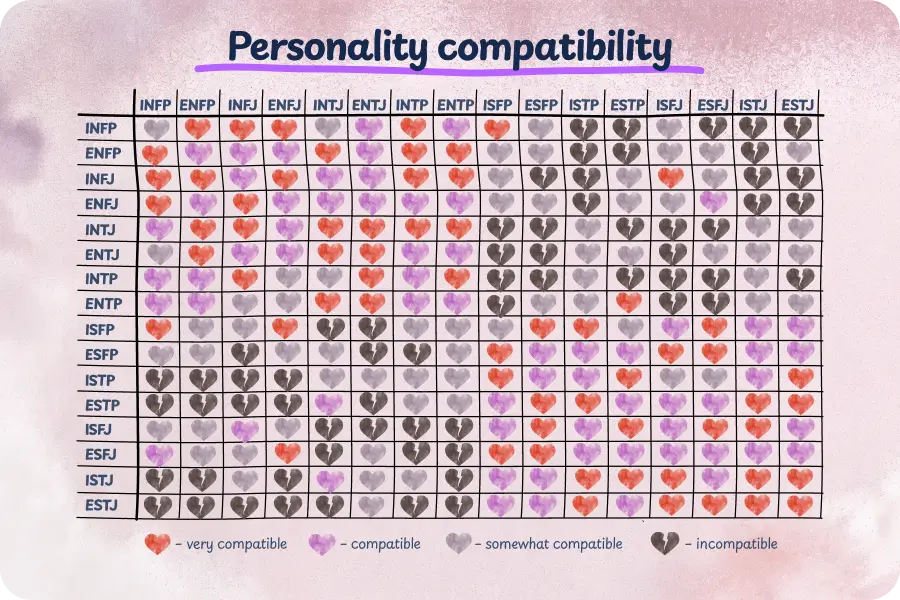
What’s the link between a couple’s compatibility test and MBTI?
Some platforms highlight the link between personality types defined through the Myers-Briggs Type Indicator and couples’ compatibility. It might be effective because the MBTI test results highlight ways partners think and can show aspects where they lack common understanding.
Certain studies also prove that MBTI-based interventions tailored to emotional needs may enhance relationship satisfaction and stability. So, here are the main aspects that may not align.
Introversion vs. extraversion
Extroverted people (E) feel recharged when they spend time with other people. Introverts (I), instead, feel drained after staying in big companies and prefer spending time alone. If “E” and “I” personalities start dating or get married, they might need to spend their free time differently.
It won’t necessarily lead to conflicts. However, an extrovert may decide to attend a friendly gathering, while an introvert opts for staying home on Friday evening.
Sensing vs. intuition
People who explore life through sensing (S) are realistic and detail-oriented. They focus on concrete facts rather than assumptions. At the same time, intuitive (I) people see everything from a creative perspective and tend to trust their intuition.
When such people build relationships, one may need clear plans, structure, and practical steps, while the other may crave big ideas, future possibilities, and long-term life goals.
Emily Mendez, M.S., Ed.S., explains how people can use info about their MBTI types to improve relationships. “By understanding you and your partner’s personality types, you can identify areas of difference that may cause conflict in your relationship. Respecting these differences can lead to healthier compromises rather than arguments. With time (and practice), respectful dialogue and accepting your different perspectives will strengthen your chances of a successful long-term relationship.”
Thinking vs. feeling
Thinkers (T) value logic, and the feeling (F) personality type pursues their heart. As a result, one person in a couple may want to make decisions rationally, and the other one may focus mostly on their values and go with the flow.
Judging vs. perceiving
For the judging (J) type, the world is about structure and organization. They may plan their holidays months before and have a schedule for when to do household chores. The perceiving (P) type likes to be more flexible and easygoing. This can create tension when one wants to know everything beforehand, and the other one needs more freedom in life.
How to overcome differences and build a stable relationship
If your scores in the compatibility test, as well as MBTI personality types, are completely different, it doesn’t necessarily mean that you shouldn’t be together. Instead, you may need to communicate better during tough moments and spend more quality time together. You may have to compromise more as well.
1. Understand your attachment style
According to the study in attachment theory developed by John Bowlby and later expanded by Mary Ainsworth, attachment style plays a significant role in romantic relationship satisfaction and overall well-being.
People with secure attachment styles build more stable relationships and feel comfortable with closeness. Those with insecure attachment styles may struggle with fear of abandonment, emotional distance, jealousy, or constant doubts about their partner’s feelings.
You may need to check yourself and your partner for attachment style. The good thing is that it can be changed throughout life. So, if one or both of you live with an insecure style, a licensed therapist can help you deal with it.
2. Engage in open communication
Share your worries and fears, and, most importantly, discuss your partner’s actions that make you feel frustrated. Sometimes, even one open conversation can be effective in avoiding conflicts.
For instance, your loved one may be fond of computer games. While this is their way to rest after a busy day, you may feel neglected if they play the whole evening. Instead of trying to process this alone, communicate about your needs. You may decide to set simple agreements, like choosing specific evenings for shared activities or defining personal downtime for both of you.
3. Be curious about your partner’s needs
Try not only to listen to your partner but also actually hear them. When they talk about the desire to spend a week on vacation without a clear plan, it may be frustrating for you. But you may ask, “Why do you think it might be cool?” In turn, they will explain to you that planning beforehand brings additional stress, while going with the flow gives them flexibility.
Next time, you may approach the situation differently. Curiosity shifts the focus from “Who’s right?” to “What makes you feel safe and happy?” When you understand the need behind your partner’s behavior, compromise becomes much easier.
4. Accept that some challenges can’t be solved
According to the research, people are most likely to try solving the problem once it arises in relationships. While it sounds pretty rational, some misunderstandings can be ongoing and happen over and over again.
For instance, one partner may always need emotional closeness, while the other requires more independence. Or one values strict planning, while the other feels restricted by too many rules. In this case, looking for compromise and accepting that your loved one may have different needs is the only way to build a balanced relationship.
Frequently asked questions
Can a lack of understanding in relationships influence my mental health?
Yes, relationship challenges can cause ongoing stress that, if it remains unsolved, may affect your well-being. Constant misunderstandings, feeling unheard, or walking on eggshells trigger cortisol release, which, in turn, may cause:
- Sudden mood swings
- Insomnia
- Fatigue
- Difficulty concentrating
- Loss of appetite
- Headaches or muscle tension
- Symptoms of depression
How can I understand our relationship compatibility from the very beginning?
The key here is to listen to a person attentively and pay attention to small details in their actions.
- Pay attention to the relationship green flags listed in the article.
- Then, discuss your plans for the future, life vision, and approach to daily life.
- Check whether they try to get close or intimate too quickly, as it may be a warning sign.
- Also, notice how you feel around them. Do you feel calm and safe or tense and unsure?
- Pay attention to how they handle small disagreements, whether they respect your boundaries, and if their words match their actions.
If all these aspects make you feel fine, it can be a positive sign.
Sources
- Jiaxin Li, Gu Fang, Yiyang Li. “Personality typology, emotional needs, and romantic relationship stability in Chinese college students: A cultural perspective on MBTI dynamics.” Acta Psychologica. 2025
- Sagone E, Commodari E, Indiana ML, La Rosa VL. “Exploring the Association between Attachment Style, Psychological Well-Being, and Relationship Status in Young Adults and Adults-A Cross-Sectional Study.” Eur J Investig Health Psychol Educ. 2023
- Apostolou M, Samara A, Lajunen TJ. “How People Manage Relationship Problems: An Exploratory Study in the Greek Cultural Context.” Behav Sci (Basel). 2025
Disclaimer
This article is for general informative and self-discovery purposes only. It should not replace expert guidance from professionals.
Any action you take in response to the information in this article, whether directly or indirectly, is solely your responsibility and is done at your own risk. Breeze content team and its mental health experts disclaim any liability, loss, or risk, personal, professional, or otherwise, which may result from the use and/or application of any content.
Always consult your doctor or other certified health practitioner with any medical questions or concerns
Breeze articles exclusively cite trusted sources, such as academic research institutions and medical associations, including research and studies from PubMed, ResearchGate, or similar databases. Examine our subject-matter editors and editorial process to see how we verify facts and maintain the accuracy, reliability, and trustworthiness of our material.
Was this article helpful?