



Do you often think, “I always make stupid choices and make mistakes in important tasks,” or “I always sound stupid when meeting new people”?
If you are your own biggest critic and believe you’re always doing wrong things, this article will help you understand why you might feel stupid and how to stop this negative self-talk.

Why Am I So Stupid? 8 Common Psychological Triggers
Feeling “stupid” is rarely a reflection of your actual intelligence. Instead, it can be a symptom of how your brain processes stress and social pressure. When your nervous system is overloaded by these triggers, you may have trouble understanding things you’re usually completely fine with.
1. You have low self-esteem
When you don’t trust yourself, your brain may exist in a state of chronic self-doubt. Instead of focusing on the task at hand, your mental energy is drained by the internal question, “Am I doing this right?” or “What if they think I’m slow?”
This split focus makes you more likely to make simple mistakes or forget things, which then confirms your false belief that you aren’t smart.
Moreover, when your self-worth is low, every minor challenge feels like a threat to your entire identity. This triggers your body’s fight-flight-freeze response and diverts blood flow away from the prefrontal cortex (the part of the brain that handles logic and reasoning).
This may explain why your mind goes “blank” during a test or a meeting, or why you might make careless mistakes. It doesn’t mean you don’t know the information. The reason is that your brain has physically prioritized survival over thinking.
2. You experience cognitive distortions
These are biased ways of thinking that trick you into believing things that aren’t true. Distorted thinking can be expressed in labeling and black-and-white thinking:
- Instead of saying, “I made a mistake,” you tell yourself, “I am so stupid.” Once your brain accepts the label, it stops trying to find solutions.
- If you aren’t perfect, you believe your whole life is a failure.
3. You have persistent negative thoughts
Automatic negative thoughts (ANTs) are reflexive, cynical thoughts that flood your mind during a challenge. If your inner monologue is screaming that you’re going to fail, your working memory (the part of the brain that holds information) decreases because it is too busy processing the “threat” of failure.
Common types of ANTs that can make you feel stupid
| The ANT type | The thought | The intellectual impact |
| Fortune-telling | “I’m definitely going to fail this.” | You stop trying, which looks like a lack of ability. |
| Mind reading | “They think I’m stupid and ugly.” | You become too anxious to speak clearly. |
| All-or-nothing | “I missed one step. I’m incompetent.” | You abandon a project that was 90% correct. |
4. You have imposter syndrome
This is the persistent fear that, despite your successes or competence, you are a “fraud” and will eventually be found out. High achievers may suffer the most from imposter syndrome. You may attribute your success to “luck” and your failures to “stupidity”. As a result, you can’t build a stable sense of your own competence.
5. You feel guilty in daily life
If you are constantly worried that you’ve upset someone or failed a responsibility, every decision may feel high-stakes because you fear it might make you feel ashamed. You may constantly scan your past actions for mistakes and your current environment for signs of disapproval from others.
Instead of focusing on the task in front of you, your brain is busy asking, “Did I sound rude in that email?” or “Is my boss mad that I was five minutes late?” This hesitation looks like a learning disability or slowness to others, but it is actually a defensive mechanism to avoid further mistakes.
6. You put the opinion of everyone else above your own
When you prioritize what everyone else thinks above your own perspective, you lose your intellectual autonomy. As a result, you may show people-pleasing tendencies and arbitrarily agree with someone else just to avoid conflict. This, in turn, can later make you feel stupid for not standing your ground. If you only feel smart when someone praises you, your self-worth may crash the moment you face criticism.
One possible reason for your anxious thoughts may be your partner’s behavior. Take the test to find out if you’re experiencing narcissistic abuse in your relationship.

7. You’re surrounded by critical people who make you feel self-doubt
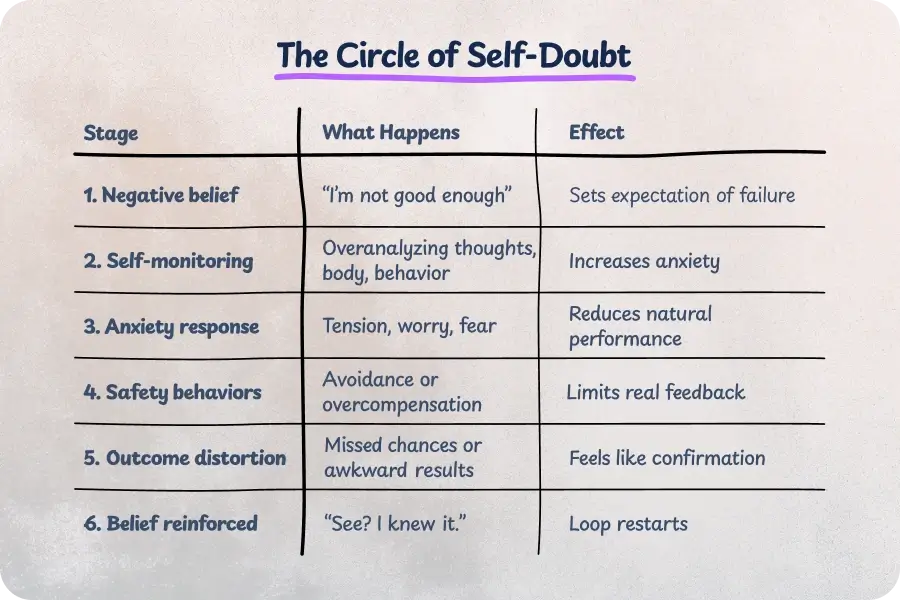
When your friends or family members constantly point out your flaws, your brain may eventually stop filtering their criticism and start accepting it as objective truth. Here is how a critical environment sabotages your mental performance:
1. The internalization of your own worst critic
If a parent, partner, or boss consistently tells you that you’re “clumsy,” “slow,” or “forgetful,” your brain builds a mental model around those labels. When you face a challenge, you may hear their predicted disappointment.
Because you expect to fail as they predicted, you become anxious and can make the very mistakes they criticize, which reinforces the cycle.
2. Hypervigilance under pressure
When you know you are being watched by someone critical, your brain enters a state of hypervigilance. You are so focused on not making a mistake to avoid their judgment that you lose the ability to focus on the task itself. This anxiety can make you more prone to making mistakes.
According to research, high-pressure monitoring from others disrupts procedural memory. This is why you might forget how to do a simple task like typing, driving, or explaining a basic concept the moment a critical person stands behind you.
For example, a critical co-worker says, “Let’s see how you handle the data entry today.” Your brain immediately flashes: “I’m going to click the wrong cell, and they’ll think I’m incompetent.” Because you are now actively “monitoring” your fingers instead of the data, your procedural memory breaks. You can forget the basic keyboard shortcut for “copy and paste.” Your hands feel heavy, your vision narrows, and you make a typo.
3. Chronic cognitive dissonance
If people around you treat you as though you lack intelligence, you may stop trusting your own logic and stay quiet just to keep the peace. This creates a painful split between what you genuinely think and what you feel allowed to express. Constantly suppressing your perspective can harm self-confidence, even when you are right.
8. You compare yourself to other people
This happens because of a psychological phenomenon called upward social comparison, where we measure our “internal” mess against everyone else’s “external” highlight reel. You may fall into two major cognitive traps:
1. The “specialist” fallacy
You may compare your general knowledge to someone else’s specific expertise. For example, you might feel stupid because you don’t know as much about coding as your programmer friend or as much about history as a professor. This creates a false sense of worthlessness because you ignore all the things you know that they don’t.
2. The “effortless perfection” illusion
When you see someone succeed, you usually only see the final result, not the hundreds of hours of confusion, mistakes, and “stupid” questions that got them there. If you start comparing your achievements, you may perceive their success as a sign of “natural genius” and your own struggle as a sign of “natural stupidity.”
Expert Insight
This can be a result of internalized shame or low self-esteem. You may also default to assuming that others have inherent strengths or goodness while assuming something within you is broken. This can reinforce feeling ‘othered’ in the world or believing that you are the only one struggling with a particular concern.

Nicole Arzt
Mental health professional
How to Stop Feeling Stupid: 10 Practical Strategies for Your Mental Health
Try to stop treating your brain like a failing engine and start treating it like a high-performance computer being slowed down by stress, triggers, social anxiety, and your self-esteem. With more practice and research-backed strategies to clear the mental fog, you may become the best version of yourself.
1. Use checklists
Create checklists for completing things that make you anxious or insecure. Break it down into simple, manageable steps. It can be a template for a difficult email or a checklist for leaving the house. The idea is to get the “how-to” out of your head and onto a sticky note or digital doc.
This moves the task from your working memory to your external memory. When the process is standardized, you can execute it even when you’re feeling stressed.
2. Focus on one thing at a time
Before starting a difficult task, write down every tiny sub-step, every worry, and every to-do currently in your head. When you put these on paper, you “offload” the data from your working memory to an external source. This can help you get out of your head and feel as sharp as you are.
3. Journal what you feel ashamed of
Write down the three things you are currently feeling guilty about or the two people you are worried about upsetting. This can instantly increase your processing speed for the task at hand.
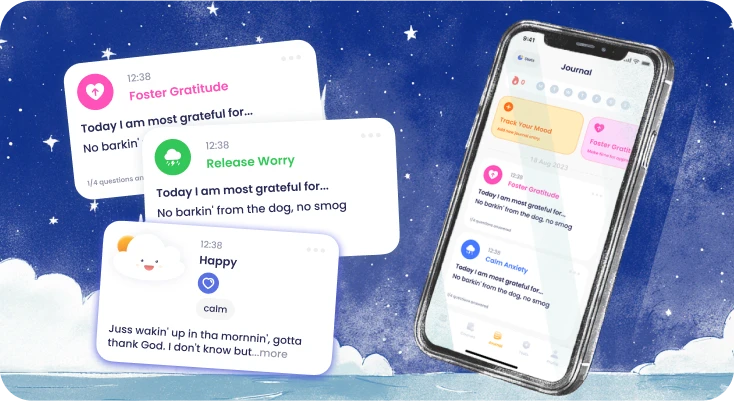
Breeze journaling exercises allow you to learn how to feel your feelings and let go of anxieties. Regular journaling about your emotions can reduce stress, as well as symptoms of imposter syndrome, and boost overall well-being. Moreover, the app offers various personal discovery tests on emotional intelligence, personality, career, friendships, values, relationships, and many more.
4. Rebuild your trust in your own logic
If you struggle with self-doubt, the goal is to retrain your brain to realize that your logic is completely fine and that you can survive a minor wrong choice without it being a catastrophe.
Start with small decisions. Pick a coffee shop, a movie, or a YouTube channel to watch, or a route home without asking for anyone else’s opinion or validation. Even if it feels uncomfortable, it’s important to practice this skill.
5. Set intellectual boundaries
Break free from the influence of critical people:
- Identify the source. Recognize that criticism is usually a reflection of others’ insecurities or need for control, not your actual IQ.
- Use the “grey rock” method. If you must be around critical people, protect your peace. Give neutral, short responses to critical comments to avoid feeding the conflict.
- Find evidence of your capability. Keep a private list of things you have done well to deal with the false narrative the critical person is trying to build.
6. Try viewing a critical person as an NPC (non-player character)
To stop or reduce the social choking that happens when a critical person is nearby, try to change your relationship with their presence. Mentally treat the critical person like an NPC in a video game. They are just noise in the room, not a moral judge of your intelligence.
This way, you may reduce the social monitoring load on your brain. This, in turn, allows your procedural memory to stay automatic, so you don’t fail tasks you know by heart.
7. Try to avoid comparison
Anxiety is a threat response, while intelligence is a discovery response.
- Compare yourself only to your past self. Consider using this metric: Do I know more today than I did yesterday? Use that as a baseline for examining your intelligence.
- Deconstruct the success. When you see someone who seems “smarter,” ask, “What systems or habits did they use to learn that?” instead of “Why don’t I just have that brain?”
- Limit social media usage. Platforms like LinkedIn or Instagram are designed to trigger comparisons and can reinforce negative feelings about yourself. Set strict limits on how long you spend there. Unfollow or mute accounts that trigger your negative thoughts.
8. Shift from competition to curiosity
When you feel stupid because you don’t understand something, consciously say, “That’s interesting. I wonder why that part is confusing me?” This reframes the situation from a “threat to your ego” to an “objective puzzle.” It signals your brain to stay in the prefrontal cortex (the learning center) instead of retreating to the amygdala (the fear center).
9. Practice self-compassion using the third-person perspective
When you criticize yourself, you may use a harshness you would never use on a friend. This creates an emotional threat that shuts down logic.
The next time you make a mistake, narrate it in the third person. Instead of “I’m so stupid for forgetting my keys,” say, “[Your name] forgot the keys because they were rushed.” This is called self-distancing. It honors neutrality, reduces the activation of the amygdala, and allows you to view the mistake as a solvable problem.
10. Talk to a therapist
When you feel “stupid,” your brain can be stuck in a cycle of emotional reasoning. You feel a certain way, so you assume it must be a factual truth. A mental health professional doesn’t just “cheer you up.” There are different types of therapy that literally help you rewire the neural pathways that are currently bypassing your intelligence.
According to research, cognitive behavioral therapy (CBT) is especially helpful for persistent negative self-evaluations and social anxiety. It focuses on the link between thoughts, feelings, and behaviors. Your therapist helps you identify cognitive distortions.
For example, if you get one question wrong and think, “I’m a total failure,” CBT teaches you to catch that thought and replace it with a neutral fact: “I missed one question, but I understood the rest.”
You may also work on building a list of things you are really good at. When you look at concrete evidence of past successes, you weaken the brain’s “I am stupid” narrative.
When Your Thought “I Feel So Stupid” Is a Sign of Something More: A Mental Health Professional’s Opinion
Here is what might actually be happening when you feel stupid:
1. Cognitive fatigue
Prolonged stress causes high levels of cortisol, which can temporarily shrink the hippocampus (responsible for memory) and weaken the connection to the prefrontal cortex (responsible for logic). You feel “slow,” forget words, and struggle to follow simple instructions because your brain’s battery is at 1%. Eventually, constant stress may lead to burnout and social isolation.
2. High-functioning anxiety
If you are an overachiever who suddenly feels stupid and incapable, you might be experiencing hypervigilance and anxiety. You might “blank out” during a presentation or struggle to read a simple paragraph because your brain lacks the capacity to handle complex problem-solving.
3. ADHD
People with undiagnosed ADHD may feel stupid because they struggle with working memory and task initiation. They might have 10 great ideas at once, but because you can’t pick one, you feel paralyzed and “dumb.”
4. Depression and pseudo-dementia
In clinical psychology, there is a phenomenon where severe depression mimics the symptoms of cognitive decline.
Depression slows down neural firing. This leads to psychomotor retardation — you literally think, move, and speak more slowly. Because your brain feels “heavy” and “foggy,” you may mislabel this biological slowing as a lack of intelligence.
5. Intellectual gaslighting or childhood trauma
If you grew up in an abusive environment where you were constantly criticized, your brain may have developed a collapse response. When faced with a challenge, it may shut down to avoid the “danger” of making a mistake, blocking the logic you actually possess.
Expert Insight
In some cases, feeling dumb may speak to underlying mental health concerns like depression or anxiety. Furthermore, if you are constantly overlooking details or making careless mistakes, you may want to consider a neurological evaluation. ADHD or autism, for instance, can sometimes present as “feeling dumb.” Furthermore, there may be physical concerns to rule out.
Nicole Arzt
Mental health professional
Frequently asked questions
1. How do I know if I'm low IQ?
True cognitive ability is measured by professional clinical assessments. You can’t accurately determine your IQ based on feelings alone. Struggling with focus, memory, the learning process, or certain tasks does not automatically mean you have a low IQ. Intelligence is complex and includes many different abilities, such as logical reasoning, verbal skills, creativity, emotional awareness, and more.
2. Is it ADHD, or am I just stupid?
ADHD is a neurodevelopmental condition that affects attention, impulse control, and executive functioning — not intelligence. Many people with ADHD are average or above average in IQ but struggle with organization, consistency, or follow-through. If you frequently feel distracted, forgetful, restless, or overwhelmed despite trying hard, it may be worth speaking to a professional for an evaluation.
3. Why am I smart but act dumb?
This may happen because high intelligence doesn’t automatically include processing speed or social awareness. You may have a brilliant analytical mind, good grades, and a bachelor’s degree, but stress, social anxiety, or overthinking can make you freeze up or make simple mistakes in the most important tasks.
Sources
- Yu R. Choking under pressure: the neuropsychological mechanisms of incentive-induced performance decrements. February 2015
- Warnock-Parkes E, Wild J, Thew G, Kerr A, Grey N, Clark DM. ‘I’m unlikeable, boring, weird, foolish, inferior, inadequate’: how to address the persistent negative self-evaluations that are central to social anxiety disorder with cognitive therapy. December 2022
- Matt Gonzales. Here’s How Bad Burnout Has Become at Work. April 2024
- Jonathan A. Mars; Raman Marwaha. Depressive Cognitive Disorders. September 2025
Disclaimer
This article is for general informative and self-discovery purposes only. It should not replace expert guidance from professionals.
Any action you take in response to the information in this article, whether directly or indirectly, is solely your responsibility and is done at your own risk. Breeze content team and its mental health experts disclaim any liability, loss, or risk, personal, professional, or otherwise, which may result from the use and/or application of any content.
Always consult your doctor or other certified health practitioner with any medical questions or concerns
Breeze articles exclusively cite trusted sources, such as academic research institutions and medical associations, including research and studies from PubMed, ResearchGate, or similar databases. Examine our subject-matter editors and editorial process to see how we verify facts and maintain the accuracy, reliability, and trustworthiness of our material.
Was this article helpful?