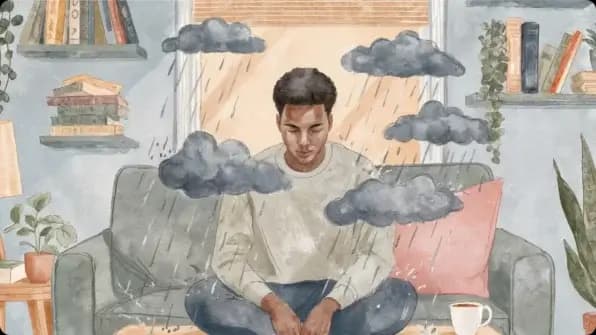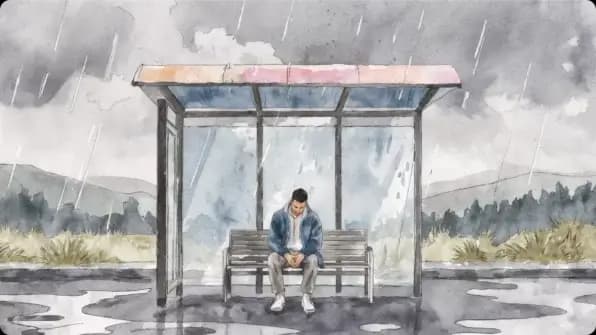


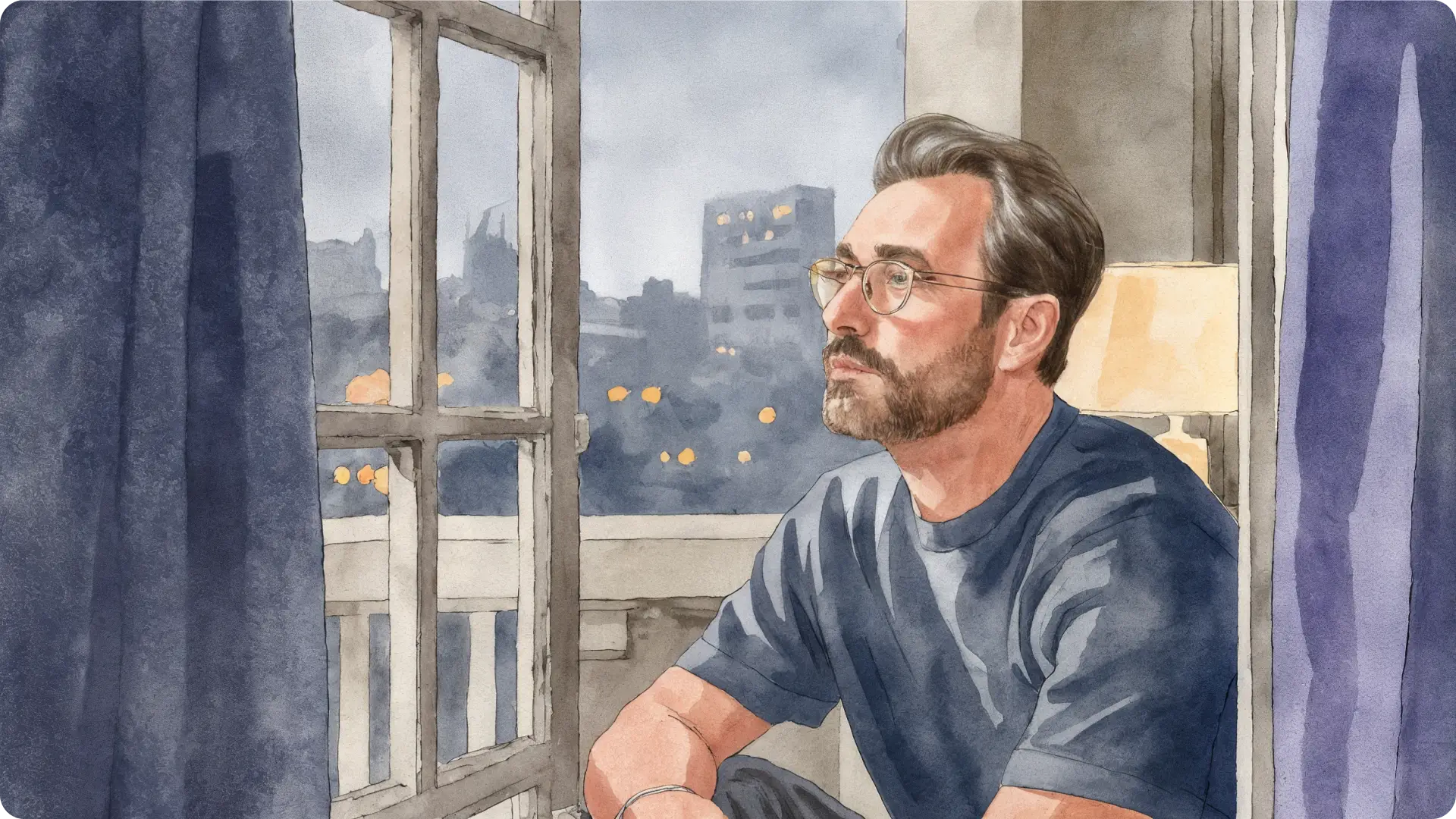
Another weekend you’re going to spend alone in bed, talking to nobody. But while at first it seemed like something you needed, it slowly stopped feeling like a choice. A break from people started turning into heaviness. The world outside feels louder, faster, and more demanding, and you feel that it’s challenging to keep up.
In this article, we’ll explore the meaning of emotional and social withdrawal, why you might isolate yourself, and how it may influence your mental and physical health. We’ll find out tips to overcome social isolation and discover when it might be the norm.
What is emotional withdrawal?
Emotional withdrawal is a state where a person reduces involvement with the world around them, including people, activities, and obligations. Things that once felt normal, like replying to messages, meeting a friend, or joining a group chat, begin to feel like tedious or insurmountable tasks. People may literally feel cut off from everyone, even in a room full of people. As a result, you may notice that you:
- Share less
- React less
- Feel less excitement
- Avoid situations where emotions might come up
- Limit your interactions with other people
Such self-isolation may serve as a protective response. If someone feels overwhelmed, hurt, or stressed, they may use it as a way to reduce emotional overload. And it is completely normal when it happens occasionally and serves as a way to deal with negative thoughts.
However, when social withdrawal becomes a consistent pattern, a person can experience emotional distress and depression symptoms they tried to avoid, which turns into a vicious cycle.
Emotional withdrawal vs. introversion
| Aspect | Emotional withdrawal | Introversion |
| What it is | A psychological state where a person pulls back emotionally | A stable personality trait describing how someone gains energy |
| Choice vs. reaction | Unconscious and reactive | Intentional and natural |
| Emotional tone | Feels heavy, numb, detached, or drained | Feels calm, comfortable, and balanced |
| Desire for connection | May want closeness but feel unable or unsafe | Still values connection, just in smaller doses |
| Effect on mood | Linked to low mood, anxiety, or emotional fatigue | Not linked to distress |
| Impact on life | Can reduce the quality of life if prolonged | Neutral or positive when respected |
| Core feeling | “I can’t deal with people right now.” | “I prefer quieter, smaller interactions.” |
If you self-isolate and feel good at the same time, you might be an otrovert, a new personality type. It’s on the same line with introverts and extraverts but describes individuals who feel independent of their social connections.
Check your personality type by taking a quick self-discovery test in the Breeze app. We provide research-based insights and tips on how to make the most out of your strengths and take care of your well-being and inner balance.
Why do I isolate myself from everyone? Common root causes and risk factors
A person may self-isolate due to numerous reasons, including low self-esteem, past trauma, staying in an unfamiliar setting, burnout, or social anxiety disorder. Let’s explore the most common causes of avoidance behaviors in detail.
1. The need to process difficult feelings
Many people may self-isolate if they need to overcome grief from loss, handle a recent breakup, or process intense emotions they don’t yet have words for. Temporary sadness, anger, and even frustration are normal.
So, if you or your close one has been avoiding social contact for some time, it isn’t necessarily an alarming sign. When it starts interfering with daily life, it may signal that the person is no longer just processing and is getting stuck.
2. Unfamiliar environment
You might have changed jobs or even moved to another city. Until you establish meaningful connections, it is completely normal that you might avoid close social interactions. It isn’t withdrawal but rather an adjustment phase. Nevertheless, it can be a kind of isolation if you intentionally avoid communication with friends and family members as well.
3. Low self-esteem
“I’m so boring and basic.” “Other people can’t truly like me.” If you regularly think something like this, your self-isolation might stem from a lack of confidence. When self-esteem is low, a person may assume others will judge and lose interest without real evidence. To avoid that imagined risk, they pull back first.
4. Fear of rejection
Those who fear that others may stop liking them after one unfunny joke may unconsciously prefer alone time. “I need to seem ideal to be loved.” This belief turns distance into a form of self-protection, because when others get close, it’s much easier to see you as a real human rather than an idealized version of yourself.
5. Social anxiety
Those who live with a social anxiety disorder (SAD) may intentionally avoid social settings to prevent excessive stress. There may also be people without an official diagnosis who can exhibit some of the traits typical of this mental health condition.
Still, SAD or its tendencies are a persistent pattern rather than a temporary mood or passing phase. So, if you started experiencing social withdrawal sometime ago, the reason might be different.
6. Traumatising experiences
According to the 2025 study, a clear relation is established between distress in childhood and experiencing social withdrawal as an adult. So, if you grew up with a narcissistic mother or faced emotional abuse or neglect, it can be the underlying factor why you avoid social connections.
Traumatizing experiences that you’ve dealt with in adulthood can also impact social isolation. For instance, a year ago, a woman experienced a severe car crash. While her physical health is fine now, she’s still dealing with PTSD symptoms, particularly anxiety in social settings.
7. High sensitivity to sensory experiences
People with hypersensitivity may quickly get overstimulated in crowds, big companies, or even during long one-on-one communication. So, maybe you don’t withdraw emotionally but rather protect your nervous system. However, if a person begins avoiding most social connections altogether, even in calm, low-stimulation settings, it may go beyond simple sensory protection.
8. Mental health conditions
Certain mental health challenges may lead to isolation as well. Among the following are:
- Depression
- Generalized anxiety disorder
- Autism spectrum disorder
- Schizophrenia
- Substance use disorders
These conditions can affect energy levels, thinking patterns, emotional regulation, and social comfort. This, in turn, may make the connection feel exhausting or inaccessible. For example, depression can reduce motivation and interest in anything, which is why a person avoids getting out of the home or even answering their friends online.
Why do I isolate myself when I’m upset or stressed?
Withdrawal behavior can act as a defense mechanism. It enables people to psychologically distance themselves from the source of stress, according to the study.
As such, if you find yourself retreating, it may be because your brain has categorized the outside world as “too much noise” to process. It can signal to you that it’s better to avoid social connections now in order to handle an internal crisis.
Expert Insight
“Emotional withdrawal can be a result of a multitude of things; however, if it typically occurs when someone is upset, it’s usually as a means of protection. It means your nervous system is too dysregulated for you to be able to process the feeling or experience as you usually would, or that the environment is not safe for you to do so.”

Hannah Schlueter
Mental health professional
Recognizing withdrawn behavior: Signs you or a loved one is pulling away
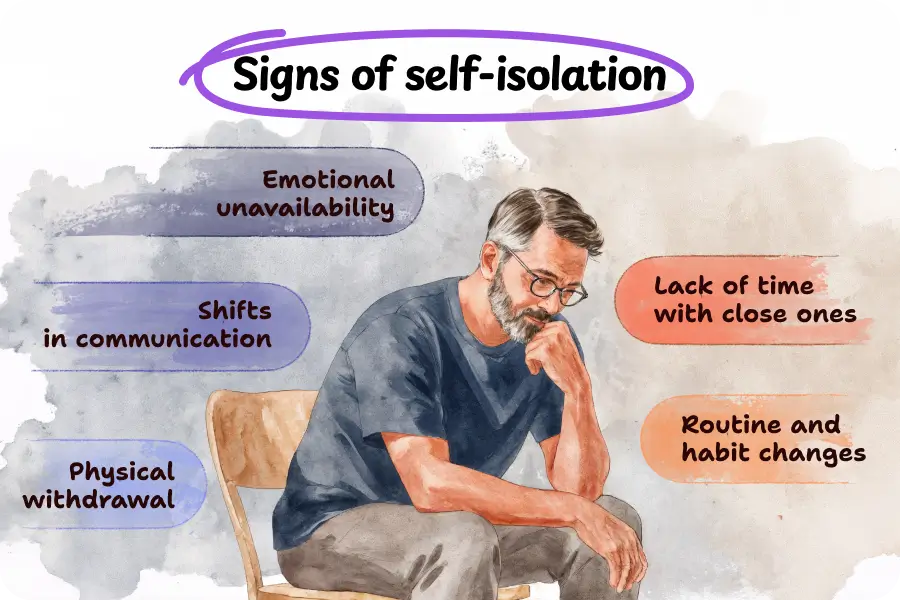
Early signs of self-isolation may include excessively spending time on one’s own, emotional unavailability, intentionally avoiding social gatherings, and a general lack of self-care. Here’s how it can manifest in daily life.
1. Emotional unavailability
An emotionally withdrawn person may feel numb and apathetic, avoid situations that trigger deep feelings, or find it challenging to express what they feel inside. “I’m better processing everything on my own,” you may think. But it can gradually turn into losing connection with people who really care, pushing you further into feelings of isolation.
2. Physical withdrawal
You avoid intimacy with your partner, don’t hug friends anymore, and can’t handle even the slightest physical closeness without feeling tense. If early on you weren’t so sensitive to touch, it can signal self-isolation.
3. Lack of time with close ones
“No, today I’m busy” and “I already have plans for the weekend” become automatic responses, even when there are no real plans. Of course, all people may occasionally refuse to go out and need some alone time. However, if you started seeing close ones much more rarely than before and keep refusing to meet anyone, it may signal emotional distancing.
4. Routine and habit changes
You used to start your Wednesdays working in a coworking space or a cozy cafe. Or, maybe, you typically go to the gym three times a week. But lately, all these habits have started looking unimportant. The only thing you want to do is to stay at home and avoid engaging with anyone.
5. Shifts in communication
You no longer hurry up to answer text messages and keep them unread for days. You don’t want to answer phone calls even though you used to like talking to your friends. And spending time with relatives has turned from something familiar into something that feels draining or forced. The way you talk and the topics discussed might have changed as well.
The impact: What isolation does to the human mind and body
Self-isolation may seem like a safe pause from the world, but when it lasts for a long time and turns into a way of life, underlying issues with physical and mental health can arise. In particular, research shows that emotional withdrawal is linked to changes in mood, stress systems, and even brain structure and connectivity, especially when the withdrawal is chronic.
Impact on the mind
1. Increased anxiety
Without regular communication with close friends, colleagues, or at least small talk with strangers, people may start experiencing anxiety. They may overthink and expect the worst. This happens because the brain interprets a lack of social contact as a potential threat, heightening alertness and stress responses even in ordinary situations.
2. Risk of depression
Long isolation may lower dopamine activity, which can lead to low mood, emptiness, and loss of motivation. It can also lead to constant dissatisfaction with life, suicidal thoughts, and an increased risk of depression.
3. Negative thoughts
Another point of view might be necessary in particular situations. With fewer external inputs, the mind turns inward and turns to rumination — replaying mistakes, imagined problems, or fears.
4. Distorted self-perception
A sense of self-worth may be affected as well. For instance, if a person doesn’t have a support system from close ones, they can become overly self-critical.
5. Heightened stress sensitivity
Intense anxiety and feelings of self-isolation might make you more sensitive to challenges. “I can rely only on myself.” This thought makes daily functioning feel heavier.
6. Increased risk of paranoia or social fear
When you miss the gym for some time and then return to training, exercises can feel more difficult and unnatural. The same goes for social situations. Long periods alone can influence your self-confidence in interaction with others.
Impact on the body
1. Higher stress hormones
Feelings of loneliness are associated with increased cortisol. So people who avoid social situations may generally feel more tense.
2. Physical health challenges
Loneliness and social isolation increase the risk of stroke, heart disease, diabetes, and cognitive decline, according to the World Health Organization.
3. Weakened immune system
Chronic isolation can weaken the immune system. When the body experiences stress over a long period of time, it focuses on immediate survival instead of repair and protection. Because of this, people who feel lonely for a long time may catch colds more easily and take longer to recover.
4. Sleep problems
People who feel socially isolated may have lighter, more fragmented sleep. Poor sleep then makes it harder to manage anxiety and emotions the next day, creating a cycle of exhaustion and stress.
5. Low energy
Emotional isolation drains physical energy because the body runs in a low-grade stress state.
6. Increased pain sensitivity
The brain processes social pain and physical pain similarly, according to the study published in Pain Management. So, social withdrawal can literally make pain feel worse.
How to stop isolating when stressed: Practical recovery steps and when to seek professional help
There are numerous support and treatment facilities that can help a person stop emotionally withdrawing from friends and family. Save these tips to stop perceiving social situations as a threat.
1. Identify the reasons
You need to understand why you started to self-isolate. For instance, if it’s linked to a painful breakup, you may need to work on it with a therapist. Or, maybe, you have nobody to spend time with because you’ve recently moved to another country. In this case, social withdrawal is temporary. List:
- When did this pattern start?
- What significant life changes have you experienced recently?
- What emotions were you feeling around that time?
- What thoughts come up now before you cancel plans?
When you know what self-isolation stems from, it can be easier to find a way out.
2. Start small and go up in the social re-entry ladder
You don’t need to host a huge party tomorrow night. Instead, do everything step-by-step. For instance, you can:
- Text one close friend
- Have a short text conversation
- Send a voice note or make a brief call
- Go to a public place with no social obligation (café, walk, store)
- Meet one safe person for a low-pressure hangout
- Join a small group setting for a limited time
3. Focus on things you like
You may not want to interact with relatives you don’t like or engage in some bureaucratic stuff. But how about doing something that involves social interaction and makes you happy? It can be a hobby class, a sports group, a book club, volunteering, or a creative workshop. When the activity itself is enjoyable, social contact feels more natural and less forced.
4. Develop existing relationships
Finding friends after social isolation can seem challenging. But you can talk to people you already know. Invite an old friend for coffee, organize a team-building activity with your colleagues, or visit your parents. Even a phone call can make a person understand, “Hey, you’re still meaningful to me.”
5. Find new connections you’re comfortable with
If you’re ready to meet new people, make sure these are the ones who feel emotionally safe and aligned with your values, pace, and interests. When a person — whether a stranger or a friend — disrespects your boundaries, it might worsen social withdrawal. So, keep in touch only with ones who make you feel better and learn to say “no” if something feels overwhelming.

6. Practice self-compassion
Approach yourself with the same understanding you’d offer a close friend. Instead of “What’s wrong with me?”, try “I’m going through something difficult right now.” Self-criticism increases stress and may deepen withdrawal, while self-compassion helps calm the nervous system.
Also, acknowledge your limits without labeling yourself as antisocial. It’s okay if your capacity for interaction is lower for a while. Notice small efforts and give yourself credit for them. For instance, you can keep a gratitude journal in the Breeze app and write down your achievements in overcoming emotional withdrawal and social anxiety.
7. Seek professional support
Hannah Schlueter, MA, LAC, comments, “When your patterns of social isolation feel too overwhelming to address, it’s time to look for extra support with a mental health professional. If you are unable to take the steps to get yourself out of social isolation, people are here to help you.”
Conclusion: balance social interactions and time alone to take care of your well-being
Staying alone for a certain period is completely fine. But when you take excessive time withdrawing from others, it can negatively influence your physical and mental health. Check yourself for early signs of self-isolation and start overcoming it with Breeze. The app allows you to engage in self-discovery through tests, custom routines, and mood tracking, so after a few weeks, you may see how much better and more balanced your life has become.
Frequently asked questions
Is withdrawing a healthy coping mechanism?
Emotional withdrawal can serve as a coping mechanism to deal with stress, a low sense of self-worth, or past trauma. Nevertheless, if used for a long period of time, it can bring additional challenges into a person’s life.
When does a woman withdraw emotionally?
A woman may withdraw emotionally when she feels overwhelmed, hurt, unappreciated, or emotionally unsafe. This can happen after repeated conflict, feeling unheard, lack of support, betrayal of trust, or long-term stress.
Why do guys withdraw emotionally?
Men might withdraw emotionally when they feel inadequate, criticized, or unsure how to handle intense emotions. Some men are socialized to solve problems rather than talk through feelings. When they can’t “fix” a conflict, relationship tension, stress at work, or emotional demands, they may pull back to regain a sense of control.
Sources
- Shabbir, Ms & Rauf, Ayesha & Ernesto, Francesco & Alessi Longa, Francesco & Mufti, Sidra & Faiza, Mehreen. (2025). “IMPACT OF CHILDHOOD TRAUMA ON ADULT BEHAVIOUR.” Contemporary Journal of Social Science Review.
- Chih-Chieh Chu, Chun-Yi Chou. “Hybrid work stressors and psychological withdrawal behavior: A moderated mediation model of emotional exhaustion and proactive personality.” Journal of Vocational Behavior. 2024
- Risner M, Stamoulis C. “Neural correlates of social withdrawal and preference for solitude in adolescence.” Cereb Cortex. 2025
- Valeria Lallai, Cristina Congiu, Giulia Craig, Letizia Manca, Yen-Chu Chen, Angeline J. Dukes, Christie D. Fowler, Laura Dazzi. “Social isolation postweaning alters reward-related dopamine dynamics in a region-specific manner in adolescent male rats.” Neurobiology of Stress. 2024
- Doane LD, Adam EK. “Loneliness and cortisol: momentary, day-to-day, and trait associations.” Psychoneuroendocrinology. 2010
- World Health Organization. “Social connection linked to improved health and reduced risk of early death.” 2025
- Sturgeon JA, Zautra AJ. “Social pain and physical pain: shared paths to resilience. Pain Manag.” 2016
Disclaimer
This article is for general informative and self-discovery purposes only. It should not replace expert guidance from professionals.
Any action you take in response to the information in this article, whether directly or indirectly, is solely your responsibility and is done at your own risk. Breeze content team and its mental health experts disclaim any liability, loss, or risk, personal, professional, or otherwise, which may result from the use and/or application of any content.
Always consult your doctor or other certified health practitioner with any medical questions or concerns
Breeze articles exclusively cite trusted sources, such as academic research institutions and medical associations, including research and studies from PubMed, ResearchGate, or similar databases. Examine our subject-matter editors and editorial process to see how we verify facts and maintain the accuracy, reliability, and trustworthiness of our material.
Was this article helpful?