



Podcast name
Anxious Ambivalent Attachment
Have you ever wondered why you feel so anxious when someone gets close, but also when they pull away? Or, have you ever thought, “How do I stop seeking constant reassurance without pushing people away?”
Take a test to find out whether you have an ambivalent-anxious attachment style and how to build inner security, develop healthier emotional connections, and build fulfilling relationships.

What Is Anxious-Ambivalent Attachment Style?
Anxious-ambivalent attachment, also known as anxious-preoccupied attachment, is a pattern of relating to others marked by a deep desire for closeness paired with an equally strong fear of rejection.
Anxious-ambivalent attachment is one of the four main attachment styles (along with secure, dismissive-avoidant, and disorganized attachment styles) identified within attachment theory, originally developed by John Bowlby and later expanded by Mary Ainsworth [1] Inge Bretherton. The Origins of Attachment Theory: John Bowlby and Mary Ainsworth. .
Anxious-Ambivalent Attachment vs Anxious-Preoccupied Attachment Styles
The term “anxious-ambivalent” comes from early research by Mary Ainsworth using the Strange Situation experiment, where some children showed mixed (ambivalent) reactions to caregivers when separated, but were not easily soothed upon reunion.
“Anxious-preoccupied” is the modern term used in adult attachment theory to emphasize the internal experience of being highly focused on relationships and needing reassurance [2] Wilson-Ali N, Barratt-Pugh C, Knaus M. Multiple perspectives on attachment theory: Investigating educators’ knowledge and understanding. 2019 . Despite the different wording, both describe the same pattern of craving intimacy, fearing rejection, and struggling to feel securely connected.
Expert Insight
If the push–pull pattern shows up across multiple relationships, it’s more likely rooted in an anxious attachment system that gets activated by closeness and uncertainty. If the pattern feels specific to this relationship, it may be your nervous system accurately responding to a mismatch. I’d also pay attention to what happens when the other person is steady and clear: do you settle, or does the anxiety persist anyway? That distinction often tells us whether we’re healing an internal pattern or responding to something external that may not be a good fit.

Rychel Johnson
Mental health professional
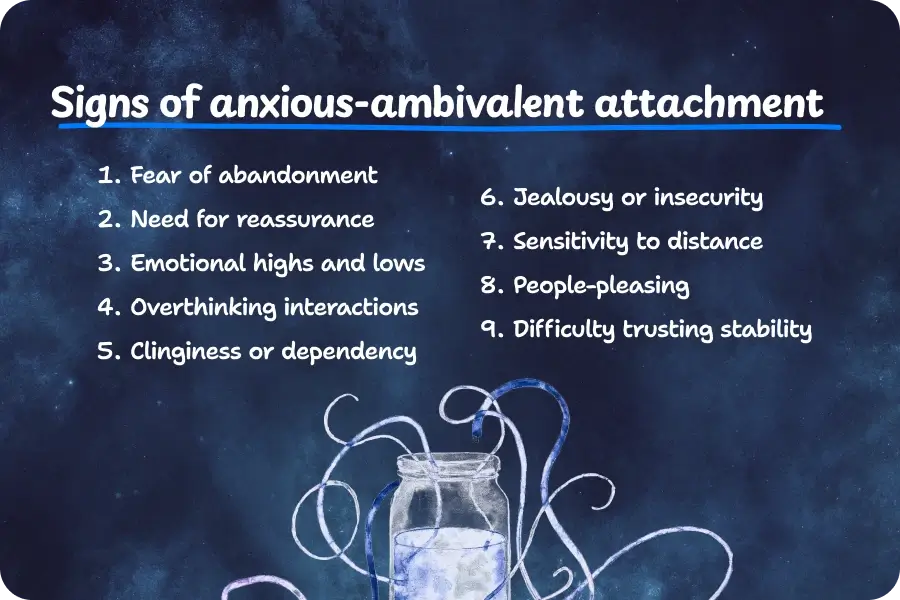
5 Signs of Anxious Attachment
People with anxious-ambivalent attachment often display several recognizable patterns:
- Fear of abandonment. Even minor signs of distance can feel like rejection.
- High emotional sensitivity. They may quickly detect changes in tone, behavior, or attention and take it personally.
- Need for reassurance. They crave emotional intimacy and validation to feel secure.
- Clinginess or dependency. There can be jealousy and a strong reliance on partners for emotional stability.
- Difficulty trusting stability. Even in healthy relationships, they may anticipate loss or betrayal.
5 Origins of Anxious Ambivalent Child Attachment
Attachment theory states that ambivalent attachment patterns typically develop in early childhood, shaped by how consistently a child’s emotional needs are met by primary caregivers [3] Martín Quintana JC, Alemán Ramos PF, Morales Almeida P. The influence of perceived security in childhood on adult self-concept: The mediating role of resilience and self-esteem. 2023 . This is how anxious-ambivalent attachment is commonly formed:
Is childhood trauma part of your story? Uncover your trauma score with an insightful Breeze test.

Effects of Anxious Preoccupied Attachment
From their childhood, a person with ambivalent attachment may learn the following:
- “There’s no unconditional love; it isn’t stable or guaranteed”
- “I need to stay close to feel safe”
- “If I don’t signal strongly, I might be ignored”
How anxious ambivalent attachment shows up in childhood
- Intense distress when a caregiver leaves the room or home, even temporarily
- Difficulty calming down, even after the caregiver returns
- Clinginess mixed with frustration or anger
- Hyper-focus on the caregiver’s attention
Eventually, the question “Will I be loved, or will I be ignored?” becomes internalized and carried into adult relationships.
How ambivalent attachment shows up in adulthood
One of the most challenging aspects of anxious-ambivalent attachment is the internal conflict it creates. There is a powerful desire for intimacy, but also a fear that closeness will lead to pain.
These unhealthy behaviors can affect adult relationships and create cycles of anxiety, misunderstanding, and emotional dependency that make it difficult to feel secure.
Expert Insight
You may notice subtle shifts in your internal state before any behaviors fully play out, like a spike in urgency and feeling like you need immediate reassurance. This need may be paired with more mental preoccupation (re-reading texts or questioning where you stand). Emotionally, there’s often a mix of anxiety and irritation, which can quickly turn into impulses to act: reaching out more than usual, pulling back to “protect yourself,” or testing the other person’s interest.
Rychel Johnson
Mental health professional
8 Tips To Stop Seeking Attention from Emotionally Unavailable People & Moving Toward Secure Attachment
The good news is that attachment styles are not fixed. With awareness and effort, people can move toward a more secure attachment style and overcome relationship challenges.
1. Identify your “attraction pattern”
People with anxious attachment may feel drawn to inconsistency because it mirrors familiar emotional patterns, even when it isn’t healthy or stable. They may also confuse intensity with intimacy. To prevent it, write down your last 3–5 romantic interests and answer:
Then highlight: “calm + consistent” vs “intense + uncertain”. Then, go one step deeper and reflect on:
Then make a simple summary for each person:
The goal isn’t to judge your past choices, but to train your mind to recognize a key distinction within attachment theory: secure connection tends to feel steady and predictable, while anxious attraction often feels intense, uncertain, and consuming.
2. The “pause before pursuit” rule
This exercise focuses on breaking impulsive emotional chasing and interrupting the dopamine-driven cycle. When you feel a strong attraction, pause 24–72 hours before initiating contact or over-investing. Ask:
- “Do I actually know this person or just feel activated by them?”
- “Is this connection steady or unpredictable?”
Before investing, also check for:
- Do they follow through on plans?
- Do they communicate consistently?
- Do they ask about your feelings, not just surface talk?
- Do you feel calmer or more anxious after contact?
3. Reframe “distance triggers”
When your partner feels slow to reply, emotionally distant, or inconsistent, an anxious system often treats it as danger, not just a delay. This is a core pattern within attachment theory, where past relational uncertainty gets reactivated in present situations.
Instead of immediately defaulting to “They’re losing interest” or “Something is wrong with me”, practice a structured reframing process:
Step 1. Name what’s happening internally
“My nervous system is activating old attachment fear.” This step is important because it creates separation between emotion and reality. You’re labeling your feelings as a response, not a fact.
You can also translate it more simply, like “I’m feeling activated right now” or “This is my anxiety response, not necessarily the truth.”
Step 2. Slow down the story your mind is building
Anxious-ambivalent attachment tends to rapidly create narratives like:
- “They’re pulling away”
- “I said something wrong”
- “I’m about to be abandoned”
Pause and recognize: a story is forming, but it hasn’t been confirmed.
Step 3. Separate facts from interpretation
Step 4. Regulate before reacting
Before texting, checking, or withdrawing:
- Wait 10–30 minutes (minimum)
- Do something grounding or practice an analog activity like writing or walking
- Let the emotional spike settle before acting
This prevents anxiety-driven behaviors like double texting, testing, or emotional withdrawal.
Step 5. Reality-based reframe options
Replace automatic thoughts with balanced alternatives:
- “They’re losing interest” → “I don’t have enough information yet.”
- “They’re pulling away” → “There’s a communication gap right now.”
- “I’m being ignored” → “Response timing varies for many reasons.”
4. Stop “testing” behavior replacement
“Testing” (like withdrawing to see if they chase or acting distant to get reassurance) is a common anxious-attachment response, but it usually increases confusion and anxiety instead of creating security.
Instead, try direct communication. Say things clearly instead of signaling indirectly: “I notice I feel unsure sometimes. Can we clarify how we communicate?”
5. Build “secure repetition”
Secure attachment grows through consistent experiences, not insight alone. Many anxious patterns misread calm as “lack of chemistry.” Train your system to tolerate healthy love:
- Spend more time with people who are predictable, even if less “exciting”
- Notice discomfort with stability without acting on it
- Stay present instead of chasing emotional highs
After interacting with someone stable, ask:
- Did I feel calm or bored?
- Did I want to create drama or pull away?
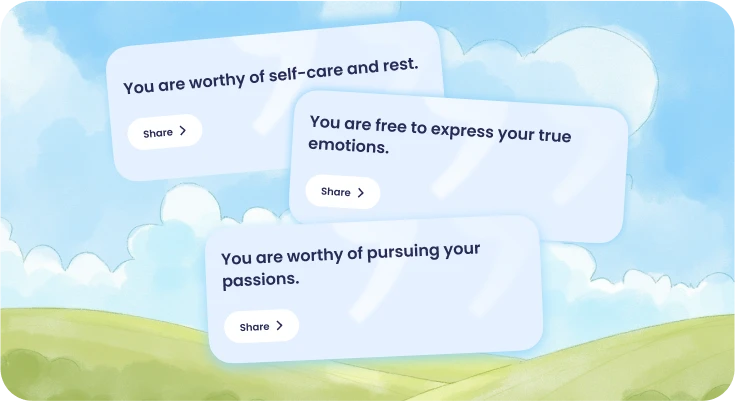
6. Daily affirmations for reassurance
Daily affirmations help calm the nervous system when anxious-ambivalent attachment is activated and reduce the urge to seek external validation. Repeat when triggered:
- “I don’t need to earn consistency.”
- “If it’s right for me, it won’t require chasing.”
- “Uncertainty is not proof of rejection.”
- “I can feel anxious without acting on it.”
- “Secure connections feel steady, not confusing.”
- “I can tolerate uncertainty without creating a story.”
- “I choose calm over assumption.”
- “I am safe even when I don’t have immediate reassurance.”
Breeze’s self-reflection approach encourages similar positive affirmations to interrupt spiraling thoughts and bring attention back to emotional stability. Try self-soothing statements in the Breeze app.
7. Try trust & vulnerability exercises
1. “What I Need You to Know”
You may do this practice with your partner, or use it as a pre-conflict or post-conflict resolution. Both of you need to complete the sentence: “One thing I need you to know about me is…” Repeat for 2–3 rounds. This phrase invites partners to reveal something personal they normally keep hidden without demanding a full backstory. This simple exercise helps to build empathy and understanding of personal experiences.
2. Circles of Trust
The following practice encourages self-reflection on how people in your life build or lose your trust and helps you understand your boundaries in relationships.
Draw three concentric circles:
- Inner circle. People you trust completely
- Middle circle. People you trust somewhat
- Outer circle. People you know but don’t trust yet
Then, think:
- Who is where and why?
- What earns or breaks your trust?
3. The “Last 5%” Conversation
It’s a powerful practice to overcome your insecure attachment and be vulnerable. Both you and your partner may reflect on something you’ve shared 95% of, but still withhold the “last 5%,” the part that’s hardest to say. Then, share it. For example: “I’ve told you I was upset, but the last 5% is that I felt abandoned.”
As people typically self-protect by holding back, revealing that last layer may help to build deep, transformative trust to effectively resolve conflicts and create more meaningful relationships.
8. Seek therapy
Therapy for anxious-ambivalent attachment focuses less on “fixing a personality” and more on helping you build emotional security, regulation skills, and healthier relationship patterns. Here are the main effective approaches:
1. Attachment-focused therapy
This is one of the most direct approaches to overcoming attachment issues. A therapist helps you:
- understand how early relationship patterns shaped your expectations of love
- notice “protest behaviors” like chasing, reassurance-seeking, and overthinking
- learn what a secure connection and emotional support actually feel like in real time
2. Cognitive Behavioral Therapy (CBT)
Typically, CBT targets the thought spirals that fuel anxiety. You work on:
- challenging negative emotions and thoughts like “They’re losing interest”
- separating facts from assumptions
- reducing rumination and overanalysis
3. Emotion regulation skills (DBT-informed tools)
It’s helpful if emotions feel intense or overwhelming. You learn:
- how to calm your nervous system before reacting
- distress tolerance (sitting with uncertainty without acting impulsively)
- grounding techniques during triggers
Sources
- Inge Bretherton. The Origins of Attachment Theory: John Bowlby and Mary Ainsworth.
- Wilson-Ali N, Barratt-Pugh C, Knaus M. Multiple perspectives on attachment theory: Investigating educators’ knowledge and understanding. 2019
- Martín Quintana JC, Alemán Ramos PF, Morales Almeida P. The influence of perceived security in childhood on adult self-concept: The mediating role of resilience and self-esteem. 2023
Disclaimer
This article is for general informative and self-discovery purposes only. It should not replace expert guidance from professionals.
Any action you take in response to the information in this article, whether directly or indirectly, is solely your responsibility and is done at your own risk. Breeze content team and its mental health experts disclaim any liability, loss, or risk, personal, professional, or otherwise, which may result from the use and/or application of any content.
Always consult your doctor or other certified health practitioner with any medical questions or concerns
Breeze articles exclusively cite trusted sources, such as academic research institutions and medical associations, including research and studies from PubMed, ResearchGate, or similar databases. Examine our subject-matter editors and editorial process to see how we verify facts and maintain the accuracy, reliability, and trustworthiness of our material.
Was this article helpful?