


You’ve always felt different. Maybe you tend to practice conversations in your head, feel drained or deeply awkward in social situations, and feel uncomfortable making eye contact. Sometimes you feel distressed by sounds or small details that others don’t pay attention to.
This autism test for adults can help you find out whether you live with autistic traits and what to do about it.
What is autism?
Autism spectrum disorder (ASD) is a neurodevelopmental condition that coincides with specific social communication challenges, repetitive behaviors, sensory processing difficulties, and a strong need for routines. Autistic people process information and experience the world differently from neurotypical individuals.
According to research, autism is now understood as a broad spectrum rather than several completely separate conditions, because autistic traits can appear in many different combinations and intensities from person to person. [1] Grzadzinski R, Huerta M, Lord C. “DSM-5 and autism spectrum disorders (ASDs): an opportunity for identifying ASD subtypes.” Mol Autism. 2013 While some autistic individuals may require significant support in their daily lives, others can manage their responsibilities independently, build successful careers, maintain relationships, and show few outward signs of autism.
Regardless of the diagnosis, autism is associated with various traits that impact different parts of life.
Why take an autism spectrum test?
We recommend using this autism test as a screening tool to help you determine whether you may experience certain symptoms. Please note that it isn’t a diagnostic tool or formal assessment, as only a mental health professional can diagnose autism spectrum disorder. Instead, it’s a way to explore more about yourself and find out whether you might benefit from further evaluation.
How does the adult autism test work?
The autism assessment includes questions about various ADS symptoms. By answering whether a person strongly agrees, somewhat agrees, or disagrees, the test looks for patterns linked to autism-related traits and experiences.
There are no right or wrong answers. Based on your results, the assessment provides general insight into whether someone may relate to characteristics commonly associated with autistic adults.
How reliable are autism spectrum test results?
This free autism test for adults isn’t equal to a professional evaluation. However, it’s an accessible and simple way to explore autism-related traits and reflect on personal experiences. The results can be quite reliable as they’re built based on the main ASD traits listed in the latest Diagnostic and Statistical Manual (DSM-5), and this autism test is proofread by a licensed mental health professional.
What are the most common autistic traits?
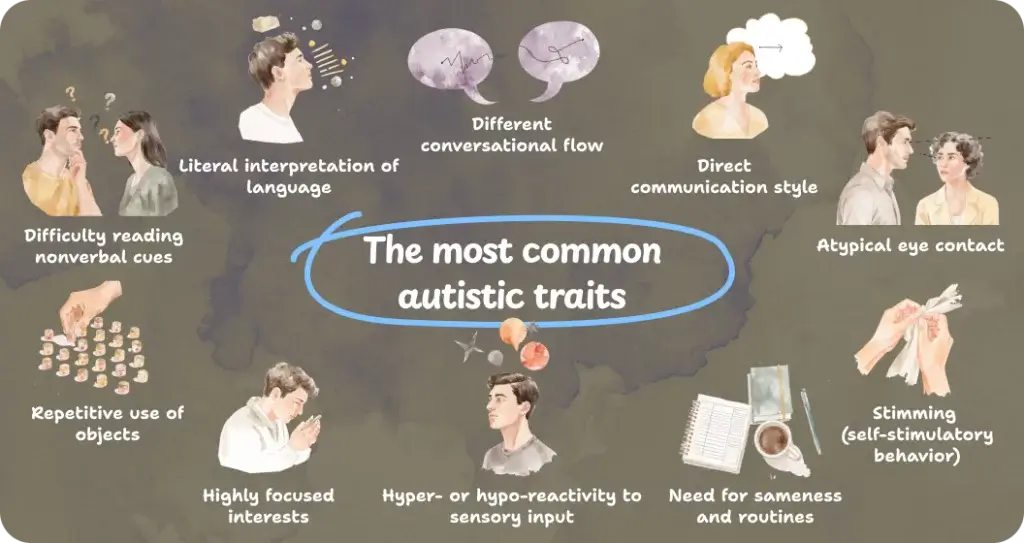
The most common autistic traits can be divided into two categories: social communication peculiarities and restricted, repetitive behaviors.
Social‑communication
These traits involve how a person interacts with others and interprets social cues. They often stem from a different way of processing social information rather than a lack of interest in connecting.
- Difficulty reading nonverbal cues. People with ASD may struggle to interpret body language, facial expressions, make small talk, or read between the lines. It can feel like everyone else knows certain unspoken rules of communication, while a person with autism spectrum disorder has to consciously figure them out.
- Literal interpretation of language. Those with an autism diagnosis may miss sarcasm, idioms, or metaphors and interpret speech literally.
- Different conversational flow. Such people may have challenges with knowing when to start or stop talking in a conversation. They can talk for hours about their hyperfixations, even if the other person has lost interest. On the other hand, they may struggle to join conversations at all and prefer to stay quiet.
- Direct communication style. People with autism spectrum symptoms might seem excessively honest, which others might sometimes misinterpret as being blunt or rude.
- Atypical eye contact. Avoiding eye contact because it feels intense or distracting, or using it in a way that feels unnatural to neurotypical people, is another social communication challenge for people with ASD.
Expert Insight
ASD isn’t the same as anxiety or shyness. Instead, it’s more of how someone approaches communication and adapts or struggles to adapt to various social cues. Autistic individuals do not necessarily feel worried about how they communicate, but they may struggle to feel connected to others due to particular social differences. They may also be more susceptible to masking to fit in with others.

Nicole Arzt
Mental health professional
Restricted, repetitive behaviors (RRB)
These traits involve a need for predictability, physical regulation, and deep focus on specific areas that autistic people find interesting.
- Stimming (self-stimulatory behavior) involves repetitive movements, such as hand-flapping, rocking, or finger-flicking, used to manage emotions.
- Need for sameness. People with ASD have a strong preference for routines and feel significant distress if plans change unexpectedly. It can seem quite similar to obsessive-compulsive disorder, but OCD rituals are usually driven by intrusive fear and the need to neutralize distress, while autistic routines and repetitive behaviors are more often about predictability, sensory regulation, or a “just right” feeling. [2] Jiujias M, Kelley E, Hall L. “Restricted, Repetitive Behaviors in Autism Spectrum Disorder and Obsessive-Compulsive Disorder: A Comparative Review.” Child Psychiatry Hum Dev. 2017
- Hyper- or hypo-reactivity to sensory input. Some people may be oversensitive to sounds, lights, or textures, leading to sensory overload, while others may be undersensitive and seek intense sensory experiences.
- Highly focused interests. Those with ASD may develop an intense, deep, and encyclopedic knowledge of specific topics or hobbies. For instance, a person may spend hours researching trains, astronomy, animals, video games, or history and feel genuinely energized when talking about these interests.
- Repetitive use of objects. Such adults and children may line up toys in a specific order or spin wheels on a car rather than using them for their intended purpose.
Treatment and support for people with a formal autism diagnosis
Autistic people may receive treatment depending on their specific needs, age, and personal goals. Since autism is not a “disease” to be cured, support focuses on improving quality of life, developing coping strategies for a neurotypical world, and managing co-occurring conditions like anxiety or sleep issues.
Common forms of support include:
- Cognitive behavioral therapy (CBT) helps a person better understand their emotions, recognize stress triggers, manage anxiety, reduce emotional overwhelm, and build healthier coping strategies for difficult situations.
- Occupational therapy (OT) helps with sensory issues and everyday functioning. For example, it may help someone manage overstimulation from noise, lights, textures, or crowded places, as well as improve routines, organization, or self-care skills.
- Speech and language therapy supports communication skills, especially social communication. People with ASD may learn to understand tone, sarcasm, body language, or conversational timing, or express thoughts more clearly.
- Support groups give autistic people a space where they can relate to others with similar experiences, feel understood, exchange advice, and reduce feelings of isolation.
- Medications help manage some co-occurring symptoms that may appear alongside autism, rather than autism itself. While psychosocial therapies are the main approach for core autistic traits, medications are mainly prescribed for associated difficulties such as irritability, anxiety, depression, sleep problems, hyperactivity, or severe emotional dysregulation, according to the study. [3] DeFilippis M, Wagner KD. “Treatment of Autism Spectrum Disorder in Children and Adolescents.” Psychopharmacol Bull. 2016
Nicole Arzt, LMFT, explains how clinical assessment for ASD typically happens. “Assessment is generally multifaceted and requires a comprehensive evaluation. A trained psychologist will evaluate various domains of one’s life and review functioning within these domains. If a child is being evaluated, they will also seek feedback from relevant sources, including parents and teachers.”
Frequently asked questions
How much does an autism quiz cost?
The “Am I autistic?” quiz from Breeze is completely free. It takes about 5 minutes to pass, and you’ll get results immediately.
Is the autism test for adults scientifically accurate?
This autism test is research-backed and expert-reviewed, which makes it a good self-screening questionnaire that doesn’t provide a formal diagnosis.
Are the results of the autism assessment test private?
Yes, the results of Breeze’s autism test are private. We do not store your data or share your answers with anyone. This test is designed as a tool for your self-discovery, and the results are for your eyes only.
What is an autism spectrum quotient (AQ)?
The Autism Spectrum Quotient (AQ) is a specific screening test developed by researchers at the University of Cambridge. It was created to measure the level of autistic traits in adults and adolescents with average or above-average intelligence.
There are several versions of the AQ, including the standard AQ-50, the shorter AQ-10, and adaptations for children and teens.
Sources
- Grzadzinski R, Huerta M, Lord C. “DSM-5 and autism spectrum disorders (ASDs): an opportunity for identifying ASD subtypes.” Mol Autism. 2013
- Jiujias M, Kelley E, Hall L. “Restricted, Repetitive Behaviors in Autism Spectrum Disorder and Obsessive-Compulsive Disorder: A Comparative Review.” Child Psychiatry Hum Dev. 2017
- DeFilippis M, Wagner KD. “Treatment of Autism Spectrum Disorder in Children and Adolescents.” Psychopharmacol Bull. 2016
Disclaimer
This article is for general informative and self-discovery purposes only. It should not replace expert guidance from professionals.
Any action you take in response to the information in this article, whether directly or indirectly, is solely your responsibility and is done at your own risk. Breeze content team and its mental health experts disclaim any liability, loss, or risk, personal, professional, or otherwise, which may result from the use and/or application of any content.
Always consult your doctor or other certified health practitioner with any medical questions or concerns
Breeze articles exclusively cite trusted sources, such as academic research institutions and medical associations, including research and studies from PubMed, ResearchGate, or similar databases. Examine our subject-matter editors and editorial process to see how we verify facts and maintain the accuracy, reliability, and trustworthiness of our material.
Was this article helpful?