


Trying to quiet your mind in a world that never stops scrolling and demanding your attention? Your focus, mood, and productivity may all be improved by making time for mindfulness activities that increase your awareness of your thoughts and needs, research shows [1] Marieke Karlijn Van Vugt. “Mindfulness as a Potential Tool for Productivity.” May 2019 .
That’s where meditation apps come in, and two names dominate the space: Calm and Headspace apps. Let’s find out which one is right for you.
Take the Personality Type Test to learn more about yourself and increase your self-awareness.

Which App Is Better: Headspace or Calm?
These two popular meditation apps promise better sleep quality, stress management, and a clearer mind, but they take surprisingly different paths to get you there.
Headspace may feel better if you want a more structured approach to building healthier habits. Calm may feel better if you want relaxation and better sleep. Neither is strictly “better,” but they serve slightly different needs.
Headspace focuses on building a habit. It teaches practicing meditation in a way that feels simple and organized, and easily integrated into everyday life. Calm, in turn, focuses on the experience and gives you something that feels soothing right away, especially if your goal is to unwind.
So the better question is not “which one is better,” but “what do you need right now?” Let’s explore the features of both mindfulness & meditation apps.
If you’re unsure what your mind currently needs, take this quick Anxiety Test to better understand your emotional state and see what kind of support might help you most.

Headspace App Features
Headspace is a mindfulness-based smartphone app and a meditation teacher that offers mindfulness on the go and helps you build this skill step by step, especially if you’re just starting.
It is designed to make mindfulness practices simple and predictable. You usually begin with short meditation courses that explain what it is and how to do it. Moreover, the app has a dedicated Kids section (ages ~3–12) with guided meditations made for children.
You don’t have to guess what to do next, because the mindfulness app gives you a clear path, and this removes a common barrier. Starting something new can feel uncertain, and Headspace reduces that uncertainty.
Headspace offers mindfulness exercises for those who:
- want to build a daily routine with morning meditations
- feel distracted or overstimulated recurrently throughout the day
- prefer guided meditations instead of choices
Eventually, this can help create consistent practice. You return to the app, follow the same flow, and slowly build the simple habit. At the same time, some people notice that after a while, the structure starts to feel repetitive. Especially if they already understand the basics. This app is great at building a mindfulness foundation; however can become redundant.
Main features
- Meditation courses with step-by-step programs and kids’ meditations
- Guided sessions with micro-meditation (3–10 min)
- Sleep tools like sleepcasts, wind-down exercises, and calming audio
- Focus & productivity features such as music, soundscapes, and “focus mode”
- Progress tracking like streaks, reminders, and personalized plans
Expert Insight
Self-reflection apps can be a great addition to therapy, but cannot act as a replacement for therapy. Research shows that up to 70% of therapeutic change is influenced by the rapport built within the therapeutic relationship. This is something technology or an app can do alone. Self-reflection apps can evoke deeper reflection; however, therapy can aid in perspective shifting, cognitive reframes, and more sustainable change.

Katherine Scott
Mental health professional
Calm App Features
Calm is a relaxation-focused app that helps you slow down, rest, and have a deep sleep through soothing sounds. Calm feels different from the first interaction. Instead of guiding you through a path, it gives you options. You can choose a meditation practice or sleep music. There’s no strong sense of progression. That freedom can feel easier because you don’t need to think much. You just pick what feels right in the moment.
One of the most well-known features is Calm’s sleep stories. These are designed to help your mind slow down before bed.
People often turn to Calm when they:
- feel mentally tired at the end of the day
- have difficulty falling asleep
- want something soothing without effort
Main features
- Sleep meditations as a standout feature
- Morning meditations and daily mindfulness techniques with a large, flexible library
- Music & soundscapes: nature sounds, ambient, white noise, sleep remixes
- Daily сalm: new 10-minute session every day
- Breathing exercises for quick stress and anxiety relief
Think you might have ADHD? Taking the ADHD quiz for women can help you identify common ADHD symptoms and determine whether it may be worthwhile to seek a professional assessment from a therapist.
Calm and Headspace Key Differences: Comparison Table
| Feature | Headspace | Calm |
| Best for | Beginners, family-friendly app | Sleep & relaxation, adult-oriented app |
| Teaching style | Structured courses | Flexible, pick-anything |
| Meditation library | 1,000+ sessions | ~800 sessions |
| Sleep content | Sleepcasts, music | Bedtime stories (vast library) |
| Interface | Playful, animated | Calm, nature-inspired |
| Monthly subscription price | ~$12.99/month | ~$14.99/month |
| Free version | Limited free content | Limited free content |
| Free trial period | Seven-day free trial | Seven-day free trial |
| Effect in real life | More awareness, better focus, and improved emotional control over time | Faster relaxation, better sleep, and emotional comfort in the moment |
Headspace vs Calm: Effects in Real Life
Headspace encourages consistency and repetition, which helps build a long-term mindfulness habit. With Headspace, the impact tends to be gradual and skill-based:
- you’re becoming more comfortable sitting with your thoughts
- your attention is easier to control and redirect
- you pause more before reacting in stressful situations
- meditation starts to feel like a learned skill, not just an activity
With Calm, the impact can feel more immediate and experience-based:
- you turn to the app when you feel stressed or overwhelmed
- it becomes part of your evening or bedtime routine
- you associate it with relaxation and unwinding
- it helps you fall asleep faster or calm down quickly
- Helps quiet internal ‘noise’
Why Mindfulness & Meditation Mobile Apps May Not Always Feel Enough
Sometimes you may notice that you finish a session, feel calm, and then later the same thoughts return. You might still:
- overthink conversations
- feel anxious in relationships
- feel emotionally triggered by small events
- struggle to fall asleep even after meditation
- feel stressed again shortly after a “calm” session
- notice recurring worries that return during the day
- find it hard to stay mindful in real-life moments
- default back to autopilot habits under pressure
This can feel confusing. Because you are doing something helpful and trying intermittent mindfulness practices, yet the deeper pattern stays the same. This does not mean meditation isn’t working. You need something more than calming tools.
Expert Insight
Meditation can be difficult for a busy mind with a lot of ‘noise.’ Today’s world reinforces us to distract from our discomfort vs sit with it and move through it. This shortens our zone of tolerance for uncomfortable ‘noise,’ that is, ruminating thoughts that evoke uncomfortable feelings such as anxiety, shame, anger, or sadness. Many of us doomscroll rather than process a big feeling in the moment, putting off the discomfort to an undefined later time. So, when we purposefully reapproach our own internal states through acts such as meditation, it can almost heighten the ‘noise’ that we have accidentally put off. This heightened discomfort is temporary, as more practice with sitting with the ‘noise’ can build our resilience with the right resources and coping strategies.
Katherine Scott
Mental health professional
What You May Start Looking For Next After Using Headspace And Calm?
You may eventually look for ways to understand your emotions, not just calm them. After some time, the focus can shift. Instead of asking, “How do I relax?” you may begin asking:
- Why do I feel this way?
- Why do I react like this?
- Why does the same situation affect me again and again?
- What deeper need is underneath this emotion?
- What patterns keep repeating in my relationships or thoughts?
These questions are about awareness. You may need not only to manage feelings but also to understand them. At this stage, many people begin to see mindfulness not as a final solution but as a starting point.
The calm created by meditation can make space to observe thoughts more clearly, but it doesn’t always explain where they come from. This is often when curiosity shifts inward. Instead of only trying to feel better in the moment, there is a growing interest in exploring personal history and deeper psychological triggers. This is where the gap between meditation apps and deeper tools becomes noticeable.
Breeze As An Alternative: What Makes It Different?
Breeze takes a broader approach to mental well-being. Instead of focusing mainly on meditation or relaxation, it looks at patterns and helps make sense of your experience. For some people, this feels more practical. Because once you understand a pattern, it becomes easier to change it.
For example, it may help you:
- notice how your mood changes over time
- reflect on your reactions
- understand emotional triggers
- explore relationship dynamics
8 Key Breeze Features for Your Mental Health
In the Breeze app, you’ll find quick and insightful self-discovery tests, self-growth tips, relaxation games, guided journaling, and more tools that can help you become the best version of yourself.
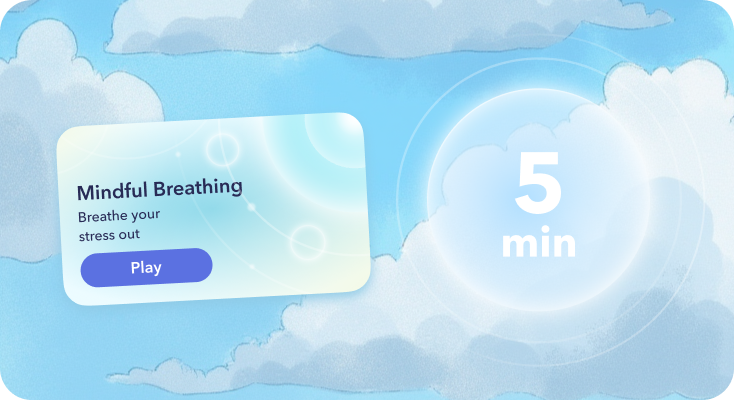
1. Mindful breathing
The Breeze app makes it easy to let go of worries with just a few simple steps. Open the app, choose Mindful Breathing, and follow the step-by-step guidance.
This practice reflects how your brain is wired to manage attention and filter out distractions. When you focus on your breath, you’re engaging a natural process in the brain that supports clarity and calm, research shows [2] Sacchet MD, LaPlante RA, Wan Q, Pritchett DL, Lee AK, Hämäläinen M, Moore CI, Kerr CE, Jones SR. “Attention drives synchronization of alpha and beta rhythms between right inferior frontal and primary sensory neocortex.” J Neurosci. 2015 . Even a few minutes of this practice can allow you to get out of your head.
2. Journaling
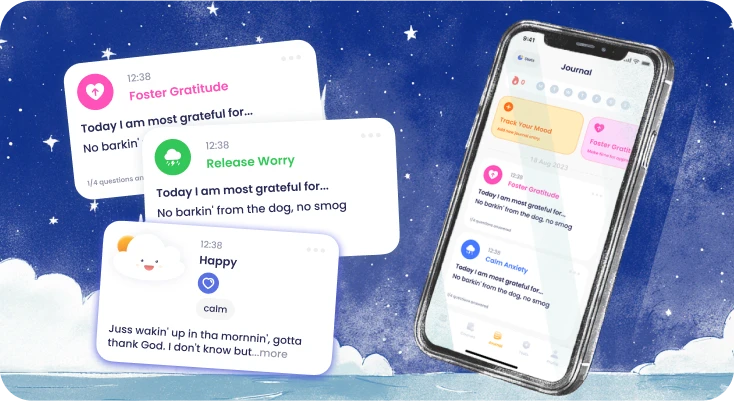
Whether you’re just starting or have been journaling for a while, using the proper journal prompts can make your practice even more powerful. With Breeze guided journaling, you can control your thoughts and concerns, track your emotional progress, and gain insights into your behavioral patterns.
Studies on expressive writing have shown that journaling can improve sleep, boost the immune system, and increase self-confidence [3] Scullin MK, Krueger ML, Ballard HK, Pruett N, Bliwise DL. The effects of bedtime writing on difficulty falling asleep: A polysomnographic study comparing to-do lists and completed activity lists. January 2018 . Moreover, regular journaling about your emotions can reduce stress, as well as anxiety and depression symptoms.
3. Mood tracker & mood notes
Want to become more aware of your emotional patterns? Try using a mood tracker with the Breeze app. Tracking your mood daily can help you notice triggers and shifts over time. It’s a simple but powerful way to support your emotional awareness and emotional regulation.
Alongside tracking, mood notes add an extra layer of insight. Instead of just selecting how you feel, you can briefly write:
- What happened during the day
- What might have triggered the emotion
- How you responded in the moment
These notes help you connect the dots between situations, thoughts, and emotions. You may start to notice patterns you wouldn’t otherwise see and understand how certain people, environments, or thoughts consistently affect your mood.

4. Customized routine plans
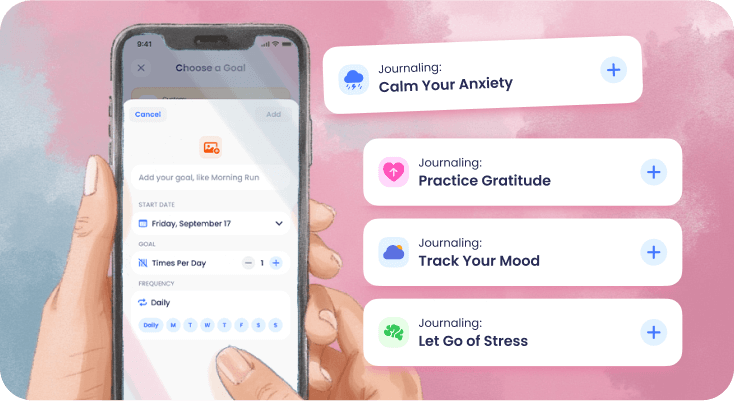
Try customized routines in the Breeze app to track your consistency in regular exercises. You only need to plan it in Breeze Wellbeing and set a reminder and frequency. It’s much more convenient than printable habit trackers or apps that only let you have this one feature.
Here’s how you can do it in the app:
- Create a goal within the app, like increasing your self-esteem or managing stress around people.
- Breeze offers you a routine with small steps like mindfulness exercises, journaling prompts, or mood-boosting activities.
- Review your daily schedule and cross things off as you complete them.
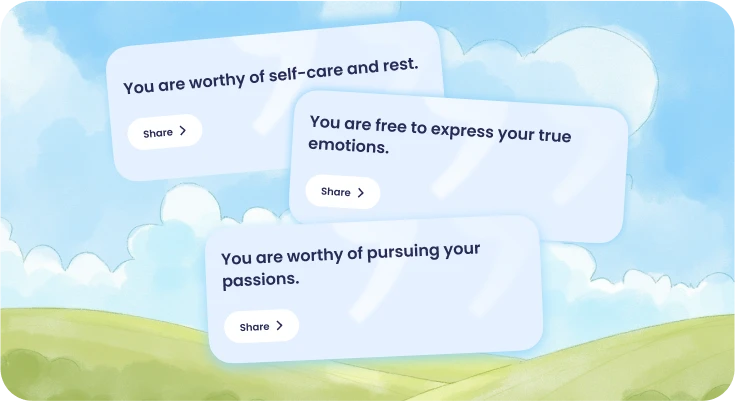
5. Daily affirmations
If you’re looking for tools to improve your self-esteem, daily affirmations in the Breeze app can ease anxiety. A study shows that daily positive affirmations can activate brain areas responsible for emotional regulation and self-acceptance [4] National Library of Medicine. Self-affirmation activates brain systems associated with self-related processing and reward and is reinforced by future orientation. November 2015 . That’s why these confidence boosters may help you to stop taking others’ opinions so personally and handle stress more effectively.
6. Self-discovery tests
If you’re looking for more quizzes to improve your emotional intelligence or relationships, you can analyze specific personality traits and behavioral patterns in the Breeze app. There are more than 30 personality tests where you can learn more about your:
- Relationship patterns
- Past wounds
- Certain traits
- Growth opportunities and strengths
- The way you communicate with others
You can always be sure that Breeze tests are grounded in science because they have been approved by certified psychologists and mental health specialists.

7. Relaxation games
The app also offers relaxation games designed to help you unwind and mentally reset. These are simple, low-pressure activities that gently shift your attention away from stress and into a calmer, more focused state.
Relaxation games can:
- give your mind a break from overthinking
- reduce overstimulation and mental fatigue after a long day
- help you transition between tasks or environments
- create a sense of lightness and ease without effort
Unlike traditional games, the goal isn’t competition or achievement. All you need to focus on is a calm engagement. The visuals, sounds, and interactions are intentionally soothing, helping your nervous system slow down. Using these games can become a quick way to recharge your mental energy, especially during stressful or overwhelming moments.
8. Connecting with like-minded people
Breeze has social features that allow you to share your self-discovery test results with friends and family members. This creates an opportunity to explore your emotional patterns together and gain different perspectives on how you think, feel, and react.
By sharing insights, you may:
- better understand how others perceive you
- notice similarities or differences in emotional patterns
- open up conversations about personal growth and self-awareness
- feel more supported in your self-discovery journey
How to Choose the Right App For You
There isn’t a single correct choice, but there are patterns that may help.
Headspace may feel right if:
- you need learning + habit-building
- you are new to meditation and want step-by-step guidance
- you prefer a clear order instead of choosing from many options
- you want to build a consistent daily routine
- you like short, practical sessions you can easily follow
- you want gentle reminders and progress tracking to stay consistent
Calm may feel right if:
- you’re looking for relaxation + sleep + easy access calm-down tools
- you want to relax quickly in moments of stress
- sleep is your main concern (falling asleep or staying asleep)
- you prefer flexibility instead of organized programs
- you enjoy audio-based experiences like music, stories, and soundscapes
- you want something you can open and use immediately without planning
- you like calming your mood in the moment rather than following a course
Breeze may feel right if:
- you need emotional awareness + insight + deeper self-understanding
- you want to understand your emotions, not just calm them
- you notice repeating emotional or behavioral patterns in your life
- you are ready to go deeper than relaxation into self-reflection
- you want to explore why you feel and react the way you do
- you are interested in emotional awareness and personal insight
- you prefer reflection-based exploration instead of guided relaxation only
- you are looking for tools that help you connect thoughts, emotions, and triggers
Conclusion
Headspace and Calm both help people take care of their mental well-being. Headspace helps you learn meditation step by step. Calm creates a space where you can relax and rest.
Both can be useful. But they focus mostly on how you feel right now. If you begin to look for more than that, more clarity, more understanding, and more awareness, you may find yourself exploring tools like Breeze. Not because meditation stops working, but because your needs grow.
Frequently asked questions
1. Is Headspace or Calm better for beginners?
Headspace is often easier for beginners because it provides clear guidance. Calm may feel simpler, but it offers more choice and less direction.
2. Which app is better for sleep?
Calm is usually preferred for sleep. Its sleep stories and audio content are designed specifically to help you relax before bed.
3. What are the effects of Calm & Headspace apps?
With Headspace, you might notice that you’re getting used to sitting with your thoughts. You begin to understand how your attention works. With Calm, you might rely on it to relax. It becomes part of your routine, especially at night. Both outcomes are useful, so you may choose which one matches your current mental health needs.
4. What if meditation apps don’t seem to work for me?
The possible reason is that meditation helps with awareness and relaxation, but it doesn’t always address deeper emotional patterns. If you notice the same thoughts or reactions returning, you might benefit from combining meditation with reflection tools like journaling or mood tracking (as in Breeze).
5. Is Breeze a replacement for meditation apps?
It depends on your needs. You don’t have to choose only one approach. These tools can support different parts of your mental well-being. The key is knowing what each one offers. Breeze may complement mindfulness & meditation mobile apps or replace them if your focus shifts toward understanding emotional patterns. Some people use Calm to relax in the evening and Breeze to reflect during the day. Others use Headspace for a step-by-step framework and Breeze for a deeper understanding.
Sources
- Marieke Karlijn Van Vugt. “Mindfulness as a Potential Tool for Productivity.” May 2019
- Sacchet MD, LaPlante RA, Wan Q, Pritchett DL, Lee AK, Hämäläinen M, Moore CI, Kerr CE, Jones SR. “Attention drives synchronization of alpha and beta rhythms between right inferior frontal and primary sensory neocortex.” J Neurosci. 2015
- Scullin MK, Krueger ML, Ballard HK, Pruett N, Bliwise DL. The effects of bedtime writing on difficulty falling asleep: A polysomnographic study comparing to-do lists and completed activity lists. January 2018
- National Library of Medicine. Self-affirmation activates brain systems associated with self-related processing and reward and is reinforced by future orientation. November 2015
Disclaimer
This article is for general informative and self-discovery purposes only. It should not replace expert guidance from professionals.
Any action you take in response to the information in this article, whether directly or indirectly, is solely your responsibility and is done at your own risk. Breeze content team and its mental health experts disclaim any liability, loss, or risk, personal, professional, or otherwise, which may result from the use and/or application of any content.
Always consult your doctor or other certified health practitioner with any medical questions or concerns
Breeze articles exclusively cite trusted sources, such as academic research institutions and medical associations, including research and studies from PubMed, ResearchGate, or similar databases. Examine our subject-matter editors and editorial process to see how we verify facts and maintain the accuracy, reliability, and trustworthiness of our material.
Was this article helpful?