

You feel exhausted all the time. No matter how long you sleep or how you try to rest, the fatigue doesn’t really go away. Work feels heavier, small tasks take more effort, and even things you used to enjoy don’t bring the same energy or fulfillment. This burnout test can help you better understand whether what you’re experiencing may be ordinary stress or signs of emotional burnout.
What is burnout?
Burnout is a syndrome of intense emotional, mental, and physical exhaustion that develops after long-term stress. If a person is constantly worried, overwhelmed, or anxious, their nervous system stays in a “fight or flight” mode. When it persists for too long, it exhausts the body’s internal resources, so even simple tasks feel impossible.
As a result, burnout alters how your brain processes information and can lead to mental and physical health problems.

Why take a burnout test?
Studies prove that burnout develops gradually. [1] Khammissa RAG, Nemutandani S, Feller G, Lemmer J, Feller L. “Burnout phenomenon: neurophysiological factors, clinical features, and aspects of management.” J Int Med Res. 2022 At first, you may notice that you’re feeling tired more often than usual. Then irritability and a lack of motivation may appear. And then, one day, you realize that even rest doesn’t fully help anymore, and getting through the day starts to feel exhausting.
Taking a burnout test can help you notice these patterns earlier and better understand whether what you’re experiencing is temporary stress or signs of something more serious. As a result, you will be able to prevent burnout early and address the causes of chronic stress before they affect your well-being.
How does the burnout symptoms test work?
This burnout self-test isn’t a diagnostic tool but rather a screening tool that helps identify common signs of burnout and emotional exhaustion. It examines patterns in stress, motivation, concentration, emotional state, and daily functioning to give you a general sense of your work-life balance and assess whether you may be experiencing burnout right now.
How reliable are burnout test results?
The results of this burnout assessment can give you a general idea of whether burnout-like symptoms may be present. However, answers depend on your current mood, stress level, and how you personally experience fatigue or pressure.
It’s best seen as a helpful reflection tool, not a final judgment about your mental health. These results can help provide information for your own mental health journey.
What are the most common signs of burnout syndrome?
The most common signs of burnout syndrome may include emotional detachment, physical exhaustion, challenges in social interactions, and reduced motivation or interest in work and everyday activities.
1. Chronic physical and mental fatigue
The World Health Organization highlights feelings of energy depletion or exhaustion as one of the main symptoms of burnout. [2] World Health Organization. “Burn-out an “occupational phenomenon”: International Classification of Diseases.” 2019 This isn’t the kind of tired that a long sleep can fix. You wake up feeling exhausted even after a full night’s rest. Your brain feels “heavy,” and the idea of tackling your to-do list feels frustrating.
It may turn into a vicious cycle: you still have things to do, but can’t focus or find the energy to do them, which creates even more stress and guilt.

2. Increased cynicism and detachment
You might find yourself feeling increasingly numb toward your work, colleagues, or even your hobbies. People with burnout syndrome and compassion fatigue may start to distance themselves emotionally to cope with the stress, often feeling like nothing they do matters anymore.
3. Reduced workplace performance
You may work extra hours or try to do your best but still feel like you’re accomplishing less than you intend to. Burnout syndrome can lead to:
- lack of creativity
- “brain fog”
- short attention span
- slower decision-making
- frequent small mistakes
- difficulty prioritizing tasks
- procrastination even on simple work
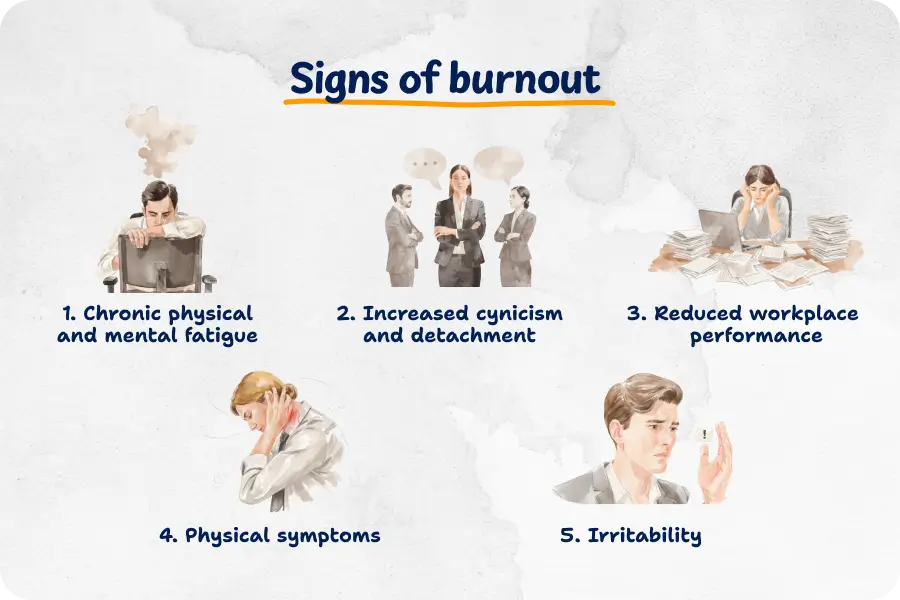
4. Physical challenges
When a person is experiencing burnout, it can manifest in the body before the mind fully acknowledges it. Common signs include:
- Poor sleep quality
- Frequent headaches
- Muscle tension
- Stomach problems and changes in appetite
- A weakened immune system
5. Irritability
When your internal resources are depleted, stress management becomes much harder. Small inconveniences that you would normally ignore can suddenly feel overwhelming. You may notice that you react more sharply to people, feel impatient in everyday situations, or get irritated without a clear reason, which affects your relationships with others.
“I feel like I’m burned out and lack energy in my daily life. Nevertheless, when something good happens (like a trip or a friendly gathering), I’m pretty happy and may be more energetic. Because of this, I feel guilty, like I’m only pretending to be burned out or exaggerating my struggles. Can burnout still be present even if I’m able to feel joy or excitement sometimes?” Katherine Scott, M.Ed/Ed.S, LMFT, answers, “Absolutely! Burnout can exist in one category of your life but not absorb every corner. If you were unable to feel joy outside of the role that experiences burnout, there would be more concern about mental health challenges such as depression. Burnout is tended to by pouring yourself into pockets where joy and contentment are attainable, so you can help create clarity for ways to properly tackle burnout in other facets.”
Treatment and support for burnout
To manage burnout symptoms and feel better in the long term, a comprehensive approach is needed. Here are some steps you may need to take to restore your energy.
1. Set boundaries
It comes to work, relationships, and other spheres of life that can make you feel drained. If you face job-related burnout, you can start by limiting overtime, not answering work messages outside working hours, and clearly separating “work time” from “rest time.”
Studies also prove that changes at the organizational level tend to be more effective and longer-lasting than individual coping strategies alone. [3] McFarland DC, Hlubocky F. “Therapeutic Strategies to Tackle Burnout and Emotional Exhaustion in Frontline Medical Staff: Narrative Review.” Psychol Res Behav Manag. 2021 So if you can, it’s important to change the workload or expectations, not just try to manage everything on your own.
2. Take care of your physical health
You shouldn’t necessarily start hitting the gym if you’ve never done exercise before. However, even a short walk or 10 minutes of stretching can make a difference. Make sure you:
- Get enough sleep consistently
- Eat regular and balanced meals
- Drink enough water throughout the day
- Move your body regularly
Small physical habits can have a surprisingly strong effect on your energy, stress level, and ability to recover from burnout.
3. Seek support from your loved ones
You can talk to the people you trust about how you’re feeling. Burnout often thrives in isolation because we feel like we have to carry the burden alone or that others won’t understand our exhaustion.
- Instead of just saying “I’m fine,” try being specific. Saying, “I’m really struggling to focus lately, and I feel overwhelmed,” gives your loved ones a clear picture of your mental state. The best way to shift away from burnout is to challenge internalizing your stressors.
- Ask for body doubling. Sometimes you don’t need a deep conversation; you just need someone to sit in the same room while you fold laundry or answer emails. Having a supportive presence nearby can help anchor your nervous system and make tasks feel less daunting.
- Ask for help with the small things that feel heavy, like picking up groceries or handling a quick phone call. Most people want to help but don’t know what you need until you ask.
- Suggest activities that don’t require much mental effort, like going for a walk in nature or watching a movie. This helps you reconnect without the pressure of “performing” or being high-energy.
4. Do activities that help you rest
You can journal your thoughts in the Breeze app, engage in mindfulness meditation, or simply spend time doing things that help your mind slow down and recover. This can include reading, listening to music, spending time in nature, engaging in creative hobbies, or taking quiet breaks away from screens and work-related pressure.
5. Visit a mental health professional
A mental health professional can help you break the cycle of burnout by identifying the specific work or personal patterns that pushed you into “survival mode.” They provide a neutral space to process the emotional exhaustion and help you develop a customized recovery plan.
Expert Insight
Therapy geared toward tackling burnout can look a few different ways, depending on the clinician. Commonly, therapy can be a helpful safe space to examine the source of burnout from multiple perspectives to explore ways of shifting out of burnout. Secondly, therapy can be helpful in processing what led to burnout in the first place, so the client can take more preventative measures in the future to protect their peace and fulfillment.

Katherine Scott
Mental health professional
Frequently asked questions
How much does a burnout test cost?
Breeze’s burnout test is completely free. You can use it whenever you need, and it can help you determine whether you may be experiencing burnout within 5 minutes.
Is this emotional exhaustion test scientifically accurate?
The burnout syndrome test from Breeze is based on scientifically proven burnout symptoms and is approved by a licensed mental health professional. Nevertheless, it should not be treated as a diagnostic tool, but rather as a self-assessment that helps you better understand your current stress level.
Are the results of the mental exhaustion test private?
Yes, the results of this burnout quiz are completely private and are not shared with anyone. They are shown only to you and used solely to provide your personal assessment.
Sources
- Khammissa RAG, Nemutandani S, Feller G, Lemmer J, Feller L. “Burnout phenomenon: neurophysiological factors, clinical features, and aspects of management.” J Int Med Res. 2022
- World Health Organization. “Burn-out an “occupational phenomenon”: International Classification of Diseases.” 2019
- McFarland DC, Hlubocky F. “Therapeutic Strategies to Tackle Burnout and Emotional Exhaustion in Frontline Medical Staff: Narrative Review.” Psychol Res Behav Manag. 2021
Disclaimer
This article is for general informative and self-discovery purposes only. It should not replace expert guidance from professionals.
Any action you take in response to the information in this article, whether directly or indirectly, is solely your responsibility and is done at your own risk. Breeze content team and its mental health experts disclaim any liability, loss, or risk, personal, professional, or otherwise, which may result from the use and/or application of any content.
Always consult your doctor or other certified health practitioner with any medical questions or concerns
Breeze articles exclusively cite trusted sources, such as academic research institutions and medical associations, including research and studies from PubMed, ResearchGate, or similar databases. Examine our subject-matter editors and editorial process to see how we verify facts and maintain the accuracy, reliability, and trustworthiness of our material.
Was this article helpful?