


Podcast name
Insecure attachment styles. Podcast
We’re tired of seeing people on social media discuss red flags. This desire to “label” people doesn’t consider one important truth: every relationship problem, every red flag, starts long before the first crush or first breakup.
Certain habits develop deep in the subconscious during early childhood. At least, this is the idea behind attachment theory.
In this article, you’ll learn what insecure attachment in adults is and why it is so influential. You can find out here whether you show signs of insecure attachment and what to do if you do have an insecure attachment style.

What is insecure attachment in psychology? The definition
Insecure attachment in psychology is the set of maladaptive behaviors connected to the ability to form bonds with other people, oneself, and the world, which is developed in early childhood.
Psychologists knew long ago that the mother-child bond is crucial for the child’s development. But only in the 1930s-1950s did John Bowlby notice that juvenile thieves had one common trait—an “affectionless character.” These aggressive, uncontrollable children didn’t experience maternal warmth and care [1] Ainsworth, M. D. S., Blehar, M. C., Waters, E., & Wall, S. (1978). Patterns of attachment: A psychological study of the strange situation. Hillsdale, NJ: Erlbaum. .
Insecure attachment styles develop when a child learns their needs are “too much” for caregivers or that parents, these all-knowing creatures, are unreliable. For example, a child’s emotional health can be disrupted by the following:
- Physical abuse
- Emotional abuse
- Neglect of physical and emotional needs
- Parentification trauma (becoming a caregiver instead of an adult)
- Episodes of intense fear (natural disasters, loss of a caregiver, war, etc.)
- Sexual abuse
- Receiving affection after moments of abuse

Attachment patterns are rooted in early childhood experiences, but they are not fixed. Emotionally difficult situations like bullying, romantic relationships with narcissists, and/or comparison on social media can disrupt secure attachment, even in adulthood.
Types of insecure attachment styles
There are three types of insecure attachment styles:
- Anxious attachment (aka anxious-preoccupied, AP, anxious-ambivalent, resistant)
- Avoidant attachment (aka dismissive-avoidant)
- Disorganized attachment (aka fearful-avoidant)
Data from a 2023 study suggest that 15% of the world population have an avoidant attachment style, 10% are anxiously attached, and 24% have a disorganized attachment style. 51% of the world population has a secure attachment style [2] Madigan, S., Fearon, R. M. P., van IJzendoorn, M. H., Duschinsky, R., Schuengel, C., Bakermans-Kranenburg, M. J., Ly, A., Cooke, J. E., Deneault, A.-A., Oosterman, M., & Verhage, M. L. (2023). The first 20,000 strange situation procedures: A meta-analytic review. Psychological Bulletin, 149(1-2), 99–132. https://psycnet.apa.org/record/2023-79626-003 .
| Attachment style | Probable childhood experience | Defense mechanism developed |
| Anxious Attachment | Caregivers were inconsistent: loving and attentive at times, unavailable or punitive at others | Hypervigilance: believing that you can notice and control everything. |
| Avoidant Attachment | Caregivers ignored or complained about the child’s needs | Isolation: hiding needs and vulnerabilities because they are perceived as dangerous. |
| Fearful-Avoidant Attachment | Caregivers or life conditions were frightening or abusive. Parents are a source of both comfort and fear | Push-pull: fear of abandonment makes them both crave closeness and push it away. |
Signs of insecure attachment
Signs of insecure attachment that develop most frequently are emotional dysregulation, low self-esteem, sensitivity to conflict, and trust issues.
These symptoms later translate into behavior. You can use this fact to observe yourself → determine your attachment style → correct your behavior.
What does anxious attachment style look like? Signs
The anxious-ambivalent attachment style has “anxious” in its name for a reason. It’s rooted in fears, which (personal to everybody) eventually come down to the underlying fear of abandonment.
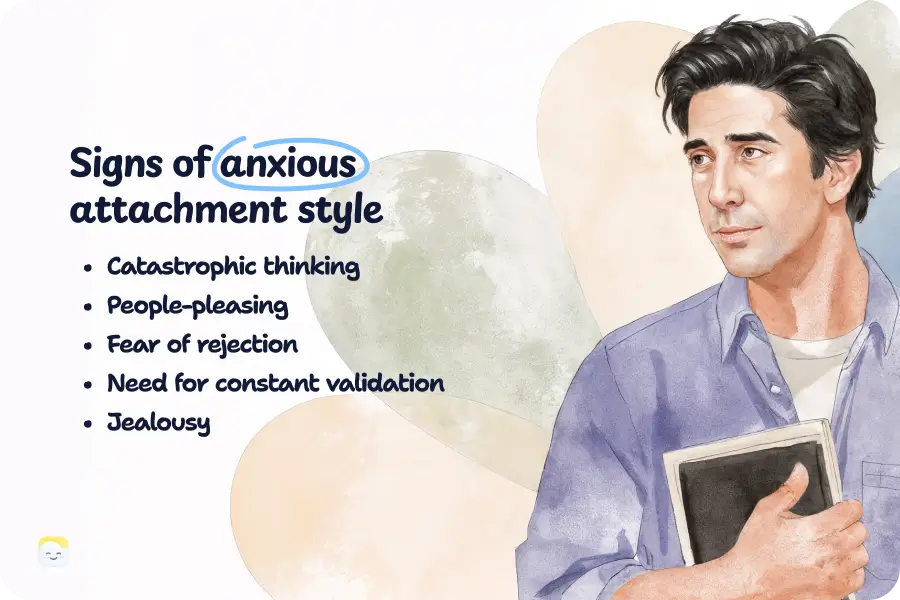
Hence, a person with insecure resistant attachment can exhibit these behavior patterns:
- Catastrophic thinking. Treating every uncertainty as a threat/negativity as a way to protect yourself.
- People-pleasing. Fear of abandonment can make you prioritize the needs of others higher than your own because your anxious mind believes you can control the feelings of others.
- Fear of rejection. Not accepting negativity, including criticism or arguments, because it might lead to the omnipresent fear of abandonment.
- Pressing need for constant validation. Reassurance through being overly needy or clingy temporarily relieves anxiety.
- Jealousy. Anxiety and overthinking, in combination with low self-worth, can make resistantly attached people feel lesser in relationships, work, and their image of life.
Examples of anxious-ambivalent attachment style from TV shows
A textbook example of a character with an anxious attachment style is Ross Geller from Friends. He’s obsessed with making sure that Rachel still loves him and she’s not cheating on him with Mark.
If you’re one with anxious attachment, you can also recognize yourself in Carrie Bradshaw from Sex and the City. Carrie uses manipulative tactics, common for anxious attachment, called romantic self-sabotage. She creates “tests” for her significant others (especially Mr. Big) and threatens to leave them to see their reactions and see whether they will chase and reassure her.
Signs of avoidant attachment style
People who have an avoidant attachment style learn this in childhood: their needs make them difficult. It’s not true, but this finding once helped them survive. So, why would they change their hyper-independence and isolation if it’s such a winning strategy?.
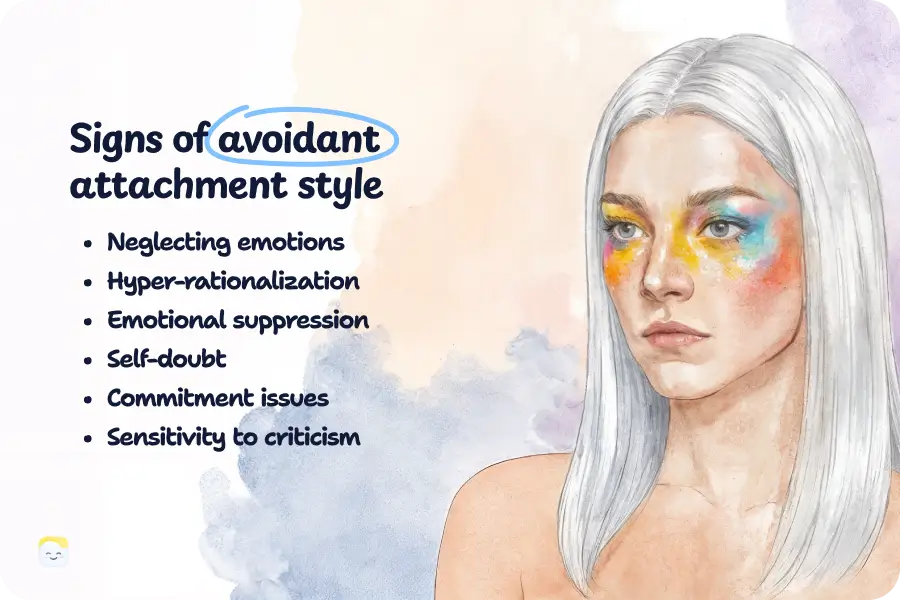
An avoidant attachment style tends to have these habits:
- Overlooking emotions (their own and others’). Because they were discouraged from emotional expression in childhood, people with avoidant attachment can treat emotions as a whim.
- Hyper-rationalizing. Avoidants feel the need to justify their feelings to vindicate their vulnerability. E.g., “I understand why I feel sad, but why do I feel angry? I shouldn’t feel this way.”
- Emotional suppression. Treating feelings as if they’re inconveniences and putting them aside leads to build-up and emotional outbursts.
- Self-doubt. Vulnerability is associated with weaknesses. Therefore, when avoidant individuals feel vulnerable, they doubt their abilities and identity.
- Commitment issues. Committing to long-lasting relationships can be associated with loss of autonomy. Close relationships also require vulnerability, which we know can be perceived as a threat.
- Sensitivity to criticism. When a person is criticized, they are automatically in a more vulnerable position.
Avoidant attachment style in pop culture
A classic example of avoidant attachment is Jules Vaughn from Euphoria. Throughout the series, Jules becomes uncomfortable when her romantic relationships start requiring emotional vulnerability.
She distances herself when intimacy becomes overwhelming and seeks freedom when she feels “like in a cage.” Like many avoidantly attached individuals, she fears losing herself within a relationship.
If you got attached to Katniss Everdeen from The Hunger Games, can it be due to the fact that you recognize yourself in her avoidant patterns?
Although Katniss cares deeply about the people in her life, she has difficulty expressing emotions and accepting support from others. Her instinct is to handle problems alone, even when help is available. When faced with emotional vulnerability, she withdraws or focuses on practical tasks instead.
Signs of fearful-avoidant attachment
The fearful avoidant attachment style is the most recent of four attachment styles, discovered in the 1990s. Half of insecurely attached people have this attachment [2] Madigan, S., Fearon, R. M. P., van IJzendoorn, M. H., Duschinsky, R., Schuengel, C., Bakermans-Kranenburg, M. J., Ly, A., Cooke, J. E., Deneault, A.-A., Oosterman, M., & Verhage, M. L. (2023). The first 20,000 strange situation procedures: A meta-analytic review. Psychological Bulletin, 149(1-2), 99–132. https://psycnet.apa.org/record/2023-79626-003 . So, if you have an insecure attachment style but are not sure what your style exactly is, it’s highly likely to be disorganized attachment.
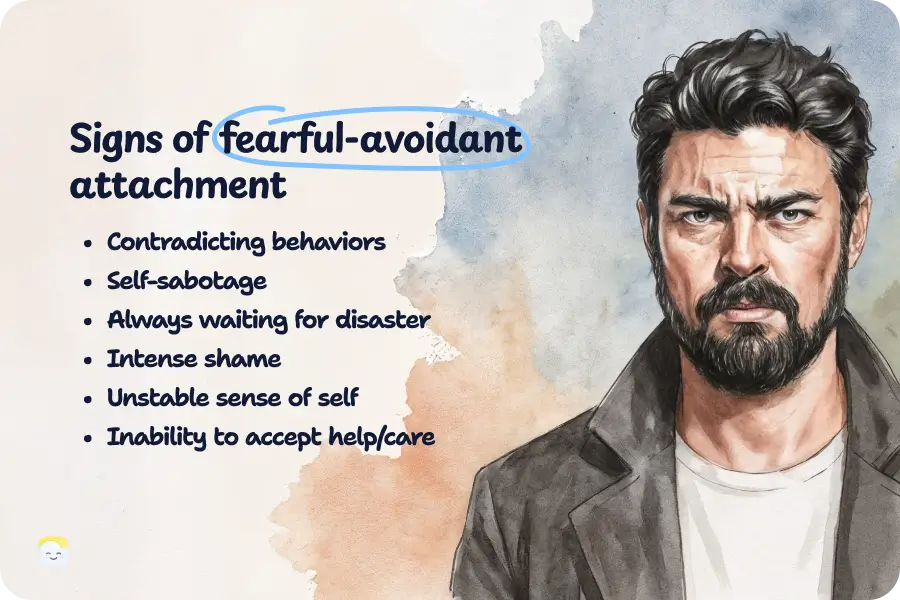
This attachment is unique because it combines both signs of the avoidant and anxious attachment styles. But a disorganized attachment style can also show up in unique ways:
- Contradicting behaviors. Craving emotional closeness but pulling away when getting too close to someone because loved ones are also perceived as a potential threat.
- Self-sabotage. Fearfully attached individuals can associate stability with lack of attention and danger. They may choose to control the lull before the storm and find a fight before a fight finds them.
- Always waiting for disaster. The hypervigilance state makes a person feel unsafe when things are going well. Combined with avoidant behavior, disorganized attachment style makes a person a passive observer of their life coming down.
- Shame-based identity. Trauma victims can internalize the feeling that there is something wrong with them to regain a perceived sense of control.
- Unstable sense of self. Fearfully attached people can change depending on who they are with, adapting their opinions, personality traits, and even values to fit different relationships.
- Difficulty receiving care. Kindness or compliments may feel suspicious because a person with a disorganized attachment style might not believe they truly deserve something good, especially if it was rare in their childhood.
Disorganized attachment style on TV
Billy Butcher from The Boys embodies all the main symptoms of an anxious + avoidant attachment style. He doesn’t allow himself to be vulnerable and uses unhealthy coping mechanisms like self-destruction and revenge. He’s also an example of how insecure attachment style can develop (or become more prominent) in adulthood after a loss of a loved one.
Another Billy with a fearful-avoidant attachment style is Billy Hargrove from Stranger Things, Max’s older, abusive brother. Behind his aggression and hostility, there is a traumatized child in Billy who learned that love equals pain. And who wants to be hurt? He yearns to be accepted but cannot act better than his aggressive defensive mechanisms.
Insecure attachment styles in relationships: Impact
People with insecure attachment styles have, on average, more relationship problems than securely attached couples. Insecure attachment can make relationships 40% less enjoyable [3] Candel, O.-S., & Turliuc, M. N. (2019). Insecure attachment and relationship satisfaction: A meta-analysis of actor and partner associations. Personality and Individual Differences, 147, 190–199. https://doi.org/10.1016/j.paid.2019.04.037 .
How exactly does attachment style worsen the quality of adult relationships? It impacts three crucial cornerstones of healthy relationships:
- Support. Insecurely attached people learned that their needs make them “difficult,” so they usually don’t count on help. But they’re the ordinary people who seek comfort too. If they don’t communicate their need for support, they’ll feel lonely. And this can result in less communication, as seen in the next point.
- Communication. Manipulative tactics, like mind-reading or silent treatment, replace the ability to talk directly, aka, healthily. It makes it difficult to manage conflict and empathize with a loved one.
- Emotional intimacy. Insecure attachment styles don’t allow a person to be fully themselves: express their opinions and show their true feelings because of difficulty trusting. And it’s impossible to be intimate with someone when you can’t be your true self around them.
Insecurely attached individuals usually view the world through a negative lens. That’s why they may assume people who surround them have bad intentions, even if it’s not true. This creates instability that contributes to dissatisfaction, divorces, breakups, and falling out [4] Conradi H.J., Noordhof A., Kaphuis J. H. (2021). Satisfying and stable couple relationships: Attachment similarity across partners can partially buffer the negative effects of attachment insecurity. Journal of Marital and Family Therapy, 47(4), 903–919. https://doi.org/10.1111/jmft.12477 .
What else does insecure attachment determine in adult life
Everybody talks about how bad insecure attachment styles are for relationships because it’s relatively easy to see the impact. Wait until they find out that anxious/avoidant habits are not limited to romantic impact only.
The attachment process also impacts:
- Mental health
Insecure attachment styles do impact mental well-being. The likelihood of anxiety and depression in adulthood rises. Fearful-avoidant attachment style, in addition, is closely linked to BPD and other cluster B personality disorders.
- Physical health
The chronic stress associated with an insecure attachment style accumulates and contributes to chronic diseases. Some cardiovascular diseases, inflammations, digestive problems, etc., develop because of the lifestyle. APA warns that the lifestyle of insecurely attached people frequently leads to these problems with physical health [5] American Psychological Association. (2010, July 20). Feeling insecure in relationships may predispose people to later health problems, says research [Press release]. https://www.apa.org/news/press/releases/2010/07/insecure-attachment .
- Sexual health
Sex is the peak of human vulnerability. The more struggles with vulnerability, the more struggles with sex. The fear of not being wanted or the fear of intimacy are not the only ways in which insecure attachment impacts sexual health. It also makes people use less protection and, therefore, get STIs and unplanned pregnancies more [6] Gasiūnienė, E. (2014). The links between adult attachment styles, emotional intelligence, and relationship satisfaction. ResearchGate. https://doi.org/10.13140/2.1.3141.2006 .
- Work
It’s been proven that employees with insecure attachment styles are less motivated, perform worse, burn out quicker, and even earn less money [7] Pham, M. (2023). A meta-analysis study of attachment styles in the workplace. Academy of Management Proceedings, 2023(1), Article 11729. https://doi.org/10.5465/AMPROC.2023.11729abstract . Why? Because they are tuned for seeing negativity that causes more stress, which impacts health, which impacts productivity.
What is an insecure attachment disorder?
Here’s the thing: insecure attachment styles are not a disorder. But a disorder of attachment actually exists.
Attachment disorder is a clinical condition of young children who cannot form emotional bonds with their caregivers. Importantly, this is a disorder that only children can have. There are two types of attachment disorder:
- Reactive Attachment Disorder (RAD): Inability to form an emotional bond with a caregiver.
- Disinhibited Social Engagement Disorder (DSED): Lack of boundaries and approaching strangers with no fear.
The symptoms of both disorders can appear around 9 months of age and are usually diagnosed under the age of 5.
If you feel like you can relate to attachment disorder, keep in mind that adults can’t have it, from a clinical perspective. A former therapist, now mental health writer, Emily Mendez explains why, “By definition, attachment disorders are developmental disorders that first appear in childhood. These disorders develop as a result of abuse, neglect, and severe disruptions in caregiving. However, the effects of these disorders typically continue well into adulthood. They can cause problems in relationships, diffiuclty trusting others, and fear of abandonment.”
Without treatment, attachment disorder in childhood can transform into BPD, (complex) PTSD, depression, etc. Hence, if you’re an adult who supposes they have/had an attachment disorder, share your concerns with a mental health professional. But expect that they will consider other conditions first.
3 myths about insecure attachment people believe in
Although attachment theory is one of the most credible psychological theories, it’s a theory. It’s not perfect, and it can’t explain everything. And it’ll most likely become outdated in the future.
Knowledge about attachments is crucial for self-awareness if you don’t fall for these myths:
- Attachment styles predict personality and behavior.
No, attachment isn’t the only thing that influences personality and your behavior. The human psyche is so complex that your reaction/behavior changes based on attachment, context, level of stimulation, exhaustion, etc.
- Avoidant/anxious attachment styles only have drawbacks.
Don’t hate on your insecure attachment because it’s actually an elaborate way your brain found to keep you safe. As an adult, most of these “safety features” become redundant but have some benefits even in adulthood.
For example, anxiously attached people are more empathetic and sensitive toward their romantic partners. Avoidants, in turn, move on more easily after falling out with people they used to be close to.
- A person can have only one attachment.
It’s possible to have a few attachment styles, e.g., an anxious attachment style toward romantic interests and an avoidant attachment in the workplace. Shout out to the fact that the “human psyche is complex.”
The rigid claims about attachment styles spread by social media are just an attempt to shock readers and get their attention. Don’t go after every label that resembles you. Keep an open mind about yourself: you are not just your attachment style or you type of personality. You are whatever you want to be.
Emily Mendez says that knowing about your insecure attachment style, but not doing anything to improve it can actually reinforce unhealthy behaviors “It’s common to try to find answers when you are experiencing painful relationship patterns. And sometimes people look for answers in relationship patterns. But, believing that you have an insecure attachment style when you don’t can cause you to use this label as an exuse for unhealthy behaviors, rather than changing.
If you believe that you have an attachment disorder, it’s always a good idea to make an appointment with a therapist. They can determine if that is actually the case, and work with you on developing healthier attachment patterns.”
Can you change your attachment style? Healing insecure attachment
Yes, attachment style is a flexible trait. Even after years of life in fear, insecurity, and resentment, it’s possible to move toward a more secure attachment style.
A change is required, though. Nothing will change if you keep trying to achieve a different aim by going the same way. Here’s what you can try for each of them:
- Self-worth → Self-care to learn that you can actually self-soothe and don’t rely on validation from others to feel enough.
- Communication → Buffering method, which means you explain to a close person what you’re struggling with, and they intentionally support you when you don’t have to ask for it (alleviates 50% of insecure attachment symptoms [8] Simpson JA, Steven Rholes W (2017). Adult Attachment, Stress, and Romantic Relationships. Current Opinion in Psychology. 13:19-24. https://doi.org/10.1016/j.copsyc.2016.04.006. ).
- Mindset → CBT exercises to reprogram your automatic negative thoughts and feel secure in everything you start.
The final method to heal an insecure attachment style is therapy: individual and family. Achieving a secure attachment style might be hard, but a good therapist will help you see the progress and celebrate each milestone with you.
Frequently asked questions
Does everyone have an attachment style?
According to attachment theory, yes. However, attachment style is just one of many psychologists’ attempts to understand the human mind. People rarely fit one of four attachment styles precisely.
What's the worst attachment style?
There isn’t a single “worst” attachment style because every person faces unique challenges, and the definition of “worst” varies. That said, it’s possible to name the most intense attachment style, which is disorganized attachment. This style combines signs of both anxious and avoidant attachment, which increases the likelihood of various mental health conditions.
What are attachment issues?
Attachment issues are difficulties with trust, intimacy, vulnerability, and self-view developed due to insecure attachment. Attachment issues themselves are not a ground for a diagnosis. But they are considered risk factors for mental health conditions if not treated in a timely manner [9] Simon Herstell, Linda T. Betz, Nora Penzel, Ruth Chechelnizki, Laura Filihagh, Linda Antonucci, Joseph Kambeitz (2021). Insecure attachment as a transdiagnostic risk factor for major psychiatric conditions: A meta-analysis in bipolar disorder, depression and schizophrenia spectrum disorder, Journal of Psychiatric Research 144 (190-201). https://doi.org/10.1016/j.jpsychires.2021.10.002. .
Are attachment styles real?
Yes, attachment theory is one of the most influential theories in relationship and social psychology. Attachment styles have decades of research behind them. Keep in mind, though, that attachment styles aren’t empirical. They are attempts to understand the human psyche. Psychology constantly develops, and we must admit that attachment theory can become obsolete one day.
What type of attachment style do I have?
In order to find this out, reflect on your close relationships. Do you tend to be more anxious and obsessive about what your significant other will think or do? Or are you the opposite: a person who avoids relationships and keeps a distance from others? Are you somewhere in the middle, or do you feel confused?
The surest way to know your attachment style is by taking an attachment test online or talking to a specialized psychologist.
What causes attachment issues?
Attachment issues usually develop from inconsistent parenting, when a child learns that parents can’t be trusted. This impacts trust and self-esteem, which will affect every adult relationship in the future. Neglect, criticism, abuse, trauma, bullying, fear, and humiliation can trigger attachment insecurity. In rarer cases, insecure attachment can appear in adult relationships after negative past experiences with narcissists, humiliation abusers, or emotional vampires.
Sources
- Ainsworth, M. D. S., Blehar, M. C., Waters, E., & Wall, S. (1978). Patterns of attachment: A psychological study of the strange situation. Hillsdale, NJ: Erlbaum.
- Madigan, S., Fearon, R. M. P., van IJzendoorn, M. H., Duschinsky, R., Schuengel, C., Bakermans-Kranenburg, M. J., Ly, A., Cooke, J. E., Deneault, A.-A., Oosterman, M., & Verhage, M. L. (2023). The first 20,000 strange situation procedures: A meta-analytic review. Psychological Bulletin, 149(1-2), 99–132. https://psycnet.apa.org/record/2023-79626-003
- Candel, O.-S., & Turliuc, M. N. (2019). Insecure attachment and relationship satisfaction: A meta-analysis of actor and partner associations. Personality and Individual Differences, 147, 190–199. https://doi.org/10.1016/j.paid.2019.04.037
- Conradi H.J., Noordhof A., Kaphuis J. H. (2021). Satisfying and stable couple relationships: Attachment similarity across partners can partially buffer the negative effects of attachment insecurity. Journal of Marital and Family Therapy, 47(4), 903–919. https://doi.org/10.1111/jmft.12477
- American Psychological Association. (2010, July 20). Feeling insecure in relationships may predispose people to later health problems, says research [Press release]. https://www.apa.org/news/press/releases/2010/07/insecure-attachment
- Gasiūnienė, E. (2014). The links between adult attachment styles, emotional intelligence, and relationship satisfaction. ResearchGate. https://doi.org/10.13140/2.1.3141.2006
- Pham, M. (2023). A meta-analysis study of attachment styles in the workplace. Academy of Management Proceedings, 2023(1), Article 11729. https://doi.org/10.5465/AMPROC.2023.11729abstract
- Simpson JA, Steven Rholes W (2017). Adult Attachment, Stress, and Romantic Relationships. Current Opinion in Psychology. 13:19-24. https://doi.org/10.1016/j.copsyc.2016.04.006.
- Simon Herstell, Linda T. Betz, Nora Penzel, Ruth Chechelnizki, Laura Filihagh, Linda Antonucci, Joseph Kambeitz (2021). Insecure attachment as a transdiagnostic risk factor for major psychiatric conditions: A meta-analysis in bipolar disorder, depression and schizophrenia spectrum disorder, Journal of Psychiatric Research 144 (190-201). https://doi.org/10.1016/j.jpsychires.2021.10.002.
Disclaimer
This article is for general informative and self-discovery purposes only. It should not replace expert guidance from professionals.
Any action you take in response to the information in this article, whether directly or indirectly, is solely your responsibility and is done at your own risk. Breeze content team and its mental health experts disclaim any liability, loss, or risk, personal, professional, or otherwise, which may result from the use and/or application of any content.
Always consult your doctor or other certified health practitioner with any medical questions or concerns
Breeze articles exclusively cite trusted sources, such as academic research institutions and medical associations, including research and studies from PubMed, ResearchGate, or similar databases. Examine our subject-matter editors and editorial process to see how we verify facts and maintain the accuracy, reliability, and trustworthiness of our material.
Was this article helpful?