



Podcast name
Choleric temperament
Choleric temperament is highly motivated, goal-oriented, assertive, and ambitious. These people typically know what they want and can motivate others to help them follow their dreams. Feeling curious whether this is about you as well? Gain valuable insights about this strong-willed temperament type and understand whether this resonates with your personality.

What is a choleric temperament?
Yet, the approach has changed. Currently, temperament theory is used to describe individual differences in a person’s emotional reactivity and regulation without the link to human health. [2] National Library of Medicine. “Temperament, Speech and Language: An Overview”
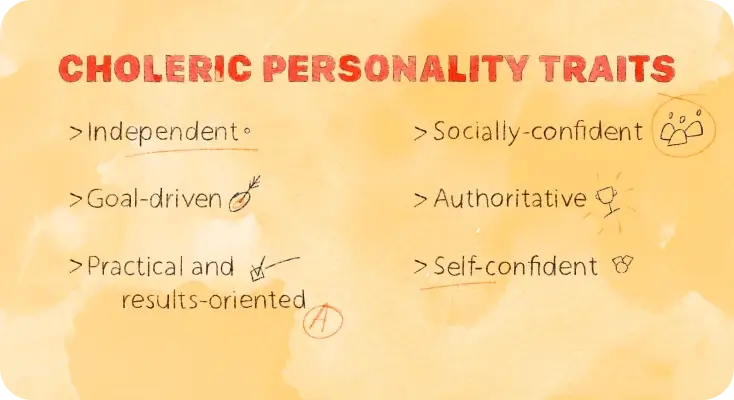
Moreover, the main choleric personality traits highlighted in scientific journals have also changed. Now, most resources define cholerics as practical, independent, goal-oriented, and analytical. [3] ResearchGate. “TEMPERAMENT PERSONALITY TRAIT AND ITS IMPACT ON PREFERENCE FOR EWALLET USAGE” These people are motivated, ambitious, self-confident, and decisive. They often have a big vision and can be natural leaders who motivate others to follow them.
Additionally, those with a choleric personality type might often live with high levels of testosterone that influence their traits, typical behavior, and communication style. [3] ResearchGate. “TEMPERAMENT PERSONALITY TRAIT AND ITS IMPACT ON PREFERENCE FOR EWALLET USAGE” As such, they might have a short fuse but are more likely to express their anger in an assertive manner rather than through emotional outbursts.
Discover what temperament you have with our quick & free four temperament test. Find out whether you’re a cheerful sanguine, have an ambitious, choleric temper, introverted melancholic, or live with a relaxed phlegmatic temperament. Gain deeper insights into your strengths, communication style, and how you interact with others.
Differences between choleric temperament and personality
While these two terms might sound similar and confusing, there are noticeable differences that we’ll briefly explain.
Choleric Temperament
This includes individual differences in affect, activity, attention, and regulation developed primarily on a biological basis, as the research states. [4] ResearchGate. “Temperament and Personality” Simply put, it’s biologically rooted patterns of behavior that influence how we approach the world and communicate with others.
Temperament is not the same as the individual’s personality but is a significant part of it. [5] ScienceDirect. “NORMAL INDIVIDUAL DIFFERENCES IN TEMPERAMENT AND BEHAVIORAL ADJUSTMENT” What’s more, scientists used to believe that temperament is regarded as a stable part of personality, an “endophenotype” developed early in life (although affective temperaments that change over time also exist). [6] National Library of Medicine. “Low affective temperament consistency during development: Results from a large retrospective study”
Being born with a choleric temper means that a person is naturally more extroverted, active, and goal-driven, with a tendency toward assertiveness and strong leadership qualities. Still, it doesn’t mean that someone will acquire a choleric personality, as over the course of life, many other factors influence what kind of person we become.

Choleric Personality
On the other hand, the phenomenon of personality includes traits such as extraversion and neuroticism, and encompasses goals, coping styles, defensive styles, motives, attachment styles, identities, and various other processes. [4] ResearchGate. “Temperament and Personality”
As such, personality is more flexible because it might constantly change under the influence of the world around us. For instance, a naturally assertive and goal-driven choleric child might grow up in an environment that values teamwork and empathy. Over time, they may develop stronger empathy, which shapes their overall personality beyond just inborn temperament and adds sanguine traits, another type of temperament.
It can happen vice versa as well. Calm and assertive melancholic might seem to have a choleric type if they were raised in an ambitious and active family where everyone had a short fuse. As a person who was constantly pushed for high achievement, and valued decisiveness over deep reflection, they might behave in a way that wasn’t initially natural to them.

Choleric personality traits
While we’ve already highlighted some of the traits typical of a choleric temper, let’s describe them in more detail.
By the way, if you want to find the answer to the question, “What should I be when I grow up?” we’ve got you covered. The “What career is right for me?” quiz is a simple yet effective way to discover professions that align with your personality, strengths, and interests, no matter what temperament type you have.
Choleric temperament strengths and weaknesses
When talking about temperament theory, we can’t forget about how this type of personality influences daily life. Here are some or the most common manifestations.
Strengths
Possible weaknesses
What the choleric temperament looks like today
A study published in the Journal of Affective Disorders Reports reveals that temperament forms a basis for how adolescents face the outer world. [11] ScienceDirect. “Temperament and symptoms of stress and depression among adolescents: The mediating role of psychological flexibility” A set number of personal traits definitely has a great influence on how we approach people and everything that happens to us.
Yet, it’s important to note that there are no such things as personality types or choleric temper generally acknowledged in modern science and psychology. Yet, the 4 types theory influenced shaping many other personality theories. For instance, become inspiration for creation of the Big Five personality traits, Jung’s psychological types and the Myers-Briggs Type Indicator (MBTI), etc.
We can say that most people try to find the answer to “What is my temperament?” to use it as a simple framework to understand themselves better. Four temperament theory remains popular because it provides an accessible way to describe personality differences and improve self-awareness.
“How often do psychologists and mental health professionals turn to the 4 personality types theory, and what can you say about its efficiency?” Hannah Schlueter, MA, LAC, answers, “The theory of four temperament types is used occasionally, but more so as a way to help client’s try and gain insight rather than an absolute. Since personality is so complex, there are only a few tools that are consistently effective. Use this theory to guide a general understanding of yourself while allowing for natural inconsistencies.”
How to communicate with people who have a choleric personality
Understanding what choleric temperament is can significantly help you find a common language with this kind of person. Let’s find out how to approach them in different social settings.
In relationships
You already know that cholerics tend to take leading roles, and relationships aren’t an exception.
What works:
What to avoid:
In friendship
If you appreciate choleric temperament strengths and weaknesses, you can become a really good friend to this kind of person. This personality type can motivate you to be a great person to lead. Still, there are a few things you need to take into account.
What works:
- Being active
- Offering direct and honest feedback
- Supporting their ambitions
- Appreciating their decisiveness
- Being self-sufficient in friendship
What to avoid:
- Being overly emotional or clingy
- Disrespecting their need for space or autonomy
- Underestimating their passion
- Disagreeing constantly without offering solutions
At work
It doesn’t matter what position a choleric person holds, their pattern of behavior will remain the same. Thus, whether you’re a manager of such an employee or just a colleague, there’s something you need to take into account.
In family
Task-oriented people with choleric temper might approach family as their project as well. Their temperament and personality require enough space to set goals and reach them.
What works:
- Giving them space to take the lead when necessary
- Showing appreciation for their hard work
- Supporting their ambition while respecting their boundaries
- Helping with organization and task management
What to avoid:
- Ignoring their need for independence
- Being overly emotional or passive in discussions
- Disrespecting their need for structure
We asked Hannah Schlueter, MA, LAC, whether mixed temperaments (e.g., choleric-melancholic) exist. “Mixed temperaments are very normal and likely more common to exist than single temperaments. Due to the commanding nature of the temperament type, all combinations will show a prevalence of choleric traits.”
Sources
- ResearchGate. “The Functionality of Four Temperaments and Communication Theories towards the Realisation of Peaceful General Elections in Kenya”
- National Library of Medicine. “Temperament, Speech and Language: An Overview”
- ResearchGate. “TEMPERAMENT PERSONALITY TRAIT AND ITS IMPACT ON PREFERENCE FOR EWALLET USAGE”
- ResearchGate. “Temperament and Personality”
- ScienceDirect. “NORMAL INDIVIDUAL DIFFERENCES IN TEMPERAMENT AND BEHAVIORAL ADJUSTMENT”
- National Library of Medicine. “Low affective temperament consistency during development: Results from a large retrospective study”
- ResearchGate. “Personal Characteristics and Personality-Temperament Traits and Its Implications to Effective Leadership in Organizations”
- CEUR-WS. “Investigation of Temperament Characteristics Influencing the Academic Achievement of First-year University Students”
- International Journal of Applied Engineering Research. “Temperament as a Determinant of Success in Formative Assessment in Engineering Education”
- ResearchGate. “Employee Temperament As A Predictor of Workstress among Plant Turnaround Workers”
- ScienceDirect. “Temperament and symptoms of stress and depression among adolescents: The mediating role of psychological flexibility”
Disclaimer
This article is for general informative and self-discovery purposes only. It should not replace expert guidance from professionals.
Any action you take in response to the information in this article, whether directly or indirectly, is solely your responsibility and is done at your own risk. Breeze content team and its mental health experts disclaim any liability, loss, or risk, personal, professional, or otherwise, which may result from the use and/or application of any content.
Always consult your doctor or other certified health practitioner with any medical questions or concerns
Breeze articles exclusively cite trusted sources, such as academic research institutions and medical associations, including research and studies from PubMed, ResearchGate, or similar databases. Examine our subject-matter editors and editorial process to see how we verify facts and maintain the accuracy, reliability, and trustworthiness of our material.
Was this article helpful?