


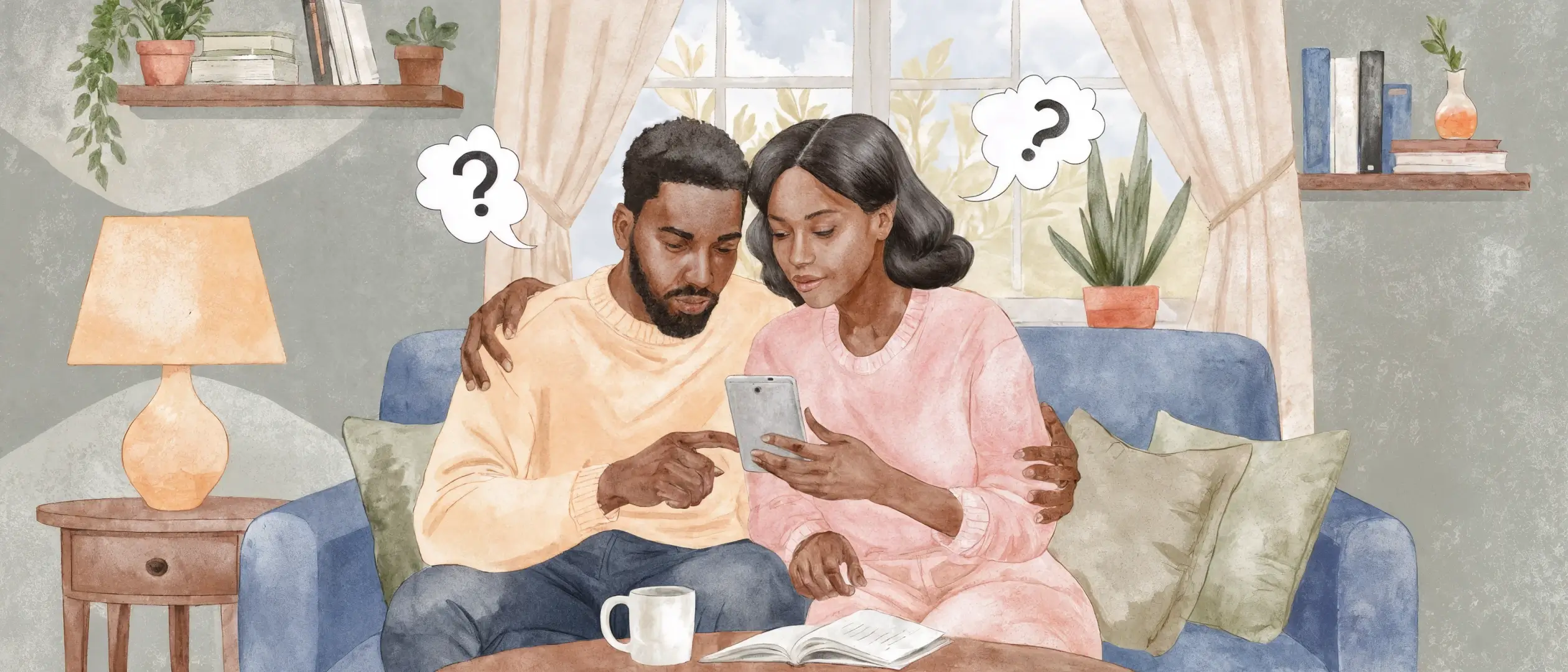
Do you really understand your partner’s emotions or just what they say? Are you building a fulfilling relationship or just maintaining one out of habit?
Extensive research shows that how well couples communicate affects their relationship satisfaction over time. Take a relationship quiz to gain insights about your emotional connection and future.

Relationship Quiz
This couples quiz isn’t about scoring points or proving who knows more. Its goal is to bring awareness to what often stays unspoken. Here are thoughtful and meaningful questions for real understanding and honest conversation.
After completing the quiz, go through the answers together and rate them. Here, you subjectively evaluate each other — your feelings, behaviors, and the relationship itself. Then, add up your total score.
- 2 points — Deeply accurate, honest, and shows a strong understanding
- 1 point — Partially accurate or surface-level
- 0 points — Missed, avoided, or inaccurate
Section 1. Understanding Each Other
- What do you think your partner struggles with internally but rarely shows?
- When does your partner feel most misunderstood?
- What kind of support does your partner need during stress?
- What past experience shaped who your partner is today?
- What does your partner value more: stability or change?
- What motivates your partner to keep going during hard times?
- What drains your partner emotionally?
- What does your partner need but find hard to ask for?
- How does your partner handle disappointment?
- What makes your partner feel truly safe?
Section 2. Communication & Conflict
- How does your partner react during conflict?
- What triggers arguments between you most often?
- What is something you feel guilty about or avoid talking about, but shouldn’t?
- How do you each prefer to resolve disagreements?
- What does “being heard” mean to your partner?
- When have you hurt your partner without realizing it?
- What patterns repeat in your conflicts?
- What would healthier communication look like for you both?
- What is one thing your partner wishes you understood better?
- How do you rebuild trust after tension?
Section 3. Emotional Connection
- When do you feel closest to your partner?
- When do you feel most distant?
- What makes you feel emotionally neglected?
- What fears do you have within the relationship?
- What reassures you when you feel insecure?
- How do you express love vs. how do you want to receive it?
- What does emotional intimacy mean to you?
- What emotional needs are currently unmet?
- What makes you feel loved?
- When was the last time you felt deeply connected, and why?
Section 4. Values & Compatibility
- What are your core values, and where do they differ?
- What does commitment mean to each of you?
- How do you view independence and spending time together within a relationship?
- What role does honesty play, even when it hurts?
- How important are ambition and personal growth?
- How do you define respect?
- What boundaries are essential for you?
- What are your expectations around loyalty?
- Where do your life priorities conflict?
- What does a “healthy relationship” look like to you?
Section 5. Future & Reality
- Do you truly want the same future?
- What compromises are you willing or unwilling to make?
- What fears do you have about long-term commitment?
- What would cause this relationship to fail?
- What would make it last?
- Are you growing together or apart?
- What does “settling down” mean to each of you?
- What sacrifices have you already made, and how do you feel about them?
- What expectations do you have that may be unrealistic?
- If nothing changed, how would you feel in 5 years?
Final Reflection (Answer individually, then share)
This section is not meant to be scored because these questions are personal. They ask you to look inward rather than evaluate your partner or the relationship. There are no “right” or “wrong” answers, only honest ones. You can choose to share it with your partner later or keep it personal.
- What am I bringing into this relationship that helps it grow?
- What am I bringing that harms it?
- What am I afraid to admit?
- Am I truly being myself here?
- Do I choose this person every day or just stay out of habit?

Relationship Quiz Results
75-100: You’re Good Partners for Each Other
You show strong self-awareness, honesty, and intentional effort to understand the other person. Your relationship is based on kindness and the daily choices you and your partner make to invest in each other.
You may have common life dreams, and your plans for the future generally coincide. Even if sometimes relationships cannot be perfect, you mostly act like mature and emotionally available partners:
- You spend quality time together
- You listen and reflect, not just react
- You’re willing to face uncomfortable truths
- You’re trying to speak the primary love language of your partner
50-75 points: You Enjoy Smooth Sailing
Your relationship likely feels stable, but growth requires more honesty and curiosity. When you started dating, you may have experienced affection and emotional connection, but now you may need to try new ways to nurture the most important components, such as trust, open communication, mutual respect, and intentional time together.
For successful relationships, it’s important to not only make an effort when you start dating but also continue to show care and attention over time, according to research on relationships.
There are some areas that lack depth or clarity:
- You avoid major conflict, but may also avoid deeper conversations
- You feel comfortable together, but not always fully open
- You both may have unspoken needs or assumptions
- You share your lives, but keep some thoughts to yourselves
25-50 points: You May Not Know Your Partner on a Deep Level
You may know what your partner likes and facts about their friends and family, but not their deeper emotional world and personality. This doesn’t mean your relationship is a failure or that something is wrong with you. But it’s a signal that there are some challenges in your relationships:
- There may be disconnects in expectations or values
- Important desires or needs might be overlooked
- There is a lack of emotional availability
- Communication and emotional exchange may be surface-level or inconsistent
According to research, emotional unavailability can erode trust, intimacy, and overall happiness, often leading to conflict and separation.
Frequently asked questions
1. What should we do if the quiz reveals uncomfortable truths about our relationship?
Try to approach it as a starting point, not a verdict. Use the insights as a guide to open, honest conversations, identify areas for growth, and explore solutions together. If needed, consider discussing the results with a therapist to deal with deeper challenges safely.
2. Is it normal for partners to answer very differently on deeper emotional questions?
Yes, differences in perception, communication style, and emotional needs are natural. What matters is how you respond: listen actively and seek to understand your partner’s perspective to strengthen empathy and connection, or create tension and conflict.
3. How can we use a quiz like this to improve communication?
Focus on sharing feelings, asking clarifying questions, and reflecting on patterns together. Set aside dedicated time for discussion, and treat the test as a tool for understanding rather than scoring or comparing.
Sources
1. Johnson MD, Lavner JA, Mund M, Zemp M, Stanley SM, Neyer FJ, Impett EA, Rhoades GK, Bodenmann G, Weidmann R, Bühler JL, Burriss RP, Wünsche J, Grob A. Within-Couple Associations Between Communication and Relationship Satisfaction Over Time. April 2022.
2. Kevin Shafer, Todd M. Jensen, Jeffry H. Larson. Relationship Effort, Satisfaction, and Stability: Differences Across Union Type. April 2014.
3. Dr. Nisha Khanna. Impact of Emotional Unavailability on the Happiness Level of Indian Couples and the Happiness Pie Chart as a Tool Towards Resolution: Qualitative Analysis of Case Studies. June 2023.
Disclaimer
This article is for general informative and self-discovery purposes only. It should not replace expert guidance from professionals.
Any action you take in response to the information in this article, whether directly or indirectly, is solely your responsibility and is done at your own risk. Breeze content team and its mental health experts disclaim any liability, loss, or risk, personal, professional, or otherwise, which may result from the use and/or application of any content.
Always consult your doctor or other certified health practitioner with any medical questions or concerns
Breeze articles exclusively cite trusted sources, such as academic research institutions and medical associations, including research and studies from PubMed, ResearchGate, or similar databases. Examine our subject-matter editors and editorial process to see how we verify facts and maintain the accuracy, reliability, and trustworthiness of our material.
Was this article helpful?