


Do you struggle to trust your own desires because you were taught your heart is “deceitful above all things”? Or, does setting a boundary still feel exactly like “committing a sin”? The scars left by harmful religious environments and spiritual abuse can affect every aspect of a person’s life.
Rychel Johnson, a master’s-level therapist in private practice, shares her insights about religious trauma and approaches to treating it.
Is childhood trauma part of your story? Take a Breeze test to find out how it may be impacting you.

5 Symptoms of Religious Trauma
From Rychel Johnson’s practice, these trauma symptoms reflect the profound impact that harmful religious experiences can have:
1. Persistent anxiety
The person becomes hypervigilant or sensitive to potential threats or triggers. They may experience ongoing fear and intrusive thoughts related to religious beliefs or teachings, and even experience eating disorders, according to studies on body image concerns [1] Akrawi D, Bartrop R, Potter U, Touyz S. Religiosity, spirituality in relation to disordered eating and body image concerns: A systematic review. August 2015 . As a result, they may avoid religious or spiritual contexts or discussions that trigger relevant distress.
2. Self-blame
The person experiences constant feelings of overwhelming guilt or shame and places undue blame on themselves for past religious experiences or perceived sins or moral failings. They may also experience deep sadness or hopelessness.
3. Sleep disturbances
Sleep problems may include difficulty falling asleep, frequent waking during the night, nightmares, flashbacks, and vivid memories related to experienced trauma that feel emotionally intense or realistic.

4. Isolation
The person may withdraw from social interactions, particularly those involving religious communities. At the same time, maintaining relationships outside of that environment can feel unfamiliar or awkward.
5. Crisis of personal identity and faith
The person questions or rejects previously held religious beliefs or practices and has difficulty trusting authority figures or institutions from past betrayals or abuses. After leaving religion, they may also struggle to form a new belief system.
Have You Experienced Religious Trauma? Test
While not a diagnostic tool, it’s helpful to ask yourself questions to see if you’ve experienced religious trauma.
What Is Religious Trauma?
Religious trauma is a form of complex trauma that happens when religious experiences create psychological or emotional distress. Religious trauma occurs when religion or spiritual authority is associated with fear, shame, guilt, or punishment.
The term “religious trauma syndrome” (RTS) is not in the DSM-5 (the Diagnostic and Statistical Manual of Mental Disorders) as an official mental health diagnosis. Some religious trauma examples include:
- Manipulation
- Control by limiting a person’s ability to question religious beliefs or practices
- Exploitation or financial abuse under the guise of spiritual guidance
- Being ostracized from a religious community for questioning beliefs
Not all religious settings are harmful. However, abusive practices or abuse of authority can happen in places where religious leaders bypass personal boundaries and demand unquestioning loyalty at the expense of their followers’ mental and emotional well-being.
Spiritual (Religious) Abuse vs. Religious Trauma
Spiritual abuse and religious trauma are related but distinct concepts, often overlapping in their impact. Actually, spiritual abuse is one of the types of religious trauma. Spiritual abuse occurs when religious leaders, community members, or even parents or other family members use religion, faith, or spiritual beliefs to control, manipulate, or harm another person.
Religious trauma, in turn, refers to the psychological distress that arises from harmful religious experiences and can be a result of spiritual abuse.
In the table below, Rychel Johnson outlines spiritual abuse and religious trauma with examples:
| Spiritual Abuse | Religious Trauma |
| Using religious teachings or authority to control others’ behavior or beliefs | Symptoms similar to post-traumatic stress disorder or complex PTSD, like flashbacks, nightmares, and hypervigilance |
| Leaders of religious institutions who demand unquestioning obedience and use their position and religious hierarchy to exploit or oppress followers | Struggling to reconcile religious teachings with personal experiences or values |
| Using fear of eternal punishment, hell, or ostracism to enforce compliance | Feeling disconnected from one’s sense of self due to religious teachings or experiences |
| Inducing feelings of guilt, shame, or worthlessness through religious indoctrination | Suffering from anxiety, depression, guilt, or shame related to religious beliefs or experiences |
| Cutting off people from outside influences or non-believers to maintain control | Difficulty maintaining relationships with family or friends who remain within the religious context, and feeling isolated |
| Using a person for personal gain (financial, physical, and sexual abuse) under the guise of religious duty | Intense fear of punishment or divine retribution and guilt over perceived moral failings |
Religious Trauma Syndrome & Its Impact on Mental Health
However, mental and physical health can be deeply impacted by religious trauma, research shows [2] Singh S, Yadav AK, Chauhan VS, Agrawal M. Religious trauma syndrome: The futile fate of faith. August 2024 . These symptoms impact several areas of functioning, including the following:
- Cognitive. A person may lack critical thinking skills and have negative beliefs about their abilities, as well as perfectionist tendencies and difficulties with decision-making.
- Emotional. They may feel anger, grief, loneliness, and self-hatred.
- Social. A person may feel socially awkward and lose their social network.
- Cultural. They may experience “culture shock” in a world beyond their religion and feel a sense of belonging only within the faith community.
How Long Does Religious Trauma Last?
Factors that can influence how long religious trauma lasts may include:
- Severity and duration of trauma. More severe and prolonged traumatic experiences often lead to longer recovery times.
- Individual resilience. Personal coping mechanisms, emotional strength, and previous experiences with trauma can influence how long symptoms last.
- Support systems. A strong network of friends, family, or support groups can significantly impact healing.
- Therapeutic interventions. Access to effective therapy and counseling can accelerate recovery.
- Personal effort and engagement. The individual’s commitment to healing, learning, and personal growth plays a critical role.
5 Causes of Religious Trauma
1. Fear-based teachings
Constant exposure to harmful messages about severe punishment, sin, or eternal consequences can create chronic anxiety. For example, being taught that normal thoughts or doubts could lead to eternal damnation may cause long-term fear and hypervigilance.
2. Manipulation of religious leaders
Religious beliefs may be used to manipulate emotions or behavior. This can include gaslighting (e.g., “your doubts mean you’re spiritually weak”) or using faith to justify control.
When religious leaders demand unquestioned obedience or present themselves as the ultimate authority, a person may feel powerless. Questioning or disagreeing can be punished, which, in turn, leads to suppression of independent thinking.
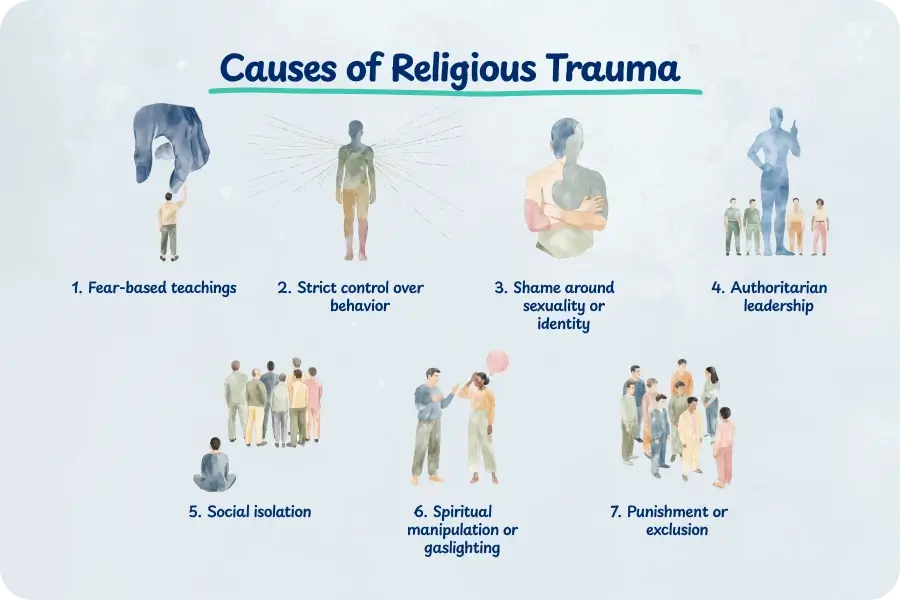
3. Shame and guilt
Some environments rely on shame to control behavior. Natural emotions, desires, or identity traits may be labeled as “wrong” or “sinful,” which can damage self-esteem and create internal conflict.
Strict rules about relationships, appearance, or major decisions can limit autonomy. For example, being told who you can date, how to dress, or what life path to follow can lead to a loss of a person’s sense of self.
Moreover, some authoritarian religions may reject aspects of a person’s identity, such as sexuality, gender, or personal values, that can also harm their emotional health.
4. Cognitive dissonance
When personal experiences conflict with religious teachings, a person may feel internal tension. For example, believing you are part of an unconditionally loving, compassionate system while constantly feeling fear, pressure, or control can create deep inner conflict.
5. Isolation or exclusion from family or faith community
Being shamed, ostracized, or excluded for questioning beliefs or breaking rules can be deeply distressing. For many, the fear of losing community or belonging reinforces compliance and internal stress. For example, if you ask questions or break a rule, the group might stop talking to you completely. This makes you feel alone and scared, so you follow the rules just to stay part of the community.
At the same time, some communities discourage or restrict contact with people outside the group. This isolation can make people inside the group more dependent on it and less likely to question harmful dynamics.
Moreover, a person’s mental health struggles can be dismissed or spiritualized instead of addressed (e.g., “just pray more”). This can prevent people from receiving the support they need.
6 Steps for Healing from Religious Trauma
You don’t have to reject spirituality entirely to heal religious trauma. The goal is to rebuild safety, trust, and a sense of self to separate harmful experiences from your own beliefs and values.
1. Name your experience
First, try to acknowledge that what you went through was traumatic and your pain is real and legitimate. People can minimize their experience because it was framed as “normal” or “for your own good.” Allow yourself to say, “That hurt me.”
Journaling your thoughts and fears is a powerful way to process this step. If traditional journaling feels overwhelming, you can try guided Breeze journaling with customized prompts.

2. Set boundaries with people or situations that trigger your trauma
Healing may require creating distance from people or environments that make you feel fear, shame, or control. This might look like:
- Limiting conversations about religion with certain people. You may say, “I’m not comfortable discussing this topic right now.”
- Saying no to events or situations that feel triggering.
3. Explore who you are outside of your religious upbringing
Religious trauma often disconnects people from their inner sense of truth. Your religious environment may have taught you to distrust your thoughts or intuition. Start small:
- Ask yourself what you actually believe
- Notice your emotional reactions without judging them
- Practice making personal choices without seeking external approval
You may begin to explore what meaning or values look like for you without pressure or fear. Eventually, you might decide to reconnect with spirituality in a new way or not at all. Both paths are valid.
This could include:
- Redefining your beliefs
- Exploring different perspectives and lifestyles
- Focusing on personal values like freedom or tolerance
4. Connect with others who have had similar experiences online or in person
Healing from religious trauma can feel isolating, especially if your previous community was a big part of your identity, research shows [3] Muammar Iqbal Ma’rief, Relung Fajar Sukmawati. Religious Trauma Syndrome (RTS): Examining the Origins of Trauma in Religious Practice and Pathways to Recovery. September 2025 . Connecting with others who have gone through similar experiences can help you rebuild a sense of belonging.
Sharing your story in a safe, supportive space can:
- Reduce feelings of isolation and “being the only one”
- Help you make sense of your experience through others’ perspectives
- Normalize emotions like anger, grief, confusion, or relief
- Name things you may not have been able to articulate before
This connection can happen in different ways:
- Online communities or forums
- Support groups
- Group therapy settings
- Conversations with trusted friends who understand your experience
At the same time, it’s important to choose spaces that feel safe, respectful, and non-judgmental. Avoid communities that replace one rigid belief system with another or pressure you into a specific way of thinking.
5. Practice self-compassion and self-care
Most importantly, be patient and compassionate with yourself. You may carry an inner voice shaped by past teachings. It can be critical, shaming, or demanding. Part of healing is learning to replace that voice with kindness and self-care. For example, instead of thinking, “I shouldn’t feel this way anymore,” try, “It makes sense that I feel this way after what I’ve been through.”
6. Talk to a mental health professional
Find a trauma-informed therapist or counselor who can guide you in your healing process. They can help you process feelings of guilt and shame and develop coping skills to regulate your nervous system and cope with stress and anxiety.
Sources
- Akrawi D, Bartrop R, Potter U, Touyz S. Religiosity, spirituality in relation to disordered eating and body image concerns: A systematic review. August 2015
- Singh S, Yadav AK, Chauhan VS, Agrawal M. Religious trauma syndrome: The futile fate of faith. August 2024
- Muammar Iqbal Ma’rief, Relung Fajar Sukmawati. Religious Trauma Syndrome (RTS): Examining the Origins of Trauma in Religious Practice and Pathways to Recovery. September 2025
Disclaimer
This article is for general informative and self-discovery purposes only. It should not replace expert guidance from professionals.
Any action you take in response to the information in this article, whether directly or indirectly, is solely your responsibility and is done at your own risk. Breeze content team and its mental health experts disclaim any liability, loss, or risk, personal, professional, or otherwise, which may result from the use and/or application of any content.
Always consult your doctor or other certified health practitioner with any medical questions or concerns
Breeze articles exclusively cite trusted sources, such as academic research institutions and medical associations, including research and studies from PubMed, ResearchGate, or similar databases. Examine our subject-matter editors and editorial process to see how we verify facts and maintain the accuracy, reliability, and trustworthiness of our material.
Was this article helpful?