

In dysfunctional families, there are not just kids and their parents. Each family member may take on one or more roles to cope with negative dynamics and help keep the family together. While these roles can help children overcome many problems as they grow up, they can also persist into adulthood, influencing how you interact with other people and the world.
Explore your main role and how it affects your present life in this dysfunctional family roles quiz.
Why take a dysfunctional family roles test?
According to the study, family dysfunction can have longitudinal effects on kids’ lives that persist into adulthood. [1] Resendes T, Ellenbogen MA, Oldehinkel AJ. “Family dysfunction, stressful life events, and mental health problems across development in the offspring of parents with an affective disorder.” J Child Psychol Psychiatry. 2024 So, you may want to take the family dysfunction quiz to:
- Improve self-awareness and explore how your childhood influences your current life, emotional needs, and sense of self-worth.
- Learn more about the maladaptive beliefs you formed in family environments that affect your current relationships.
- Spot dysfunctional patterns in thinking and behavior that you may think have become parts of your identity.
- Explore why you might experience low mood, anxiety, depression, or certain symptoms or challenges in building friendly and romantic relationships.
- Find out whether you need professional help and provide a starting point for cognitive behavioral therapy (CBT) interventions or any other professional help.

How does the test of your family system work?
The test involves questions about conflicts, boundaries, patterns of behavior, and things that felt “wrong” in your family. It looks closely at how you had to react to those stressful situations just to feel safe or keep the peace. By tracking your automatic responses, the test uncovers the specific survival strategy you adopted as a kid so you can finally start to understand it.
Dysfunctional family roles: Test results in detail
Now let’s delve deeper into each type and explore how specific roles helped maintain balance in the family and what to do now to avoid their negative influence.
The caretaker
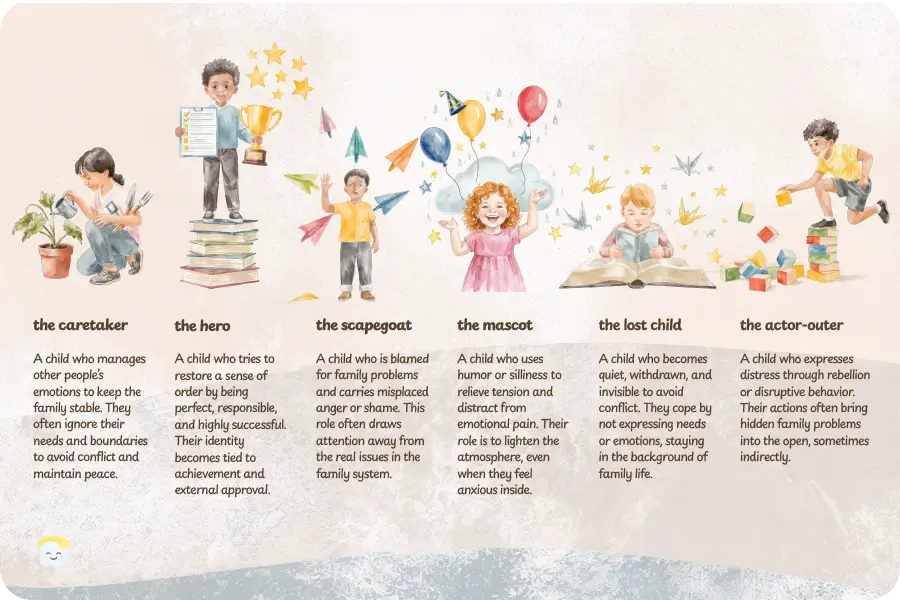
The caretaker or enabler typically neglects their own needs to maintain harmony and balance in the family. They may make excuses for other family members just to protect them from negative consequences.
Most common traits:
- Putting everyone else’s needs and feelings before your own.
- Constantly trying to fix other people’s problems or manage their crises.
- Feeling completely responsible for maintaining or fixing the emotional mood in the room.
- Saying “yes” to everyone else while hiding your exhaustion or stress.
- Feeling guilty whenever you try to set boundaries or focus on yourself.
How to break the pattern:
- Start saying no to small things. Don’t feel like you have to give a big explanation or make up an excuse.
- Stop rushing in to save people. When someone messes up, pause and let them handle the consequences if they don’t ask you for help.
- Put your needs first. Treat your rest and hobbies like important appointments that you won’t cancel for someone else’s emergency.
The hero
The hero (or golden child) is someone others see as the family’s hope. They’re the ones who put enormous effort in order to succeed in studying, sports, or life in general, and meet family beliefs.
Most common traits:
- Tying your entire self-worth to your latest achievement.
- Carrying a constant, crushing fear of failure.
- Feeling like the family’s happiness depends on how well you do.
- Hiding your flaws or sadness so you don’t look weak.
- Finding it almost impossible to relax without feeling guilty.
How to break the pattern:
- Practice doing nothing. Set aside a specific time (for instance, 30 minutes a day) to relax or pursue a hobby just for fun, without trying to be the best at it.
- Share your struggles with someone you trust. You can tell a friend, a therapist, or a trusted family member about a mistake or a difficult day instead of hiding it behind a perfect mask.
- Separate who you are from what you achieve. Before bed, write down three good things about your day that have absolutely nothing to do with work or productivity, like a good laugh you had, a nice walk, or being a good listener to a friend.

The scapegoat
The scapegoat is a kid who’s always blamed for family problems and feels responsible for anything that goes wrong. They become the outlet for all the family’s bottled-up anger and frustration. Whenever things get tense, everyone dumps the blame on them so the rest of the family doesn’t have to look at their own mess.
Most common traits:
- Believing that everything is your fault, even things you can’t control.
- Acting out because you feel like everyone expects you to fail anyway.
- Getting defensive quickly because you’re used to being attacked.
- Attracting friends or partners who criticize you or treat you like the problem.
- Believing you are the “black sheep” who will never truly fit in anywhere.
How to break the pattern:
- Audit your current relationships. Notice if you have friends or a partner who always makes you the problem. Start spending less time with them and more time with people who actually appreciate you.
- Check whether you are still playing the role of a scapegoat. When someone blames you for a problem, stop and map it out. Write down what part you actually controlled and what part belonged entirely to someone else’s choices or bad mood.
- Stop playing the villain. When you feel the urge to act out or sabotage yourself because “everyone expects me to fail anyway,” pause. Remind yourself of your inherent goodness and that you don’t have to prove their bad opinions correct.
The mascot
The mascot uses humor to lighten up the mood in the family and mask their worries. By constantly making jokes, they try to distract everyone from the tension and pain in the house. They feel the responsibility of keeping everyone smiling, even when they are hurting inside.
Most common traits:
- Feeling an intense pressure to always be “on.”
- Feeling like people only love you for the laughs you provide, not for who you actually are.
- Using humor as a defense mechanism to keep people from getting too close to your real feelings.
- Experiencing sudden, heavy drops in your mood the moment you are alone.
How to break the pattern:
- Practice being a “boring person.” Spend time with a close friend or partner and intentionally stay quiet. You don’t need to entertain anyone to deserve a seat at the table.
- Take a pause from jokes. When a conversation gets uncomfortable, pause and count to five before making a joke. Let the heavy or quiet moment just sit there instead of rushing to fix it.
- Share your worrying thoughts or expectations without a punchline. Try telling a friend about one real worry or bad day you had. Force yourself to stop before wrapping it up with a sarcastic comment at the end.
The lost child
The lost child is a person who tries to stay invisible and avoid responsibility for anything by withdrawing into their world. They cope with family drama by staying quiet and asking for nothing, hoping no one notices them. Because they are so invisible, their needs often get completely ignored by the family.
Most common traits:
- Spending most of your time alone, daydreaming, or escaping into books or games.
- Finding it incredibly hard to make decisions or state what you actually want.
- Feeling lonely and disconnected from others, yet afraid to reach out and connect.
- Bottling up your feelings until you feel completely numb.
- Believing that your voice doesn’t matter and that you are a burden if you ask for help.
How to break the pattern:
- Speak up on small choices. When someone asks where you want to eat or what you want to watch, make a definitive choice instead of saying “I don’t care” or “You decide.”
- Send a quick text to a friend or invite someone out for a quick coffee. Don’t wait for people to find you in your world, as you can practice stepping into theirs.
- Ask for one small favor. Practice asking someone for help with something minor, like carrying a bag or borrowing a tool. It helps prove to yourself that you aren’t a burden to others and they’re happy to help you.
The actor-outer
The actor-outer is a sibling who manifests the family’s underlying chaos by breaking rules, starting fights, or getting into trouble outside the home. Instead of hiding their pain like other siblings, they broadcast it loudly through their rebellious behavior.
Most common traits:
- Using anger, shouting, or physical confrontation as your primary way to express stress.
- Struggling heavily with authority figures, like bosses, teachers, or parents.
- Believing that negative attention, like being scolded or yelled at, is better than being ignored.
- Deep down, feeling incredibly unloved, unseen, or misunderstood.
How to break the pattern:
- Use the 90-second pause. When anger hits, your body floods with adrenaline. Force yourself to wait 90 seconds before showing any intense reaction, as this will let the intense physical urge pass.
- Find a constructive physical release. Channel aggression into intense physical outlets like heavy lifting, hard training, or high-intensity sports to burn off the stress before it turns into a conflict.
Nicole Arzt, LMFT, provides one more tip for an actor-outer to handle difficult emotions. “Engage in creative expression: You probably have more creativity embedded within you than you consciously realize. It can be beneficial to harness some of that energy through creative means, like writing, drawing, photography, or something else. Watch how these outlets may shift some of your emotional tones.”
I grew up in a dysfunctional family. How can I meet my emotional needs now?
Studies prove that childhood trauma can interfere with basic psychological needs and make it more challenging to regulate emotions. [2] Rashid A, van der Kaap-Deeder J, Abbate M, Costa S. “The Mediating Role of Emotion Regulation and Basic Psychological Needs: Association Between Childhood Trauma and Young Adults’ Psychological Functioning from a Self-Determination Theory Perspective.” J Trauma Dissociation. 2025 Nevertheless, even if you lacked emotional support in childhood, it’s still possible to build a healthy relationship with yourself and get those needs met today.
Here are some tips that might be helpful.
- Establish healthy boundaries with your family members. Say “no” or distance yourself when they try to involve you in their conflicts. As one Reddit user put it, “Distance makes the heart grow stronger and thankful for walking away.”
- Engage in self-care. Healing your inner child is about providing the loving structure your parents struggled or failed to build. Set healthy routines, bedtimes, and habits for yourself, treating yourself like a responsible, loving parent would.
- Take the childhood classes that piqued your interest. Sign up for activities you did not engage in doing back then, like guitar, swimming, or art lessons. This will let you reclaim the carefree experiences you missed out on and prove to yourself that your interests matter.
- Buy what you missed. Intentionally buy the small knick-knacks, treats, or toys you wanted but never received as a child. Or buy the things you remember loving but haven’t engaged with in quite some time. It helps figure out what you actually like, independent of your family.
- Lean on people you trust. Seek out friends, mentors, or partners who see the good in you, look out for your well-being, and encourage you to be authentic without needing to “perform” or protect yourself.
- Reach out for professional help. A licensed mental health professional can give you the tools to process your past and unlearn old survival habits. They offer a safe, supportive space to figure out your emotions, practice healthy coping skills, and guide you toward healing.
Frequently asked questions
How much does a dysfunctional family roles test cost?
Breeze’s dysfunctional family roles quiz is completely free. You don’t need to pay for anything; simply answer questions on your behavior and childhood background and get immediate results.
Is this test on dysfunctional family members scientifically accurate?
The concept of certain roles that family members acquire in dysfunctional families stems from family systems theory (particularly Murray Bowen’s work), attachment theory, and research on adverse childhood experiences (ACEs). [3] Zagefka H, Jones J, Caglar A, Girish R, Matos C. “Family Roles, Family Dysfunction, and Depressive Symptoms.” Innovate Age. 2021. DOI: 10.1177/1066480720973418
The questions and answers are based on the common dysfunctional family roles described by therapists and family systems researchers. However, these roles are not official mental health diagnoses, and people may identify with more than one role throughout their lives.
This test is designed as a self-reflection tool to help you explore how your family environment may have influenced your emotions, relationships, and coping patterns. It should not be used to diagnose mental health conditions or replace professional support.
Are the results private?
Yes, the results of this dysfunctional family roles quiz are completely private. We don’t share your answers or any other data with anyone.
Sources
- Resendes T, Ellenbogen MA, Oldehinkel AJ. “Family dysfunction, stressful life events, and mental health problems across development in the offspring of parents with an affective disorder.” J Child Psychol Psychiatry. 2024
- Rashid A, van der Kaap-Deeder J, Abbate M, Costa S. “The Mediating Role of Emotion Regulation and Basic Psychological Needs: Association Between Childhood Trauma and Young Adults’ Psychological Functioning from a Self-Determination Theory Perspective.” J Trauma Dissociation. 2025
- Zagefka H, Jones J, Caglar A, Girish R, Matos C. “Family Roles, Family Dysfunction, and Depressive Symptoms.” Innovate Age. 2021. DOI: 10.1177/1066480720973418
Disclaimer
This article is for general informative and self-discovery purposes only. It should not replace expert guidance from professionals.
Any action you take in response to the information in this article, whether directly or indirectly, is solely your responsibility and is done at your own risk. Breeze content team and its mental health experts disclaim any liability, loss, or risk, personal, professional, or otherwise, which may result from the use and/or application of any content.
Always consult your doctor or other certified health practitioner with any medical questions or concerns
Breeze articles exclusively cite trusted sources, such as academic research institutions and medical associations, including research and studies from PubMed, ResearchGate, or similar databases. Examine our subject-matter editors and editorial process to see how we verify facts and maintain the accuracy, reliability, and trustworthiness of our material.
Was this article helpful?