


Podcast name
How to live a slow life
There have been many talks about living at a slower pace over the last few years. People from different cultures and various backgrounds don’t agree to live in the hustle culture and prefer to step away from constant pressure and create a life that feels calmer. And I’m one of those people.
My name’s Emma, and by the age of 25, I felt completely burned out. “You’re too young to feel exhausted from the world around,” others said. However, I was. And that moment is when my journey to a slower lifestyle started. And today I want to share everything I’ve discovered on this way.

How to practice slow living: A step-by-step guide
I’ve read dozens of guides on slow living, and most of them state something like, “Move at the right speed, change your lifestyle, etc.” But for a person who still has things to do, it sounded a bit unrealistic. We still have responsibilities, deadlines, and everyday tasks, so here are some practical pieces of advice.
1. Stay minimalistic
Revise how many things you buy and how many activities you do daily. Maybe there’s something that is just “clutter,” either in your physical space or on your digital calendar.
- Start with one drawer or your desktop. If you haven’t used it or clicked it in six months, let it go. A clean environment reduces “visual noise.”
- Look at your to-do list and identify one task that is actually just a habit. Can you cancel it? Can you delegate it? Give yourself permission to have white space in your diary.
2. Organize time wisely
I lacked energy, and that made my day even more overwhelming due to the never-ending tasks that I had to finish. When you’re exhausted, even the smallest to-do list can feel challenging. So, here are some things that helped me:
- The 5-minute rule. If a task takes less than five minutes, do it immediately to stop it from cluttering your mental space.
- Prioritization. Instead of trying to do everything at once, I focus on the three most important tasks that will actually move the needle for my projects.
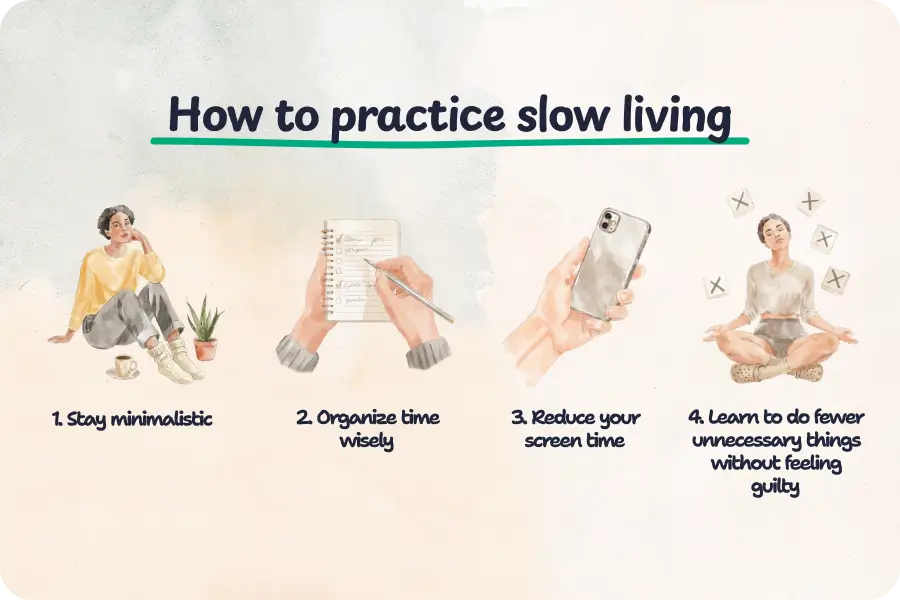
3. Reduce your screen time
I used to have about 8 hours of screen time a day. It’s no wonder that I didn’t feel I had time to do anything.
Now my phone screen is black-and-white. I’ve heard that it reduces the urge to mindlessly scroll — and it works. Colors are designed to grab your attention, so when they’re gone, your phone feels less stimulating.
I also started setting simple limits: no phone first thing in the morning, and no endless scrolling before bed. Instead, I replaced that time with small habits, like reading a few pages, going for a short walk, or sitting with my thoughts.
4. Learn to do fewer unnecessary things without feeling guilty
Guilt and anxiety make us feel like we always have to be doing something. This is what happened to me: I always felt like I needed to achieve more, stay in touch, reply immediately, and be super-productive just to “deserve” rest.
However, it all doesn’t make sense until you feel valuable for who you are. And once I started to acknowledge that I’m a good person without 10 tasks a day on my to-do list, slow living has become much easier.
Expert Insight
Guilt may be inevitable at first. That is okay. Guilt is just a feeling, and it doesn’t need to provide a specific directive for your action. Remind yourself that it can feel uncomfortable to prioritize your own needs or “go against the societal grain.” That doesn’t mean you’re doing anything wrong.

Nicole Arzt
Mental health professional
Actionable slow living tips for busy people to change their own lives
Previous insights can be quite helpful for busy people who have many things to do. Nevertheless, sometimes you need a more structured approach to slow down.
1. Analyze
I’ve spent a few days revising my whole life. I looked at how I actually spend my time, not how I think I do. I wrote down everything: work tasks, scrolling, small distractions, and the moments when I felt overwhelmed for no clear reason.
I’ve also tried to track my emotions for over a week. This helped me understand what daily challenges make me want to procrastinate, say “yes” when I don’t want to do something, or reach for my phone without even thinking. Patterns started to show up pretty quickly. Certain tasks drained me more than I expected, while others felt heavy only because I kept postponing them.
2. Restructure your life
After a thorough analysis, I’ve found out that I was carrying far more than I needed, and some habits only made my days heavier. This is what I really recommend doing:
- Delegate draining or low-value tasks
- Group similar tasks to reduce constant switching
- Leave small gaps between work instead of overloading the day
- Turn off unnecessary notifications
- Learn to delay “yes” instead of saying it automatically

3. Plan beforehand
Of course, life isn’t always super-predictable. However, slow living becomes much easier when you start giving your days structure in advance.
Decide your 2-3 real priorities for the day and treat everything else as optional. This reduces the constant feeling of urgency and helps you move through the day with less pressure.
I also found it helpful to prepare the next day in the evening (the outfit, plans for breakfast, and anything I need to bring or not forget). When you already know what matters, you don’t waste energy deciding where to start.
Nicole Arzt, LMFT, adds, “It’s also a good idea to instill some mindfulness in your daily life. This can include simply acknowledging your gratitude at the end of each night or taking a few moments to breathe deeply and mindfully. This encourages you to stay in the present moment, which supports slowing down.”
What is the slow living movement?
Slow living is a concept of life and a mindset where you intentionally slow down, stop trying to achieve everything at once, and add more meaning to everything you do. People who live slow lives follow their values and align everything they do with what truly matters to them.
As a result, you may be more likely to:
- Experience less stress
- Focus on things that help you reach your goals
- Build deeper relationships
- Feel more aware of your desires
- Make more informed decisions instead of living on autopilot
People with slow everyday lives don’t believe that being successful = being busy. And when I first discovered this idea, it changed my perception of reality. I was always thinking, “If I do more, I’ll achieve more.” But slow living showed me that doing less but with intention often leads to better results and a stronger sense of fulfillment.
The core principles of the slow living lifestyle
In this fast-paced world, slowing down can feel challenging. So, here are some core principles I’ve learned that can help you ease into a more intentional way of living without feeling like you have to change everything overnight.
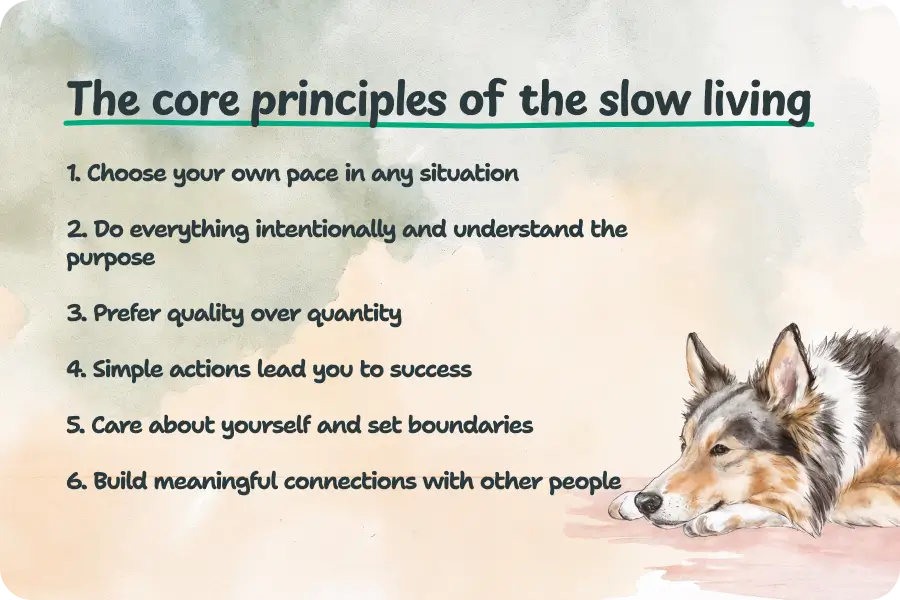
1. Choose your own pace in any situation
Some people confuse slow living with doing everything at a slow pace, but it’s actually about finding the tempo that suits you best.
For instance, you may feel inspired to finish another work project and put significant effort into doing it. At the same time, you might feel drained when it comes to social plans or constant communication, and that’s okay. In a month, the situation can change for both spheres of life.
Slow living means adjusting your pace depending on your energy, priorities, and what truly matters in that moment, rather than forcing yourself to keep up with everything at once.
2. Do everything intentionally and understand the purpose
When you try to succeed in everything and take on too much at once, it’s easy to lose touch with your main values and spend time on unnecessary things. Instead, slow living is about focusing on what matters right now.
For instance, if you want to grow in your career, instead of chasing every possible opportunity, you focus on the skills and projects that actually move you forward. If you want to improve your health, choose a few simple habits you can maintain consistently. The idea is to act with clarity so that every step has a clear reason.
3. Prefer quality over quantity
You don’t need twenty pairs of shoes that don’t fit any of your looks. You can have just a few high-quality pairs that last for years and fit everything.
This is how I can explain this principle in terms of slow fashion. The same applies to your personality, time, relationships, and even goals. Fewer, but better choices often bring more satisfaction.
4. Simple actions lead you to success
I was always wondering how I could succeed more in my career, earn more money, and live a better life. But I have never considered how good my life was in that exact moment. My well-paid job in marketing seemed “average,” and I was always striving to work 24/7 to change it. And then burnout hit.
I was unable to do anything, and in terms of the slow living movement, I’ve found another approach. This is what it says:
- Appreciate what you already have
- Add small steps to your to-do list instead of overwhelming yourself
- Focus on progress, not perfection
- Rest without guilt when your body needs it
- Celebrate small wins along the way
I can’t say that this approach helped me to become a CMO in a week. However, I managed to overcome burnout and keep taking steps toward my career goals. And they’re more consistent than ever before, you know.
5. Care about yourself and set boundaries
We make lifestyle choices every day, and a caring approach to your health and mental well-being is what really matters in the long term. Slow living encourages you to notice your limits. If you feel like there’s a need to take a break from work, you shouldn’t force yourself and work under pressure (and probably be less productive).
Boundaries and genuine care are about the people you talk to, the way you spend your time and energy, how often you allow yourself to rest and recharge, and what you choose to prioritize in your daily routine.
6. Build meaningful connections with other people
This is the thing I’ve discovered about myself. I was trying to build as many social connections as possible. Nevertheless, one day I found out that I simply can’t handle communication with all those people. Even more, some of them didn’t actually add value to my life.
Now, if I’m considering expanding my social circle, I always ask myself a few questions:
- Do I have time for meaningful communication with more people?
- Who do I want to see in my life long-term?
- Do these connections feel mutual and supportive?
Proven slow living benefits for mental health
Slow living helps you shift the body into restorative mode and reduce cortisol levels through slower paces. [1] Genevive R. Meredith, Donald A. Rakow, Erin R. B. Eldermire, Cecelia G. Madsen, Steven P. Shelley, Naomi A. Sachs. “Minimum Time Dose in Nature to Positively Impact the Mental Health of College-Aged Students, and How to Measure It: A Scoping Review.” Frontiers in Psychology. 2020 Even more, living more mindfully allows people to reduce the level of anxiety and depressive thoughts. [2] Turakitwanakan W, Mekseepralard C, Busarakumtragul P. “Effects of mindfulness meditation on serum cortisol of medical students.” J Med Assoc Thai. 2013
These findings have inspired me to live slowly, and here are other benefits I’ve also noticed so far.
1. More meaningful life
Slow life is about living according to your values and following them in anything you do. As a result, life starts feeling more fulfilling and purpose-led.
I’ve always wanted to start attending dance classes but never had time to do so. But once burnout hit and I decided to stop spending my days and nights at the office table, I managed to finally sign up for those dance classes and actually show up consistently. At first, it felt like a small thing, but over time, it became something I looked forward to each week. It reminded me that life isn’t only about work and responsibilities.
2. Higher energy levels
I no longer waste my energy on people I don’t like or things I’m not sure whether I want to do. As a result, my life’s now more fulfilled with quality time with true friends, rest, and activities that actually recharge me. I also notice that I recover faster from busy days because I’m no longer constantly running on empty, trying to keep up with everything and everyone at once.
3. Stress reduction
More time for self-care in daily life and staying present can boost your resilience and help you handle stress better. [3] Bajaj B, Khoury B, Sengupta S. “Resilience and Stress as Mediators in the Relationship of Mindfulness and Happiness.” Front Psychol. 2022
Instead of constantly worrying about what’s next or replaying what went wrong, I’ve learned to slow down and focus on what I can actually control in the present moment. For example, taking short breaks during the day, going for walks without my phone, or simply breathing before reacting to stressful situations helps me reset. Currently, these small habits make stress feel much more manageable.
4. Better emotional regulation
When you don’t need to deal with so much stress daily, it can prevent you from hard-to-manage anger or intense anxiety. Slow living gives you room to process your thoughts and emotions on the spot and not let them pile up until they become overwhelming.
5. More enjoyment from the present moment
You don’t rush. Don’t hurry up to do more. Don’t reach for your phone to take dozens of sunset pictures and post an Insta Story. You simply enjoy the moment.
In the modern era of brain rot and clip mentality, it feels so relieving to slow down and actually experience things as they happen instead of filtering everything through a screen.
In fact, I’ve found out that it’s even proven by scientific studies. Excessive screens and social media elevate stress levels through disrupted sleep, social comparison, and emotional overstimulation. [4] Khalili-Mahani N, Smyrnova A, Kakinami L. “To Each Stress Its Own Screen: A Cross-Sectional Survey of the Patterns of Stress and Various Screen Uses in Relation to Self-Admitted Screen Addiction.” J Med Internet Res. 2019 And now, when I don’t scroll TikTok videos for hours, it feels so relieving.
6. Stronger relationships with other people
When you spend more time with loved ones and actually listen to what they say, your bond deepens. In the past, I often found myself half-listening to friends while mentally rehearsing my to-do list for the next day. Now, I consciously choose to keep my phone in my bag and be fully present.
Slow living has taught me that the quality of time spent together matters far more than the frequency. And, interestingly, the frequency of these meetings also increases, as you have more free time for what really matters.
7. Lower environmental impact
Choosing slow food and taking care of how many products you buy, purchasing less stuff, and focusing on quality over quantity reduces waste and overconsumption. You become more mindful of what you use, reuse what you already have, and make choices that are not only better for you but also more sustainable for the environment.
The best slow living resources: Books, blogs, and podcasts
Slow thinking and the state of calmness are something that’s easy to lose in the modern fast-paced world. So, here are some resources that kept me inspired (and, I hope, will help you as well).
Slow living books
- In Praise of Slowness — Carl Honoré. A thoughtful exploration of how modern speed culture affects us and why slowing down can restore balance.
- Chasing Slow — Erin Loechner. A personal story about stepping away from constant hustle in search of a more meaningful, grounded lifestyle.
- Present Over Perfect — Shauna Niequist. A reflective guide on letting go of perfectionism.
- Slow: Simple Living for a Frantic World — Brooke McAlary. A practical approach to simplifying daily life through small, realistic shifts in habits.
Blogs & digital resources
- Sloww. In-depth articles on intentional living, minimalism, and slowing down in a fast-paced world.
- Be More with Less. Practical guidance on simplifying life to reduce stress.
- Slow Living LDN. Articles and reflections on mindful, slower living in a modern urban context.
Recommended podcasts
- Solo — Peter McGraw. Conversations about building a meaningful, independent life.
- Wannabe Clutter Free — Deanna Yates. Practical discussions on reducing clutter.
- Let’s Slow Down — Annemarie Stolting. Focuses on practical ways to reduce overwhelm and live more deliberately.
- The Slow Home Podcast — Brooke McAlary. Conversations and insights on simplifying home life and daily habits.
Frequently asked questions
What are examples of slow movement activities?
Slow movement activities are simple, intentional ways of doing everyday things without rushing or multitasking. Examples include:
- Walking without your phone or distractions
- Cooking meals from scratch
- Reading
- Journaling or writing by hand
- Mindful stretching or yoga
- Spending time in nature, even for 10-15 minutes
- Doing one task at a time instead of switching between things
How do you start a slow living journey?
You can start a slow living journey by noticing where your time and energy actually go and removing at least one constant source of stress. Then, begin adding small pauses into your day and choosing a few key priorities instead of trying to do everything at once.
After some time, it becomes less about changing your whole life and more about doing everyday things with more intention and less pressure.
Sources
- Genevive R. Meredith, Donald A. Rakow, Erin R. B. Eldermire, Cecelia G. Madsen, Steven P. Shelley, Naomi A. Sachs. “Minimum Time Dose in Nature to Positively Impact the Mental Health of College-Aged Students, and How to Measure It: A Scoping Review.” Frontiers in Psychology. 2020
- Turakitwanakan W, Mekseepralard C, Busarakumtragul P. “Effects of mindfulness meditation on serum cortisol of medical students.” J Med Assoc Thai. 2013
- Bajaj B, Khoury B, Sengupta S. “Resilience and Stress as Mediators in the Relationship of Mindfulness and Happiness.” Front Psychol. 2022
- Khalili-Mahani N, Smyrnova A, Kakinami L. “To Each Stress Its Own Screen: A Cross-Sectional Survey of the Patterns of Stress and Various Screen Uses in Relation to Self-Admitted Screen Addiction.” J Med Internet Res. 2019
Disclaimer
This article is for general informative and self-discovery purposes only. It should not replace expert guidance from professionals.
Any action you take in response to the information in this article, whether directly or indirectly, is solely your responsibility and is done at your own risk. Breeze content team and its mental health experts disclaim any liability, loss, or risk, personal, professional, or otherwise, which may result from the use and/or application of any content.
Always consult your doctor or other certified health practitioner with any medical questions or concerns
Breeze articles exclusively cite trusted sources, such as academic research institutions and medical associations, including research and studies from PubMed, ResearchGate, or similar databases. Examine our subject-matter editors and editorial process to see how we verify facts and maintain the accuracy, reliability, and trustworthiness of our material.
Was this article helpful?