



Have you ever struggled to admire someone without sounding awkward or overly flattering? Genuine praise is a powerful social skill. A well-timed compliment can strengthen relationships, boost confidence, deepen trust, and make people feel seen and appreciated. But not all compliments work the same way. Let’s find out how to confidently give genuine compliments.
Knowing your personality type can be the first step in building strong personal and professional relationships. Take an insightful test!

11 Tips to Give Thoughtful Compliments
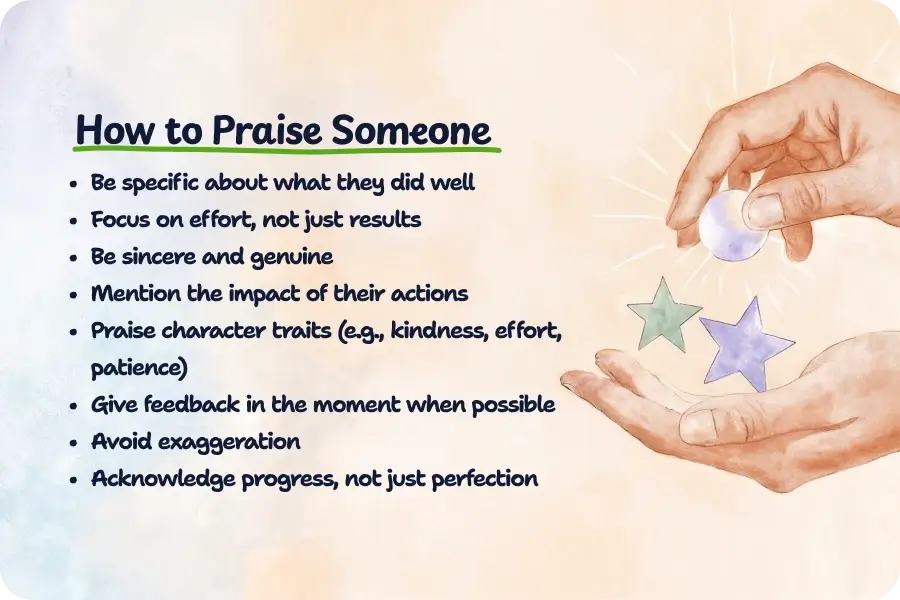
Here’s how to praise people to make them feel understood, respected, and encouraged, not manipulated or flattered for effect:
1. Acknowledge Specific Things, Not Generic Personal Traits
Have you ever received praise that stayed with you for years? What was so special about it? Recent research on behavior-specific praise shows that most people tend to remember specific observations more than dramatic compliments because concrete praise feels sincere, credible, and personally meaningful [1] Royer DJ and Ennis RP. Student-delivered behavior-specific praise: a systematic literature review and meta-analysis. 2024 . Detailed feedback creates a stronger emotional and behavioral impact than vague praise alone.
2. Avoid Hidden Agendas
Compliments can feel uncomfortable when they feel transactional. Try to avoid:
- Complimenting only when you want something
- Using praise to pressure someone
- Excessive flattery for approval
Take a quick Emotional Intelligence Test and gain insights into whether you can establish deep connections with people using your empathy and social skills.

3. Praise Effort More Than Natural Talent
Instead of saying, “You’re naturally smart,” try:
- “You clearly put a lot of thought into this, and it really shows your creative potential.”
- “Your dedication and hard work really showed.”
- “You worked through that carefully.”
Why this works:
- It feels earned and inspiring
- It encourages growth
- It avoids sounding exaggerated or performative
4. Describe the Impact They Had
One of the strongest forms of praise is explaining how someone affected others. Impact-based praise feels meaningful because it connects specific actions to real outcomes.
5. Use Observations Instead of Judgments And Comparisons
Avoid judgments like “You’re smarter than everyone here” or “You’re prettier than your friend.” Comparisons can create discomfort, competition, or pressure.
It can be better to focus directly on the specific tasks or qualities and make observations like “Your ideas are thoughtful and well-structured,” which feels safer and less intense.
Explore other Breeze tests about relationships, career, and personality to better understand your communication and behavior patterns, identify your strengths, and be the best version of yourself.

6. Match the Intensity to the Relationship
Good praise respects context. A compliment that feels warm from a close friend may feel overwhelming from a stranger. For example, with a casual acquaintance, a light and simple compliment works best: “That color looks good on you.”
With friends, compliments can become more personal and inspiring: “You’re one of the most dependable people in my life,” or “You’re a smart cookie with a great sense of humor.”
If you’re talking to a romantic interest, thoughtful emotional compliments often feel more genuine than offering overly dramatic praise. You may say, “Your smile is full of joy, and it brightens the room,” or “You’re a great listener. It’s easy to speak to you.”
7. Don’t Overdo It
The most memorable compliments are usually calm, honest, and specific. In many cases, a sincere “You handled that really well” feels more meaningful than exaggerated flattery. Balanced praise feels more trustworthy, while too much praise can feel insincere or manipulative.
8. Timing Matters
When you give praise, it is just as important as what you say. Even a well-crafted compliment can lose its impact if the timing feels off, while simple words at the right moment can feel deeply inspiring.
However, public praise should always be used carefully. While some people enjoy recognition in front of others, it can make others feel uncomfortable, embarrassed, or put on the spot.
9. Praise Character Carefully
Character compliments are powerful because they speak to who a person is, not just what they do. Unlike praise for appearance or isolated achievements, character-based compliments touch identity and can leave a lasting emotional impact. When you say something about someone’s character, you’re making a deeper statement about how they show up in the world: these statements require more care and accuracy.
10. Keep Appearance Compliments Respectful
Good appearance compliments usually focus on style, taste, presentation, and expression. You may say, “That jacket suits you” or “You have a great sense of style.”
Expert Insight
Appearance compliments feel more genuine when they’re specific, warm, and connected to the person as a whole rather than just evaluating them. A compliment like “you look really relaxed and happy today” often feels safer than one that feels overly focused on approval. When the compliment feels performative or objectifying, or carries pressure to respond a certain way, it can lead to discomfort. Your nervous system often picks up not just the words but the intention of the compliment.

Rychel Johnson
Mental health professional
11. Learn What Different People Value
Different people appreciate different kinds of praise. It becomes more meaningful when it aligns with what matters to them. Some value:
- Competence
- Kindness
- Creativity
- Loyalty
- Humor
- Intelligence
- Leadership
- Emotional support
9 Tips To Give Constructive Criticism On Performance Reviews
Giving constructive criticism in performance reviews is one of the most important (and delicate) communication skills in the workplace. Done well, it helps employees grow, improves performance, and builds trust. Done poorly, it can damage motivation and relationships, according to research by Harvard Business Review [2] Joonyoung Kim and Emily Zitek. Research: Performance Reviews That Actually Motivate Employees. November 2024 . The goal is not to criticize the person, but to clearly guide improvement in behavior, skills, or outcomes.
1. Focus on Behavior, Not Personality
Constructive feedback should always target actions, not identity. This keeps the conversation professional and prevents defensiveness. For example, instead of “You’re careless,” you may say, “There were several mistakes in the report that need closer review before submission.”
Make it specific and evidence-based. Instead of saying, “You need to do better with communication,” try “In the last project update, key stakeholders weren’t informed about the timeline change, which led to confusion.”
2. Use the “Situation–Behavior–Impact” Method
- Situation: When and where it happened
- Behavior: What the person did
- Impact: What was the result
This is one of the most effective frameworks to keep feedback clear and non-personal, a study shows [3] Lee CW, Chen GL, Yu MJ, Cheng PL, Lee YK. A Study to Analyze Narrative Feedback Record of an Emergency Department. June 2021 . For example, you may say to your direct report, “During the client meeting last Thursday, some key details were missing in the presentation, making it harder for the client to make a decision.”
3. Balance Criticism with Recognition
Performance reviews should not feel one-sided. To keep a good balance, start with strengths, then address areas for improvement, and end with encouragement. This approach maintains motivation while still being honest.
For instance, “You’ve done a great job managing deadlines consistently. One area to improve is communication during project changes, so stakeholders stay aligned. Overall, your reliability is a strong asset to the team.”
4. Be Direct but Respectful
Avoid softening feedback so much that the message becomes unclear. For example, instead of “Maybe it would be good if you possibly considered improving…” try “You need to improve how updates are communicated to the team.” Respectful directness is more helpful than vague politeness.
5. Offer Actionable Suggestions
Constructive criticism should always include a path forward. Instead of “You need better time management,” try “You could improve time management by prioritizing tasks at the start of the day and using weekly planning tools.” Good feedback always answers the question “What exactly should I do differently?”
6. Use Calm, Neutral Language
Tone matters as much as content. Avoid emotional language (“This is unacceptable”) and blame-heavy wording (“You always mess this up”). Prefer neutral phrasing (“This needs improvement,” “There was an issue with…”). The goal is clarity, not confrontation.
7. Make It a Two-Way Conversation
Performance reviews should not feel like a lecture. Encourage dialogue to build trust and ownership:
- “What challenges did you face here?”
- “What support would help you improve this?”
- “How do you see this situation?”
8. Praise Consistency, Not Just Big Achievements
You may say, “You’re consistently reliable.” “You’re good at remembering small details,” or “You’re patient even when stressed.” This kind of praise recognizes steady qualities and can feel deeply validating.
9. End with Confidence and Encouragement
Even critical feedback should close with a positive note. You can finish the conversation by saying, “I’m confident you can improve this with a bit of focus,” or “You have strong potential, and this is a small area to refine,” or “I’m looking forward to seeing your progress in this area.”
Expert Insight
Performance reviews can build confidence when they balance honest growth areas with recognition of effort and strengths. People tend to improve more when they feel supported rather than judged. A healthy review helps someone understand, “Here’s what you’re already doing well, and here’s where you can stretch,” instead of leaving them feeling defined by mistakes. When feedback is specific and collaborative, it can strengthen both self-trust and motivation.
Rychel Johnson
Mental health professional
Sources
- Royer DJ and Ennis RP. Student-delivered behavior-specific praise: a systematic literature review and meta-analysis. 2024
- Joonyoung Kim and Emily Zitek. Research: Performance Reviews That Actually Motivate Employees. November 2024
- Lee CW, Chen GL, Yu MJ, Cheng PL, Lee YK. A Study to Analyze Narrative Feedback Record of an Emergency Department. June 2021
Disclaimer
This article is for general informative and self-discovery purposes only. It should not replace expert guidance from professionals.
Any action you take in response to the information in this article, whether directly or indirectly, is solely your responsibility and is done at your own risk. Breeze content team and its mental health experts disclaim any liability, loss, or risk, personal, professional, or otherwise, which may result from the use and/or application of any content.
Always consult your doctor or other certified health practitioner with any medical questions or concerns
Breeze articles exclusively cite trusted sources, such as academic research institutions and medical associations, including research and studies from PubMed, ResearchGate, or similar databases. Examine our subject-matter editors and editorial process to see how we verify facts and maintain the accuracy, reliability, and trustworthiness of our material.
Was this article helpful?