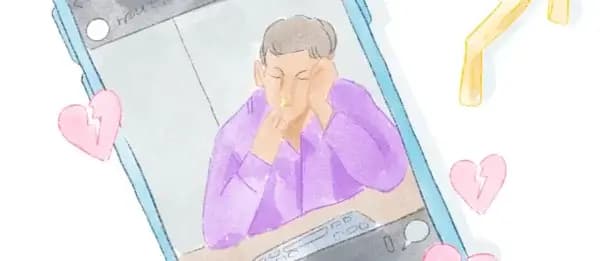


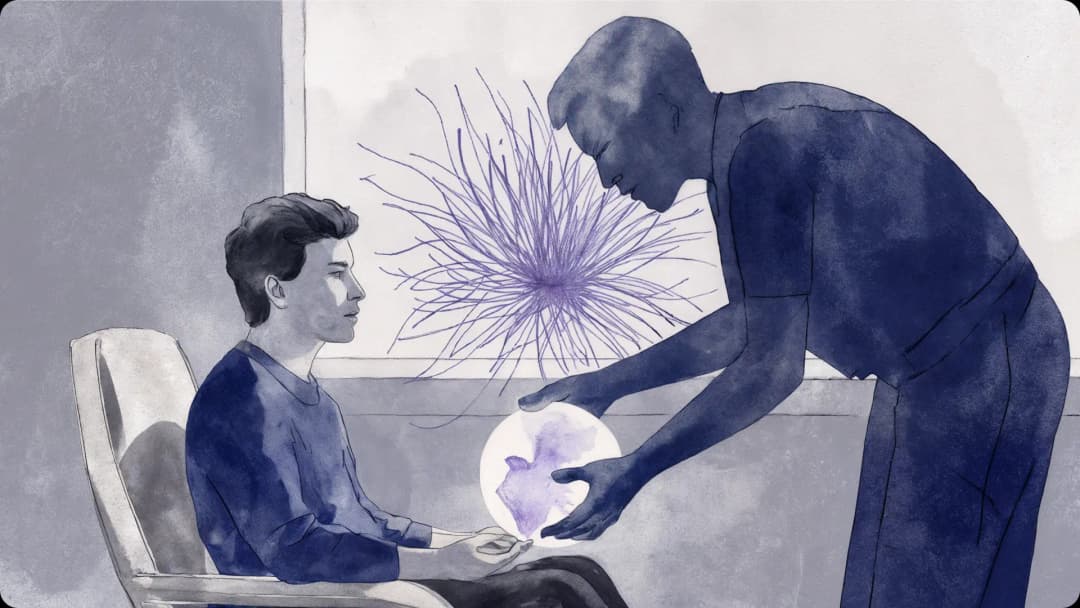
When the inner critic pushes you to doubt yourself, overthink mistakes, or feel like you’re never enough, it can quietly shape the way you see your abilities and choices.
1. Accept that critical self-talk is trying to protect us
Instead of trying to silence your inner critic completely, it can be more helpful to understand its origins. Often, this voice is attempting to protect you from failure, rejection, or embarrassment by pushing you to “do better.”
Trying to fight or suppress this voice can make it louder. A more effective approach is to “befriend” it: notice what it warns you about, but also recognize when it becomes exaggerated or unhelpful.

2. Name your inner critic
Instead of treating critical thoughts as facts, give them a name (e.g., “the perfectionist voice”). This creates distance between you and the thought, making it easier to question it.
3. Challenge the thought with evidence
When a negative thought appears, ask: “Is this 100% true?” and “What evidence do I have for and against it?” For instance, if you think, “I always mess everything up,” you can look for real examples that prove otherwise, times when you succeeded, handled something well, or received positive feedback.
4. Reframe it into a balanced statement
Replace extreme thoughts with more fair ones. For example, “I always fail” becomes “I made a mistake, but I’ve also succeeded many times before.”
5. Approach yourself with self-compassion
When you notice self-criticism, pause and name what’s happening: “I’m being hard on myself right now.” Then respond as you would to a close friend in the same situation, acknowledging the difficulty without judgment. For example, “This is tough, but one mistake doesn’t define me. I can learn from it and move on.”
6. Pause before reacting
When a critical thought appears, don’t respond immediately. Take 1-3 slow breaths and wait a few seconds before deciding what to believe. Ask yourself: “Is this fact or just a reaction?” This short pause helps break the automatic loop and gives you space to calm down.
7. Use the inner critic worksheet PDF
Print this simple PDF worksheet and fill it out whenever you notice strong self-critical thoughts. It will help you understand your triggers and gradually replace harsh inner dialogue with a more supportive perspective.
Expert Insight
Another way to liberate yourself from your inner critic is to expand your tolerance for feelings of embarrassment, judgment, rejection, and failure. Oftentimes, the inner critic is trying to protect you from unpleasant experiences because they interpret them as dangerous and threatening. Being able to effectively navigate such emotions provides you with the opportunities to make decisions based on your values, goals, and passions as opposed to your fears and insecurities.

Hannah Schlueter
Mental health professional
Embracing your inner critic: Therapeutic approaches to inner work to accept your true self
If exercises and self-help techniques are not enough, therapeutic approaches can provide deeper support. They help you understand where self-criticism comes from and how to work with it.
Cognitive-behavioral therapy (CBT)
CBT focuses on cognitive restructuring. It identifies the inner critic as a set of automatic negative thoughts that follow predictable patterns called cognitive distortions, such as “overgeneralization” or “labeling.”
The process involves identifying a specific critical thought, evaluating the evidence for and against it, and developing a balanced alternative. The goal is to align your self-evaluation with objective reality through empirical testing and cognitive restructuring techniques.

Acceptance and commitment therapy (ACT)
ACT focuses on cognitive defusion to decrease the power of self-criticism. Rather than debating whether the critic is right or wrong, you simply recognize each thought as a mental event composed of words and images, not an objective truth.
The goal is to develop psychological flexibility. This means acknowledging that critical thoughts are present without letting them control your choices. By staying focused on actions that align with your personal values, you can move forward regardless of whether your internal monologue is supportive or negative.
Compassion-focused therapy (CFT)
CFT is rooted in evolutionary psychology and the regulation of our emotional systems. It views the inner critic as an overactive “threat-protection system” that triggers the brain’s survival instincts even when there is no external danger.
The goal of therapy is to strengthen the soothing system to lower the physiological stress caused by self-criticism. By practicing specific exercises that stimulate the release of oxytocin and endorphins, you can physically reduce the heart rate and cortisol levels tied to self-directed hostility.
Hannah Schlueter, MA, LAC, comments, “Finding which type of therapy is right for you can be a process, but my recommendation would be to try one that you think would be helpful, and if, after a few months, you don’t think it’s been effective, find a provider trained in another. Research also shows that the strength of the therapeutic relationship you have with the professional is more impactful than the specific modality.”
Essential inner critic resources
There are several videos and books that share valuable information on how to understand, manage, and soften your inner critic. These resources help you recognize the patterns of self-criticism and gradually replace them with a more supportive and balanced inner voice.
TED & TEDx
- How to Confront Your Inner Critic (W/ Anu Gupta) | How to Be a Better Human | TED
- Five strategies to defeat your inner critic | Dr. Suzanne Uhl | TEDxMSJC Studio
- How Your Inner Critic Is Holding You Back | Melissa Ambrosini | TEDxMonashUniversity
Books
- Self-Compassion: The Proven Power of Being Kind to Yourself by Dr. Kristin Neff
- Freedom from Your Inner Critic: A Self-Therapy Approach by Jay Earley and Bonnie Weiss
- Unmasking the Inner Critic: Lessons for Living an Unconstricted Life by Andrew Lang
- Embracing Your Inner Critic: Turning Self-Criticism into a Creative Asset – Voice Dialogue Exercises to Transform Your Adversary into an Intelligent, Supportive Ally by Hal Stone
What is the inner critic? Meaning and psychology definition
“Inner critic” (or “critical inner voice”) is a term used to describe the negative self-talk a person experiences toward themselves. It can undermine self-worth, cause self-doubt, lead to internal conflict, or perpetuate feelings of shame and fear around standing out or doing something new.
In psychology, the inner critic is defined as the feeling of being criticized, pushed down, imprisoned in the feeling of not being good enough, and not having energy for new things and challenges in life over the long term. [1] Šoková B, Greškovičová K, Halamová J, Baránková M. “Breaking the vicious cycles of self-criticism: a qualitative study on the best practices of overcoming one’s inner critic.” BMC Psychol. 2025
Self-criticism is often automatic and habitual and can operate outside of conscious intentionality. [2] Zaccari V, Fazi M, Scarci F, Correr V, Trani L, Filomena MG, Piccione V, Cattan SJ, Ginni MG, D’Olimpio F, Mancini F. “Understanding Self-Criticism: A Systematic Review of Qualitative Approaches.” Clin Neuropsychiatry. 2024 Simply put, you don’t always notice when it starts because it just feels like your thoughts. Self-critical thoughts can manifest as:
- Anger
- Perfectionism
- Constant comparison with others
- Harsh self-judgment
- Difficulty accepting compliments
- Procrastination
And over time, this inner voice can become so familiar that you begin to accept it as truth and normalize its messages. Instead of questioning it, you might follow it: hold yourself back, avoid risks, and doubt your abilities even in situations where you’re capable.
The difference between healthy self-correction and a harsh inner critic
Some people may confuse self-reflection with self-criticism, but they are not the same. While they both can serve as self-defense systems (yes, the critical internal voice can be trying to “protect” you from failure or rejection), they work in very different ways. Self-correction is a healthy mechanism focused on improvement, and an inner critic, on the other hand, is emotional, generalized, and often extreme.
| Self-reflection | Self-criticism |
| Calm and rational | Emotional and harsh |
| Specific (“I could prepare better next time”) | Generalized (“I always fail”) |
| Separates actions from identity | Attacks your identity (“I’m not good enough”) |
| Encourages trying again | Leads to avoidance and fear |
| Accepts mistakes as part of learning | Treats mistakes as proof of failure |
| Balanced and realistic | Extreme and all-or-nothing |
| Helps solve problems | Keeps you stuck in overthinking |
Are you trying to understand whether you are dealing with your inner critic or the inner voice that pushes you for personal growth? Use Breeze’s journal to track your thoughts, notice patterns, and learn to turn criticism into self-compassion.
The 7 types of inner critic with examples
Overcoming self-criticism and learning to approach your actions more rationally starts with understanding how your inner critic actually shows up. So, here are the seven types of inner criticism you may experience.
1. Perfectionist
“If it isn’t 100% success, it’s complete failure.” This is how a perfectionistic voice can sound in your head. This type of inner critic will focus on the slightest mistake and make you feel ashamed of it, even though most of the work was done smoothly.
For instance, you finish a big project at work and get mostly positive feedback — but there’s one small comment about something you could improve. Instead of recognizing the overall success, you fixate on that one detail and think, “I should’ve done this perfectly. It isn’t good enough.”
This critical voice can also sound like your mom, dad, or another figure from your life who used to expect a lot from you or point out mistakes more than successes. Over time, their words can become your inner dialogue even when the person is no longer around.
2. Taskmaster
“You don’t do enough.” Taskmaker forces you to set unrealistically high standards for productivity and efficiency. It feels like you don’t deserve rest and always need to do something just to break free from the feeling of shame.
Imagine that you finally have a weekend after a tough week at work. You try to relax, but instead of feeling relieved, you think, “You’re wasting time. You should be doing something useful.” Even while resting, you feel tense and guilty, which can quickly lead to burnout.
3. Underminer
“Trying new things is too risky. Don’t even bother yourself if you don’t want to be a failure.” These negative thoughts erode your self-esteem and self-confidence.
For instance, you want to start a new profession. You’re ready to learn and understand that accepting new challenges requires constant self-improvement. However, the inner critic says, “You won’t be able to do it. Others are already ahead — you’ll just embarrass yourself.” And, as a result, you hesitate to even begin or give up upon facing any obstacles or challenges. This, in turn, keeps you stuck in the same place and reinforces the belief that you’re not capable.
4. Guilt-tripper
“Remember what you did two years ago…” Guilt-tripper keeps bringing up past mistakes and uses them against you, even when the situation has already passed. It doesn’t let you move on and keeps you stuck in guilt.
Think about the last mistake you made at work. While most people try to fix it and move on, your inner voice keeps bringing it back later. You can’t let go of negative thoughts, may feel stupid, and fear that this mistake defines you or will happen again, even when there is no real reason for it.
5. Inner controller
“You have no willpower. Why can’t you simply eat like normal people?” The inner controller may judge you for doing anything that doesn’t fit strict rules.
For instance, you promise yourself that you will go to the gym 3 times a week. But then you get sick and need to rest for a few days. Instead of allowing recovery, your inner voice says, “You’re weak. You can’t even stick to simple rules.”
This type of inner critic can lead to the development of eating disorders and internalized fatphobia, making you suppress “too intense” emotions, and creating constant pressure to control every part of your behavior.
6. Molder / conformer
“You shouldn’t stand out. They may abandon you if you behave differently.” The conformer can make you hide your real personality and prevent you from expressing your true thoughts, needs, or interests.
Imagine that all your family members started families in their early 20s. You’re already that age, but you want to focus on your career, education, and traveling. Even more, you don’t have a partner. Nevertheless, critical thoughts start to appear: “You’re behind. You should be doing what everyone else is doing.” This pressure may make you feel guilty about your path, even if it aligns with your goals and values.
7. Destroyer
“You’re not good enough, and you never will be.” This is probably the most toxic type of self-talk. The destroyer doesn’t focus on specific actions; instead, it attacks your entire identity and worth.
For instance, after a small mistake or rejection, you might think, “There’s something wrong with me. I always ruin everything.” Instead of learning from the situation, you feel hopeless and stop trying, because it seems like nothing you do will ever be enough.
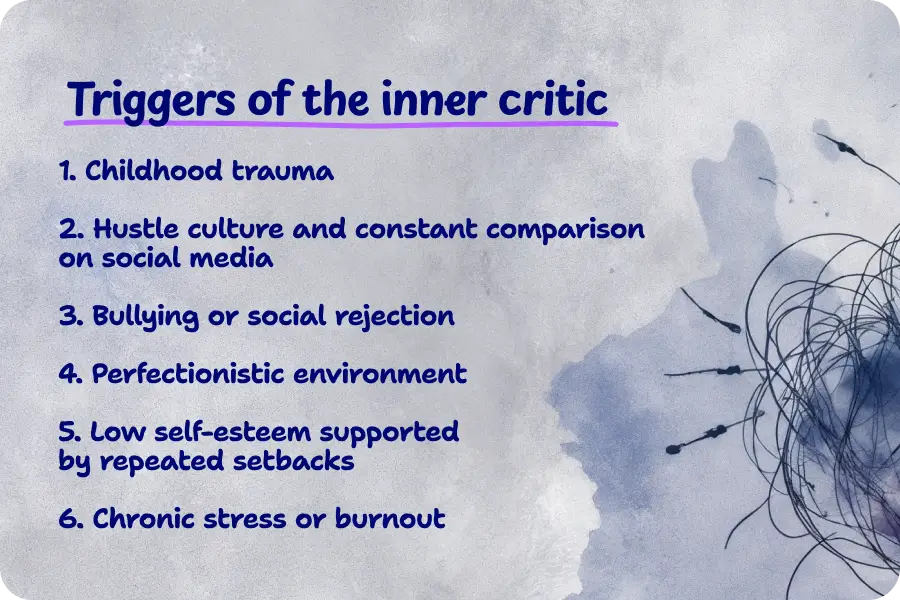
Why your inner critical voice is so loud: Triggers and root causes
Most people may experience negative thoughts and self-criticism at some point in their lives. It becomes a problem when your inner critic gets too loud, leading to feelings of anxiety or depression. Here are some common triggers and underlying causes that can strengthen this voice.
1. Childhood trauma
If your inner child was wounded and you lacked emotional support growing up, now it may be difficult for you to treat yourself with kindness or feel secure in your worth. Early criticism, neglect, or abuse can shape the way you talk to yourself later in life and turn your inner voice into something harsh and demanding instead of supportive.
2. Hustle culture and constant comparison on social media
Today’s trend toward constant productivity and striving to be the best in all spheres of life may negatively affect your self-esteem and even lead to self-destructive behaviors.
You might be scrolling through Instagram or TikTok and see dozens of people who earn millions, look like top models, and have perfect relationships and lifestyles. And while your conscious part may even understand that this is a curated, unrealistic version of life, your mind still compares your circumstances to it. This can make you feel like you’re behind, not doing enough, or not good enough, even when you’re doing just fine in reality.
3. Bullying or social rejection
If people around you can’t accept you as you are, it may be challenging to feel confident and approach mistakes with compassion. These experiences can shape negative core beliefs, such as “I’m not enough” or “Something is wrong with me.” As a result, you may start hiding your true self and adapting to others’ expectations just to feel accepted.
4. Perfectionistic environment
Another aspect is the constant pressure to succeed. Maybe your parents, relatives, or friends believe that doing “just good” isn’t enough. And if you communicate with these people regularly, you may also start adopting their perspective. As a result, your inner voice can turn into an inner critic that speaks pretty much like your friends, saying, “You could’ve done better,” or “This still isn’t enough,” even when you’ve already put in real effort.
5. Low self-esteem supported by repeated setbacks
According to the study, our self-esteem is often contingent on external validation, achievements, or social comparisons. [3] Muris P, Otgaar H. “Self-Esteem and Self-Compassion: A Narrative Review and Meta-Analysis on Their Links to Psychological Problems and Well-Being.” Psychol Res Behav Manag. 2023 If you are currently going through a tough time in your life, your inner critic may become louder and more convincing, leading you to interpret setbacks as “proof” that you can’t do anything correctly. This can lead to a vicious cycle where low self-esteem and repeated negative experiences reinforce each other.
6. Chronic stress or burnout
Scientific studies have found a direct link between negative thinking patterns, low self-esteem, and burnout. [4] Brueckmann M, Hachenberger J, Wild E, Lemola S. “Repetitive negative thinking mediates the relationship between self-esteem and burnout in an ecological momentary assessment study.” Commun Psychol. 2025 When you are under constant stress, your mind has less energy to stay balanced and realistic, so the inner critic becomes stronger and more active.
In this state, even small tasks can feel overwhelming, and mistakes may feel much bigger than they really are. You might start thinking, “I can’t handle anything anymore,” or “I’m always failing,” which only adds more pressure and emotional exhaustion.
Frequently asked questions
What is an example of an inner critic?
An example of an inner critic is the voice in your head that reacts harshly to mistakes or challenges instead of being supportive. For instance, you send an email with a small typo and immediately think, “I’m so careless, I always mess things up,” even though it’s a minor mistake. Instead of seeing it as something normal, the inner critic turns it into proof that you’re not good enough.
What is another word for inner critic?
The inner critic is also called the “critical inner voice,” “inner judge,” “superego,” or “self-critical voice.”
Can your inner critic become your own worst enemy?
The inner critic can negatively influence various aspects of your life and the way you perceive the world in general. It can make you doubt your abilities, avoid new opportunities, and interpret mistakes as proof that something is wrong with you.
Instead of helping you improve, it works against you by increasing anxiety, lowering confidence, and making even simple decisions feel overwhelming.
How to neutralize the power of an inner critic?
To avoid self-criticism and approach your actions with more self-compassion, you can start by noticing when the critical voice appears and questioning whether what it says is actually true. Instead of accepting it automatically, try to replace it with a more balanced thought, like how you would speak to a friend in the same situation.
Sources
- Šoková B, Greškovičová K, Halamová J, Baránková M. “Breaking the vicious cycles of self-criticism: a qualitative study on the best practices of overcoming one’s inner critic.” BMC Psychol. 2025
- Zaccari V, Fazi M, Scarci F, Correr V, Trani L, Filomena MG, Piccione V, Cattan SJ, Ginni MG, D’Olimpio F, Mancini F. “Understanding Self-Criticism: A Systematic Review of Qualitative Approaches.” Clin Neuropsychiatry. 2024
- Muris P, Otgaar H. “Self-Esteem and Self-Compassion: A Narrative Review and Meta-Analysis on Their Links to Psychological Problems and Well-Being.” Psychol Res Behav Manag. 2023
- Brueckmann M, Hachenberger J, Wild E, Lemola S. “Repetitive negative thinking mediates the relationship between self-esteem and burnout in an ecological momentary assessment study.” Commun Psychol. 2025
Disclaimer
This article is for general informative and self-discovery purposes only. It should not replace expert guidance from professionals.
Any action you take in response to the information in this article, whether directly or indirectly, is solely your responsibility and is done at your own risk. Breeze content team and its mental health experts disclaim any liability, loss, or risk, personal, professional, or otherwise, which may result from the use and/or application of any content.
Always consult your doctor or other certified health practitioner with any medical questions or concerns
Breeze articles exclusively cite trusted sources, such as academic research institutions and medical associations, including research and studies from PubMed, ResearchGate, or similar databases. Examine our subject-matter editors and editorial process to see how we verify facts and maintain the accuracy, reliability, and trustworthiness of our material.
Was this article helpful?