

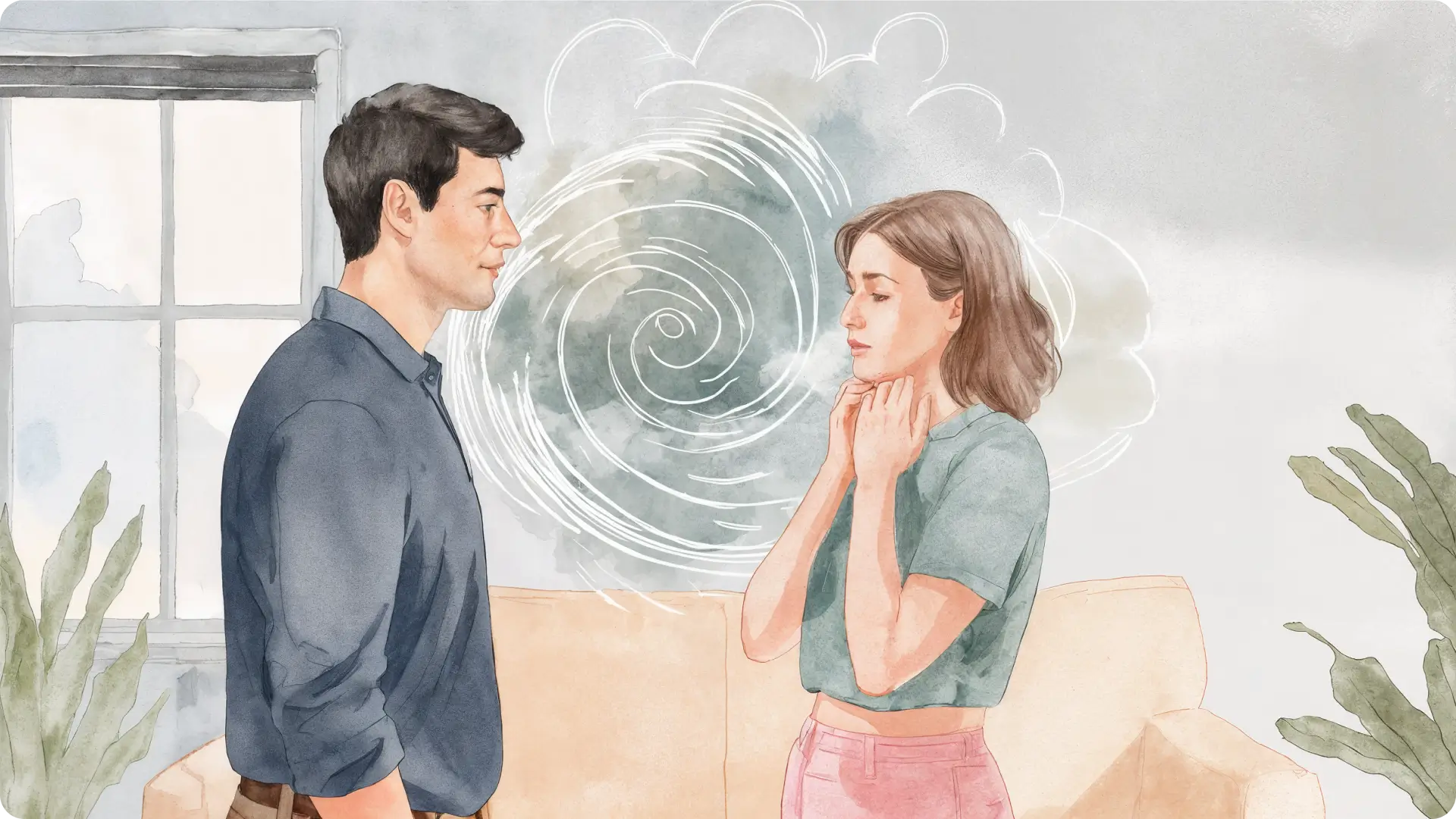
Every time you talk to your partner or think about them, you feel worried. “But why?” you may think. “I love them, and I want to be with them. What’s the reason why my partner makes my anxiety worse?”
In this article, we’ll explore why you may experience persistent sadness and worry around your significant other, what to do with it, and when it can be a warning sign.
When is it normal to be an anxious partner?
All of us can sometimes worry because of our loved ones. You may argue and misunderstand each other or experience crises together. Every couple can face difficult emotions and occasional anxiety; there’s nothing wrong with it.
Arguments are a normal part of any relationship, but what matters is whether partners feel safe and respected afterward. The problem arises when you feel, “My boyfriend gives me anxiety attacks,” or “I can’t cope with my anxiety when he’s around.” At this point, the issue may go beyond normal relationship stress. Persistent fear, tension, or emotional exhaustion can signal that something serious is going on.
Why does my partner trigger my anxiety? The two root causes of relationship anxiety
Relationship anxiety can arise from a mix of personal vulnerabilities and the dynamics in your partnership. Understanding whether your unease comes from internal factors, external influences, or both is the first step toward regaining emotional balance.
Internal factors
Some people may have a healthy relationship but still feel tense and worried due to unresolved personal issues or patterns learned from past experiences.
Anxious attachment
People with an anxious attachment style may face persistent stress and think, “They will not love me anymore, even if I make a minor mistake.” They may believe they must be perfect to “deserve” their partner’s love.
As a result, relationships turn into a constant source of worry and jealousy. And when your partner feels sad or distant, you may immediately assume it’s your fault and experience anxiety symptoms.
Past trauma
Traumatic experiences from childhood or previous relationships might be another source of stress in the present moment. For instance, if you faced emotional abuse or were neglected by your primary caregivers, trauma can keep the brain’s threat detection system (the amygdala) overactive and develop a “hyper-vigilant” survival mechanism. [1] Adriana Lori, Stephanie A. Maddox, Sumeet Sharma, Raül Andero, Kerry J. Ressler, Alicia K. Smith. “Dynamic Patterns of Threat-Associated Gene Expression in the Amygdala and Blood.” Frontiers in Psychiatry. 2019 This means you are constantly scanning for signs of rejection, even when things are going well.
External factors
Beyond internal factors, anxiety in romantic relationships may also stem from certain partners’ behaviors. Let’s explore the most common patterns in detail.
Your partner is actually toxic
Maybe your husband stresses you out because he behaves unpredictably, dismissively, or even cruelly. In this case, your anxiety is a logical, healthy response to an unhealthy environment.
It’s occasionally challenging for some people to spot emotional abuse, as it is less obvious than physical violence. Still, toxic dynamics, such as gaslighting, stonewalling (refusing to communicate during conflict), or coercive control, can keep your nervous system in a state of constant high alert.
You experience an unhealthy emotional interdependence
Emotional interdependence is an emotional linkage between people, particularly romantic couples. According to the study published in Frontiers in Psychology, 64% of couples did not actually show strong emotional interdependence. [2] Sels L, Ceulemans E, Bulteel K, Kuppens P. “Emotional Interdependence and Well-Being in Close Relationships.” Front Psychol. 2016
However, when this linkage becomes one-sided or excessive, it shifts from helping each other stay calm to emotional contagion. Your sense of well-being becomes entirely hijacked by your partner’s inner state, and if they feel angry or frustrated, you, in turn, can face anxious thoughts.
You lack financial or future transparency
Maybe it isn’t your partner who triggers anxiety, but rather a situation you’re in. If one or both partners experience frustration related to money issues or tension about the future, it can create distance within the couple and make you feel worried about relationships and life overall.
Even more, if your partner hides problems related to important life aspects, it becomes harder to feel stable and safe in the relationship. This, in turn, ruins trust and may negatively influence your mental health.
6 warning signs your partner is making your anxiety worse
The most common signs that this is your partner who makes you experience negative emotions involve feeling constantly on edge, second-guessing yourself, and walking on eggshells. You might also notice increased self-doubt or a sense that your needs are being dismissed.
1. You don’t feel safe when you’re together
When you spend time together, you constantly feel the inner tension. You’re afraid to say something wrong or do something wrong almost all the time, because they might:
- Make fun of you
- Dismiss your feelings
- React aggressively
- Give you the silent treatment
- Remind you all of past mistakes
“Maybe I just tend to dwell on certain problems?” you may think. However, a healthy relationship shouldn’t feel like you’re constantly bracing for the next reaction.
2. You feel a never-ending emotional distance in relationships
You can’t share your worries and feel afraid to express your needs. While relationships should be about mutual support and care, a partner may indirectly show that your emotions don’t matter.
People with such communication patterns may be emotionally unavailable as well. They can find it extremely challenging to say “I love you” or state that something is wrong. As such, you may feel lonely even when you’re together, constantly try to guess how they feel, and crave reassurance that never fully comes.
3. Your anxiety symptoms get stronger when your partner is around
If you feel worried all the time, there may be various reasons. But if you find managing anxiety challenging only around your loved one, it may be a warning sign. For example:
- You feel calm on your own, but tense as soon as they text or call.
- Your heart starts racing before or during conversations with them.
- You overanalyze their words, tone, or response time.
- You feel sad after spending time together.
- You constantly worry about saying or doing the “wrong” thing around them.
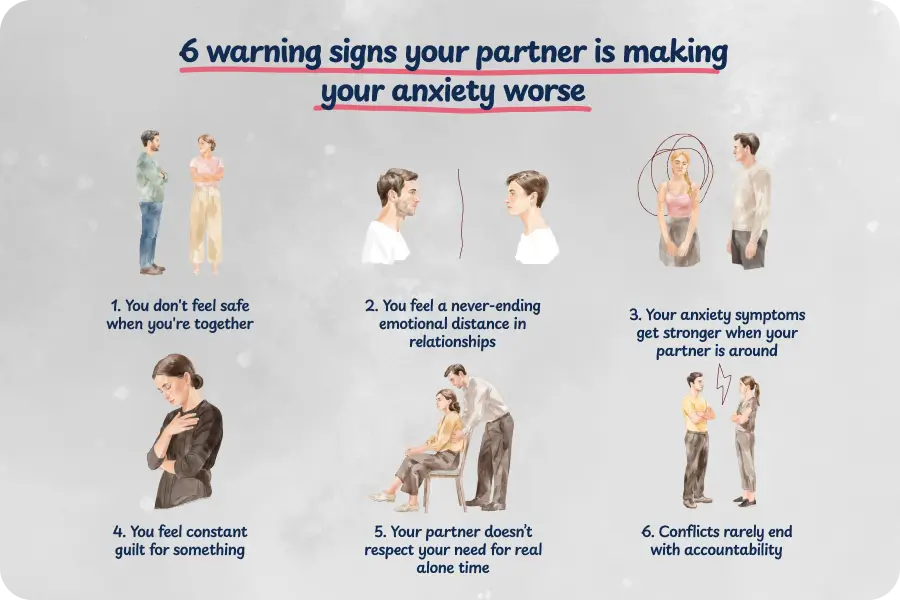
4. You feel constant guilt for something
They don’t say “You’re bad” directly, but they can make you feel like you’re guilty of something through their actions. For instance, they may instantly get upset when you tell them that you want to meet with friends, always empathize with how much they do for you and how grateful you need to be, or remind you that you’ve done something wrong even though a lot of time has passed.
These kinds of relationship dynamics can contribute to anxiety symptoms worsening, as you can start constantly dwelling on the thought, “I should be perfect so he doesn’t get upset.” And this constant state of pressure makes even the smallest interactions overwhelming.
5. Your partner doesn’t respect your need for real alone time
They don’t leave you emotional and physical space to process daily life. It can involve controlling behavior and being toxic or jealous, especially when they are not physically present.
Also, such a partner may be too clingy and constantly need your attention, even when you require time to recharge. Some examples may include:
- Constantly texting or calling when you’re busy
- Getting upset when you don’t reply immediately
- Making you feel guilty for wanting personal space
- Expecting you to always be available, even for small things
- Ignoring your boundaries when you ask for time to yourself
- Framing your need for space as rejection or lack of love
6. Conflicts rarely end with accountability
Healthy behavior after a conflict involves active listening and attempts to find a common ground. Nevertheless, if one partner engages in guilt-tripping, always refuses to acknowledge that something goes wrong, or tries to shift the blame, you are left in a state of “emotional suspension” where the conflict never actually ends.
In particular, they might:
- Use the “non-apology” apology. Saying phrases like “I’m sorry you feel that way,” which places the burden of the emotion back on you without acknowledging their own actions.
- Play the victim. When you bring up a hurt, they react so intensely (“I guess I’m just a terrible person”) that you end up comforting them and leave your needs ignored.
- Act as if nothing happened the next morning. Without a conversation on how to do better, your nervous system stays on high alert, waiting for the next eruption.
Rychel Johnson, M.S., LCPC, adds, “When someone we love triggers anxiety, it’s often because they matter deeply to our sense of safety. Their opinions can carry extra weight, so even small shifts in tone or behavior may feel threatening. Loved ones can also unintentionally activate old patterns—like fear of rejection or pressure to meet expectations. Even positive closeness can feel overwhelming at times, especially if you’re already sensitized or rebuilding your capacity.”
Immediate relief: How to stop an anxiety attack in the moment
When you experience overwhelming relationship anxiety, it can be helpful to engage in grounding techniques and focus on your breathing. Try to slow down and remind yourself that every couple can experience certain challenges, and you can get through this.
1. Focus on slow breathing
If anxiety hits, there are specific techniques that can help activate the parasympathetic nervous system and stop being so emotional.
Box breathing
- Breathe in slowly in 4 seconds
- Hold your breath and count to 4
- Breathe out in 4 seconds
- Hold your breath and count to 4 again
Diaphragmatic (belly) breathing
- Sit or lie comfortably and relax your shoulders.
- Place one hand on your chest and one on your belly.
- Inhale slowly through your nose. Your belly should rise, and your chest stays mostly still.
- Exhale slowly through your mouth so your belly falls.
- Keep it slow and steady (about 4 seconds in, 6 seconds out).
- Repeat for a few minutes.
2. Ground yourself in the present moment
Anxiety tends to dwell on past mistakes or predictions of future problems. Instead, you can gently bring yourself back to the present to feel that nothing dangerous is happening to you right now. The 333 rule for anxiety can be particularly helpful.
- Name 3 things you see. It can be your partner, your hands, flowers on the dining table, or the city out of the window.
- Name 3 sounds you hear. It may include your voice, birds singing, cars riding on the streets, etc.
- Move 3 body parts. It can help you move focus from anxious thoughts to your body and create a sense of control. Try wiggling your fingers, rolling your shoulders, or stretching your legs.
3. Focus on something different
Anxiety symptoms get stronger when you engage in the never-ending cycle of rumination. Instead, it’s vital to break this cycle and shift focus to something completely different. For instance, you can:
- Go on a walk with your favorite music playing in your headphones
- Call a friend and chat about something funny and unrelated to your anxiety
- Do a simple stretch or yoga workout
- Concentrate on the task you’ve been delaying for so long
- Watch a funny film or TV show
4. Remind yourself that the attack will pass
Another important coping strategy for managing anxiety is to remember that nothing is permanent, and your emotions aren’t either. Studies prove that rumination and repeated thinking greatly prolong negative emotions. [3] Michl LC, McLaughlin KA, Shepherd K, Nolen-Hoeksema S. “Rumination as a mechanism linking stressful life events to symptoms of depression and anxiety: longitudinal evidence in early adolescents and adults.” J Abnorm Psychol. 2013 And if you keep feeding the anxious thoughts, you unintentionally keep the feeling alive.
Instead, try to take a step back and observe what’s happening without getting pulled into it. You might tell yourself, “This is anxiety. It’s uncomfortable, but it’s temporary. I can handle it.”
Expert Insight
“In the moment, focus on calming your body first, not solving the relationship. Relax your shoulders and your jaw. Remind yourself, “This is anxiety, not danger,” to create a little separation from racing thoughts. It can also help to resist the urge to seek immediate reassurance or react impulsively—give yourself a pause so your nervous system can settle before responding.”

Rychel Johnson
Mental health professional
How to deal with a partner who stresses you out. Tips for managing anxiety
If anxiety in your relationship keeps arising again and again, it’s vital for your mental health to fix it. Here are some tips that can help you if you regularly feel overwhelmed.
1. Identify what specifically triggers your anxiety
You can use Breeze’s mood tracker or journal your thoughts. Every time anxious thoughts arise, take a minute to write down what caused them. You may find out that there are some patterns in your partner’s behavior or, in turn, something completely unrelated to relationships.
2. Engage in honest communication
If you’re worried about your partner’s behavior, talk with them about it. Just make sure you use “I” statements instead of blame. For example, say “I feel anxious when plans change suddenly” rather than “You always stress me out.” This helps your partner understand your emotions without feeling attacked.
3. Set healthy emotional boundaries
Your loved one might find it difficult to help you overcome relationship anxiety if they don’t know what especially makes you feel frustrated. As such, you may need to openly discuss your concerns and explain what behavior you find unacceptable.
Here’s how to set boundaries most effectively:
- Be specific about what bothers you. Clearly name the behavior that triggers you (e.g., sudden plan changes, lack of communication).
- Define what you need instead. For example, “I will be happy if you call me once you know your plans are changing.”
- Explain consequences. Explain to your boyfriend what will happen if they cross your boundaries, e.g., you will feel offended.
- Stay consistent. Boundaries only work if you follow through.
- Respect your partner’s boundaries too. A relationship is always about mutual care.
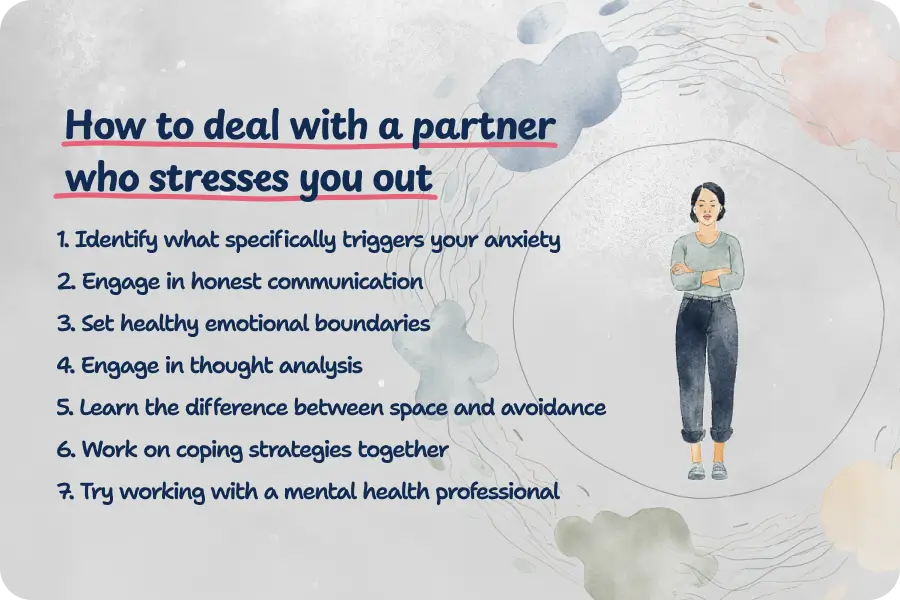
4. Engage in thought analysis
Overcoming relationship anxiety may require patience and a thoughtful approach. Here’s a simple CBT exercise you can do to slow down anxious spirals and observe your thoughts more clearly.
Start by catching the thought that triggered your anxiety. Then, instead of accepting it as a fact, treat it like a hypothesis you’re testing. Ask yourself what evidence actually supports it and what contradicts it. Below is a simple way to structure this exercise:
| Situation | Automatic thought | Emotion (0-100%) | Evidence for | Evidence against | Balanced thought |
| The partner didn’t reply for 3 hours | “They’re losing interest.” | Anxiety 80% | They’re usually quick to reply | They had a busy day before. Nothing changed in behavior overall. | “They might just be busy. One delay doesn’t mean a problem.” |
5. Work on coping strategies together
You may also discuss what your loved one can do to help you handle this anxiety. Talk about specific ways they can support you in difficult moments. It might include:
- Offering reassurance
- Being more consistent
- Giving you space when needed
Agree on simple actions that feel helpful and realistic for both of you, so you can face anxious moments together rather than alone.
6. Consider working with a mental health professional
If nothing helps, but you want to understand your anxiety on a deeper level, working with a therapist can be a powerful step forward.
Couples counseling
Working with a therapist together provides a neutral space to bridge the communication gap. A professional helps you identify repetitive cycles, such as the anxious-avoidant trap, where one person pursues and the other retreats.
A therapeutic environment allows you to learn how to repair effectively after a fight so that the anxiety doesn’t linger for days. It also helps build a foundation of emotional safety where both partners can be heard without the fear of judgment.
Individual therapy
If you feel like you might be an anxious partner due to personal reasons as well, it might be helpful to consider individual therapy. Working one-on-one with a specialist allows you to explore where your anxiety comes from (e.g., past experiences, attachment styles, or learned ways of coping in relationships). Instead of just managing symptoms, you can gradually work on changing the deeper patterns that keep anxiety active.
When is it time to leave? Check whether anxiety in your relationship stems from abuse
Sometimes relationship anxiety may signal that there are real problems between you and your partner. If you feel worried because they’re abusive and toxic, it might be better to reconsider your desire to stay in these relationships. Here are some signs of it.
1. You feel better when the distance in the relationship increases
You want your partner to go to work or spend the weekend separately. While there’s nothing wrong with the desire to have some space, it can be a warning sign if you don’t want them to come back. Here’s how to differentiate a desire for space and abusive tendencies.
| Situation | Temporary crisis | Possible abusive pattern |
| How you feel when apart | You enjoy the space but still miss your partner | You feel relief, calm, or “like yourself again” |
| Desire to reconnect | You look forward to seeing them again after rest | You dread them coming back or feel anxious about it |
| Reason for distance | You’re overwhelmed, tired, or need time to recharge | You’re trying to avoid tension, conflict, or emotional pain |
| Emotional state in the relationship | Mostly safe, with occasional stress | Frequently tense, drained, or on edge |
2. Your emotional needs are constantly ignored
Another important aspect is how your partner approaches your needs for closeness, care, or love. If they try to support you but find it challenging to do it correctly, this might signal that you simply need to work on it together.
Nevertheless, if they don’t even try to care about your needs and dismiss or minimize what you feel, that’s a different situation. A healthy partner doesn’t have to get everything right, but they show willingness to understand, adjust, and meet you halfway. If that effort is missing, it may be less about miscommunication and more about emotional unavailability.
3. Manipulation replaces healthy conflict resolution
You’re always the one feeling guilty in your relationship. Instead of resolving disagreements through open and respectful communication, manipulation becomes the default pattern. This can show up in:
- Guilt-tripping
- Gaslighting
- Digital snooping
- Financial control
- Public humiliation
In such cases, your anxiety may not be something to “fix” but rather a healthy signal. It’s your mind and body reacting to a situation that feels unsafe, activating a natural “fight or flight” response that may be urging you to protect yourself.
Frequently asked questions
Why does my anxiety get worse around my partner?
It can happen if they engage in controlling behavior, don’t respect healthy boundaries, create inconsistency, dismiss your feelings, or make you feel unsafe, which keeps your nervous system in a constant state of tension.
Is it exhausting to be married to someone with anxiety?
It may be exhausting to be married or date someone with anxiety at times, especially if it shows up as constant reassurance-seeking, overthinking, or difficulty trusting the relationship. However, it may not be a problem in a healthy relationship if you both communicate openly and work together to manage expectations.
Sources
- Adriana Lori, Stephanie A. Maddox, Sumeet Sharma, Raül Andero, Kerry J. Ressler, Alicia K. Smith. “Dynamic Patterns of Threat-Associated Gene Expression in the Amygdala and Blood.” Frontiers in Psychiatry. 2019
- Sels L, Ceulemans E, Bulteel K, Kuppens P. “Emotional Interdependence and Well-Being in Close Relationships.” Front Psychol. 2016
- Michl LC, McLaughlin KA, Shepherd K, Nolen-Hoeksema S. “Rumination as a mechanism linking stressful life events to symptoms of depression and anxiety: longitudinal evidence in early adolescents and adults.” J Abnorm Psychol. 2013
Disclaimer
This article is for general informative and self-discovery purposes only. It should not replace expert guidance from professionals.
Any action you take in response to the information in this article, whether directly or indirectly, is solely your responsibility and is done at your own risk. Breeze content team and its mental health experts disclaim any liability, loss, or risk, personal, professional, or otherwise, which may result from the use and/or application of any content.
Always consult your doctor or other certified health practitioner with any medical questions or concerns
Breeze articles exclusively cite trusted sources, such as academic research institutions and medical associations, including research and studies from PubMed, ResearchGate, or similar databases. Examine our subject-matter editors and editorial process to see how we verify facts and maintain the accuracy, reliability, and trustworthiness of our material.
Was this article helpful?