

Podcast name
Neurodivergent love language
Neurodivergent love languages is a theory that claims: People with neurodivergent conditions can express love in ways that differ from the traditional understanding of love.
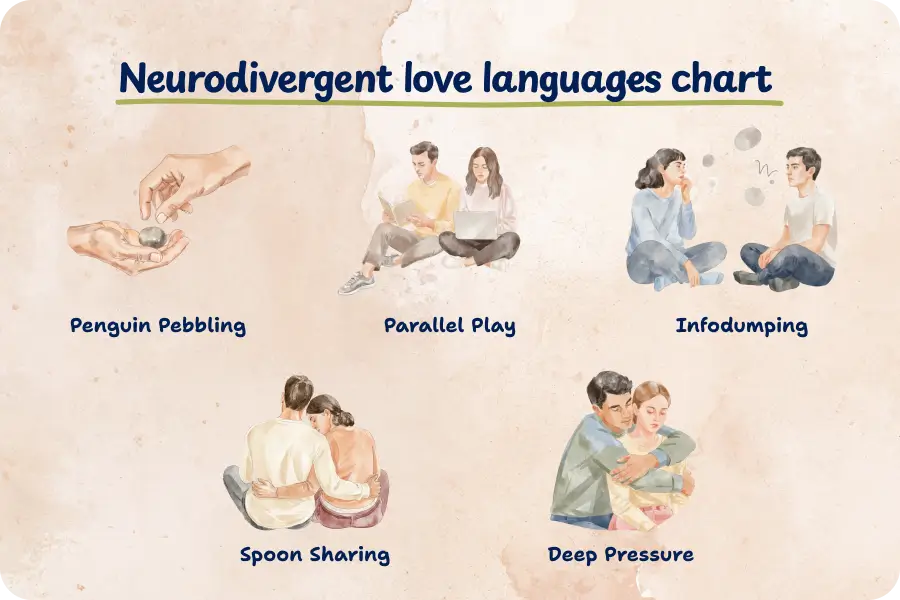
A list of neurodivergent love languages includes:
- Penguin pebbling: Giving small but meaningful gifts that prove your partner genuinely knows you and thinks about you throughout the day.
- Info-dumping: Talking “excessively” about passionate subjects, like special interests, and knowing a partner won’t judge you.
- Parallel play: Sharing the same space with a significant other, but doing separate activities and not feeling obliged to constantly interact with each other.
- Support swapping: Helping each other out with emotionally draining tasks or when one of you runs low on battery.
- Deep pressure: Squizing, touching, massaging, and other forms of physical contact that provide intense sensory experiences to autistic people.
1. Penguin pebbling
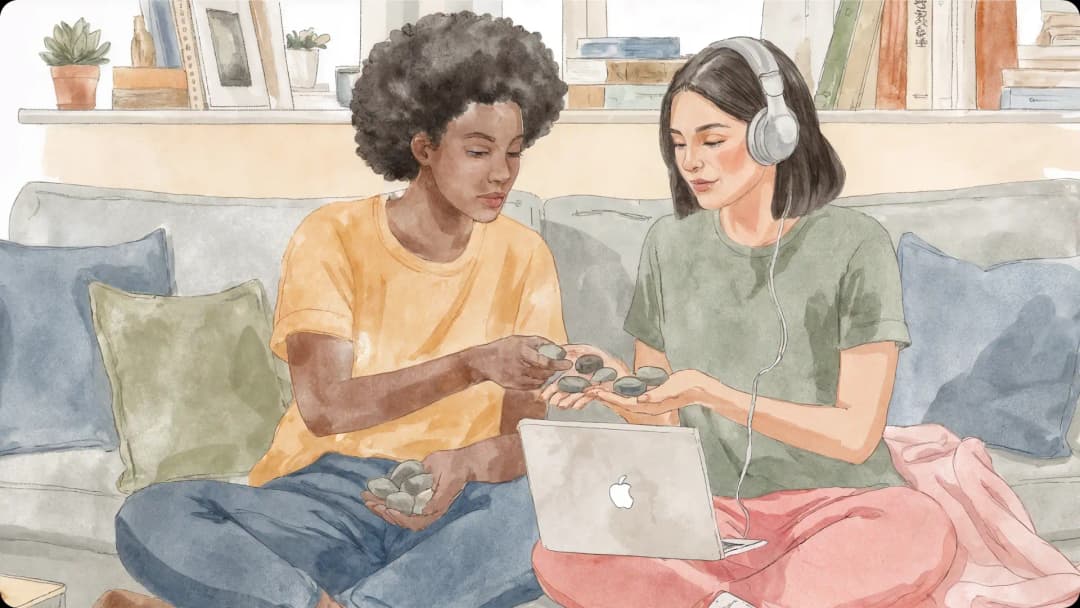
The name “Penguin pebbling” came from several species of penguins. These birds give their partners pebbles as a way to “propose.” In their communities, stones are associated with commitment because stones are used to protect eggs from melting snow.
“But isn’t receiving gifts nice, no matter whether you’re neurotypical or neurodivergent?” Yes, but penguin pebbling is especially valuable in neurodivergent relationships for two reasons:
- 95% of neurodivergent people have special interests, and nearly half of them are ashamed of them [1] Examining the special interest areas of autistic adults with a focus on their employment and mental health outcomes. L.A. Bross, J.M. Huffman, M. Hagiwara. Journal of Vocational Rehabilitation. October 2022. . Receiving gifts that support your interests is a sign that your interests are normal and that you are normal.
- Many autistic people feel social pressure to perform when they are “receivers” of meaningful gestures. Receiving small, inexpensive, not grandiose gifts frees them from the pressure to perform “surprised and excited.”
Penguin pebbling can be both physical and digital: Common examples of small physical gifts are stones, acorns, shells, keychains, coins, buttons, etc. “Digital pebbles” means exchanging intangible signs of mutual respect, like a niche meme, an interesting Reddit thread, a 15-second cat video, or an article snippet related to a partner’s hyperfixation.

2. Info-dumping
Neurodivergent people can be really passionate about their interests. When they start talking about something they love, they might overlook everything: how long they talk, whose turn it is to talk, and whether their conversation partner shows non-verbal cues of curiosity. It’s info-dumping in action.
Unfortunately, some neurodivergent individuals are judged for being passionate about “unrelevant” topics. Hence, they learn to mask their passions, and their enthusiasm remains unexpressed.
Info-dumping when the person on the other side not only listens but also seems engaged and encourages special interests is a very intimate trust experience in neurodivergent relationships.
Being accepted when you’re truly yourself. Isn’t that a definition of love?
3. Parallel play/Body doubling
The neurodivergent community adopted parallel play from children’s development as it initially emerged as a toddler milestone. At around 2-3 years of age, children engage in side-by-side play without direct interaction. This shows that kids develop social awareness and learn to share space with others.
Neurodivergent people can have difficulties with social communication, similar to children. Not because they’re behind on social development, but because they process information differently.
Because of getting easily overwhelmed in social functions and social pressure to mask, ND individuals might not enjoy traditional romantic dates that involve lots of romantic mind games and physical touch. Parallel play reduces the social tension of traditional dates “to do something to appear normal.”
Body doubling vs parallel play
Body doubling is an ADHD productivity strategy to get things done. ADHDers who have someone else by their side while they complete a task can focus better and distract less, even if the person doesn’t engage with them at all.
Parallel play is a way to spend quality time together, which is more intimate and personal.
Here’s a more detailed overview of the body doubling vs. parallel play differences:

4. Spoon sharing/Support swapping
Neurodivergent persons are twice as likely to experience long-term fatigue as neurotypicals [2] Childhood neurodivergent traits, inflammation and chronic disabling fatigue in adolescence: a longitudinal case-control study. L. Quadt, J. Csecs, R. Bond, N.A. Harrison, H.D. Critchley, K.A. Davies, J. Eccles. BMJ Open. July 2024. . Since childhood, they have had to deal with an extra mental load that most neurotypicals don’t spend energy on. For example, processing sensory sensitivities, executive dysfunction, masking, anxiety, etc.
A 50/50 household chores split doesn’t work for most neurodivergent folks. Spoon swapping transforms acts of service from generic into targeted, empathetic energy exchanges:
- Splitting tasks while considering the uniqueness of the nervous systems of each other: Partner A might find washing dishes sensory-repulsive due to wet food textures but doesn’t mind organizing finances because they love working with tables. The spoon theory decision: Partner A handles the finances, and Partner B supports them in the kitchen cleanup.
- Empathetically taking over tasks a neurodivergent partner doesn’t have energy for: On days when one partner experiences burnout or sensory overload, the other steps in to cover high-cost tasks without requiring explanation or apology.
Expert Insight
We asked Katherine Scott, a Licensed Marriage and Family Therapist, how to correctly practice spoon swapping. Here’s what she said:
“Support is ever-evolving. There are many facets that go into what makes a task draining on any given day, so it’s important to routinely check in with one another.
For example, workplace demands can shift for someone, making them spend a lot more time front-facing customers one week. A partner could say, ‘Hey, love, I used up all of my spoons at work today. Could we find a show to put on and check out on our phones tonight?’ Then, another week, they may be stuck doing computer work, leaving their social batteries fully charged.
It’s important to keep communication surrounding needs open to match the ever-evolving nature of demands and environmental stressors.

Katherine Scott
Mental health professional
5. Deep pressure
Neurodivergent people are more likely than others to experience sensory problems. They might get easily overwhelmed by noise, lights, distractions, etc. Paradoxically, they can sometimes seek sensory stimulation, like deep pressure inputs, to compensate for a lack of stimulation or to calm body stress responses.
Deep pressure can look like:
- Bear hugs
- Lying together under a weighted blanket
- Lying on each other
- Massages
- Hand squeezes
However, receiving deep pressure only works when the neurodivergent individual is “in the mood for it.” Of course, take safety into consideration: pay attention to breathing and physical pain.
What is my neurodivergent love language? 5 neurodivergent love languages quiz
Neurotypical vs. neurodivergent love languages
Neurotypical love languages are based mostly on social norms and cultural values.
The five neurodivergent love languages, in turn, focus on expressing affection by creating a safety net where neurodivergent people find the validation and understanding they don’t find elsewhere.
This neurodivergent love languages chart explains these differences separately for each love language:
Traditional love language |
Primary aim |
Its neurodivergent counterpart |
Main difference |
Gift-giving |
Demonstrate care and attention: “I thought about you throughout the day.” |
Penguin pebbling |
Gifts are small but reflect a deep understanding of a person and their special interests. |
Quality time |
Give full, undivided attention to show that a person matters. |
Parallel play/body doubling |
Spending time together in the same space doesn’t mean doing the same activity. Parallel play involves doing separate activities to maintain the comfort of neurodivergent partner(s). |
Words of affirmation |
Highlight the person’s importance and express gratitude for being together through verbal affirmations. |
Info-dumping |
Verbal affirmations in info-dumping don’t express love; they express an autistic identity that is otherwise stigmatized. Listening to infodumps is a way to validate this identity. |
Acts of service |
Express affection to a significant other by making their life easier. |
Spoon sharing/support swapping |
Spoon swapping is flexible, dynamic, and mutual, unlike the one-sided nature of acts of service. |
Physical touch |
Communicate safety and affection in non-verbal ways. |
Deep pressure |
Physical touch is intentional and considers sensory sensitivities. It provides sensory input if/when a neurodivergent person requires it. |
Why do neurodivergent people need alternative love languages altogether?
The answer is really easy: traditional love languages do not satisfy the specific needs of the neurodivergent community.
A study that explored how autistic persons experience romantic love found that the neurodivergent participants felt the most loved when:
- They could unmask and still feel accepted.
- Communicated in a way that is comfortable for them, not society.
- Shared activities/special interests together.
- Had intellectual compatibility with significant other (reasoned and thought in similar ways)
- Had stability and routine.
- Their partner accommodated their specific neurodivergent needs [3] Relationship Satisfaction Among Autistic Populations: How Partner Neurotype Influences Relationship Satisfaction Factors for Autistic Adults. J. Khaw and T. Vernon. Autism in Adulthood. January 2025. .
Without alternative frameworks for neurodivergent love languages, neurodivergent people may be perceived as “bad partners.” For example, their simple need for nonverbal alone time can be misinterpreted as withdrawal.
Are the five neurodivergent love languages valid? Criticism of ND love languages
The five neurodivergent love languages theory is not perfect. It faces valid criticism from both the neurodivergent community and psychologists.
Before labeling yourself with a particular love language or adapting your relationships to it, we recommend that you familiarize yourself with alternative perspectives. Here are three crucial risks associated with neurodivergent love languages explained:
How to love a neurodivergent person? Tips for neurodiverse couples
Whether you are an ND + NT or an ND + ND couple, there are three cornerstones to strengthen relationships and make you more comfortable with receiving love:
1. Respect
Spending time together doesn’t always require active interaction. Create space for parallel play—you can both rest in the same room without putting pressure on each other to unmask and pretend to enjoy things you don’t.
Also, you don’t have to love or engage with your partner’s special interests if you don’t want to. But you have to respect them. Listen and show interest, but set a boundary when your cognitive battery is drained.
2. Validate
Neurodivergent individuals live with a never-ending inner doubt that there is something wrong with them. Although a neuro-inclusive world is our common responsibility to fulfill, you can already validate that your significant other is normal in the moments when they do not feel enough. For example, you can:
- Take care of their sensory needs before they ask (e.g., dim the lights or turn down the TV volume).
- Normalize their self-soothing (e.g., surprise them with weighted blankets or bring fidget toys to a socially draining function).
- Praise the effort, not an end result (e.g., “I know how much mental energy it took for you to make that dentist appointment today. I’m really proud of you.”)
3. Communicate
Communication is the foundation. That includes neurodivergent couples. These communication tips consider the unique communication styles of neurodivergent partners:
- Conduct daily spoon audits. Start each morning or evening with a 10-second check-in using a 1-10 scale (e.g., “I have four spoons left today, so I can take over some chores”). This tells you whether your partner can handle a complex discussion or needs low-demand space, preventing misunderstandings before they start.
- Express needs and requests directly. Replace indirect comments and expectations with actionable language. For example, “The kitchen is a mess” or “You never help around the house” triggers executive overload and defensiveness. “Could you take out the kitchen trash before 8 PM tonight? I am handling the dishes” is clear and action-oriented.
- Set rules and boundaries in writing. Put core agreements about household routines and communication boundaries in writing to remove guessing games and alleviate pressure on overloaded working memory. You can use shared digital notes, a magnetic whiteboard on the fridge, or a pinned chat thread.
For the longest time, neurodivergent individuals were believed not to need love in general. But it’s not true. Love and connection aren’t reserved for neurotypicals only.
Frequently asked questions
How do autistic men show love?
Autistic men express love in diverse ways, depending on their personal love language and the emotional needs of their romantic interest.
On r/autism in Reddit, a common way to express affection for autistic men is to learn as much about their romantic partners’ personalities and patterns as possible. You’ll know when your neurodivergent partner genuinely cares about you when they remember small things about you, show interest in your interests, and ask you questions to understand you more deeply.
Are ADHD men loyal?
Yes, men with ADHD are fully capable of deep loyalty and commitment.
People who were romantically involved with men with ADHD do report that their impulsivity and dopamin-seeking behavior sometimes pushed them to make poor decisions. This is not a rule, though, because other men with ADHD put this same energy and impulsivity to pleasantly surprise a partner or into their hobbies. Whether ADHD or not, loyalty is always a matter of morality and personal boundaries.
Do autistic people have a hard time expressing emotions?
Yes, 50% of autistic individuals have alexithymia, difficulties with processing and expressing emotions [5] Investigating alexithymia in autism: A systematic review and meta-analysis. E. Kinnaird, C. Stewart, K. Tchanturia. European Psychiatry. January 2019. . However, it means that they struggle to express emotions in ways society approves of.
While an autistic person might struggle with socially acceptable declarations of love, they often express intense care through meaningful ways for them, like non-verbal support.
Do people with ADHD get attached easily?
Yes, some individuals with ADHD might experience hyperfocus during the early stages of a relationship because these early stages usually bring lots of dopamine. This dopamine spike can lead to rapid emotional bonding.
How to make someone with ADHD fall in love with you?
You cannot force anyone to fall in love. The connection with a person should be built genuinely. If you’re romantically interested in someone with ADHD, they genuinely appreciate it when you try to understand them.
What you can do to make a good impression on someone with ADHD:
- Actively listen to them when they’re oversharing about a special interest.
- Show genuine curiosity about their current area of hyperfocus.
- Be their safe space and show understanding of their unique challenges.
- Provide functional support with energy-draining tasks.
Sources:
- Examining the special interest areas of autistic adults with a focus on their employment and mental health outcomes. L.A. Bross, J.M. Huffman, M. Hagiwara. Journal of Vocational Rehabilitation. October 2022.
- Childhood neurodivergent traits, inflammation and chronic disabling fatigue in adolescence: a longitudinal case-control study. L. Quadt, J. Csecs, R. Bond, N.A. Harrison, H.D. Critchley, K.A. Davies, J. Eccles. BMJ Open. July 2024.
- Relationship Satisfaction Among Autistic Populations: How Partner Neurotype Influences Relationship Satisfaction Factors for Autistic Adults. J. Khaw and T. Vernon. Autism in Adulthood. January 2025.
- Popular Psychology Through a Scientific Lens: Evaluating Love Languages From a Relationship Science Perspective. E.A. Impett, H.G. Park, and A. Muise. Current Directions in Psychological Science. January 2024.
- Investigating alexithymia in autism: A systematic review and meta-analysis. E. Kinnaird, C. Stewart, K. Tchanturia. European Psychiatry. January 2019.
Disclaimer
This article is for general informative and self-discovery purposes only. It should not replace expert guidance from professionals.
Any action you take in response to the information in this article, whether directly or indirectly, is solely your responsibility and is done at your own risk. Breeze content team and its mental health experts disclaim any liability, loss, or risk, personal, professional, or otherwise, which may result from the use and/or application of any content.
Always consult your doctor or other certified health practitioner with any medical questions or concerns
Breeze articles exclusively cite trusted sources, such as academic research institutions and medical associations, including research and studies from PubMed, ResearchGate, or similar databases. Examine our subject-matter editors and editorial process to see how we verify facts and maintain the accuracy, reliability, and trustworthiness of our material.
Was this article helpful?