



Podcast name
Signs of short attention span
I feel like I’m fighting my brain. I start the task, then switch focus to my phone, remember about a message I forgot to send, and before I know it, I’m three layers deep into a Wikipedia rabbit hole about the history of salt.
If this scenario sounds familiar, you aren’t “lazy.” You are likely experiencing the signs of a short attention span. In a world designed to hijack your dopamine, maintaining focus has become a skill to develop. Here is the complete guide to identifying, understanding, and fixing a limited attention span.

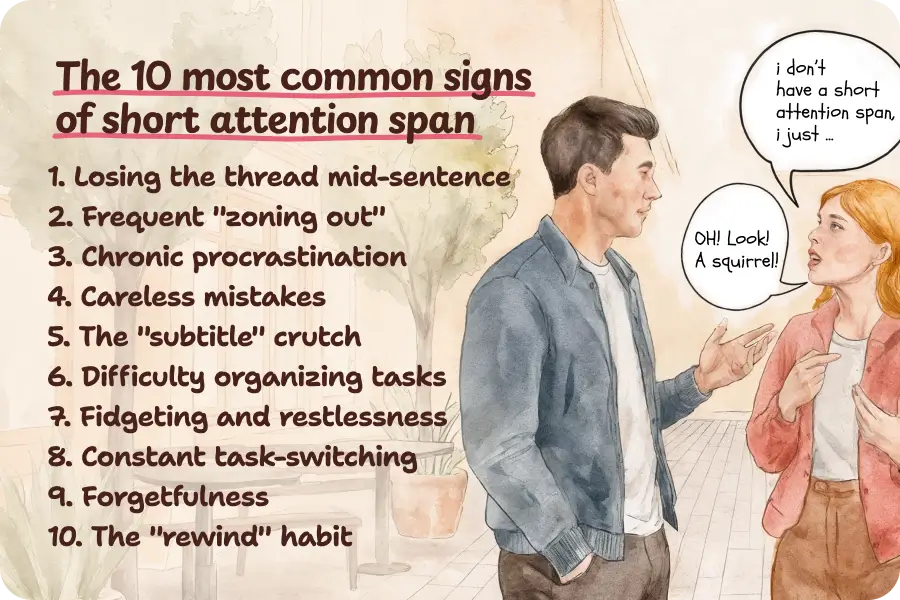
The 10 most common signs of short attention span
A short attention span means a person’s inability to maintain focus on a certain task, activity, thought, or conversation for an age-appropriate period of time. People with short attention spans get easily distracted and struggle to stay on track, often feeling like their brain is a “browser with 50 tabs open,” and they don’t know where the music is coming from.
Based on experience from those navigating this daily, here are the 10 most common signs of a short attention span.
1. Losing the thread mid-sentence
You forget the beginning of the sentence before you finish it. Reddit users describe it as their brain just buffering for a second. It can also happen when you listen to others.
For example, during class, you might catch the first step in the instruction, but by the time the second or third comes, it’s already gone. In the end, you’re just nodding along, trying to look like you’re following even though you’re not entirely sure what to do next.
2. Frequent “zoning out”
During meetings, conversations, or social outings, you may start simply staring into space. Your attention drifts away without you noticing the exact moment it happens. When you come back, you may realize you missed part of what was said and have to quickly catch up or pretend you were following along.
Studies also prove that people with lower working-memory capacity are more likely to mind-wander, at least during demanding tasks. This can help explain why they might make mistakes more often. [1] Kane, Michael. (2012). “What Mind Wandering Reveals About Executive-Control Abilities and Failures.” Current Directions in Psychological Science.

3. Chronic procrastination
You may start avoiding tasks that require paying attention for extended periods of time. A work report can feel overwhelming or “too much to start,” while something simple like writing an email gets delayed for hours or even days, even though, realistically, it might only take 10–15 minutes to complete.
Irene, Breeze’s user, shared, “It seems like my brain perceives the start of the task as a threat or a physical burden that is so difficult to push through. Even when I know it will take just a few minutes, I can spend hours avoiding it, switching between other small things, and still not manage to begin.”
4. Careless mistakes
Were you the one who lost minus signs in math problems because you kept forgetting they were there? That’s it! People who have trouble paying attention can forget where they’ve put their keys or send a message with missing words or typos because their attention jumps away too briefly to notice them.
5. The “subtitle” crutch
You can’t follow a movie or video without subtitles, even though you’re fluent in the language. Without written support, your attention drifts, and you miss key lines or lose the plot halfway through a scene. Reading subtitles lets you shift focus between video and text and provides constant stimulation.
This is why more and more content creators use subtitles on TikTok videos (not only to engage users whose phones are muted but also to keep attention anchored).
6. Difficulty organizing tasks
Missing deadlines, taking on too much work, and working overtime just to catch up on what should have been manageable from the start may be common for people with trouble focusing.
While a short attention span can negatively influence your work success or academic performance, it may also feel like you can’t do anything about it.
Mike (another Breeze user) shared, “It feels like tasks come out of nowhere. One day, I can chill because I have only a few small things to do until the end of the week, and the next day, everything suddenly piles up. I don’t even remember how it happened; I just end up overwhelmed and trying to fix everything at the last minute.”
7. Fidgeting and restlessness
While it’s difficult to keep sustained attention, you may constantly want to go somewhere, do something active, or simply fidget just to feel engaged. For people with short attention spans, stillness can feel uncomfortable, so movement becomes a way to keep the brain “switched on.” These can include:
8. Constant task-switching
You might be talking to a friend, typing a message, thinking about dinner, and planning tomorrow all within the same minute. You may also start doing a few work tasks and get easily distracted, jumping from one thing to another without fully finishing any of them. Such behavior might lead to a sense of being busy all day but still not getting a clear result.
9. Forgetfulness
Your partner asked you to buy bread for dinner, but you forgot… for the third time this week. No, it isn’t because you don’t care. Instead, forgetfulness may stem from a short attention span. You might have zoned out when they were talking about bread, or your mind may have shifted to something else right after hearing it.
And even if you did remember it in the moment, on the way home, other thoughts could take over and push it out of focus, making it harder to stay focused on the original intention long enough to actually act on it.
10. The “rewind” habit
Well, you are having a hard time focusing on the task, but you are still trying to complete it. However, you need to reread the same paragraph of the article and rewatch parts of the video again and again. It seems like your brain can’t “record” the data.
Have you ever thought, “I’m having an exam tomorrow, but I can’t remember anything, even though I’m trying”? That’s it!
Low attention span vs. ADHD
Some people may confuse having a short attention span and experiencing symptoms of attention-deficit/hyperactivity disorder. While the first one is a temporary state that can vary depending on sleep, stress, workload, or overstimulation, ADHD is a persistent neurodevelopmental condition that typically starts in childhood and remains consistent across most areas of life.
Expert Insight
A short attention span and ADHD may look similar, but they aren’t the same thing. If you are worried about ADHD, it’s best to have an evaluation. But there are a few things to look for to tell the difference. A short attention span is situational, habit-related, and reversible with lifestyle changes, while ADHD is a broader neurodevelopmental pattern involving constant challenges with impulse control, attention, and executive functioning. It usually begins when you’re a kid and affects several areas of your life over time.

Emily Mendez
Mental health professional
6 root causes of short attention span
At first, it may seem that getting easily distracted is a self-control problem. However, a short attention span may be a result of technology overload, stress, trauma, mental health conditions, etc. Let’s explore the main causes.
1. Excessive screen time
Researchers have found that excessive screen time in children may be associated with attention problems. [2] Santos RMS, Mendes CG, Marques Miranda D, Romano-Silva MA. “The Association between Screen Time and Attention in Children: A Systematic Review. Dev Neuropsychol.” 2022 Another study found that short-form video use is associated with greater inattentive symptoms. [3] Chiencharoenthanakij R, Yothamart K, Chantathamma N, Sukhumdecha W, Charoensri S, Thanyakulsajja B, Anuroj K. “Short-Form Video Media Use Is Associated With Greater Inattentive Symptoms in Thai School-Age Children: Insights From a Cross-Sectional Survey.” Brain Behav. 2025 This is often linked to constant stimulation and rapid content switching, which can make it harder for the brain to sustain focus on slower or more demanding tasks in everyday life.
Adults can also experience similar challenges, as digital overstimulation may create a “dopamine hit” loop that makes real life feel boring. Because we consume information in short bursts (emails, notifications, TikToks), our brains are being conditioned to expect a change in stimuli every few seconds, making sustained reading feel physically uncomfortable.
2. Stress and trauma
Research proves that chronic stress has a significant negative impact on attention control. [4] Liu Q, Liu Y, Leng X, Han J, Xia F, Chen H. “Impact of Chronic Stress on Attention Control: Evidence from Behavioral and Event-Related Potential Analyses.” Neurosci Bull. 2020 When the brain is constantly in a “threat-ready” state, it becomes harder to stay focused, process information clearly, and hold attention on one task. Instead, attention tends to shift toward potential risks.
The same goes for people experiencing symptoms of childhood trauma and PTSD. If your brain has learned to stay alert to possible danger, it may prioritize scanning the environment over focusing on one task.
3. Physical factors
Some of us may underestimate the link between our overall well-being and our ability to focus. When you’re tired, lack quality sleep, or experience mild dehydration, your brain has less energy to filter out distractions.
4. Health issues
Head injuries may negatively influence attention, memory, and overall cognitive processing. Even mild trauma can affect how efficiently the brain filters information. In some cases, other medical conditions, such as hormonal imbalances or neurological disorders, can also contribute to persistent difficulties with focus and mental clarity.
5. Anxiety, depression, and OCD
Obsessive-compulsive disorder and mood disorders can also lead to trouble focusing. Here’s how it happens.
6. Learning disabilities
A short attention span can be due to dyslexia or auditory processing disorders. When a kid finds it challenging to decode information, their brain has to spend extra effort just to understand what is being read or heard. Because the task is mentally exhausting, attention can drop quickly.
Hidden mimics of inattention
There are also a few things that can influence your ability to focus, even though you have a generally healthy attention system.
1. Multitasking
While a desire to engage in multitasking can be a sign of a short attention span, it may simply be a learned habit or a daily necessity. For example, when you’re cooking while watching a child, replying to messages during work, or switching between tasks under pressure, your brain constantly splits attention.
Interestingly, according to the University of California, Irvine, it takes up to 23 minutes and 15 seconds to fully regain focus after a significant distraction. So, maybe the issue isn’t “bad attention,” but rather constant interruptions.
2. Perfectionism
If it takes too long for you to finish a task because you feel frustrated, it may be a symptom of anxiety. Maybe you’re afraid of making mistakes or doing something imperfectly. As a result, you might overthink every detail, shift your focus to think about ways to improve something, or delay finishing altogether because it never feels good enough.
Normal vs. small attention span: An age-based guide
An attention span naturally develops as the brain matures, so what is considered “normal” strongly depends on age. Children are expected to focus for shorter periods, while attention gradually increases with development, learning experience, and self-regulation skills.
The table below shows general age-based ranges to help understand what typical sustained focus can look like.
What should I do with a child’s short attention span?
The simplest rule for kids’ attention is 2–3 minutes per year of age. However, this figure is only a general guideline. Every child develops at their own pace, and attention can vary depending on interest, fatigue, environment, and emotional state.
Instead of trying to “force” a child’s attention span to be longer, it’s more effective to gradually build attention through short, structured, and engaging activities. Breaking tasks into smaller steps and including regular breaks can help a child stay less frustrated.
Expert Insight
A child with a shorter attention span doesn’t necessarily have ADHD. They could be overstimulated, sleep-deprived, anxious, or underchallenged. There are many things that could be going on. Some things I would recommend to parents are looking at their child’s quality of sleep, their screen time, or whether there is stress at home or school. Sometimes, making lifestyle adjustments for your child is all you need to help their attention span. Of course, if you still have questions or concerns, you should always make an appointment with your doctor just in case.
Emily Mendez
Mental health professional
How to improve focus: 7 healthy habits to overcome low concentration span
If you’ve decided to improve your focus, here are simple strategies that can bring noticeable results quickly.
1. Ensure that your physical well-being is fine
First, take care of the basics. Get enough sleep, drink water, ensure balanced nutrition, and exercise regularly. While it may sound a bit obvious and boring, having enough rest can significantly improve your ability to focus, process information, and stay mentally engaged. Even small habits, like going to bed at the same time or taking short walks, can make a noticeable difference in how steady your attention feels.
2. Reduce screen time
Do you find it difficult to stop checking your Instagram or Facebook every 10 minutes? Here are a few ideas on how to eliminate distractions:
3. Use environmental “anchoring”
If you work from home, the desire to keep lying in bed and scrolling through your phone all day may be too high. Instead, to concentrate better, you may need to wear “office” clothes or choose a dedicated desk that you’ll perceive as a work zone. This helps your brain associate a specific place and routine with focus.
4. Work in the presence of someone
While this tip was initially used among people with ADHD, for those having short attention spans, it can also be helpful. This is called “body doubling” — working near another person, even if you’re doing different tasks. The simple presence of someone else can help you reduce distractions and create a sense of accountability.
5. Listen to lectures at 1.5x or 2x speed
It may not improve attention span in the long term, but it can help you concentrate when your mind tends to drift during slower-paced content or when you have a hard time focusing on one thing for too long. Listening to something at a higher speed forces your brain to “keep up,” which prevents it from having time to wander.
6. Break tasks into smaller steps
This tip might sound too simple, but for people having trouble focusing, it can make a real difference. Even more, do you remember the last time you broke tasks into subtasks instead of simply thinking about it?
This is how it can look:
Breaking tasks down like this reduces overwhelm and gives your brain clear, manageable actions to follow.
7. Try to incorporate gamification into your routine
“I feel guilty for my challenges with focus.” No, you shouldn’t. Maybe your brain simply lacks dopamine. Gamification can make a difference.
- The visual loading bar. Draw a physical progress bar for a big task. Color it in as you go. Seeing that the bar fills up provides a dopamine boost that keeps you from abandoning the task halfway through.
- The 10-minute speed run. Set a timer for 10 minutes and see how much you can get done before it beeps. Trying to beat your “personal best” turns a boring slog into a competitive game against the clock.
- Temptation bundling. Only allow yourself to listen to your favorite playlist while performing a task you usually avoid, like chores or taxes. By linking a boring activity with a reward you actually enjoy, you create a positive association that makes it much easier to start and finish the work.
- Tree growing. Use apps that turn focus into a living thing. If you stay off your phone for 25 minutes, you grow a digital tree. If you get distracted and leave the app, the tree dies.
Frequently asked questions
Is a small attention span permanent?
No, a short attention span is not necessarily permanent. Often, it’s influenced by lifestyle factors like stress, sleep, screen time, and daily habits, which means it can improve over time with the right adjustments.
Can a head injury cause a short attention span?
Yes, a head injury may be one reason you find it difficult to focus.
How can I improve focus?
You need to start by reducing distractions, working in short time blocks, and giving your brain simple tasks instead of overwhelming to-do lists. Also, focus on your physical well-being and reduce stress to improve concentration.
When should I see a healthcare provider?
You may need to see a mental health provider if you notice that difficulties with attention are persistent, significantly affect your daily life, or are getting worse over time. This includes situations where you constantly struggle to complete tasks, frequently forget important responsibilities, or find it particularly challenging to function at work, school, or in relationships despite trying different strategies to improve focus.
Sources
- Kane, Michael. (2012). “What Mind Wandering Reveals About Executive-Control Abilities and Failures.” Current Directions in Psychological Science.
- Santos RMS, Mendes CG, Marques Miranda D, Romano-Silva MA. “The Association between Screen Time and Attention in Children: A Systematic Review. Dev Neuropsychol.” 2022
- Chiencharoenthanakij R, Yothamart K, Chantathamma N, Sukhumdecha W, Charoensri S, Thanyakulsajja B, Anuroj K. “Short-Form Video Media Use Is Associated With Greater Inattentive Symptoms in Thai School-Age Children: Insights From a Cross-Sectional Survey.” Brain Behav. 2025
- Liu Q, Liu Y, Leng X, Han J, Xia F, Chen H. “Impact of Chronic Stress on Attention Control: Evidence from Behavioral and Event-Related Potential Analyses.” Neurosci Bull. 2020
Disclaimer
This article is for general informative and self-discovery purposes only. It should not replace expert guidance from professionals.
Any action you take in response to the information in this article, whether directly or indirectly, is solely your responsibility and is done at your own risk. Breeze content team and its mental health experts disclaim any liability, loss, or risk, personal, professional, or otherwise, which may result from the use and/or application of any content.
Always consult your doctor or other certified health practitioner with any medical questions or concerns
Breeze articles exclusively cite trusted sources, such as academic research institutions and medical associations, including research and studies from PubMed, ResearchGate, or similar databases. Examine our subject-matter editors and editorial process to see how we verify facts and maintain the accuracy, reliability, and trustworthiness of our material.
Was this article helpful?