



Podcast name
What is an otrovert?
“I don’t understand the trends and why people get into mainstream things. The opinion of others never seemed to bother me. I will always follow my instinct first before listening to someone’s advice.”
Does this sound familiar? If yes, you might be an ontrovert, the brand-new personality type in line with introverts, extroverts, and ambiverts. This article will explore the psychological meaning of otroverts, their differences from other personality types, their strengths, and 6 tips to get the most out of your otrovertive nature.
What is an Otrovert?
Otrovert is a personality type that describes a person who doesn’t like to be part of group settings. Psychiatrist and author of the book The Gift of Not Belonging, Rami Kaminski, calls otroversion “not a label, not a diagnosis, and not a psychological condition. It is a human trait. Similar to left-handedness or musicality.”
Why do we even need a new personality type? The binary system of extroverts and introverts is limited. Introverts get energy from loneliness; extroverts—from other people. The term “otrovert” was created for those whose energy source is feeling different from group dynamics.
Core Otrovert Meaning: 8 Signs You Might Be One
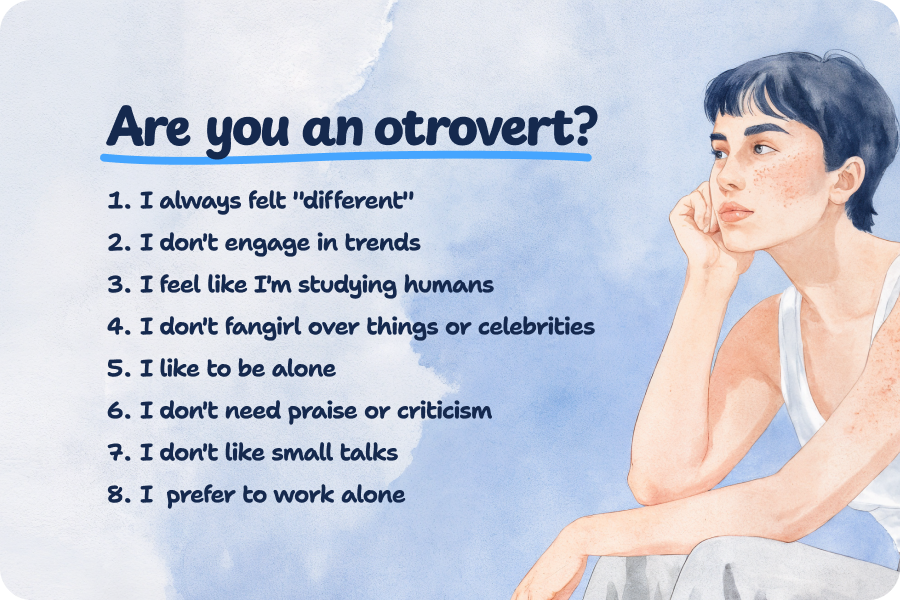
1. You always felt separate from others
No matter the social settings, otroverts never feel like they belong. They don’t get the concept of communal mentality. “If everybody believes in it, why do I have to?” is their slogan. That’s why their beliefs and values can feel alternative and, sometimes, controversial.
If you relate to this, you may have sensed that your way of engaging with people or life didn’t fully match what others seemed excited about. You likely adapted well enough to blend in, but internally, something always felt slightly misaligned.
2. You don’t enjoy trends
“…I simply do not understand ‘being a fan’ of a person (actor, sports person) or wanting to be a fan of a sort or particularly a team, but always happy to play a sport,” one commenter wrote on Medium.
It’s a perfect summary of otroversion. Otroverts tend to seek sense beyond mainstream ideas. That’s why they may be resistant to popular shows, pop music, emerging ideas, etc. Otroverts tend to be non-conformistic, not because they are “pick-me,” but because they are true to themselves.
3. You feel like an anthropologist
Otroverts aren’t participators. Because they tend to be outside of the group, they make perfect observers. Some psychologists describe them as “destined to be anthropologists.”
Otroverts are very interested in human psychology. They “study” people through social interactions and unspoken rules because it brings them more satisfaction than actually participating in social life.
4. You don’t “fangirl” over stuff
As an otrovert, you may have learned that people define themselves by their tastes: in music, films, books, and social media. And you can’t relate to that.
Emotionally self-sufficient individuals, like otroverts, don’t need to identify with celebrities or fandom. They know they are interesting people due to self-acceptance, not external validation.
5. You are comfortable with loneliness
Otroverts enjoy their own company. Their emotional independence and maturity allow them to feel the most authentic when they’re alone. Being a perpetual non-belonger gives them personal contentment they can’t find in any type of social situation.
Vice versa, group dynamics can make otroverts uncomfortable because they can’t help but feel separate. They still have a social circle of close friends and family members, whom they love and respect. But they don’t need others to feel complete.
6. You don’t need validation
Praise doesn’t motivate otroverts much, in the same way that criticism doesn’t fully derail them. Otroverts don’t seek validation because they are confident about their own thoughts and ideas due to their independent thinking and developed belief system.
Independent thinkers are often confused with skeptics. The truth is, communal people can feel intimidated by people with emotional resilience, like otroverts, because the latter can’t be manipulated.
7. You dislike small talk
It’s simple: otroverts need meaning on a deeper level. If conversation doesn’t have it, their social batteries will feel drained.
The comfort zone for otroverts is deep conversations with intense debates, controversies, and life-changing ideas. Since such a connection is almost impossible in groups, most otroverts prefer individual conversations.
8. You don’t like to work in groups
From otroverts’ vantage point, group projects are frustrating. They are original, independent thinkers. Because otroverts tend to think in different directions, their vision can be dismissed.
If you:
- don’t get a sense of belonging besides your family or close friends;
- feel social anxiety around group projects;
- cannot focus in noisy environments;
- find group work performative;
- are more effective when working alone;
It’s a strong sign that you may actually be an otrovert.

Key Differences between an Otrovert and Other Personality Types
Other personality types are defined by the levels of social energy: introverts face inside for energy, extroverts—outside, and ambiverts need a combination of both.
Otroversion is measured not in social energy but in otherness. Otroverts face completely elsewhere from the group because they don’t have an interest in becoming a part of it whatsoever.
Otrovert vs. introvert
An introvert is someone who gets energy from solitude and spends it in social circles. They stay aside because they can be shy, introspective, awkward, or hesitant to “warm up.” Otroverts, on the other hand, stay outside because they feel other, unwelcome, misunderstood.
Otroverts never feel like “a team player.” Introverts can also experience this feeling, but they don’t necessarily feel aversion to joining the group.
Otrovert vs. extrovert
Extroverts have a prominent need for social stimulation, and they also feel rewarded and energized in communal environments.
The Otherness Institute claims that otroverts can show some extrovertive traits, such as being well-spoken, confident, relaxed, etc. However, these sociable traits show up only when otroverts are comfortable, so mostly among friends, kids, parents, etc.
Otrovert vs. ambivert
An ambivert is someone who has both extrovert and introvert traits. Ambiverts can be called extroverted introverts because they enjoy both solitude and social time. But they need to frequently interchange parties with time alone to avoid social burnout.
Otroverts can also enjoy communal or alone time, but most likely, they won’t get a sense of belonging in a group. No time to recharge before social occasions matters for otroverts, they’ll still feel out of the group unless there’s a deeper level to social interaction.
Otroverts and ambiverts are confused quite often because they both deviate from the binary introvert/extrovert system. Here’s a detailed breakdown of the differences between an otrovert and an ambivert:
| Trait | Ambivert | Otrovert |
| Social energy | Adjusts based on context and people. | Engages only when meaningful. |
| Motivation | Wants to be free and independent; Avoids extremes. | Listens to internal instincts, not to the opinion of others; Wants to learn about the world, people, and themselves; Wants to live a life true to their beliefs and values. |
| Interaction with the world | Has certain preferences and beliefs and is flexible about the choice of books, TV shows, fandoms, etc. | Rarely influenced by trends. Non-conforms to mainstream ideas unless they correspond to their liking. |
| Group dynamics | Can enjoy parties, teamwork, or solo work. | Strong preference for working alone. |
| Validation needs | Depends on their life circumstances. Usually minimal. | Emotionally self-sufficient. Will first rely on self-validation and only then consider the feedback of others. |
Brain Processes behind Otroversion
Otroverts are not another “trend” in mental well-being because multiple studies provide neurological proof of otherness. Non-belongers indeed have different brain processes:
- Noradrenergic systems in otroverts can be more sensitive to dopamine. This is associated with novelty-seeking and exploratory behavior. That’s why unconventional activities and original ideas seem more thrilling to otroverts, claims neurological research.
- Unconventional thinking is associated with a higher number of neurons in the frontopolar cortex. The more neurons in this part of the brain and the better they interplay with each other, the more creative and unusual a person’s thinking will be, neurological studies suggest.
- Certain innate brain differences can change sensory sensitivity and social behavior. According to the research, neurodivergent traits might make people focus inward and on their special interests to recharge. You can discover your neurodivergent traits with a quick online test below.
Pros and Cons of Being an Otrovert
Being an otrovert isn’t inherently good or bad. But it can make a person powerful or weak in certain areas.
Advantages of otroverts
- Self-awareness. Otroverts know who they are. Unlike most people, they can easily identify their thoughts and emotions. They also know how others see them, but it doesn’t influence their self-image or self-esteem.
- Self-sufficiency. People with otroversive traits use their own knowledge and previous experience to make important decisions. Collective wisdom isn’t authority to them. It means they usually don’t need much external support.
- Enhanced objectivity. Otroverts are naturally gifted observers. In companies, otroverts will pay close attention to gestures, body language, hidden meanings, surroundings, and overall vibes. It allows them to form a clear, objective picture of what’s going on.
- Creativity. Otroverts find conventional methods and ideas boring and are more likely to engage in divergent thinking. One study found that traits associated with otroversion, like novelty-thinking, nonconformity, and a sense of “different,” were commonly found in Nobel Prize winners.
- Logical empathy. Otroverts may not be overtly expressive, but they are very understanding and welcoming individuals. Unlike the common myth, their ability to reason emotional reactions allows, not restrains, them from holding empathy.
- Authentic social circle. Otroverts don’t feel obligated to make friends with someone for convenience or advantage. Their relationships are based on mutual understanding and honesty.
Weaknesses of otroverts
The provided weaknesses are not moral disadvantages of people who may relate to otroversion. These weaknesses only exist because of restrictive social standards that focus on extroversion. Here are some challenges that fellow otroverts can face in daily lives:
- Negative self-questioning. The thought “What is wrong with me?” is frequent in the minds of otroverts. Deep self-reflection is a part of them, and they also objectively assess their character and actions. Sometimes, it can even lead to hating oneself.
- Hardships with relationships. Otroverts need alone time and have very high standards for potential friends or partners. The real connection for them is about quality over quantity, but it can be interpreted as a lack of love or a lack of desire to spend time together.
- Overlooked achievements. Otroverts can achieve remarkable things, but they don’t get recognition for them. They don’t like to attract attention and would never ask for praise. Because of that, otroverts’ successes in work or studies can be overlooked.
Emily Mendez, M.S., Ed.S, explains why people can feel like non-belongers from a psychological perspective:“Becoming a non-belonger in adulthood is not about being a social failure. It’s usually the result of being deeply self-aware. When a person is emotionally complex, they don’t fit into the dominant social structure. Their experiences, perceptions, and inner lives are more highly individualized. That creates social separation and difference. People who are very emotionally aware or unusually gifted may outgrow their environments. Their inner world does not match their environment. Just because a person doesn’t belong, doesn’t make them antisocial. In fact, they may be exceptionally kind and caring.”
6 Tips on How to Thrive as an Otrovert
In order to thrive as an otrovert, you don’t need to completely change who you are. Many question themselves, thinking, “Why am I so insecure?” That’s because they live against their nature to fit in a society that wasn’t designed for them.
These 6 tips will help you to lead a more genuine lifestyle as an otrovert.
1. Journal
Many otroverts are naturally drawn to psychology, anthropology, philosophy, sociology, etc. Use that curiosity as a tool for self-understanding. Here’s the algorithm:
- Choose one topic that fascinates you and explore it on the internet. For example:
- Why humans crave belonging.
- What loneliness means across cultures.
- How our childhood experiences influence us in adulthood.
- Reflect on how these ideas show up in your life. Journaling can also help you explore deeper questions, such as:
- Do I truly enjoy loneliness, or have I just learned to tolerate it?
- What does being a “non-belonger” give me, and what does it cost me?
- Do I want connection on my own terms or complete independence?
- Write down the thoughts and ideas these topics/questions trigger in you. You can do it traditionally with a notebook, or in the Breeze app, which includes guided prompts, freewriting, and a mood tracker in the journaling feature.
2. Cultivate your solo hobbies
No matter how “weird” your hobbies or interests are, it’s essential that you keep investing in them. They are the source of your identity: something that distinguishes you from the masses.
Here are some hobby ideas that fit an otrovert lifestyle:
- Photography
- Scrapbooking
- Solo sports (weightlifting, running, swimming, cycling, skiing, bowling, darts, etc.)
- Collecting (rocks, postmarks, collection figures, books, etc.)
- Budgeting
- Self-growth courses
- Books clubs
Try to explore these or other hobbies. Don’t feel pressured to immediately find something you’ll be passionate about. Give it time.
3. Challenge your comfort zone
Otroverts shouldn’t be forced to feel like they belong just for the sake of belonging. Trying to be something you aren’t won’t work. Challenging your comfort zone is more about learning more about yourself and the world.
The small steps you can start with:
- Share one personal detail about yourself in a conversation. Start with internet forums if real-life conversations seem too intimidating.
- Go to a social function you wouldn’t normally go to.
- Join one meeting about the topic that particularly appeals to you. For example, join online book clubs, attend workshops on topics of interest, or discuss a video on psychology with your close friends.
The rule of thumb is to be open to new experiences while not neglecting your values.
4. Find compatible non-belongers
You’re an otrovert, but you’re a person first. While it might feel like you need nobody, don’t close these communal doors.
Expert Insight
The way to find like-minded friends is to look for spaces built around shared values or interests, rather than general groups and clubs. For instance, look for neurodivergent-friendly spaces. Next, look for people who speak your emotional language. Find others who are also social ‘outsiders’.

Emily Mendez
Mental health professional
Disclaimer: If you’re comfortable being alone, don’t force yourself into undesired social connections. Be authentic about whether you need communication or you’re content with how things are.
5. Learn social survival rules
Whether you want it or not, you’re likely to be in a group someday. But luckily, you can manage your own discomfort by learning how to engage with people. Don’t confuse it with people-pleasing. It’s about your comfort.
If you feel uncomfortable in conversations, try to:
- Find things to relate to. It can be obvious things like the weather or an event you are at right now. But you’ll feel better when you discover shared hobbies or problems. Common experiences bring people together.
- Match and mirror the energy. As an otrovert, you already observe the body language of a person you’re talking to. Now, try to mirror it. If your conversational partner leans forward, repeat it. It’s a subconscious technique to appear more likable.
- Offer sincere compliments and accept them. A killer way to nail small talk is to highlight efforts or positive features of a person. But you have to really mean what you say. Accepting appreciation with a humble “thank you” is as important.
- Speak up if you disagree. It’s natural for otroverts to disagree with things, and you can talk about it and create meaningful conversation. Make sure to address the ideas the group discusses, not the people.
Read the article to learn more hacks on how to talk to anyone.
6. Build a predictable routine
Predictable routines generally have a positive influence on mental health. For otroverts, routines provide convenience. When all your daily tasks are sorted out, it leaves you more time for creativity and self-exploration.
You can easily build a routine in the Breeze app:
- Tap “Add task” in the upper right corner.
- Choose a task from a list or create your own.
- Customize a task: its name, symbol, repetitiveness, notifications, etc.

Conclusion
Otrovert is a newborn personality type. It’s so young that there were no empirical studies to explore the deeper motivations of otroverts or their origins. But in its short existence, thousands of people related.
Otroversion is for non-belongers. Independent, self-reflective individuals who never quite fit. The main takeaway for otroverts is that you are okay.
Pay attention to your mental well-being and continue cultivating the reliable inner core and curiosity you have. With Breeze Wellbeing, you can do both in no time.
Sources
- Otrovert is not a label. By Rami Kaminski. Instagram. September 2025.
- Novelty seeking is related to individual risk preference and brain activation associated with risk prediction during decision making. By Wang et al. Scientific Reports. June 2015.
- What Does the Frontopolar Cortex Contribute to Goal-Directed Cognition and Action? By Hogeveen et al. The Journal of Neuroscience. November 2022.
- Access Points: Understanding Special Interests Through Autistic Narratives. By Rebecca-Eli Long. Autism in Adulthood. February 2025.
- What Makes a Nobel Prize Innovator? Early Growth Experiences and Personality Traits. By Zheng et al. Organizational Psychology. March 2022.
Disclaimer
This article is for general informative and self-discovery purposes only. It should not replace expert guidance from professionals.
Any action you take in response to the information in this article, whether directly or indirectly, is solely your responsibility and is done at your own risk. Breeze content team and its mental health experts disclaim any liability, loss, or risk, personal, professional, or otherwise, which may result from the use and/or application of any content.
Always consult your doctor or other certified health practitioner with any medical questions or concerns
Breeze articles exclusively cite trusted sources, such as academic research institutions and medical associations, including research and studies from PubMed, ResearchGate, or similar databases. Examine our subject-matter editors and editorial process to see how we verify facts and maintain the accuracy, reliability, and trustworthiness of our material.
Was this article helpful?