


Podcast name
Why do I have separation anxiety?
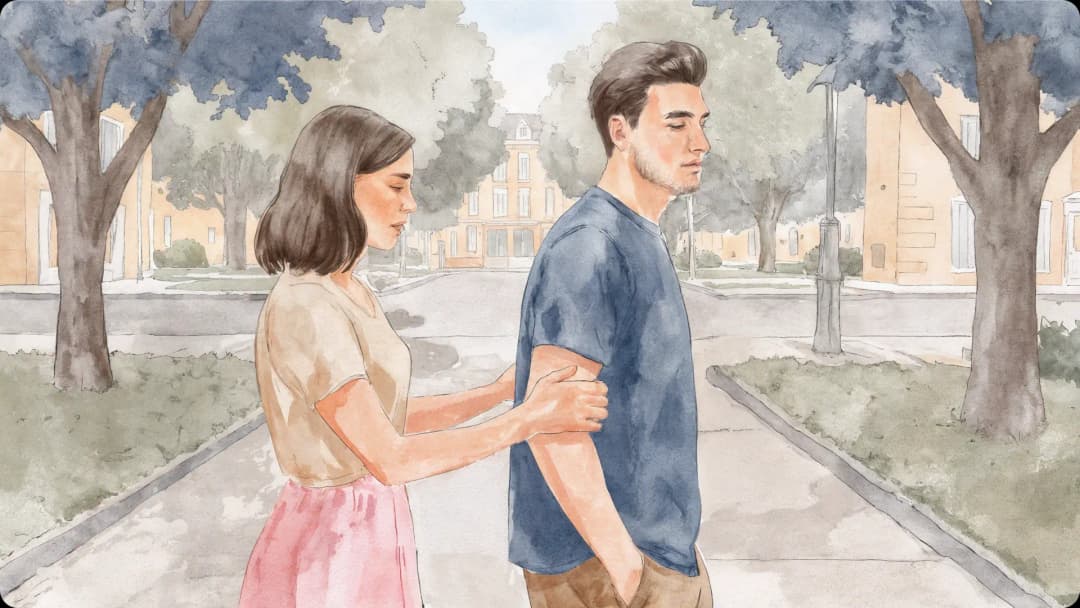
You’re always together: you wake up side by side, make breakfast, go to the gym, run errands, and wind down at night in the same space. It starts to feel like your days only make sense when they’re shared. So when you’re suddenly apart, even for a short time, you start experiencing excessive worry.
What felt like a genuine desire to be around your loved one now starts turning into separation anxiety. In this article, we’ll explore where it comes from and what to do so it doesn’t harm your romantic relationships.
What is separation anxiety in relationships?
Separation anxiety in relationships means an intense emotional distress and irrational worry a partner experiences when they’re apart from their loved one. It can involve a fear of abandonment, feelings of guilt or unease, and a constant need for reassurance.
You may accidentally find yourself questioning if your partner still loves you, what they’re doing without you, and worry they might realize they are happier alone or with someone else.
Separation anxiety may affect your well-being and lead to:
- Physical symptoms, such as a racing heart, or even difficulty sleeping when your partner is away for work or social events.
- Preoccupation with “signs” that the partner is pulling away. You may believe that love is over when they’re simply busy, tired, or unable to respond.
- Loss of self, as you find it difficult to enjoy personal hobbies or solo time because your sense of security is entirely tied to your partner’s presence.
Is feeling anxious normal or something to work on?
Mild separation anxiety may be normal, and many Reddit users share the same experience as they’re away from their partners. Nevertheless, it can bring some challenges if you start experiencing intense anxiety when you’re apart, even for a short time, or find it difficult to focus on your life.
While there’s nothing wrong with missing someone you love, it becomes something to work on when the distress begins to shrink your world or dictate your routine. When your partner becomes your only source of emotional safety and stability, it can influence both daily life satisfaction and future relationships.
| Normal experiences | Anxiety to work on |
| You can shift attention back to your tasks after missing your partner | You keep checking your phone or can’t stay mentally present if they’re away |
| Your mood stays relatively stable throughout the day | Your mood swings depend on their replies |
| You can make decisions without the loved one’s advice | Even decisions that are unrelated to your relationship feel like something that needs their approval |
| You maintain a sense of identity outside the relationship | You feel unsure who you are without them |
4 signs you might have separation anxiety
Separation anxiety can manifest differently from person to person. However, it typically influences 4 main aspects: physical well-being, mental balance, your sense of identity, and patterns of behavior.
1. Physical symptoms
Excessive fear of being alone can cause:
- The feeling of a heavy chest
- Loss of sleep or appetite (or vice versa, sudden fatigue or emotional eating)
- Muscle tension
- Headaches
- Restlessness and difficulty relaxing
2. Mental and thought patterns
Probably, the most noticeable aspect of separation anxiety is how your thoughts begin moving in circles and create circles of rumination. You may start:
- Feeling guilty for staying apart from your romantic partner even if this distance is necessary (e.g., you need to go on a work trip).
- Overthinking small details and drifting into worst-case scenarios.
- Experiencing intense fear that they will cheat on you.
- Facing difficulty concentrating because your mind keeps returning to worries.
- Checking your screen repeatedly and feeling a spike of mini-panic when a message goes unanswered.
The Breeze app can help you spot the first signs of separation anxiety. Track your mood and analyze triggers of what makes you worried or frustrated. A few minutes a day will let you take care of your well-being in advance.
3. Identity signs
You don’t know who you are without them, and your own life seems impossible without this person. You may doomscroll TikToks all day or struggle to spend time alone when they aren’t around.
If this happens and separation anxiety affects your sense of self so deeply, it can be a warning sign. You may not simply experience occasional distress when apart but develop an anxious attachment style where your identity, confidence, and sense of direction become tightly tied to the relationship.
Other signs that separation anxiety may be a serious challenge include:
- Losing touch with your interests and goals.
- Basing your self-worth on how your partner treats or responds to you.
- Avoiding independent plans because they feel less meaningful or interesting.

4. Behavioral signs
When separation anxiety kicks in, your actions usually focus on one thing: trying to feel “safe” again by closing the gap between you and the other person. These can include:
- Constantly texting or calling your partner, as well as checking their social media to see the last time they’ve been online.
- When you’re in touch, you may frequently ask questions like “Are we okay?” or “Do you still love me?” You need to hear it over and over to quiet the “what-ifs” in your head.
- If there’s an opportunity to meet (even for a short time), you may cancel plans with others or neglect your need for rest and sleep just to ease anxiety.
- You may find it challenging to say “Goodbye” and even experience panic after each “See you later.”
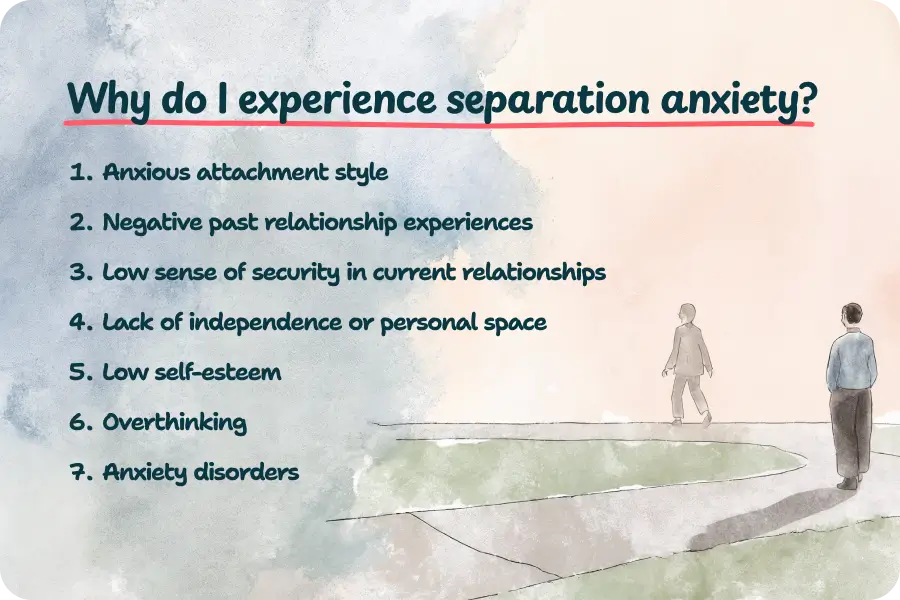
Why do I experience separation anxiety? 6 main causes
You may experience separation anxiety due to an insecure attachment style, low self-esteem, past relationship trauma, or childhood trauma. You may also live with an adult separation anxiety disorder or face outcomes of other mental health conditions.
1. Anxious attachment style
If your parents were inconsistent and didn’t provide you with enough attention and care in early childhood, you might have developed an anxious attachment style. This means you may feel you need to “earn” love and care from partners, friends, or others. As an adult, this translates into a deep-seated fear of abandonment and rejection, resulting in a persistent need for reassurance to feel safe.
You may behave clingy, seek constant validation, or feel uneasy when there’s even a small emotional or physical distance. You might overanalyze your partner’s words and actions, looking for signs of withdrawal, or try to “secure” the relationship through extra attention.
2. Past relationship experiences
Maybe your childhood was pretty joyful, but you faced betrayal or a painful breakup in previous relationships. For instance, you might have been dating a narcissistic partner, which influenced your sense of self-worth and made you question your approach to relationships in general.
So, now, even in a stable relationship, your anxiety stems from the feeling, “What if they hurt me too?” You may feel worried even if a small distance occurs or your loved one starts behaving differently than before. You may also dwell on the thought, “The honeymoon phase will be over quite soon, and they will no longer want to spend time with me, pretty much like my ex did.”
3. Low sense of security in current adult relationships
Your current relationship may be a rollercoaster of emotions, which makes you wonder whether they love you anytime they’re away. For instance, if your current partner gives you mixed signals and shows affection when you’re around but becomes distant or inconsistent when you’re apart, it can create a constant sense of uncertainty.
As a result, you may start relying on their presence as “proof” of the relationship, feel anxious during any gap in communication, or question where you stand. In this case, the anxiety isn’t coming out of nowhere. It’s a response to unclear, inconsistent, or unstable signals.
4. Lack of independence or personal space
On the other hand, even a healthy relationship can quickly become the center of your life. If you stay together 24/7, you might simply get used to it. And when you go to the gym together and have common friends and hobbies, your lives can become so intertwined that being apart starts to feel unusual.
Hannah Schlueter, MA, LAC, shares insights for people who are in a healthy relationship but stay with their partner 24/7 and, because of this, experience separation anxiety. “A first step in navigating separation anxiety in a relationship is to build internal reassurance of the stability and presence, even if your partner is not physically with you. Acknowledging that your connection with your partner is not any less valid or meaningful when you are apart can be a helpful reminder.”
5. Low self-esteem
Imposter syndrome and feeling that something is wrong with you can also lead to excessive fear that your partner may leave you or cheat on you anytime they aren’t around. Even more, low self-esteem can make you:
- Ruminate on your perceived flaws and compare yourself to others
- Assume the relationship was created out of pure luck
- Take neutral situations personally
- Over-apologize to avoid conflict
- Depend on your partner’s attention or approval to feel worthy
6. Overthinking
If you experience intense anxiety in daily life, it can influence your love life as well. Maybe you overthink everything, including work, your health, or your future.
Studies prove that chronic stress and elevated cortisol levels impair the brain’s ability to adapt and recover from stress, exacerbating anxiety. [1] Sic A, Cvetkovic K, Manchanda E, Knezevic NN. “Neurobiological Implications of Chronic Stress and Metabolic Dysregulation in Inflammatory Bowel Diseases.” Diseases. 2024 Simply put, your mind gets used to staying in a “what if” mode, and your relationship becomes just another area where that anxiety shows up.
7. Anxiety disorders
- Separation anxiety disorder (SAD) typically starts in childhood and makes a kid experience constant worry when they’re out of their home or away from caregivers. [2] Ehrenreich JT, Santucci LC, Weiner CL. “SEPARATION ANXIETY DISORDER IN YOUTH: PHENOMENOLOGY, ASSESSMENT, AND TREATMENT.” Psicol Conductual. 2008 However, adult separation anxiety also exists and can manifest as an intense fear of separation from attachment figures (partners or children, for example). [3] Anxiety UK. “Separation anxiety (adult).”
- General anxiety disorder (GAD) can also play a major role. While SAD focuses specifically on the fear of being apart, GAD may involve all spheres of life, including relationships.
- Panic disorder involves unexpected and frequent panic attacks. While it may not directly be linked to separation anxiety in relationships, a person may start associating being away from their partner with a lack of safety, which can intensify anxious reactions.
- Social anxiety disorder is a condition that manifests as a fear of being judged or made fun of in social situations. A partner can become a source of comfort and confidence in these settings, so being without them may increase feelings of vulnerability.
5 coping strategies for managing separation anxiety
Effective coping strategies to reduce anxiety and feel more confident being alone include building life outside the relationship, challenging anxious thoughts, and engaging in grounding self-soothing techniques.
1. Communicate openly and talk about your feelings
Don’t hesitate to share your worries with a loved one. Open conversation can make you feel supported and will let you look for the solution together. For instance, you may decide to:
- Agree on quick check-ins during the day, if possible
- Let each other know in advance when you’ll be busy
- Name specific triggers (e.g., late replies) and how to handle them
- Decide when to talk things through and when to give space
2. Create a life outside the relationship
If you are always together with your partner, negative thoughts may arise because you don’t know what to do without them. To avoid it, you may need to build stronger connections with friends and meet with them once or twice a week, or find a hobby that belongs only to you.
By developing your own interests (whether it’s a sport, a creative project, or simply a solo routine at a coffee shop), you remind your brain that you are a complete person on your own. This independence makes the time spent with your partner feel like a choice rather than a survival need.
3. Set boundaries
Relationship boundaries let partners build healthy relationships and, at the same time, find space for personal growth. You may agree to keep certain hours dedicated to personal tasks without staying in touch or, in contrast, plan at least one date a week to brighten up your routine.
This ensures that your partner feels that they have enough personal space, while you clearly understand when they might be unavailable and can feel prepared for it.
4. Challenge anxious thoughts
This CBT exercise can be particularly helpful if you regularly experience separation anxiety in relationships and tend to ruminate on specific thoughts. Fill in the table with the following columns and analyze your answers. Once the table is ready, your mind starts shifting from emotional reactions to more balanced thinking.
| Anxious thought | Evidence for it | Evidence against it | More balanced thought |
| “They are losing interest in me.” | They replied later than usual | They are still consistent overall, just busy | “My anxiety is triggered by delay, not actual rejection.” |
| “Something is wrong between us.” | They seemed a bit quieter today | No direct signs of conflict | “Mood changes don’t automatically mean problems.” |
| “They might leave me.” | I feel insecure when they’re away | No behavior suggesting withdrawal | “This is a fear, not a fact.” |
| “If they loved me, I wouldn’t feel anxious.” | Anxiety feels intense | Emotions are not proof of relationship quality | “My feelings reflect my attachment style, not their love.” |
5. Learn to self-soothe
Grounding techniques can help you calm down in the moment when separation anxiety hits. They shift your focus from the state of high alert to what’s happening in the present moment.
- The 333 rule. Name 3 things you see, 3 things you hear, and 3 things you feel in your body.
- 5-4-3-2-1 technique. Identify 5 things you see, 4 you can touch, 3 you hear, 2 you smell, and 1 you taste.
- Breathing reset. Inhale slowly for 4 seconds, hold for 4, and exhale for 6-8 seconds. Repeat until your body slows down.
- Cold water grounding. Wash your face or hold something cold to quickly reduce emotional intensity.
- Redirect attention. Do one small physical task (tidy up, walk, stretch) to break the rumination pattern.
Expert Insight
“Another coping skill to reduce separation anxiety is to build up your tolerance for time spent away from your partner over time. Gradually increasing the amount of time you are separated from your partner can increase confidence and reduce fear of being apart.”
Hannah Schlueter
Mental health professional
When to consider deeper support and professional help
You may need to talk to a mental health professional when separation anxiety becomes overwhelming and directly interferes with your daily life. For instance, if you find yourself unable to focus at work because you are constantly checking your phone for a reply, or if you begin avoiding social events just to stay near your partner.
If the fear of being alone causes physical symptoms like panic attacks, insomnia, or a constant “pit” in your stomach, it is a sign that your nervous system is stuck in a survival loop.
A licensed professional counselor can help you unpack the roots of these feelings and provide a safe space to practice self-regulation techniques. Therapy will let you strengthen your relationship with yourself so that your connections with others are based on desire and personal fulfillment rather than desperation.
Frequently asked questions
Can you have separation anxiety in a healthy relationship?
Yes, you can have separation anxiety in relationships, no matter how healthy they are. In this case, you might feel worried due to past traumas, anxious attachment style, generalized anxiety disorder, or a lack of emotional self-regulation skills.
How do I stop overthinking when my boyfriend is away?
When your boyfriend is away, you may:
- Shift your focus to something else (meet with friends, go to the gym, concentrate on working tasks)
- Challenge anxious thoughts to stop the cycle of rumination
- Create small routines for alone time so it feels more structured and safe
- Write down your thoughts to get them out of your head instead of looping
- Reduce triggers like scrolling relationship content that fuels comparison or doubt
Is separation anxiety a red flag?
No, separation anxiety may be quite common and doesn’t automatically mean something is wrong with you or your relationship. However, it can become a warning sign if it begins to control your behavior, restrict your independence, or exert constant pressure on either your partner or the relationship.
Sources
- Sic A, Cvetkovic K, Manchanda E, Knezevic NN. “Neurobiological Implications of Chronic Stress and Metabolic Dysregulation in Inflammatory Bowel Diseases.” Diseases. 2024
- Ehrenreich JT, Santucci LC, Weiner CL. “SEPARATION ANXIETY DISORDER IN YOUTH: PHENOMENOLOGY, ASSESSMENT, AND TREATMENT.” Psicol Conductual. 2008
- Anxiety UK. “Separation anxiety (adult).”
Disclaimer
This article is for general informative and self-discovery purposes only. It should not replace expert guidance from professionals.
Any action you take in response to the information in this article, whether directly or indirectly, is solely your responsibility and is done at your own risk. Breeze content team and its mental health experts disclaim any liability, loss, or risk, personal, professional, or otherwise, which may result from the use and/or application of any content.
Always consult your doctor or other certified health practitioner with any medical questions or concerns
Breeze articles exclusively cite trusted sources, such as academic research institutions and medical associations, including research and studies from PubMed, ResearchGate, or similar databases. Examine our subject-matter editors and editorial process to see how we verify facts and maintain the accuracy, reliability, and trustworthiness of our material.
Was this article helpful?