


Podcast name
What is quiet confidence?
Think of a confident person. Do you see a typical alpha hero with unlimited charisma? Or do you see a person who actively listens, sympathizes, and gives more than receives?
Today’s article will be about quiet confidence, which many call true confidence. What makes silent confidence so impressive? How to become quietly confident? Find the answers to these questions and more in today’s article.

What is quiet confidence?
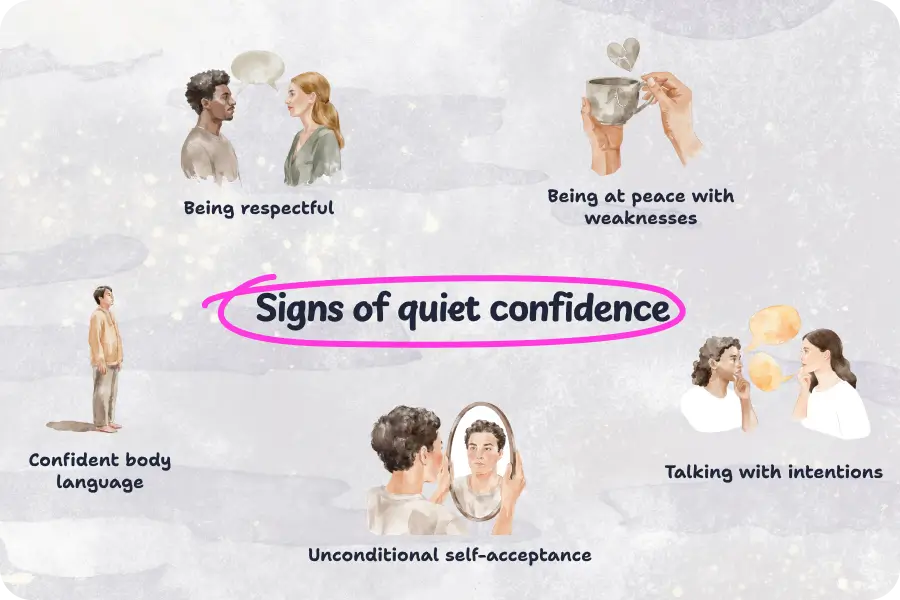
Quiet confidence is a form of self-reliance rooted in unconditional self-acceptance and self-validation. It’s called “quiet” because people who unconditionally love themselves don’t seek external validation and, hence, can seem quiet and reserved.
The main qualities of a person who feels quiet confidence are:
- self-assurance
- indifference to external validation
- authenticity
- humility
- competence
- composure
Modern understanding of self-confidence is extrovert-centric: the louder, more active, and more engaged you are, the more confident you seem. Introverts and otroverts disagree with such a stereotypical portrayal of confidence.
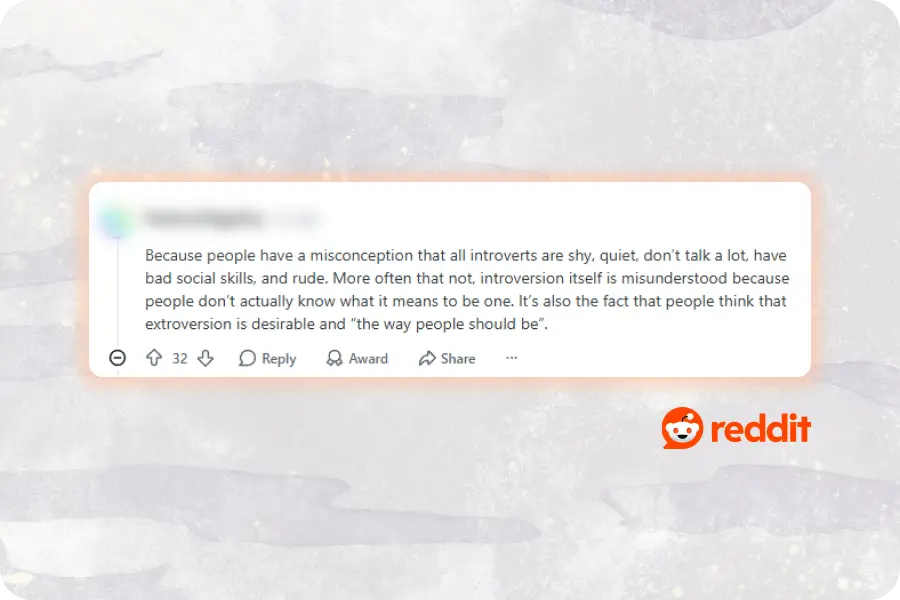
Susan Cain even published a book, Quiet: The Power of Introverts in a World That Can’t Stop Talking, where she highlights that the world underestimates qualities of silent confidence [1] Quiet: The Power of Introverts in a World That Can’t Stop Talking by S. Cain. January 2012. .
Where does “confidence is quiet” come from? Origins of quiet confidence
The claim “confidence is quiet” comes from the quote “True confidence is quiet; insecurity is loud.” This exact phrasing was first said in the movie The Godfather by the Godfather himself. Don Corleone is also one of the best representations of silent confidence.
However, the idea that someone reserved can actually hide the most confidence is much older than you may think.
Will you be surprised that even ancient humans commemorated the power of silence and calmness? Prehistoric humans who lived in tribes noticed that those who had the most wisdom tended to keep it to themselves.
From a psychological perspective, silence = confidence because it conserves energy. One study found that people with lower self-esteem found it harder to regulate their emotions: their anger and sadness were disproportionate to the situation [2] Do difficulties in emotion regulation impact self-esteem and adult attachment? – the role of trauma by A. V. Antunes, C. Santos, P. Oliveira, T. C. Almeida. Annals of Medical Research. September 2021. .
The main outcome: confident people are not spending energy managing insecurity in the moment; hence, they seem quiet.
9 signs of quiet confidence
1. High self-esteem
High self-esteem means that a person genuinely believes in their own abilities to succeed and overcome challenges. It also means that no matter the mistake you make, how lonely you feel, what others think of you, you still will be kind to yourself.
Such self-esteem is a product of the advanced ability to distinguish what you really are from temporary states. For example:
| What you aren’t | What you are |
| What others think of you | Your potential |
| Temporary negative emotions | Your dreams |
| Past mistakes | Your visualization of success |
| What society tells you you are | Your awareness and observation of life |
Quietly confident individuals are silent because they don’t care that others may think they are cold/shy/uninterested. They live according to the insight: my true essence won’t change because other people will think badly of me.
2. Treating everyone with unconditional positive regard
Treating others with unconditional positive regard means treating everyone with respect and positivity, no matter if a person is different from you in terms of opinions, descent, education, or financial background.
Quietly confident people will perceive CEOs, housewives, maintenance workers, ex-convicts, etc., as decent human beings worthy of respect. Why? Because they can set apart the individual from behavior, real intentions from their subjective perception of a situation.
3. High emotional intelligence
High emotional intelligence (EQ) is the skill to effectively manage your emotional reactions and support others in theirs.
Some signs of well-developed EQ include:
- knowing what you feel in a moment
- ability to self-regulate
- asking for a pause when feeling that emotions might overtake
- admitting mistakes
- taking good care of emotional health
- sticking to personal boundaries
- validating emotions of self and others
- accepting feedback without feeling personally attacked
4. Certain body language and behavior
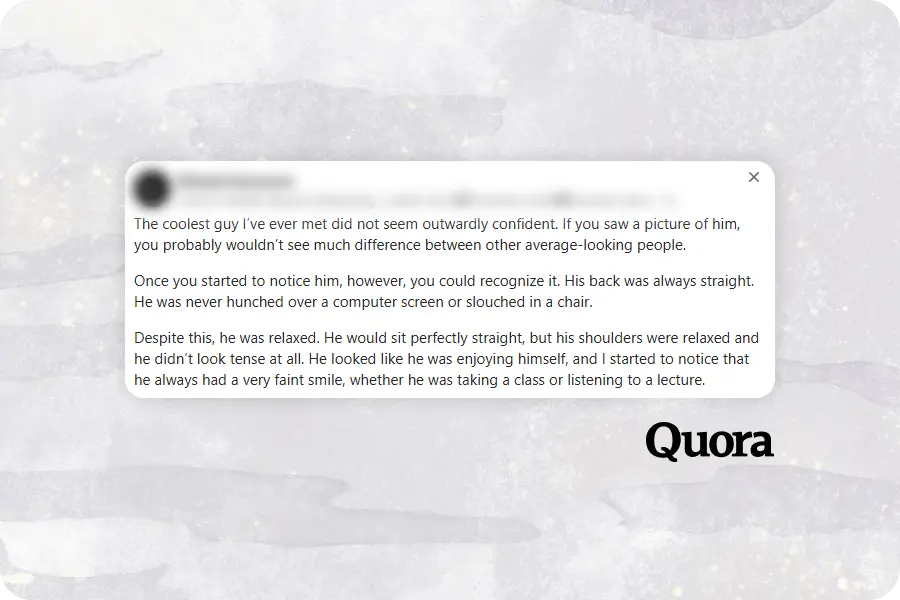
Quiet confidence is physically visible. People who feel at peace with themselves will look relaxed and comfortable in their own skin.
This Quora user describes an acquaintance who’s the perfect example of quiet confidence:
People with silent confidence are the opposite of try-hards. They look and behave effortlessly, which shows up in the way they dress, carry on a conversation, and navigate the room. Their efforts don’t go into impressing someone but into things that are meaningful to them.
5. “Golden retriever” vibes
In slang, “golden retriever energy” means an enthusiastic, loyal, and optimistic person who is often reminiscent of a golden retriever, a dog breed known for its friendliness. Golden retriever traits usually come from a combination of high self-worth and EQ.
Quiet confidence makes people more empathetic and optimistic about life. They are not afraid to share that optimism and support because they know that others’ success doesn’t detract from them.
Examples of golden retriever behavior are:
- playfulness
- not being afraid to be perceived as goofy
- being easy going
- supporting and helping others
- sharing success secrets and not feeling threatened
Expert Insight
People who have low self-esteem may feel an intense need to justify their boundaries or choices. They may feel as though their decisions are not good enough. Over-explaining something can be a way to gain validation or seek reassurance from others.
This is more common among people who grew up in environments where they were often criticized or felt unheard. They may have learned that they need to over-explain things in order to be taken seriously.

Emily Mendez
Mental health professional
6. Working hard and enjoying it
Have you noticed that genuinely confident people are also more motivated and hard-working? Not because they necessarily have huge ambitions, but because they respect themselves to the extent that they don’t want to invest precious time into something not meaningful or not enjoyable.
Breeze user Anna shared, “I’m new to the concept of quiet confidence, but I always found the more confident I become with age and therapy progression, the more I act. I take on more responsibility, and I procrastinate less and less. Is it because I’m not so afraid of failure anymore?
You can find more interesting stories of Breeze users in the Breeze Wellbeing app with the new “Insights” feature.
7. Not talking a lot, but always on point
Nervous giggles, talking excessively, not making pauses… The idea that somebody might not like you is often haunting and scary for people with insecurities.
Quiet confidence is the opposite of that. Quiet but confident people might seem as if they are not interested in conversation because they rarely speak up. In reality, they might have a strong opinion, but proving that their opinion is the only right one doesn’t seem necessary. In the end, what would they get from arguing with people who are not ready for meaningful exchange?
Quiet confidence is all about “show, don’t tell.” Words for confident people are filler, whereas substance and actions are what matter to them.
Expert Insight
People with low self-esteem or low self-confidence often overexplain themselves because they don’t want to give the other person an opportunity to criticize them. They use it as a way of preventing rejection. In most cases, this behavior is rooted in self-protection.
Emily Mendez
Mental health professional
8. Acceptance of (own) mistakes and vulnerabilities
Quietly confident people can easily do an objective self-evaluation and be right about it. That’s because they can accurately pinpoint their personal weaknesses while also accepting them as part of their personalities.
Failures and weaknesses are not embarrassing to confident people because they can separate mistakes from self-worth. A mistake is just a mistake: it’s a coincidence, bad planning, missing a mark, etc. It’s anything but something that defines who you are in life.
Also, quiet confidence means accepting and forgiving others’ mistakes out of empathy and patience.
9. Not needing to prove anything
Because individuals with quiet confidence aren’t afraid to be vulnerable, they don’t feel the need to prove anything. A healthy ego prevents them from doing things out of spite or dare. That’s also why confident people don’t partake in arguments just for the sake of winning or proving something.
Examples of quietly confident TV/film characters
- Samwise Gamgee (The Lord of the Rings)
Do you remember that Samwise was one of the few characters who resisted the temptation of the One Ring? That’s due to strong inner values and morals.
Frodo’s loyal companion was quiet but confident in the sense that he rarely spoke but consistently proved his worth through actions. Samwise’s confidence came from loyalty and perseverance, not a traditional understanding of charisma.
- T’Challa (Marvel comics)
T’Challa represents a more composed and leadership-oriented form of quiet confidence. He doesn’t seek a fight, but also isn’t scared of one if Wakandian people are in danger.
The king of Wakanda does not seek authority. Because anyone in Wakanda could become a king after proving themselves, T’Challa learned that respect should be deserved.
- Thomas Shelby (Peaky Blinders)
Tommy speaks very little, but when he does, his words carry weight. He creates the impression that he does not need to convince the room of his competence because he already believes in it himself.
Quiet but confident, Tommy knew how to establish authority through silence and direct communication. This composure means that he just knows he’ll manage anything because he has done so before, so why should he doubt his own abilities and those of his gang?
Pros and cons of silent confidence
Pros
- Happier life, in general
People who feel authentic and don’t mask their true selves are four times more likely to thrive in life, meaning they feel happier, achieve more, and deal with challenges better [3] Living Your Values Linked to Positive Life Outlook by T. Davoodi. Gallup News. December 2025. .
- Better performance
Quiet confidence preserves mental energy for performance rather than anxiety. Hence, quiet but confident people are more likely to take more rewarding but risky opportunities AND stay collected under such pressure.
- Healthier relationships
Highly developed EQ and awareness of quietly confident people allow them to be really accepting and supportive. The authenticity that goes along with silent confidence also means that they build relationships with people who share their values and worldview, leading to better outcomes with partners, friends, and family.
- Improved mental health
Confident people feel less threatened in life because of their self-reassurance and control. Studies consistently prove that the higher the self-worth is, the fewer symptoms of anxiety and depression a person will experience [4] Is High Self-Esteem Beneficial? Revisiting a Classic Question by U. Orth and R. W. Robins. American Psychologist. January 2022. .
Cons
- Pressure to maintain the “quiet confidence” image
Some people start believing they must always appear mysterious and unbothered to be perceived as a truly confident person. Although “fake it till you make it” can have some results, faking quiet confidence without inner work will most likely lead to emotional suppression.
- Potential suppression of extroverted traits
It’s not okay to hide sincere enthusiasm, humor, excitement, and even loudness just to maintain some sort of aesthetic. Quiet confidence is a mindset and not a vow of silence. So, it means showing your genuine self, even if it’s a little loud.
- Reduced visibility in career environments
Many workplaces reward self-promotion and constant presence. Although quietly confident people can be really competent and the best specialists in their fields, their efforts can sometimes be overlooked if not intentionally brought up.
- Misinterpretation by others
Quiet confidence can sometimes be perceived as coldness, arrogance, emotional distance, or lack of interest. But is the perception of others something to worry about?
Expert Insight
It’s not necessary to completely change who a person is to be accepted by others. Confidence is often thoughtful and quiet, rather than charismatic or loud.
However, it’s still important to consider how behavior is perceived by others. For example, constantly apologizing or avoiding eye contact may communicate unintentionally that a person is insecure, even if they are highly capable.
Emily Mendez
Mental health professional
How to have quiet confidence in 7 steps
1. Define what confidence is for you
Are you naturally quiet and a calm person? Great, silent confidence most likely supports your authentic view of self. But if you are an extrovert or naturally outgoing person who loves to be involved, quiet confidence can feel limiting to you.
In order to know what confidence feels like to you, think about the time when you felt the most relaxed around people without masking or people-pleasing. How did you behave? What was different in that moment?
If you can’t think of anything, try also thinking of the opposite: a time when you were uncomfortable and pretended to be someone just to be liked. Imagine a confident self in that situation: how would they behave?
2. Take care of yourself
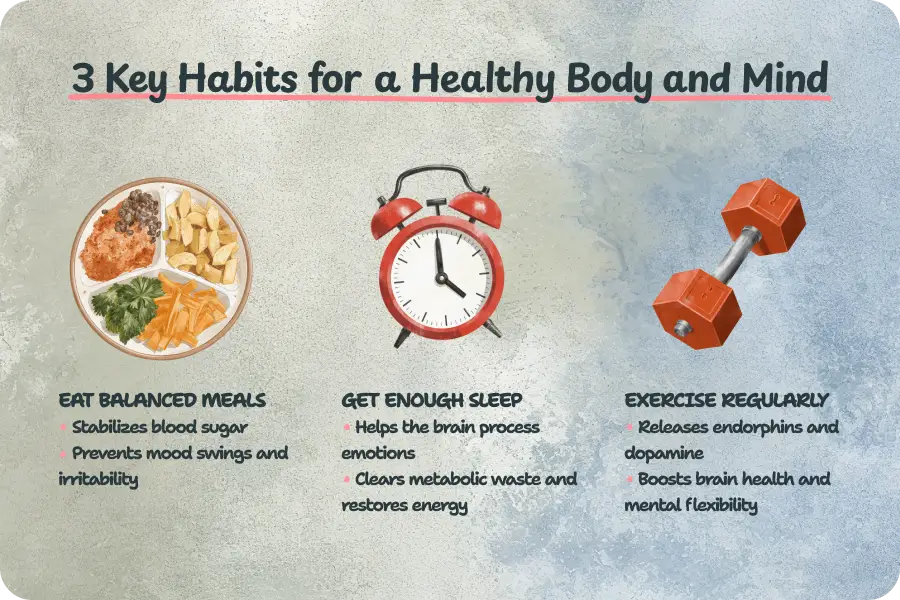
A healthy lifestyle consistently proves to increase people’s self-worth. One study showed that this happens because when people take care of themselves, they start to believe they are worth the effort on a neurological level [5] Healthy Lifestyle in Adolescence: Associations with Stress, Self-Esteem and the Roles of School Violence by A. G. Moreno and M. M. M. Jurado. Healthcare (Basel). December 2023. .
Because of that, their self-worth grew. And with better self-worth, it’s easier to be at peace with yourself.
3. Practice confident body language
Body language is the single most important thing you need to feel as a self-assured person. Key elements of confident body language are:
- Good posture
Keep your shoulders back, lower your shoulders, and put your ears directly over your shoulders.
- Taking space and not rushing
Practice taking up physical space in cafes or an office by physically taking more space and walking confidently. Stop “shielding” your core: uncross your arms and keep your head slightly up. Slow down your movements.
- Minimize fidgeting
Try not to shake your legs or rock yourself. Also, practice not getting distracted, including by your phone. Even if you’re not actively participating in conversation, create an impression that you’re available.
- Practice power poses
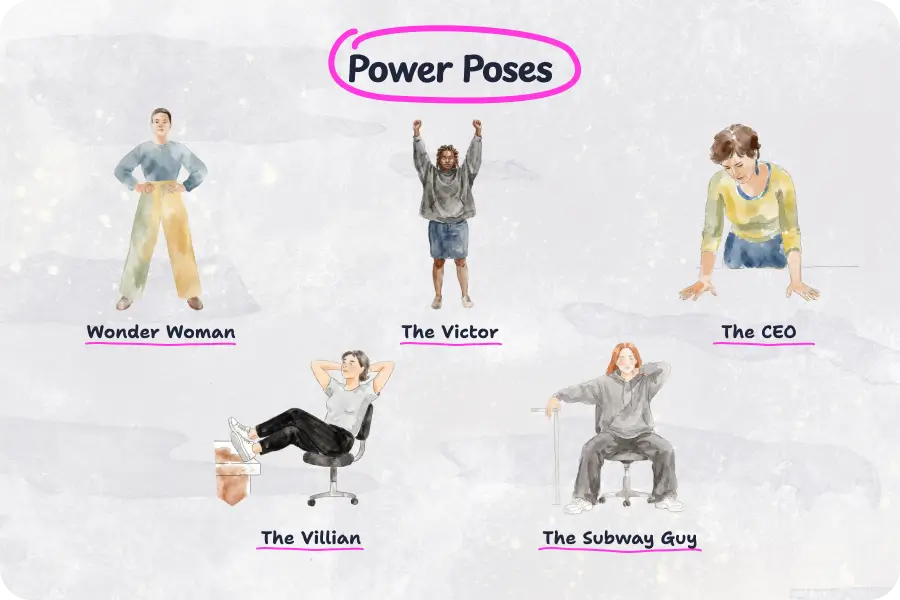
You can practice these power poses alone or before important meetings to boost your confidence. Consistent practice of these poses can actually decrease the fear of judgment.
4. Listen to others, for real
The underrated tip on how to be more respected is to actually listen to others. Secretly, everyone likes to talk about themselves a bit, right? So, the genuine investment in other people talking makes you look more confident.
In order to practice active listening, try:
- asking more questions
- nonverbal empathy (active eye contact, nodding, head tilt, etc.)
- not interrupting
- repeating/summarizing what others said
- reacting to the interlocutor’s nonverbal signs
Mathew, a Breeze user, shares, “I always find people who ask me questions more confident than those who never stop talking about themselves. I’m like, ‘Oh, you let me dominate the conversation?’ This type of confidence is really attractive.”
5. Own your mistakes and weaknesses
Insecure people are insecure because they believe that their mistakes and weaknesses make them a worse person. Truly confident people set their identities and mistakes apart: there is “I,” and those are my mistakes.
In order to own your mistakes, admit them. Say/think, “I made a mistake here,” or “I missed this KPI.” But don’t tell others or yourself things that generalize you as a person. Don’t say “I’m not competent enough for missing this KPI.”
Take the responsibility, but be positive. Offer a solution to fix the mistake. And remember that the only people who don’t make mistakes are people who don’t do anything.
6. Speak up (about your needs, wants, opinions)
Self-advocacy is a crucial part of living a fulfilled life. When talking about your desires, you ensure your needs are met. For example, you can
- share your true emotions → “I feel uncomfortable when…” or “I love it when…”
- protect your boundaries → “I have to hang up now, but we can talk later.”
- express your needs → “I want to ask for this without any expectations.”
- tell your true opinion → “I believe the opposite, but I can see your perspective.”
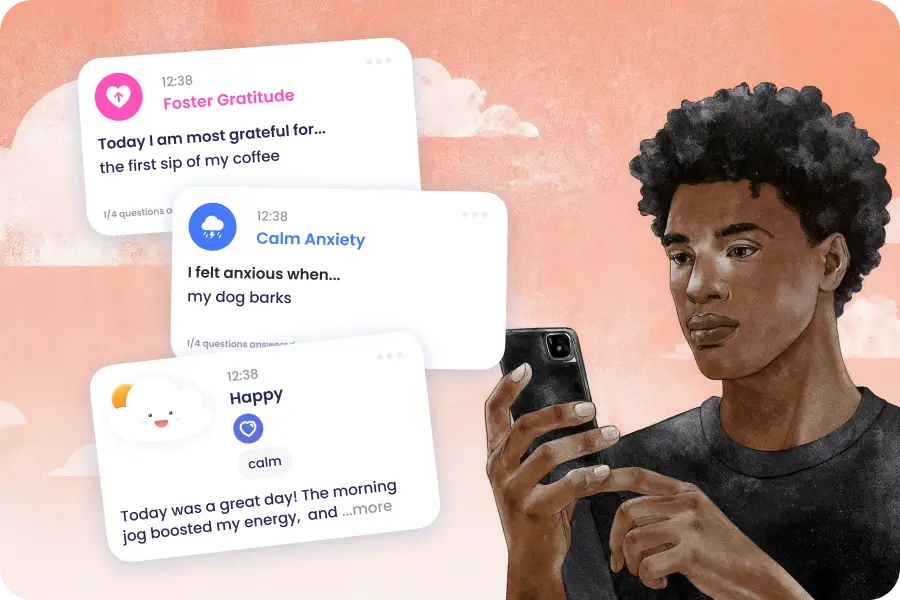
Journaling helps a lot with accepting that your needs and desires are valid.
7. Detach yourself from the opinions of others
In one study, researchers asked people to wear an embarrassing T-shirt. People wearing the T-shirt estimated that about 50% of others would notice them, but in reality, only 25% did [6] The spotlight effect in social judgment: an egocentric bias in estimates of the salience of one’s own actions and appearance by T. Gilovich, V. H. Medvec, K. Savitsky. Journal of Personality and Social Psychology. February 2000. . This is called a spotlight effect, and it proves that people overestimate how invested others are in them.
Mark Manson, the author of the bestseller The Subtle Art of Not Giving a F*ck, famously said that you worry about the opinions of others because you don’t have something more important in life to care about [7] The Subtle Art of Not Giving a F*ck: A Counterintuitive Approach to Living a Good Life by M. Manson. November 2016. .
Here are better alternatives where you can invest your mental energy:
- self-care
- hobbies
- professional development
- finding beauty in everyday moments
- resting
- mental and cognitive self-improvement
Sources (Accessed May 2026)
- Quiet: The Power of Introverts in a World That Can’t Stop Talking by S. Cain. January 2012.
- Do difficulties in emotion regulation impact self-esteem and adult attachment? – the role of trauma by A. V. Antunes, C. Santos, P. Oliveira, T. C. Almeida. Annals of Medical Research. September 2021.
- Living Your Values Linked to Positive Life Outlook by T. Davoodi. Gallup News. December 2025.
- Is High Self-Esteem Beneficial? Revisiting a Classic Question by U. Orth and R. W. Robins. American Psychologist. January 2022.
- Healthy Lifestyle in Adolescence: Associations with Stress, Self-Esteem and the Roles of School Violence by A. G. Moreno and M. M. M. Jurado. Healthcare (Basel). December 2023.
- The spotlight effect in social judgment: an egocentric bias in estimates of the salience of one’s own actions and appearance by T. Gilovich, V. H. Medvec, K. Savitsky. Journal of Personality and Social Psychology. February 2000.
- The Subtle Art of Not Giving a F*ck: A Counterintuitive Approach to Living a Good Life by M. Manson. November 2016.
Disclaimer
This article is for general informative and self-discovery purposes only. It should not replace expert guidance from professionals.
Any action you take in response to the information in this article, whether directly or indirectly, is solely your responsibility and is done at your own risk. Breeze content team and its mental health experts disclaim any liability, loss, or risk, personal, professional, or otherwise, which may result from the use and/or application of any content.
Always consult your doctor or other certified health practitioner with any medical questions or concerns
Breeze articles exclusively cite trusted sources, such as academic research institutions and medical associations, including research and studies from PubMed, ResearchGate, or similar databases. Examine our subject-matter editors and editorial process to see how we verify facts and maintain the accuracy, reliability, and trustworthiness of our material.
Was this article helpful?