



Podcast name
AI Relationship Advice
Are you turning to AI when relationships get confusing? It doesn’t judge, it doesn’t get tired, and it’s always available when emotions are intense. But the real question is: are these responses always helpful, or can they sometimes harm human relationships? Let’s explore how to use AI personalized advice in a smart way.
Have you ever asked ChatGPT whether your partner has narcissistic personality traits and might be manipulating you? Take a test to find out.

Is AI Good for Dating Advice?
AI can be useful for relationship advice, but only in specific, limited ways. Generative AI chatbots can simulate many aspects of close relationships, such as ongoing conversation, responsiveness, and emotional support, research shows [1] Molly G. Smith, Thomas N. Bradbury, and Benjamin R. Karney. Can Generative AI Chatbots Emulate Human Connection? A Relationship Science Perspective. July 2025 .
However, AI still struggles to assess emotional risk and build truly collaborative solutions. While it offers short-term support, it can be viewed as a useful tool for reflection rather than a replacement for human judgment, experience, or professional counseling.
Where AI Relationship Guidance Actually Helps
AI can be useful in exploring patterns, though it shouldn’t be used to “diagnose” your relationship. Here are the situations where you can get practical advice:
1. Basic education about relationships
AI can explain general concepts like:
- Specific personality traits
- Healthy boundaries
- Common conflict cycles
- Attachment styles
- Communication styles
Want to understand your emotions better and get valuable insights into how you express them? Take the Emotional Intelligence test!
2. Organizing your thoughts
When you’re upset, it can be hard to think clearly. AI can help you:
- Summarize what you’re feeling
- Separate facts from assumptions and avoid catastrophic thinking
- Reframe a situation in neutral language
3. Offering multiple perspectives on relationship issues
AI can simulate different viewpoints, which can reduce cognitive bias, especially in heated situations:
- “How might my partner see this?”
- “What would a neutral third party say?”
- “What are possible interpretations besides the worst-case one?”
4. Communication practice
This is one of its most practical uses, especially for people who struggle with confrontation. You can use AI to:
- Draft messages before sending them
- Rephrase something to sound calmer or clearer
- Role-play tough conversations
Expert Insight
Using AI for support is not automatically a problem. However, it is an issue when AI advice replaces your own judgment. When you start to trust AI’s judgment or advice more than your own, or when you feel as though you can’t make a decision without AI, then it might be a problem. For example, if you find yourself asking AI for advice for every disagreement that you have with your partner, and feel unable to manage these on your own, you may have become too dependent on AI for emotional reassurance.

Emily Mendez
Mental health professional
3 Red Flags of an AI Relationship Coach
According to research, among major concerns are one-sided opinions and plausible-sounding advice, even when the situation is ambiguous [2] Lujain Ibrahim, Franziska Sofia Hafner, Myra Cheng, Cinoo Lee, Rebecca Anselmetti, Robb Willer, Luc Rocher, Diyi Yang. Sycophantic AI makes human interaction feel more effortful and less satisfying over time. May 2026 .
1. It lacks real context
AI only sees what you type, which is often incomplete or emotionally filtered.
For example, if your partner replies with short messages, AI might interpret it as emotional distance or loss of interest. But in reality, they could simply be stressed, exhausted, or dealing with personal issues you didn’t mention.
Without the full context of the relationship, AI can easily misread situations that humans close to you would understand differently. As a result, that can actually weaken relationships rather than improve them.
2. It can excessively agree even when you’re wrong
AI can show excessive agreement with users, reinforcing their perspective instead of challenging unhealthy thinking or behaviors. In relationship situations, this can increase bias rather than encourage balanced reflection.
That can lead to:
- Over-simplifying complex emotional dynamics
- Giving generic “break up / communicate” style answers
- Missing subtle but important details
3. AI is not a therapist
AI is not trained to handle:
- Abuse situations
- Mental health crises
- High-conflict relationships
- Trauma responses
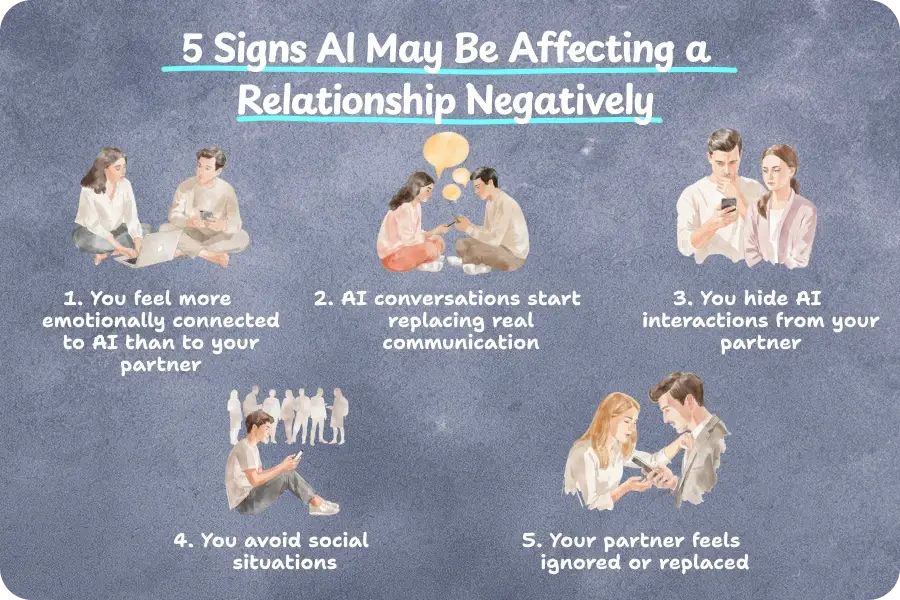
8 Tips to Use Artificial Intelligence As a Relationship Coach
The healthiest approach is to treat AI as a guide for reflection and communication, not as the final authority, a study shows [3] Laura M. Vowels, Rachel R.R. Francois-Walcott, Joëlle Darwiche. AI in relationship counseling: Evaluating ChatGPT’s therapeutic capabilities in providing relationship advice. August–December 2024 . Here are practical ways to use AI wisely without becoming overly dependent on it to navigate relationships:
1. Use AI to Clarify Thoughts, Not Make Decisions
A good way to think about AI is, “I will use this to expand my thinking, not replace my judgment.” AI can help you organize your feelings and turn emotional reactions into clearer communication.
For example, instead of asking, “Should I break up with my partner?” try asking, “Can you help me understand why this situation upset me?” or “Can you help me explain my feelings more clearly?” This keeps you in control of the decision-making process instead of outsourcing it to AI.
Self-discovery tests in the Breeze app are designed to help you become more self-aware and improve your empathy, emotion regulation, and communication skills. Here you may find quizzes about personal growth, relationships, careers, attachment styles, childhood trauma, and many more.

2. Use AI to Improve Communication
One of the best uses of AI is conversation support. It can help you:
- Rewrite emotionally charged messages
- Make your tone calmer and clearer
- Avoid sounding defensive or accusatory
- Prepare for difficult conversations
For example, you may turn “You don’t care about me” or “You hate me” into “I felt ignored when you didn’t respond after an argument.” That shift alone can reduce emotional intensity and improve clarity.
3. Ask for Multiple Perspectives
AI becomes more useful when you ask it to challenge your assumptions rather than validate them. This reduces emotional tunnel vision and encourages balanced thinking.
4. Don’t Use AI for Validation Only
A common mistake is using AI only to confirm what you already believe. Since AI often tends to agree with users, this can reinforce bias instead of helping you grow.
For example, if you only ask questions that paint your partner negatively, AI may mirror that framing. This can make conflicts feel more one-sided than they really are. Use AI to explore possibilities, not to “win” emotional arguments.
Expert Insight
AI can help with communication by helping you express your thoughts more clearly. However, if you are using AI to come up with arguments or defenses that aren’t your own, then you may be using it to prepare arguments. The problem is that when a person uses AI to prepare arguments, the communication becomes tense and defensive.
Emily Mendez
Mental health professional
5. Pause Before Acting on AI Advice
Just because advice sounds logical doesn’t mean it fits your real-life situation.
6. Give Balanced Context
AI responses are only as good as the information you provide. Instead of saying, “My partner ignored me all day,” add context: “We had an argument yesterday, and they’ve been stressed with work recently.” More complete context usually leads to more balanced guidance.
7. Know When Human Help Matters More
AI should not replace therapy, couples counseling, trusted friends or mentors, and honest conversations with your partner.
If the relationship involves emotional neglect, manipulation, severe trust issues, or past trauma, human support is far more important than AI-generated responses.
8. Avoid Emotional Dependency on AI
It’s easy to start relying on AI for every emotional decision because it’s always available and nonjudgmental. But overdependence can weaken self-trust and reduce real-world communication.
Healthy use means:
- Using AI occasionally for reflection
- Not checking every argument with a chatbot
- Still developing emotional confidence independently
Avoid using AI as your primary source of guidance when:
- You’re deciding whether to stay in or leave a serious relationship
- There is emotional, verbal, or physical abuse
- You are repeatedly stuck in the same conflict cycles without improvement
- You feel emotionally dependent on external validation for every decision
Final Thought
AI is good for relationship advice in a supporting role, not a leading one. It can help you slow down, think more clearly, and respond more intentionally and thoughtfully.
AI works best as:
- A thinking tool
- A communication helper
- A perspective generator
It fails when treated as:
- An authority on your relationship
- A substitute for real-world experience
- A final decision-maker
Frequently asked questions
1. Can AI replace a relationship therapist?
No. AI can offer general reflections and communication help, but it cannot understand a full personal history or provide professional help.
2. Is it okay to use AI to decide whether to break up?
It’s better not to rely on AI for final decisions. It can help you clarify your thoughts, but major relationship decisions should come from your own reflection, lived experience, and possibly real-world counseling or trusted support.
3. Can AI help improve communication with my partner?
Yes. AI is useful for rewriting messages in a calmer tone, practicing difficult conversations, and identifying unclear or emotionally loaded wording.
4. Is AI advice unbiased?
Not fully. AI can reduce some emotional bias by offering neutral perspectives, but it can also introduce generic or incomplete interpretations because it lacks real context.
5. Which AI is best for relationship advice?
There isn’t a single “best” AI for relationship advice, but in general, the most capable large language models are equally useful for reflection, communication help, and perspective-taking.
Sources
- Molly G. Smith, Thomas N. Bradbury, and Benjamin R. Karney. Can Generative AI Chatbots Emulate Human Connection? A Relationship Science Perspective. July 2025
- Lujain Ibrahim, Franziska Sofia Hafner, Myra Cheng, Cinoo Lee, Rebecca Anselmetti, Robb Willer, Luc Rocher, Diyi Yang. Sycophantic AI makes human interaction feel more effortful and less satisfying over time. May 2026
- Laura M. Vowels, Rachel R.R. Francois-Walcott, Joëlle Darwiche. AI in relationship counseling: Evaluating ChatGPT’s therapeutic capabilities in providing relationship advice. August–December 2024
Disclaimer
This article is for general informative and self-discovery purposes only. It should not replace expert guidance from professionals.
Any action you take in response to the information in this article, whether directly or indirectly, is solely your responsibility and is done at your own risk. Breeze content team and its mental health experts disclaim any liability, loss, or risk, personal, professional, or otherwise, which may result from the use and/or application of any content.
Always consult your doctor or other certified health practitioner with any medical questions or concerns
Breeze articles exclusively cite trusted sources, such as academic research institutions and medical associations, including research and studies from PubMed, ResearchGate, or similar databases. Examine our subject-matter editors and editorial process to see how we verify facts and maintain the accuracy, reliability, and trustworthiness of our material.
Was this article helpful?