


Podcast name
Catastrophic thinking
Have you ever convinced yourself that one mistake could ruin everything? Maybe a delayed text message made you think a relationship was ending, or a small health symptom sent your mind spiraling toward the worst possible diagnosis.
Let’s explore the signs, causes, and effects of catastrophic thinking—along with practical strategies to help you stop expecting the worst possible outcome and regain control of your thoughts.
6 Signs of Catastrophic Thoughts
Catastrophizing may feel automatic, which can make it difficult to recognize in the moment. However, certain emotional, mental, and behavioral patterns commonly signal that your mind is jumping to the worst possible conclusion instead of responding realistically. Here are the common signs:
1. You Constantly Expect the Worst
One of the clearest signs is automatically assuming negative outcomes, even in ordinary situations. Small problems quickly become imagined disasters. For example, you may think that one mistake at work will ruin your future or assume that conflict means a relationship is ending.
Take the Breeze anxiety test to understand what triggers your anxiety and how to manage stress more effectively.

2. “What If” Thought Spirals
Negative thinking patterns may begin with endless “what if” questions that escalate anxiety. These thoughts tend to build on each other and become increasingly extreme. You may logically know you’re overreacting, yet still feel unable to stop the fear spiral.
3. You Avoid Situations that Trigger Anxiety
This might include avoiding difficult conversations or social situations, delaying decisions, constantly seeking reassurance from others, or procrastinating due to fear of failure. While these behaviors may provide short-term relief, they prevent people from learning that uncertainty and discomfort can be managed safely. As a result, the cycle continues and may become stronger over time.
4. You Overthink Conversations and Situations
People who catastrophize may replay events repeatedly in their minds, searching for signs of danger, embarrassment, or rejection. They may reanalyze conversations for mistakes, overthink about future consequences, or assume neutral reactions are negative, taking things personally.
5. You Experience Physical Symptoms of Anxiety
Catastrophic thoughts often trigger physical stress responses, including:
- Rapid heartbeat and tight chest
- Sweating
- Stomach discomfort, dizziness, or nausea
- Muscle tension
6. You Feel Emotionally Exhausted
Living in a constant state of mental danger can become emotionally draining, making it difficult to relax or feel present in daily life. You may experience restlessness, trouble sleeping, or irritation around your family or at work.
Wondering whether the thoughts and behaviors you experience might be related to Obsessive-Compulsive Disorder? Take an OCD Test to find out!

Catastrophic Thinking Examples & Tips to Stop Catastrophizing
Once you understand how it works, you can learn to challenge negative thought spirals, manage anxiety more effectively, and develop healthier ways of responding to uncertainty.
1. Use Reality Testing
For example, you may think, “They haven’t replied → they’re losing interest → the relationship is over.”
When a situation feels much bigger than it actually is, try separating fearful assumptions from actual facts to respond more rationally rather than emotionally.
It’s better to write down the answers and review them later. If the situation repeats, you’ll be able to see another perspective and focus on more positive outcomes.
Use Breeze’s journaling exercises to learn how to feel your feelings and let go of anxieties. Regular journaling about your emotions can reduce stress, as well as symptoms of anxiety and depression, and boost overall well-being.

2. Set “Worry Time”
This exercise helps break the cycle of urgent overthinking. For example, you think, “I need to figure this out right now.”
Instead of fighting anxious thoughts all day, schedule a specific time to focus on them—for example, 15–20 minutes in the evening.
This technique helps prevent anxiety from taking over your entire day. Surprisingly, you may discover that by the time their “worry time” arrives, the thoughts no longer feel as urgent or important. The reason is that setting limits around worry teaches the brain that not every anxious thought requires immediate attention.
3. Meditate Regularly
Thinking, “Something feels wrong, so something must be wrong”? In this case, spending a few moments daily meditating can help you feel more present and less stressed.
Try a 5-minute guided meditation in the morning to clear your mind. This practice can improve your mood and focus and teach you to respond to situations calmly, leading to better problem-solving skills. You can choose a meditation app that matches your goals, lifestyle, and preferences.
4. Practice Deep Breathing
Have you ever felt your anxiety approaching panic and thought, “What if this feeling never goes away?” Instead of trying to fight the feeling, use slow, controlled breathing to signal to your body that you are safe and can slow down.
Box breathing is a proven stress reliever. You can start by taking 2-3 short breaks during the day to breathe deeply to calm your mind.
5. Try Cognitive Behavioral Therapy
Cognitive Behavioral Therapy (CBT) is one of the most effective treatments for catastrophic thinking.
For example, instead of thinking, “Everything will go wrong,” a mental health professional can help you reframe the thought into something more realistic, such as, “This situation may be difficult, but I can handle it step by step.” Eventually, CBT can retrain the brain to react less intensely to uncertainty and stress, reducing anxiety.
Expert Insight
The less you ‘feed’ this particular type of worry bug, the less intrusive and disruptive it can become. Catastrophic thinking is a part of the human condition, as thinking about the worst-case scenario can be an element of self-preservation, which is instinctual. So, we never want it to fully dissipate. What we want is cognitive space to respond to a possible threat vs just running on adrenaline and reactions. Therapy can help you create this cognitive space by gaining awareness and practicing different responses to catastrophic thinking so it becomes less triggering for your body’s central nervous system.

Katherine Scott
Mental health professional
This is where the Breeze app can also help. It offers guided science-backed tools to help you track your emotions, identify triggers, and build healthier emotional responses. With the Breeze mood tracker, daily affirmations, and personalized routines, you can begin to understand the deeper patterns behind your anxious thoughts.

What Is Catastrophic Thinking?
Catastrophic thinking is a mental habit where the brain jumps from uncertainty to extreme negative conclusions. This pattern of automatically imagining disaster can feel convincing and uncontrollable, especially during stressful moments. While it may seem like your mind is trying to protect you by preparing for the worst, catastrophic thoughts often increase anxiety and result in emotional exhaustion instead, research shows [1] Cox AR. “It’s all in your head”: Managing catastrophizing before it becomes a catastrophe. Can Urol Assoc J. October 2021 .
Catastrophic thinking itself is not considered a mental health condition, but it is commonly associated with anxiety disorders, panic disorder, depression, health anxiety, obsessive–compulsive disorder, and chronic stress [2] Gellatly, R., Beck, A.T. Catastrophic Thinking: A Transdiagnostic Process Across Psychiatric Disorders. February 2016 .
Expert Insight
Catastrophic thinking colors the lens through which we experience the world. This cognitive distortion is like wandering the world with a blue shade of sunglasses. Our nervous systems react to this thought pattern, and our minds and bodies begin to expect danger around every corner and with every outcome. Catastrophic thinking interrupts hope, self-confidence, and productivity. It can also disrupt relationships, as it can drive a wedge between connections. If we are chronically overpowered by fear of the worst-case scenario possible, it becomes our main priority to avoid.
Katherine Scott
Mental health professional
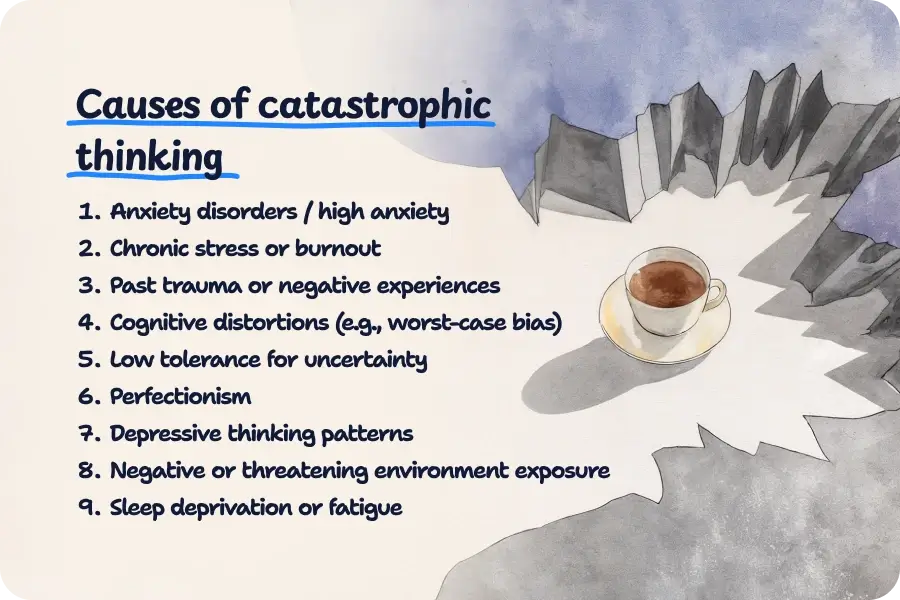
What Causes Catastrophic Thinking
People catastrophize because the brain tries to predict and prepare for danger. Stress, anxiety, and past experiences can train the mind to focus on worst-case scenarios, even when the actual risk is low.
1. Anxiety and stress can keep the brain in “threat mode,” making it more likely to expect negative outcomes.
2. Past trauma. People who have experienced painful or unpredictable situations may become more sensitive to danger and uncertainty.
3. Fear of uncertainty. Some people struggle with not knowing what will happen, so the mind fills in the gaps with worst-case possibilities.
4. Perfectionism and imposter syndrome can make people view mistakes or setbacks as catastrophic because they place extremely high expectations on themselves.
5. Need for control. Catastrophic thinking can develop as an attempt to feel prepared for difficult situations.
6. Negative thinking habits. Repeatedly focusing on fear, failure, or danger can train the brain to think catastrophically automatically.
7. Low self-confidence. People who doubt their ability to cope are more likely to assume they won’t be able to handle challenges or problems.
8. Chronic stress or burnout. Mental exhaustion can reduce emotional resilience and make negative thoughts feel more overwhelming and believable.
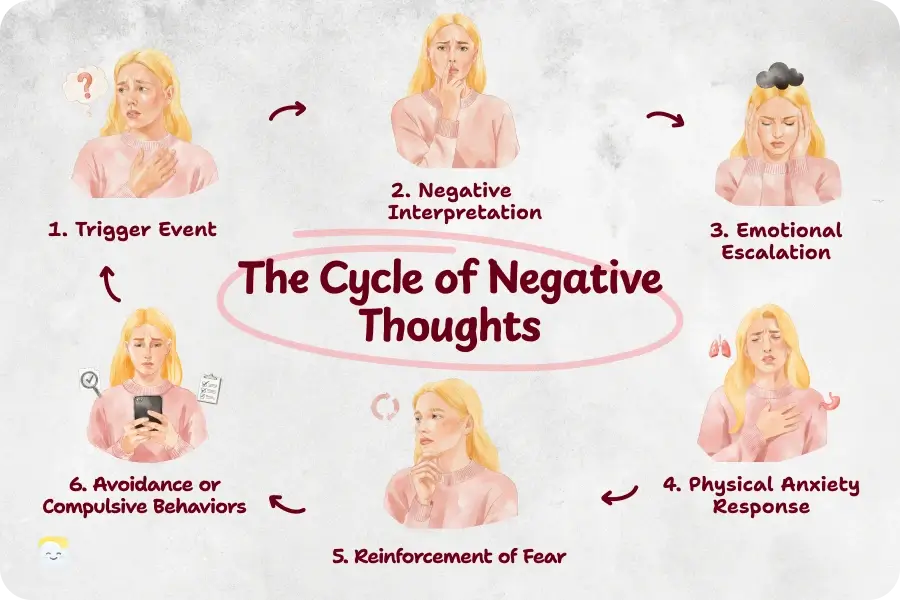
The Cycle of Negative Thoughts
Catastrophic thinking often follows a predictable cycle. A small event triggers a negative interpretation, which quickly escalates into emotional and physical anxiety. Eventually, the brain begins to treat these irrational thoughts as potential threats, reinforcing the cycle and making it harder to break.
1. Trigger Event
The cycle usually begins with an ordinary situation or moment of uncertainty. The trigger itself may be small, but your mind and your nervous system interpret it as something dangerous or threatening. The trigger happens so quickly that a person may barely notice it before their thoughts spiral.
Imagine someone notices a slight chest discomfort during a stressful day. While the symptom may be caused by fatigue, stress, dehydration, or tension, catastrophizing can quickly turn a minor sensation into a frightening mental spiral, such as wondering, “Why is my heart beating so fast?”
2. Negative Interpretation
Instead of viewing the situation realistically, the brain immediately jumps to the worst possible explanation. The mind treats possibilities as probabilities, even when there is little evidence to support them. This cognitive distortion creates a sense of danger that feels real and urgent.
Instead of considering common explanations like stress or caffeine, the mind jumps to the worst-case scenario: “What if I’m having a serious medical emergency?”
Do you worry excessively, with or without reason? If so, try the Breeze app. Self-observation practices, in-depth tests on your personality or childhood trauma, and many more helpful resources can be on your way to a calmer, happier you.

3. Emotional Escalation
Once catastrophic thoughts appear, emotions quickly intensify. Fear, panic, shame, helplessness, or dread begin to grow stronger. Because the brain’s nervous system believes a threat is present, emotional reactions become difficult to control or regulate. A person may start replaying worst-case scenarios in their mind, imagining future disasters, or obsessing over what could go wrong.
When pain catastrophizing begins to rise, the person starts imagining hospitals, bad diagnoses, or losing control. Their attention becomes fully focused on the symptom.
4. Physical Anxiety Response
As anxiety increases, the body reacts as though it is facing real danger. This activates the body’s stress response system, often known as “fight, flight, or freeze.” Ironically, anxiety symptoms like chronic pain in the chest or shortness of breath can mimic the very illness the person fears, making the panic stronger.
5. Reinforcement of Fear
The brain starts learning that these fearful thoughts deserve attention due to the feedback loop with the body’s nervous system overresponse. Each time a person catastrophizes, the brain strengthens the connection between uncertainty and danger.
This behavior teaches the brain to continue using catastrophizing as a coping mechanism, even though it increases long-term anxiety. In the example with chest discomfort, the person may begin constantly monitoring their body or scanning for signs that something is wrong.
6. Avoidance or Compulsive Behaviors
To reduce anxiety, people may begin avoiding situations that trigger fearful thoughts (avoiding medical appointments) or engaging in behaviors meant to create reassurance and control (repeatedly checking symptoms online or turning to AI for advice).
Frequently asked questions
1. Can catastrophic thinking cause physical symptoms?
Yes. Catastrophizing can activate the body’s stress response, leading to symptoms such as rapid heartbeat, muscle tension, chest tightness, dizziness, shortness of breath, and fatigue.
2. How do I stop catastrophic thinking?
Some effective strategies include:
- Challenging worst-case assumptions
- Focusing on evidence instead of fear
- Practicing mindfulness and grounding exercises
- Reducing reassurance-seeking behaviors
- Reframing negative thoughts more realistically
- Learning to tolerate uncertainty
3. What if focusing on my breathing makes my pain catastrophizing worse?
That can happen. If focusing on your breath feels uncomfortable, try grounding yourself through your surroundings. For example, notice five things you can see, four things you can touch, and three things you can hear.
Sources
- Cox AR. “It’s all in your head”: Managing catastrophizing before it becomes a catastrophe. Can Urol Assoc J. October 2021
- Gellatly, R., Beck, A.T. Catastrophic Thinking: A Transdiagnostic Process Across Psychiatric Disorders. February 2016
- Valerie J Hruschak, Yan Yuan, Whitney Ringwald, Corinne Beaugard, Melissa Repine, Maria Pacella-LaBarbara, Daniel Rosen, Gerald Cochran. Pain Appraisals in Patients with Physical Injury: Assessing the Role of Distress Tolerance in the Relationship between Depression and Pain Catastrophizing. August 2021
Disclaimer
This article is for general informative and self-discovery purposes only. It should not replace expert guidance from professionals.
Any action you take in response to the information in this article, whether directly or indirectly, is solely your responsibility and is done at your own risk. Breeze content team and its mental health experts disclaim any liability, loss, or risk, personal, professional, or otherwise, which may result from the use and/or application of any content.
Always consult your doctor or other certified health practitioner with any medical questions or concerns
Breeze articles exclusively cite trusted sources, such as academic research institutions and medical associations, including research and studies from PubMed, ResearchGate, or similar databases. Examine our subject-matter editors and editorial process to see how we verify facts and maintain the accuracy, reliability, and trustworthiness of our material.
Was this article helpful?